

Customer satisfaction at Haidilao restaurants
Haidilao has been, for many years, the most popular hot pot restaurant chain in China. Famous for its Sichuan-style broth and its top-level customer service, the company runs more than 900 restaurants – most of them in China, but with branches throughout Asia, as well as in Canada, Australia, the United States and the United Kingdom.
HDL, the abbreviation for Haidilao, has very high revenue per square meter and one of the highest profits in the sector. It employs more than 100,000 people and when it went public in Hong Kong, at the end of 2019, it was valued at US $30 billion. Clearly, people like what Haidilao has to offer! The self-cooking concept (a pot is filled with broth, and guests can order different ingredients to then cook themselves, from meats to noodles and vegetables) creates a relaxed, family-like atmosphere that has made the chain a favorite for family and business gatherings.
My fascination with this restaurant chain began in 2007. At the time, I was working at YUM! Brands, in Shanghai (this is the company that owns Kentucky Fried Chicken, Pizza Hut and other famous chains), as national training manager.
My colleagues and I used to go to the first Haidilao restaurant in Shanghai, not only to eat, but also to observe the service – which was a potential inspiration for some training materials we were developing. Back then, our training courses mainly used cases from foreign countries – such as Seattle's Pike Place Fish Market, or Starbucks. We wanted to discover local practices and add Chinese cases to the content.
During a team meeting, one of my colleagues, Mrs. Fang, told us a story: one evening, on her way to an HDL restaurant, she tore her jacket. When the waitress greeted her, she took a cover to protect the jacket, which was hanging on the chair (this is a common practice in Chinese restaurants); she soon noticed the tear and mentioned that one of the other waitresses was very good at mending clothes. Mrs. Fang accepted the help and, before she finished dinner, the jacket was returned to her fully repaired. As far as customer service is concerned, this exceeded our expectations and, for that reason, our team chose HDL for many of its future get-togethers.
What happened to Mrs. Fang was not an isolated event. You do not become one of the most popular restaurants in China without pleasing customers. In this sense, reading online reviews is very informative: Haidilao's staff is known for fetching an ointment for an injured customer, mending another's torn jacket (as we saw), offering appetizers to a group when they found out that the restaurant where they wanted to eat was closed, and even driving to the station a customer who was having trouble finding a taxi.
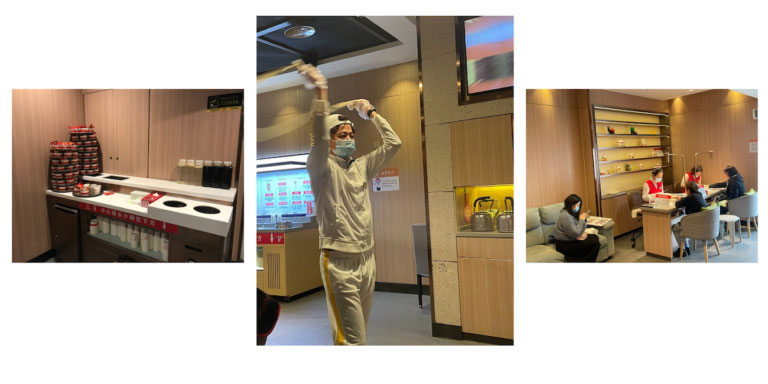
The customer experience is everything for Haidilao. It is a great differentiator for them, something that sets them apart from many other restaurant chains. HDL even offers free services to customers who have to wait for a table, including manicures, shoe shining, the opportunity to make origami for charity (each origami reduces the dinner bill by half an RMB), shows and juggling with kitchen utensils, and free tea and snacks.
How does HDL manage to be so successful?
Let's examine the five dimensions of the Lean Transformation Framework to try to answer this question.
1. What is the company's purpose?
As a Sichuan native, I don't necessarily think HDL's food is the best I've ever tasted, but I trust its service and I know that my guests and I will always have a good time there. That is why, when I organize family gatherings, such as birthday parties, HDL is always my first choice. I remember once organizing a birthday dinner for my mother at an HDL restaurant in ChengDu, and the experience was great. The staff took care of everything (except the cake) and surprised my mother with a peach-shaped bun (a symbol of longevity in China), singing and a special neon birthday card. Everyone had a great time!
Customer satisfaction is so important to Haidilao that anything that does not directly impact it tends to be seen as secondary. The way they select the locations for their sites is a good example that illustrates this point. The site selection team knows the reasons why customers choose to eat at HDL and knows that they do not necessarily care whether the restaurant is inside a shopping mall. These prime locations always cost more in terms of rent. The fact that the company can avoid these costs (and that the Hadilao brand attracts a large number of visitors) gives the company an advantage in negotiating lease terms. In fact, Haidilao has a considerable advantage here, with an average rental cost of about 4% of restaurant revenues, compared with the 10-20% average of Chinese restaurants.
2. How do they improve the process?
Knowing what the customer wants requires observation at the gemba – a practice in which even senior leaders are encouraged to take part – and an environment in which employees are encouraged to highlight problems and share possible solutions. One of these solutions, put forward by a frontline employee, was to install a metal stand next to the hot pot to hang the ladles and spoons customers use to cook their food. Eating from a hot pot can be a messy task, and not having a place to put these tools can quickly turn the table into a mess. The solution keeps the table tidy and improves the customer experience.
3. How do they develop the team's capabilities?
I analyzed Haidilao's 2019 financial statements and found that labor represents 30% of the company's costs, compared with an average of about 20% for its competitors. This indicates that HDL is willing to give a larger share of revenue to employees through wages, benefits and opportunities.
Its distinctive hiring strategy favors employees from rural areas with an interest in working and learning. Some may think this is a way to keep labor costs low, but in reality HDL pays a higher base salary than many white-collar office workers. Why? Because they want to retain employees and a reliable, diligent, hard-working and stable workforce. The company tends to promote people internally rather than recruit for senior positions: even its COO, Mrs. Yang, began her career at HDL as a waitress.
HDL's human resources strategy is centered on:
- A mentoring system in which new employees are assigned to a mentor store manager, with the apprentice's performance directly reflecting on the manager's ability to advance in his or her career. For example, when a mentor is able to develop four store managers, he or she will be promoted to an area manager position.
- Daily, weekly and monthly monitoring of each restaurant's performance and frequent reflection on the current state in order to always know which gap needs to be closed to reach the desired condition.
- Employee self-study and development, and financial support for those who wish to pursue higher education.
4. What is their approach to leadership and management?
The approach HDL takes here is based on the idea of empowering frontline employees and developing their leadership skills through problem solving, all with the goal of increasing customer satisfaction. According to the Haidilao training manual, a frontline waiter or waitress is authorized to round the final bill down to 0, replace dishes if the customer is not satisfied, give gifts or dishes on special occasions, offer customers discounts as a token of appreciation, waive certain fees or even order dishes or goods from outside that customers would like to have. The trust the company places in its employees increases their confidence and capability.
5. What is the culture underpinning its transformation?
As we have seen, trust is the heart of the value system that informs all of Haidilao's actions, as is respect for people – whether a customer or an employee. What could be more respectful toward employees than trusting them unreservedly to serve customers throughout their journey inside an HDL restaurant? And what could be more respectful toward customers than doing everything within our power to provide them with the best possible experience?
This unique corporate culture has also proven to be of great help to the company during crises. When, in August 2017, an undercover investigation revealed that one of the company's outlets in Beijing was suffering from a rat infestation, the company was quick to admit its mistake and publish an action plan to resolve the situation. The honesty it displayed and the transparency it promised the public were greatly appreciated by HDL's customers.
No company is perfect, and I certainly see some challenges for Haidilao. For example, attentive service is great until it becomes excessive – there is no need to have a person handing out paper towels inside the restrooms, especially during a pandemic. Another potentially problematic situation for the company is the fact that it has no franchises. With the average customer spending RMB 150 (US $23) per meal per person, rising operating costs could put HDL's revenue growth at risk. Haidilao has begun to diversify its business models (I recently noticed that a new HDL fast-food store has entered the noodle market offering meals for US $3. A good start!).
Despite these challenges (and what company doesn't have them?), Haidilao is an incredibly successful and inspiring business. What I hope you have gained from this article is an understanding of the fact that its success is neither a miracle nor a coincidence. It is the result of its attitude of putting the customer first and of the lean way of thinking.







