

Lean Healthcare: the impact of reducing time in an oncology patient's journey
A patient undergoing chemotherapy spends, on average, eight hours on each session and needs to undergo the procedure three times a week. A private healthcare institution that handles highly complex cases and is recognized as one of the best in Latin America managed to reduce the total cycle time of this process by approximately 50%, providing a better experience for the patient and eliminating wasted time for the healthcare professionals involved.
By following and recording the patient’s journey through the hospital to understand how the entire value chain works and improve it, they were able to increase the institution’s care capacity using the same resources.
Analyzing the entire chain from the patient’s perspective can reveal the opportunities that exist for implementing improvements, bringing benefits to society as a whole. Let us see how closely following the journey of a chemotherapy oncology patient, whom we will call Pedro in this article to protect his identity, enabled the institution’s lean implementation group to achieve better results.
The state of the healthcare sector in Brazil
Healthcare is a sector that experiences many difficulties in various respects all over the world. With regard to private institutions, health insurers have recently begun a strategic move to change the payment model. Previously, “fee for service” was the established model, meaning that the more procedures the institution performed, the greater the revenue it received from the insurer. This can create a negative incentive in the sense of a loss of quality in care, as well as the performance of unnecessary procedures, that is, procedures for which there is no relevant indication. The main objective of the new “fee for value” payment model is based on the value added by the service in resolving the patient’s issues, with their needs at the center of care, that is, paying for what adds value and generates the best result. With this new model, a movement began toward payment by bundles of procedures tied to clinical outcomes.
Given this scenario, a cross-functional group from one of the largest hospitals in Latin America got together and decided to concentrate its efforts on implementing process improvement, focusing on changing the care model, so as to make its processes more efficient and provide a better experience for its patients, family members and staff. The group chose the oncology area, with the main objective of understanding the journey of a patient who needs to undergo chemotherapy treatment. The institution in question, recognized as a reference in oncology, has this as a high-volume service, that is, a large number of patients seek out this institution for treatment.
The group was made up of nurses, administrators, physicians and physical therapists, as well as lean specialists with a command of process improvement methodology. The first step, which seemed easy, was to choose a customer whose journey they would follow closely: they pulled data from the system and went through the list of patients registered for chemotherapy treatment. The list contained full name, date of birth, the physician’s name and other information about the treatment, but it was difficult to simply point to a name, coldly and without “human warmth”, as one of the members put it.
At that point, they set the system list aside and asked the nurse in charge of the area, who was part of the team, which patient she would recommend to take part in this new project. The group’s concern was valid, because they wanted to see the patient’s life, and not just describe a process; they wanted the patient to be part of the solution, to be able to join the project group. Considering all this, she said enthusiastically: “We can invite Pedro!”. “But why Pedro?” was the question she heard next. She explained: “Pedro is a patient who needs to undergo the chemotherapy procedure three times a week; he is an extremely approachable person, at peace with life, always talks to everyone and is willing to point out improvements and help solve problems. He is a retired businessman, lives with his daughter and, despite his delicate health situation, makes the journey from home to the hospital on his own and with a broad smile on his face”. Without a doubt, he was the ideal patient for this project!
The team talked with Pedro to explain the project’s objective, and he immediately made himself available, very happy to be able to help. They organized themselves and, the following week, began to accompany Pedro to his chemotherapy sessions; they did this for a few months, but after a while they were tired and dismayed at the excessive time they spent in the hospital to complete this journey. Pedro remained tireless, leaving home three times a week and going to the hospital for his sessions, giving thanks every day for life.
A day in Pedro’s life
While following the journey, they took many notes, but the most important thing was that they were able to live a typical day in Pedro’s life. They took the opportunity to connect with Pedro and build empathy for the situation he was living through, and the purpose of improving this process became increasingly clear: Pedro’s Time. It was passing, and Pedro was investing about 14% of his precious lifetime inside the hospital to receive the treatment that kept him alive.
The team mobilized, because it needed to deliver the best treatment for Pedro in the shortest possible time; they began to understand that eliminating the waste in this journey would be the only way to achieve that purpose.
As recorded, Pedro’s routine went like this:
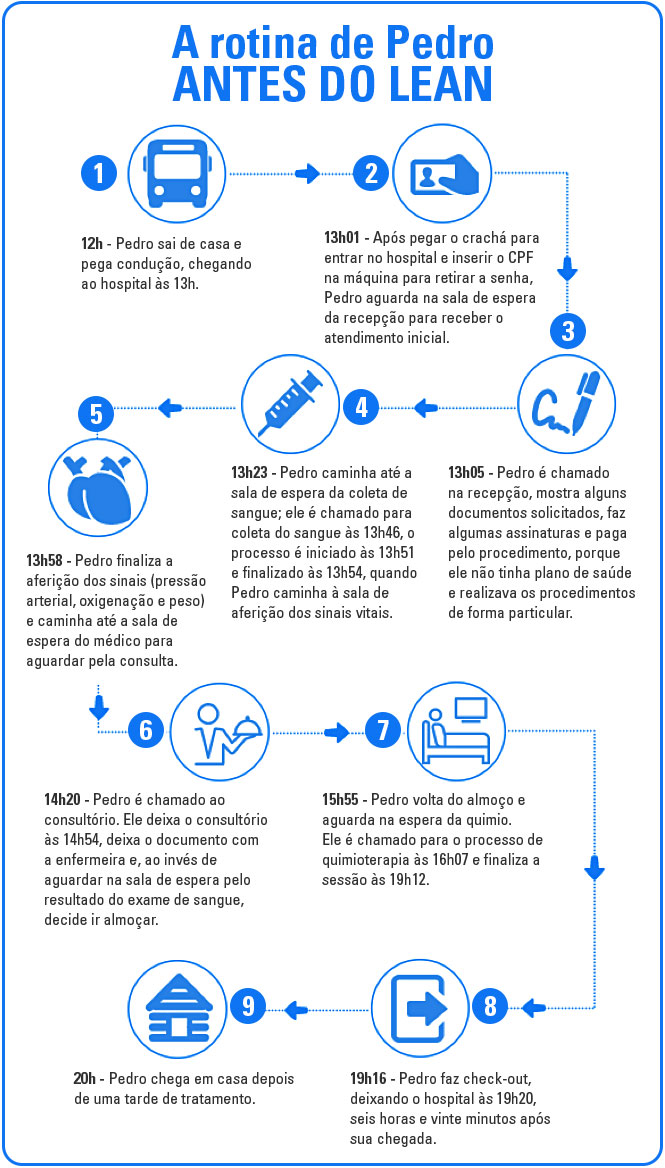
As recorded, Pedro’s routine went like this:
During the follow-up, the team had the opportunity to map and understand the entire procedure from Pedro’s perspective and to verify the good practices and the opportunities across the complete chain of this treatment, that is, what was value added or waste from his point of view. Despite the institution’s recognized excellence in chemotherapy services and the great human skill offered by all the healthcare staff who had contact with Pedro, at this very delicate moment when he turned to the institution there were huge gaps, problems, rework and waste along the process chain.
By actively observing the journey, they were able to feel, together with Pedro, his anxieties, waits and fears, and had the opportunity to work on empathy for others. When they met to discuss their perceptions, they were surprised at how each member had paid attention to different details of the journey and understood that this was due to each one’s professional and life experience. The nurses commented that measuring vital signs was unnecessary, since the physician measured them again in the consulting room. The administrators, in turn, discussed why the patient, who in this case was paying for treatment privately, had to pay on every visit to the hospital and why there was no bundled payment. And the physicians questioned the long waits between procedures.
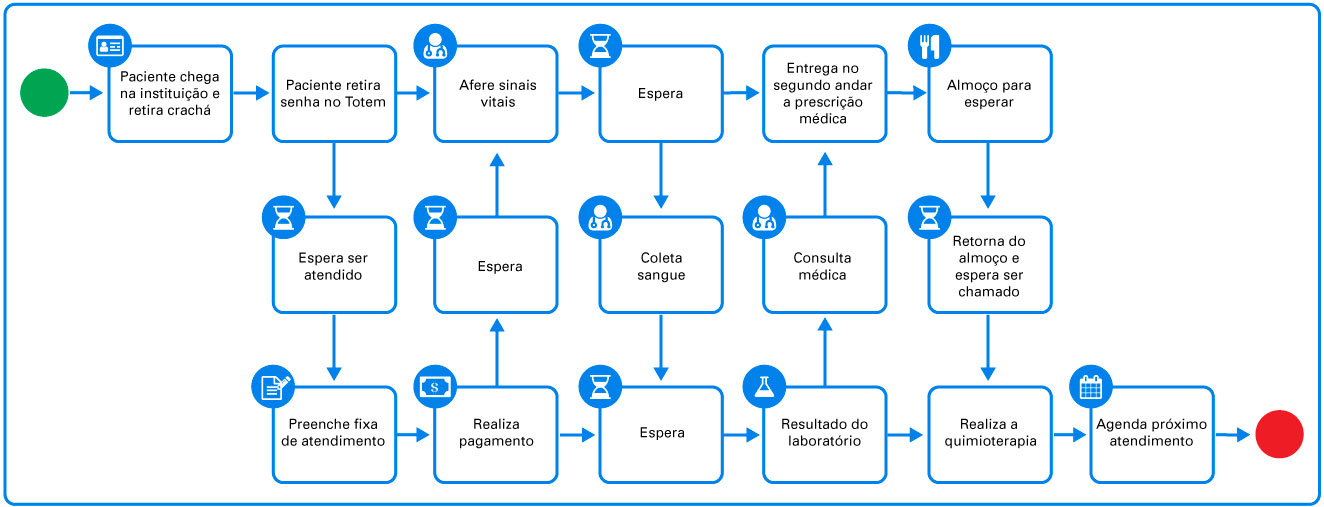
The lean specialist suggested that they could use some tools to guide the work, organize ideas and identify waste. Once everyone agreed, they began drawing the process using the value stream mapping tool, as shown in figure 1. Starting with the patient’s arrival at the institution, each activity was described in a box with processing times, waiting times, number of staff involved and percent complete and accurate, which, by definition, expresses the proportion that arrives correct at that stage without the need for any kind of rework (for example, if a patient arrives at the doctor’s office without the blood test result, the physician needs to ask him to take the test and come back; in this case, the patient arrived at the office “incorrectly”, or incomplete. When a process needs to be redone, it generates unnecessary rework and additional costs, that is, waste in the process).
Figure 1: Simplified process map of the chemotherapy procedure journey
Source: Authors’ own work
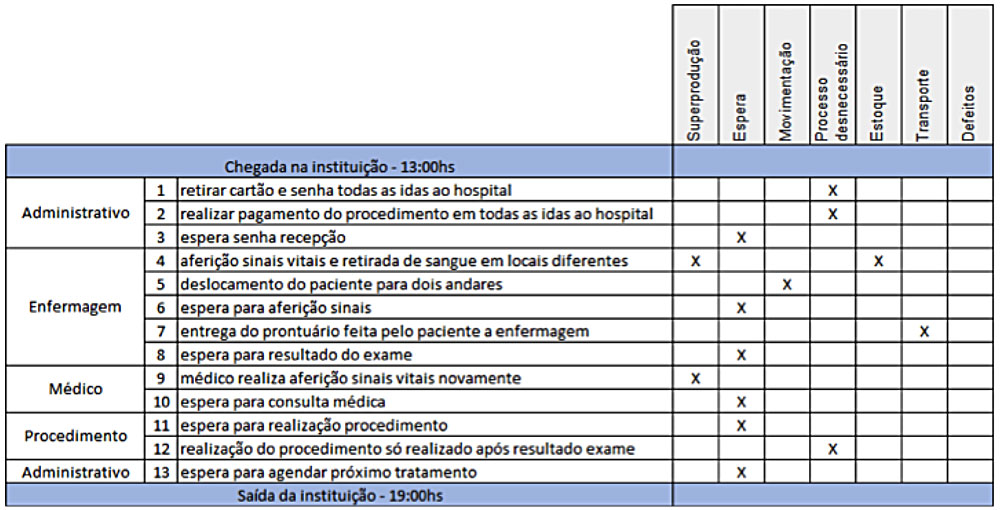
After analyzing and discussing each stage of the process at length, they moved on to the next action: identifying the possible improvement opportunities in each stage. The goal was to reduce waste and make the process leaner, or faster. After studying the seven wastes of lean, they identified thirteen improvement opportunities in the process, as shown in figure 2. At that point, many questions arose about what they should do first, what they should stop doing and what would have the greatest impact on the process.
Figure 2: Opportunities in the patient’s journey through the chemotherapy procedure
Source: Authors’ own work
Some doubts were also raised in team meetings, but despite this, they always believed it was possible and that everyone would benefit from the improvements, especially Pedro. Being a highly regarded institution concerned with the patient, the board promptly authorized them to begin the next move: identifying countermeasures and drawing up an action plan to improve the current process.
Changes based on value for the patient
After analyzing the findings, the team began to propose countermeasures with the aim of improving Pedro’s journey, reducing waste and making it possible to price the procedure on a “value based” basis, as defined in the institution’s strategic change. Several ideas were drawn up and widely discussed, but the most important thing is that the process analysis and the improvement ideas were developed together with Pedro. He actively took part in the entire project and brought important information that the team would not have been able to see from the process alone.
Before any implementation, they created a risk matrix with potential occurrence and frequency, with the aim of anticipating possible problems and maintaining reliability and patient safety; in addition to the board, Pedro became the approver of the actions. The team then held a meeting to present the prioritized ideas, at which those approved would be implemented.
At this point, it is important to review the causes or problems identified, because the ideas or countermeasures to be implemented need to address these problems, as well as being feasible within the hospital’s possibilities.
For administrative issues, they arranged for recurring patients to be given an access card to the unit; that way, they would not need to pick up a card at reception and a queue ticket at the kiosk every time they arrived at the institution. They also prepared a two-month bundle for paying procedure expenses for private patients and took the opportunity to price the bundle that would be offered to health insurers.
The care team decided to eliminate the vital signs measurement step, since it was a procedure that was duplicated by the physician during the consultation. They also took on the responsibility of working with engineering on designing a better layout of the hospital’s physical spaces and flows, so as to reduce the need for the patient to move between one step and another. However, since this action was more complex and would probably require financial investment, it was left for a later phase.
The action that had the greatest impact on reducing processing time and increasing Pedro’s satisfaction was eliminating the blood draw on the day of the procedure; to that end, an addendum was made to the partner laboratory’s contract to offer patients in treatment the option of home collection one day before the procedure. Blood collection and analysis of the result was a critical point in the process, in addition to requiring longer waiting time, since the laboratory takes one hour to analyze the blood. This step could not be eliminated, because it is with this result that the physician assesses the patient’s clinical condition, that is, whether he is fit to receive chemotherapy. This action was only possible because, in conversations with the physicians, it was discovered that the test result did not change from one day to the next. Patients who opted for this solution would receive a call from the hospital if the result showed any discrepancy that would prevent treatment; that way, they would not need to travel to the hospital. Those whose results were adequate would arrive with this test step already completed.
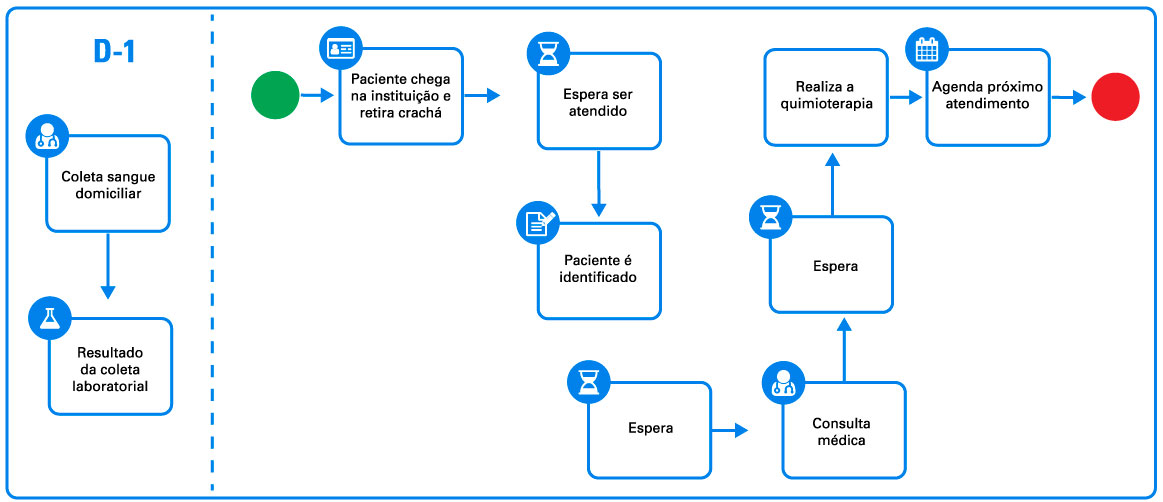
The project team was concerned about how the operations team would accept and incorporate these changes into their routine. That is why they held group and individual meetings to explain the proposal, conducted process training, mapped the critical cases and prepared everything for the start. After tests and adjustments, the team was ready to begin providing care in the new format, as shown in figure 3.
Figure 3: Simplified process map of the new chemotherapy procedure journey
Source: Authors’ own work
A new day in Pedro’s life
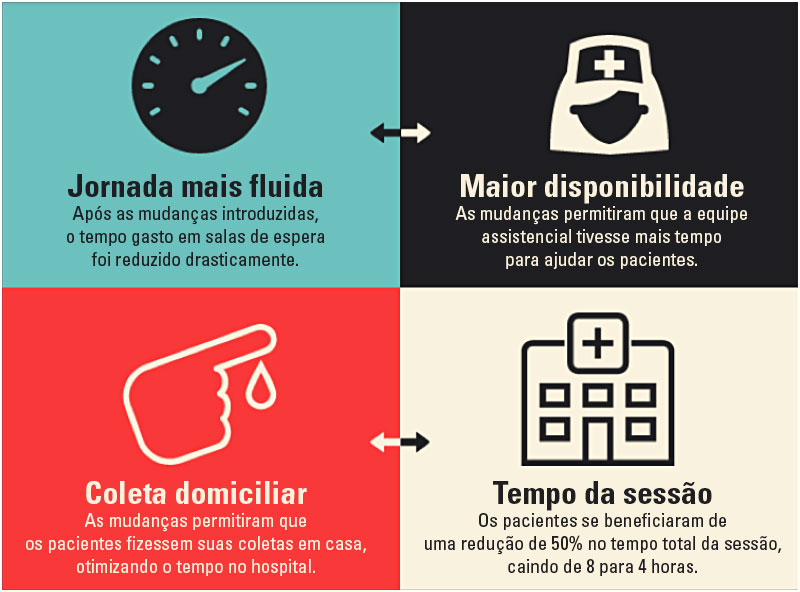
After the changes, Pedro and the other patients began to enjoy a smoother journey, with less waiting, and felt that the care team was more available to talk and to welcome them, without the usual rush they normally observed.
Pedro remained happy and grateful for each new day, but now he had more time to spend with his daughter, go to the park and read his books; the chemotherapy treatment still took place three times a week, but he opted for home collection, so now, instead of taking eight hours per session, he started spending only four.
See what Pedro’s new day of care looks like:
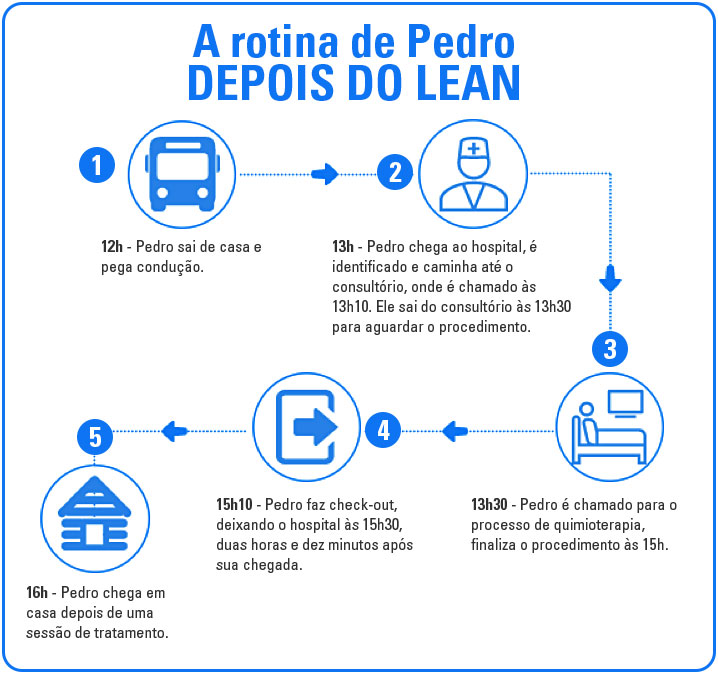
The improvements implemented by the team together with Pedro eliminated four hours of waste from the journey, that is, 50% of the time. He “gained” approximately 48h per month of quality TIME, time in which he could choose what to do and enjoy. At the moment he is living through, making the most of the time he has left is a priority beyond discussion.







