

Improving frontline work in construction
Lean was introduced in construction almost at the same time as in manufacturing. However, decades after its first appearance, the construction industry continues to lag behind on key indicators such as safety and productivity.
Why does this happen? Over the years, important tools and methods have been introduced in the sector (for example, the Last Planner System), bringing greater stability to construction projects. Unfortunately, there has not been enough focus on studying and improving the work of the front line, which is who adds the value.
One reason behind this may be the way the industry itself is structured: on most construction projects, the actual work is not performed by the general contractor but by subcontractors. General contractors plan, coordinate and design, but they do not physically take part in the actual construction of the building. Because they are not doing the work, they seem to have lost the ability to improve it. As a result, subcontractors usually become much more experienced than general contractors in carrying out the daily work – which makes them harder to coordinate. A disconnect is created between the parties, which has become one of the most common problems in the sector.
To deal with this situation, we need to focus on the following:
- Supporting owners in developing contracts in which lean is required as a project strategy, and bringing together the owner, the general contractor and the subcontractors to share responsibility for the work.
- Supporting owners in learning how to understand and assess the real lean capabilities of contractors in general.
- Helping general contractors understand that a lean transformation requires addressing the five dimensions of the Lean Transformation Framework (moving from a tool-oriented approach to a culture-oriented approach).
- Placing the improvement of value-creating work, through the engagement of front-line employees, at the center of lean construction.
Categorizing work correctly
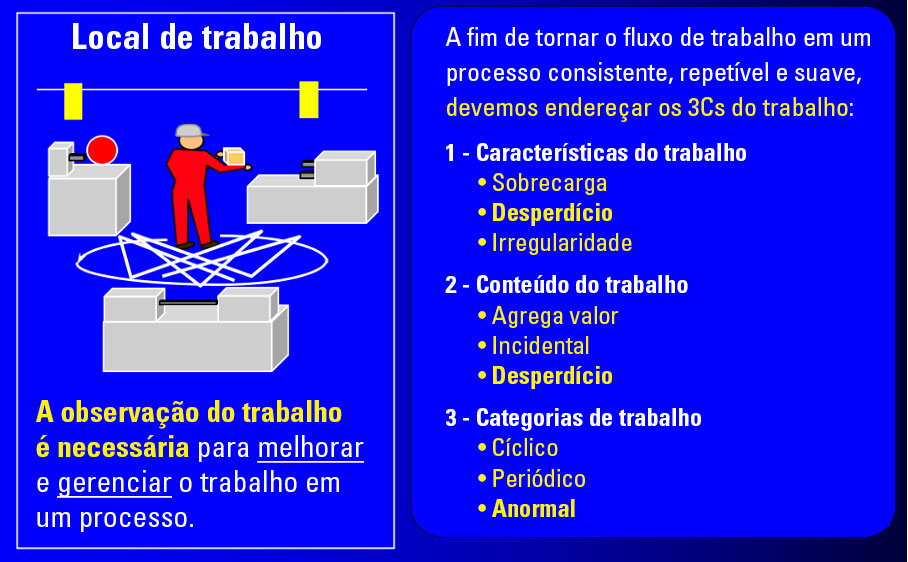
Before we discuss how to improve front-line work, we believe it is useful to say a few words about how it should be categorized and studied. We have found that, in lean, the focus of work study can be divided into something we call the “3Cs of Work.” Traditionally, companies in the construction sector do not study work using this framework, but those that value it do.
First, we examine the “characteristics” of the work. While the team member is doing the work, does he or she experience any overburden? Is the work physically hard to do? Is there waste in the person's work? Is there unevenness (are they very busy at one moment and not so much at another)? In lean thinking, we usually refer to these as the 3Ms – muri, muda, mura. The reason we focus on the characteristics of the work first is that the construction industry has traditionally ignored overburden: it is a common belief that construction work is supposed to be hard.
The second C refers to the “content” of the work. As lean thinkers, we are all familiar with this. Is this work waste, incidental or value-adding? Hitting the nail with the hammer adds value. Swinging the hammer is incidental. Walking around looking for the hammer is waste.
The last C is the “categories” of work. In this case, we want to understand what the team member's cyclical work is (such as driving a nail or installing drywall), what their periodic work is (such as going to fetch supplies) and what their abnormal work is (tasks that cause problems and take them out of their cycle).
By categorizing work in this way, we can create a flow of work, making the work consistent, repeatable and smooth. This is the first step toward improving the work.
Improving value-creating work
Work in construction is usually organized around “getting the job done” to meet the schedule, often with very little regard for safety and quality. Whenever a problem occurs, the “solution” implemented is simply to increase labor, add overtime, use more equipment or change the work specifications.
If we want to transform the construction industry, we must find a way to challenge this approach and prove that the exact opposite is true: it is by making the work easier, reducing hard work (in all its forms) and increasing safety and quality by doing it “right the first time” that we can achieve the productivity and lead-time improvements we seek. As we become more productive, it becomes clear that we will be able to reduce the duration of our projects as well.
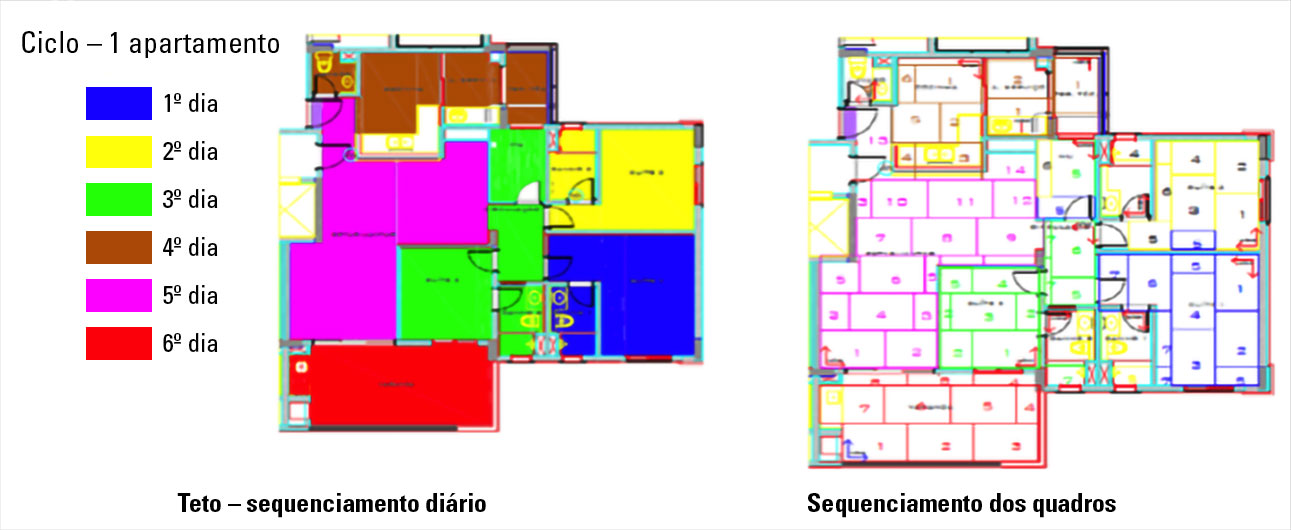
The Brazil-based construction company Habiarte, for example, managed to harness the power of lean thinking to achieve the basic stability needed to establish standardized work and, thus, a framework for improvement. This allowed the company to increase the productivity of its projects by 15% to 30%, eliminating cost and schedule deviations. As a result, Habiarte is now able to complete projects on budget and in less time (on average, 6% faster than before). Standardization has become part of the company's culture: today, 30 days before the start of each trade, the company creates standardized work involving the site team and the subcontractors.
Do we need to engage people in improving the work, or improve the work to engage people? The answer to this chicken-and-egg question is found in the way improvement works in the gemba. Bringing the owner, the general contractor and the subcontractors together repeatedly on site to observe and improve the work activates a process that builds engagement while enabling further improvements. Engagement and improvement are, in this sense, two sides of the same coin.
Sometimes the improvement process begins with a very simple question we can ask employees: “What can we do to make your day better?” Creating an environment in which they can share their experiences and the problems they see is a powerful enabler of change. From there, we believe the work improvement process should be standardized and contain the following key points:
- Go to the gemba, observe the work, study the project.
- As a general contractor, make sure to involve the owner, the subcontractors and the safety team.
- Win people's support by explaining that improving front-line work is the key to their own success, not just the project's.
- Build quality control into every work method.
- Organize control measures so that front-line employees can perform the checks, and problems (deviations) can be made visible and discussed directly on site.
- Teach and use problem solving directly on site to fix problems and improve standards.
The role of leadership
Improving front-line work starts with management. Leaders must develop their ability to enable this process and focus on three main aspects.
First, they must shape behaviors. People often take pride in working hard rather than doing work that adds value, and this mindset needs to change: easier, safer work with quality the first time is what we should strive for. Once front-line people understand that this is the main goal of a lean transformation, they become willing to contribute. For that to happen, however, managers need to be in the gemba, acting as servant leaders and carefully observing the work.
Second, coaching needs to happen in the gemba, where the problem occurs. Showing respect, a fundamental principle of lean thinking, means talking to people, listening to their problems, challenging them to always go deeper in their analysis of the work to find ever better solutions, and supporting them in following the work standards that have been created. In other words, using coaching to show respect on the one hand and to help people develop their problem-solving skills on the other.
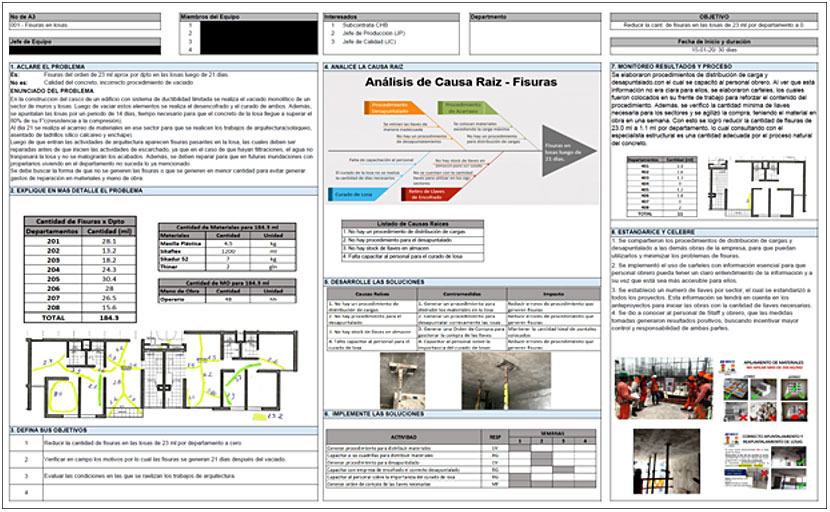
Finally, managers need to encourage the use of A3 thinking on site. Involving management in improvement work can be challenging (it is hard to change deeply ingrained habits), but their guidance can be extremely helpful – especially when dealing with complex problem-solving exercises. Instituto Lean Management, in Spain, has trained several managers and coached them in A3 thinking with great results: the A3 below shows how a construction company was able to reduce concrete quality problems (surface cracks) by an impressive 95%.
Developing people is crucial
Before kicking off any improvement activity, we need to make sure people receive the knowledge and tools they will need to do it successfully. That is why training and developing people is a step that a construction company really cannot skip if it wants to create a context in which new behaviors can take shape.
Employees must learn lean thinking, how it applies to construction and how it can lead to the creation of a different culture. They also need to be taught to recognize and eliminate the waste that exists in the process, and the standard that must be followed to improve work in the gemba (improving is not just a matter of will, but also of method).
Improving work means creating standards and practical knowledge for the organization. In this sense, managers should promote the development of skills matrices to understand which competencies the company considers important and to map their actual presence and pursuit within the company. The goal of any training initiative should be to create a shared knowledge base that will support the improvement process across the entire company.
Improving the way we work
Lean means creating the right conditions and environment for employees to produce value for the end customer. What they are experiencing in terms of hard work and safety should always be at the center of any improvement activity. When lean thinking becomes a response to the employee's needs and helps them in their daily work, the positive effects will naturally be felt throughout the process.
Several construction companies are implementing lean management tools – such as pull, flow planning and daily and weekly management – often with very good results. The next logical step is to dive deeper into how the work is done, focusing on improving productivity, quality and safety with the participation of subcontractors and front-line employees. This is necessary to make progress in a transformation, to sustain results and to improve continuously.
The Lean Global Network's lean construction working group aims to contribute to the development of the industry. We have witnessed and supported several experiments in lean construction and believe that our global, multi-sector experience can contribute ideas and concepts that have so far not received the attention they deserve.







