

Sales in the Lean Enterprise
Introduction
In a company, the Sales area is extremely important to the success of the business. Improving its performance has been a challenge for managers. How can sales be increased? How can we ensure that orders are fulfilled on time? How can actions to stimulate sales be planned efficiently? How can internal processes be improved? How can the relationship with the customer be improved? These have been some of the questions surrounding the Sales area.
The role of Sales in the lean enterprise can contribute to meeting its delivery and product availability objectives, as well as to answering the questions above. While the application of lean concepts in the Production and Logistics areas has been intense, bringing impressive results that enable better customer service, in the Sales area its application is still embryonic, in Brazil and around the world.
This article takes a preliminary look at how lean concepts can be applied in the Sales area in the pursuit of superior business results. It is structured around the 3Ps: Purpose, Processes and People, three fundamental factors for any area within the company.
The Purpose of the Sales area
Lean management presupposes defining the 3Ps for the business as a whole, that is, it aims to clearly define the Purpose, establish the Processes and align the People. These premises can be deployed to the various areas of the company, so as to ensure the strategic alignment of all of them.
One example of a purpose statement for organizations could be: to consistently provide value to customers at the lowest possible cost. As for the Sales area, its purpose should take into account not only selling, but aligning its purpose for the benefit of the business as a whole and not individually. Based on this consideration, in a lean enterprise the purpose of Sales involves:
Ensuring profitability for the business – Stability is the foundation of a profitable business. To this end, Sales has some essential roles: creating mechanisms that enable business stability - among them leveling sales (see the article “Reducing artificial sales peaks”) -, creating actions to achieve planned sales, and not generating variations that create instability in the supply chain. In the unbridled pursuit of selling more at any cost, business margins are often compromised. Having a systemic view of how a sales action can generate additional costs in the supply chain is essential.
Defining objectives aligned with the whole business – Sales objectives must be aligned with business objectives. This seems obvious, but sometimes sales targets are set without any alignment with Production, in terms of planned capacity and resources, or with Logistics. Often there is even vertical alignment, but horizontally it does not exist, generating additional costs that compromise the business margin. The use of hoshin kanri¹ is one of the ways to promote the alignment of objectives and actions vertically and horizontally (see the article “Hoshin Kanri”).
Preparing an assertive sales plan (with good accuracy) without wishful thinking²– The Sales plan is the guide for planning Production and suppliers; therefore, if it is not assertive, it will end up generating additional costs or failures in product delivery. To establish a good sales plan, you need to know the customers' plans, the historical behavior of each product, market share and the projected budget, in that order of priority. This is only possible when there is an established information system, not necessarily software, but a structured network for gathering information. Preparing this plan must take into account some fundamental strategic premises, such as leveling (heijunka³), frequent deliveries, distributor/customer inventory strategies and regional characteristics.
Defining takt time to determine resources together with the other areas of the business– Takt time is defined from the company's overall budget, which starts from the premise of what the company's revenue target is. From there, we determine how many products we want to sell, based on this information and the items described above. Sales defines what the sales plan will be, which indirectly defines the takt time for the entire supply chain. Remember that takt time is defined by dividing the planned available time by demand. This indicator is fundamental for defining the company's resources, number of people, number of machines , quantity of materials and which methods are to be used (“Standardized Work”).
Taking actions to achieve planned sales – Monitoring sales performance daily is essential to allow Sales to take immediate action to correct their course. Actions should be planned in advance so that, when planned sales are not being achieved, the actions can be implemented immediately. On the other hand, if sales are above plan, we also have problems, because productive resources were sized according to the sales plan: if we sell much more, how are we going to add resources to increase production immediately? That is not possible. Thus, unlike other companies, Sales in the lean enterprise halts actions that are stimulating sales above forecast, maintaining the balance between increased sales and the costs generated by this variation.
Providing information to Product Development – Being a radar for the company is one of the extremely important roles of the Sales area, since it is the area that has the most contact with the customer, or at least it should be. The communication channel with the customer should be established in a way that makes it possible to capture what adds value for them, and this information should be passed on not only to production, but primarily to the product development area. In this way, that area can drive changes toward what adds value for the customer, in both current and new products; therefore, creating a close relationship between the areas is essential.
Connecting Customer and Production – Connecting the customer with Production means providing information about the customer to Production, so that production processes can be improved by eliminating waste, such as unnecessary processing, a process that does not add value for the end customer, unnecessary packaging, a product feature not used by the customer, among others.
Processes in Sales
Once the purpose of sales has been defined, it is important to define the processes that make this purpose a reality. Sales processes are directly related to the customer, from the placing of a product order through to its delivery, which often goes beyond the company, passing through a representative or reseller and a carrier that takes the product to the customer. It is essential to see these processes and improve them, so as to eliminate waste and provide real value for the customer.
The customer experience – The starting point of sales processes is the customer; providing the customer with a pleasant experience in searching for, acquiring and using the product or service is a fundamental of Sales.
The customer's experience when acquiring a particular product or service usually involves: searching, which can happen physically through stores or via the internet; visiting the point of sale, where they can find information about the product free from pressure so that they can make the purchase decision; buying, creating ways for the customer to buy, within their financial means and without major red tape; receiving, getting access to the product within the agreed time frame and at the desired quality; owning the product, that is, using it in a way that meets their expectations, with efficient after-sales support should any problem arise.
Key processes in Sales – For each experience above in which the customer has contact with the company, there is an associated process: searching – communication and promotion process (close to the customer); visiting – process integrating sales, service and customer care; buying – process of selling to the customer (pressure-free and with quality); receiving – product delivery process; owning – after-sales process to retain the customer.
Mapping these processes from the customer's point of view is essential to eliminate unnecessary steps and optimize steps that add value for the customer. Value Stream Mapping for administrative and service processes is a tool that makes it possible to see the waste that harms the customer's experience with the company and with the product. Creating continuous flow in the process, establishing work standards and eliminating rework is essential to provide a pleasant experience so that the customer can buy products and services.
The figure below shows a sales process for paying representatives. In this company, the problems were the long time it took to make payment, significant payment errors, data rework causing dissatisfaction, and time the reseller spent at the company solving problems, which took up time that should have been devoted to the customer. After mapping the process, a series of kaizens was carried out, achieving a significant reduction in time and the elimination of rework through simplification and the application of the continuous flow concept in the processes.
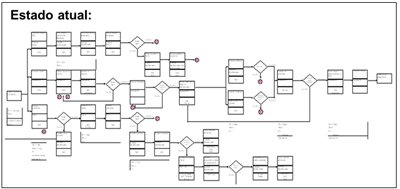
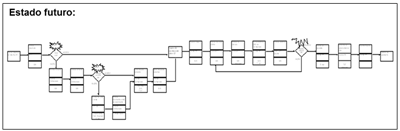
Example: Administrative process map in sales, before and after the improvements
From the internal perspective of the Sales department, the processes that enable the area's purpose, as described above, must be mapped and properly sized to provide quality information at the right time and to the areas that interface with Sales. These processes include:
Sales forecasting process – This process is critical to the stability of the business, since it is what generates the reference for sizing resources. The sales forecast should be made from data gathered as close as possible to the sales front line, which in principle is closest to the customer and has the ability to identify, together with the customer, their growth plans and future demand. Having an established data collection method and statistical analysis is essential for a good forecast; sales history and the customer's growth forecast should be the first references for preparing a good sales forecast.
Sales monitoring process – Once the forecast is established, it is important for the Sales area to have a constant monitoring process to identify possible actions to increase or contain sales so as to ensure margin and good business performance. The monitoring process must be linked to a strategy of actions, defined in advance, that can be triggered in the shortest possible time.
Communication channel between Sales and Production– When carrying out work in companies, we notice that Sales is so disconnected from Production that it sometimes gives the impression of being another company. Often, the connection between the areas is a one-way street: the order comes in and is sent to Production; there is no two-way street, in which production communicates its constraints and aligns demand and capacity in addition to receiving orders. This process needs to be created by PPC (Production Planning and Control) through medium- and long-term planning mechanisms in S&OP (Sales and Operations Planning4) meetings and daily communication channels to pass on information about deviations that affect production performance. Customers will often understand a delay, as long as they are notified in advance and not on the day after the promised delivery date.
Communication channel between Sales and Product Development (PD) – The Sales area has direct contact with the customer and a clearer understanding of their needs, but the information often does not reach the PD area, causing PD to work without sufficient information on product performance or an understanding of what value is for the end customer. A process for capturing customer information on what constitutes value often does not exist; this channel must be created and structured so that information reaches PD as quickly as possible, enabling product launches aligned with customer needs.
People in Sales
People are fundamental to a new way of thinking, and, within Sales, each role in this area has a contribution to make to process improvements; it is therefore important to create mechanisms so that people can contribute ideas and improvements. This mechanism takes the form of flow and process kaizen, which must be established so that managers can promote continuous improvement, one of the pillars of the Toyota Way for Sales and Marketing.

Figure 1: Pillars of the Toyota Way for Sales and Marketing.
For people to contribute effectively, it is necessary to create kaizen circles, whose objective is to make process improvements through teamwork. These circles should use a scientific method that makes it possible to identify the root causes of problems (see the article “Kaizen Circle”).
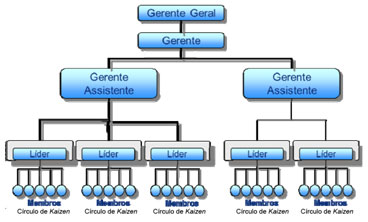
Figure 2: Circle teams for kaizen.
These groups, called kaizen circles, should use a scientific problem-solving method that helps identify the root cause of the problem and thus allows effective countermeasures to be developed so that problems do not recur. The use of problem-solving methods in the sales area is not very common, because there are some catchphrases suggesting that sales relies heavily on feeling, among them: that's just how the market behaves and we can't change it; sales is an art, there is no method or process. In the lean enterprise, Sales should use data collection mechanisms and structured analysis to understand a problem and its possible causes; PDCA is a useful tool that people should use.
Kaizens do not happen only in groups; there are also individual kaizens using problem-solving methods such as the fishbone diagram and the 5 whys, among others.
Salesperson compensation – Historically, salespeople were trained to push a sale, not to seek to understand the customer's need (see the article on eliminating artificial sales peaks). From a lean perspective, this role changes radically, as the customer starts to pull the product based on a need; thus, the salesperson takes on the role of demand analyst. In companies that already apply these concepts, it was necessary to rethink the form of compensation, because the salesperson no longer influences customer demand, which is passed automatically to the factory through the pull system. In this way, the salesperson has to help the reseller sell more and identify new customer needs in order to offer other products.
The salesperson begins to act as a radar for the company, identifying customers' trends and future plans that enable the development of products aligned with customer needs.
Standard Work for sales – Another existing paradigm from the Sales point of view concerns standardization: since the sales process is something unpredictable, it cannot be standardized. From a lean standpoint, standardization is a fundamental process for achieving the objectives of a sale; therefore, standardizing the salesperson's approach with minimum parameters is essential for lean implementation in Sales. To carry out the development of standardized work, it is necessary to define the parameters involved in a sale, what the approach should be, how to listen to the customer and identify the need, how to offer the right product to meet the customer's needs, how to close the sale without pressure and, finally, how to deliver the product. These are some of the main points that can be standardized.
Conclusion:
Rethinking the concepts that govern the Sales area from the perspective of lean management is a challenge that, just as it was in manufacturing, requires discipline and a deep understanding of lean concepts in order to apply them and obtain the desired results. Some companies are already applying some lean concepts in the Sales area, among them sales leveling, standardized work for promoters, reduction of lead time5 in the product sales process, among others.
Based on what has been written, I recommend that you reflect on the questions below as a kind of roadmap on the journey of implementing lean concepts in the Sales area:
- What is the purpose of Sales in the company?
- How does Sales generate stability for the business? Are there sales peaks? How are they handled?
- Are Sales objectives aligned with the objectives of the business and of the other areas?
- How is the sales plan prepared? How assertive is the sales plan?
- What is the takt time established by Sales?
- What actions are planned to ensure planned sales?
- What is the communication channel between Sales and Product Development?
- How does Sales pass customer information on to Production?
- Which sales processes relate to the Customer?
- What process improvement method is used by the Sales area?
- How do people contribute to process improvements?
Author's notes:
1 - Hoshin kanri - Japanese term meaning to establish direction.
2 - Wishful thinking - Excessive optimism or, pejoratively, daydreaming.
3 - Heijunka - Japanese term meaning leveling.
4 - Sales and Operations Planning- Sales and Operations Planning.
Alexandre Cardoso
Project Manager at LIB. He is coordinating the development of the sales area with advanced lean companies.







