

Lean at SMC: a “Brazilian recipe” for transforming a company worldwide
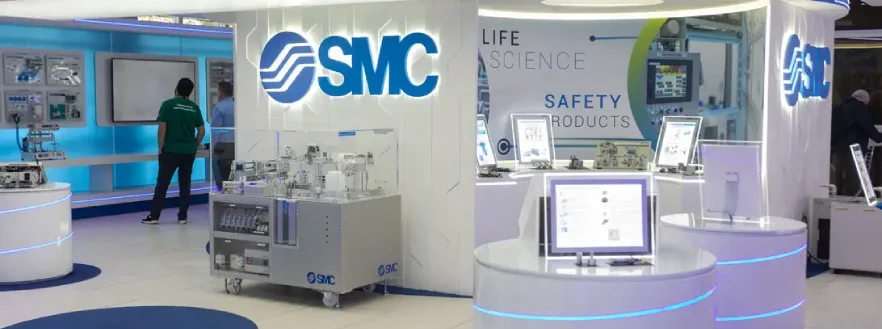
The company is a leader in pneumatic solutions here and around the world.
With a portfolio of 12,000 products and 700,000 combinations – spanning electro-pneumatic, vacuum, instrumentation, filtration and fluid temperature control equipment –, it would seem natural for SMC, one of the largest companies in the world in this sector, that the adoption of the lean system at its Brazilian subsidiary would have come from the company's headquarters in Japan.
After all, that country, as we know, is the birthplace of the Toyota model, the embryo of the lean system. And SMC is a world reference in the manufacture of automation equipment, present today in more than 80 countries, with more than 22,000 employees.
However, despite its Japanese origins, in the birthplace of Toyota management, the recent initiative to embark on a
lean journey came precisely from the Brazilian leaders and employees of this company, which, in Brazil,
is the market leader and is centralized in a plant in São Bernardo do Campo (SP), in an
industrial park of 67,000 square meters.
It was there, about two years ago, in 2022 to be precise, that SMC Brasil began a journey that has been solidly implementing important lean management concepts and practices throughout the organization, generating increasingly consistent and sustainable results.
The enthusiastic words of José Teixeira Brandão Neto, the company's CEO, set the tone for this evolution. According to him, in just two years lean has already generated significant increases in production and productivity, reductions in costs and lead times, logistics optimization, as well as flexibility and agility, among many other results, generating local and international gains and transforming the mindsets and behaviors of leaders and their teams.
"All this optimization has brought us an enormous competitive advantage. It supports our growth in Brazil. And it means that our Brazilian unit increasingly holds, more and better, an important strategic position within SMC worldwide. I would say that the lean system went far beyond what we were expecting in the short term", celebrated the company's CEO (read a full interview with the leader of SMC Brasil at the end of this article).
Results without new hires and without more equipment or technology
The numbers don't lie. With just two years on the journey, the results of this movement are already plainly visible on the company's visual management boards, especially in three indicators that are strategically essential for SMC Brasil: production volume, productivity and lead time.
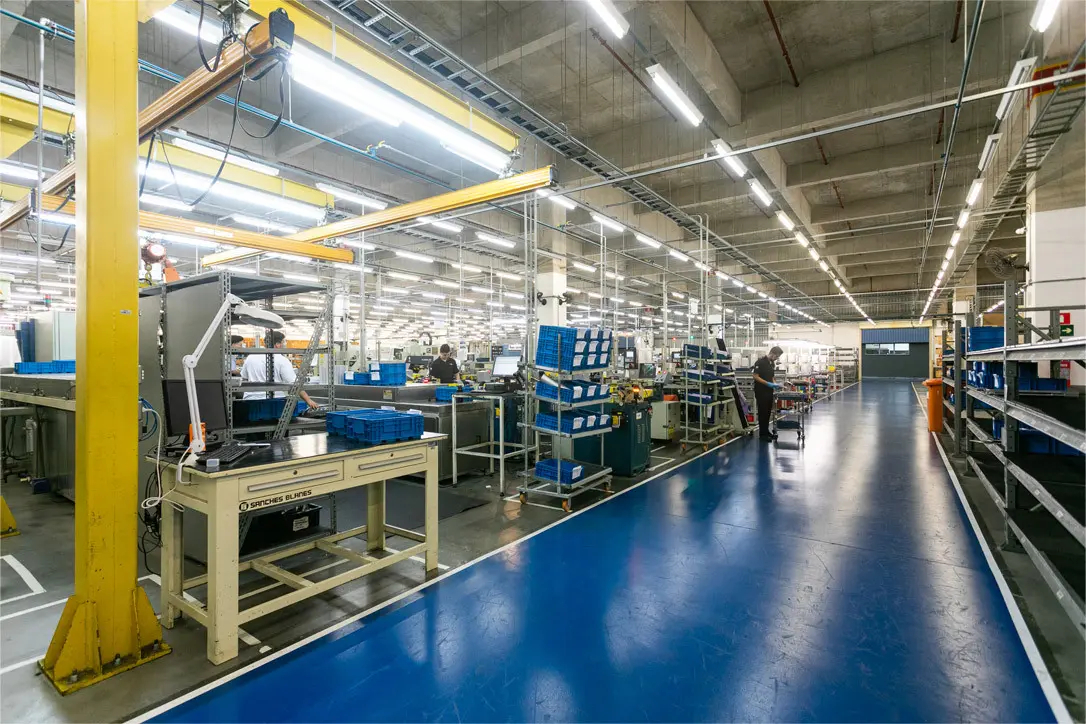
A view of the production area at SMC Brasil: with lean, in just two years the company has already achieved significant increases in production volume and productivity, as well as reductions in lead time, costs and inventory.
Just to give you an idea, in 2022 alone, the year the lean journey began, the company recorded an impressive 40% increase in productivity, measured as parts produced per hour. The growth did not stop there. Last year came another increase, this time of almost 14%, totaling, over the last two years, growth of 60%.
And of course, if productivity increased, there was consequently an increase in production volume, a record: in 2022, the first year of lean, a rise of 25%. And, likewise, last year, an increase of almost 30%, totaling, in two years, a 57% increase in production volume.
Also impressive was the evolution of lead time, which at SMC Brasil combines the processing time and waiting time of parts. At the start of the journey, a reduction of 49% was projected, a bold target, executives said at the time. However, with less than two years on the journey, half of that has already been achieved.
A view of the production area at SMC Brasil: with lean, in just two years the company has already achieved significant increases in production volume and productivity, as well as reductions in lead time, costs and inventory.
“And it is important to stress that these extremely positive numbers were achieved without
any increase in staff, machines or new technologies. This is very
significant and unprecedented in the company. They were the fruit of a change that is still in its early stages, but already
very relevant, in management, mindsets and internal culture”, celebrated Marcello
Brett, Production and Real Estate Manager at SMC Brasil.
A step-by-step journey, with more than 25 training programs...
It all began with the necessary dissemination of lean fundamentals among employees. For
example, the need to reveal and eliminate waste, the ability to solve problems by
attacking root causes through scientific solutions, the mindset of seeking to
add value in everything you do...
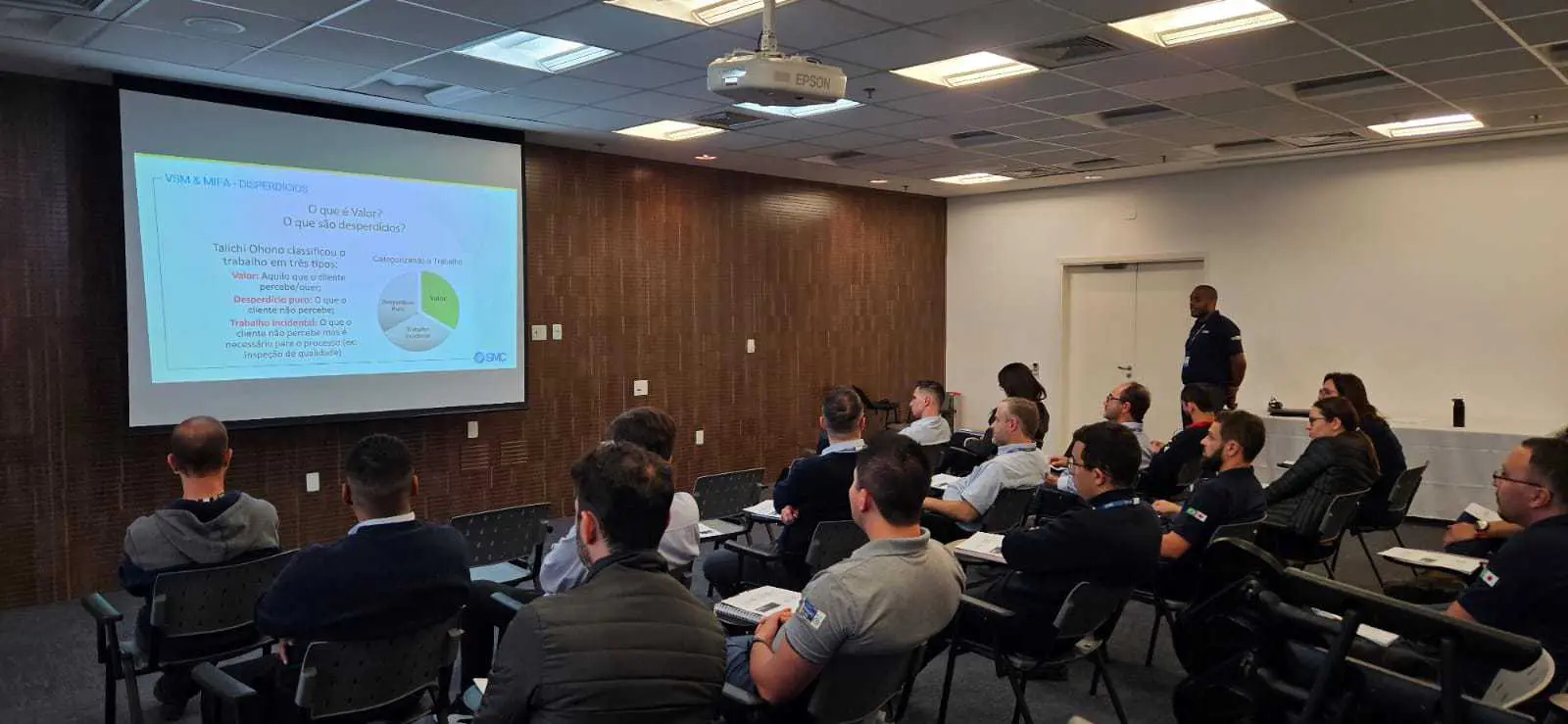
The company invested heavily in more than 25 training programs, covering the main essentials of lean
Next came the adoption of foundational lean concepts and practices: visual management, the
daily application of 5S, a deep understanding of the seven types of
waste... This was followed by practical, in-depth work using Value Stream
Mapping (VSM), accompanied by intensive use of the A3 Method.
In parallel, the company began to organize production into “cells”, based
on just-in-time. It also spread the use of kanban, PDCA and Standardized Work. It began a
solid dissemination of “Lean Leadership”. Alongside this, it began the
dissemination of Lean Process and Product Development (LPPD).
All of this was developed and applied on a schedule that has already involved more than 25 training programs and the resulting practical applications. Of these, nine were entrusted to consultants from Lean Institute Brasil (LIB), which has become a key partner for the company on this journey, say the company's leaders. The actions supported by the LIB consultants focused on deepening, within the organization, four of the most strategic concepts and practices of the lean system: the A3 method, VSM, Lean Leadership and LPPD.
The company invested heavily in more than 25 training programs, covering the main essentials of lean
Lean “make to order”
All of this was only possible thanks to a change in the management team that made it possible for the company to embrace the lean system. It all started with the arrival at SMC Brasil of the current CEO, José Teixeira, who already had experience and conceptual and practical knowledge of lean. He then brought Marcello Brett to the company, now Production and Real Estate Manager, who was hired with the goal of starting a turnaround in the management of the organization.
“There was an urgent need for a significant increase in productivity and production volumes, as well as changes in mindset within the teams. After I arrived, I began to identify ‘gaps’ in the team and the need for training and coaching with key people in production. And we soon identified a certain resistance to change”, recalls Brett.
According to him, there was then the opportunity and the good fortune to bring into the company new employees who had always worked with a lean culture. As a result, in a very spontaneous and natural way, the focus on reducing waste and improving processes gradually began to become something more present every day.
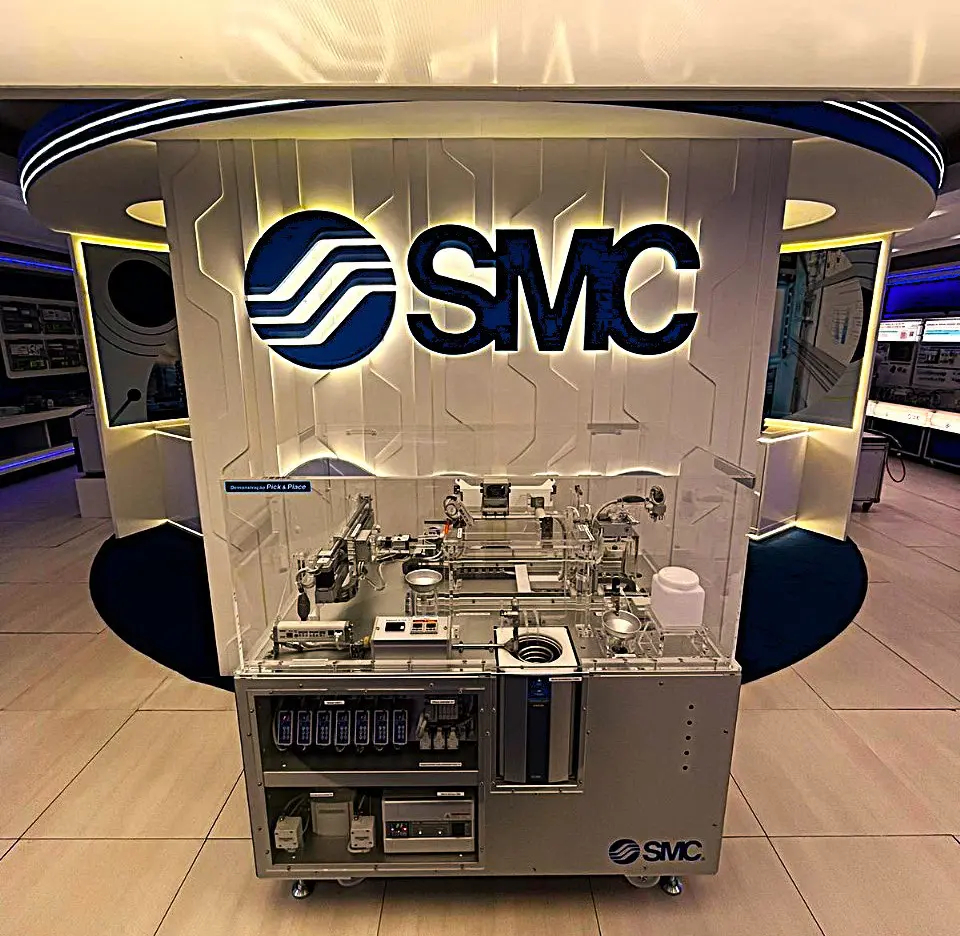
100% of the company's products made locally are “make to order”, which demands flexibility and agility, a “perfect opportunity” for lean management.
At that point, recalls the Production and Real Estate Manager, the company already knew it had deep “pains”, typical of industries with traditional management, which needed to be better understood and stopped. For example, excessive unnecessary movement of materials and people, and poor performance on a number of production lines. And, above all, low team engagement in the daily pursuit of continuous improvement, which hindered better customer service.
In this context, it is important to understand that 100% of the orders produced at SMC Brasil are classified under the acronym MTO, which stands for “Make to Order”. In other words, these are orders for items manufactured on demand. Production only begins when customer requests have been submitted, validated and confirmed. Anyone who works with this model knows that it demands flexibility and agility, management elements that needed to be strengthened. A perfect opportunity for adopting lean.
100% of the company's products made locally are “make to order”, which demands flexibility and agility, a “perfect opportunity” for lean management.
“To be very honest, we had a ‘culture of not changing’, of not pursuing continuous improvement and, consequently, of not eliminating waste. All of this greatly affected our production lead time and order fulfillment”, admits Brett.
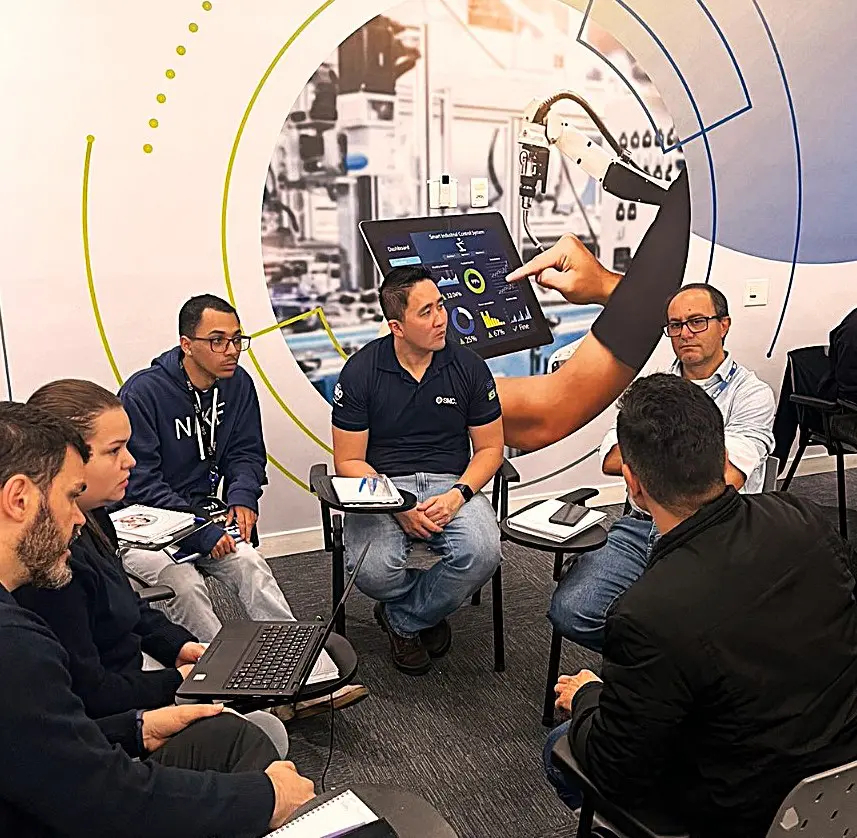
SMC Brasil employees held a number of management meetings to understand what the systemic problems were and how lean concepts and practices could change this for good.
The first step, then, was to start an initial, embryonic process of identifying the “gaps” that needed to be filled. To do this, during the first months of the lean journey, the company set up a weekly management meeting with its leaders, in which problems were routinely exposed and discussed.
“It was a difficult initial process, but a very important one. We even put together a ‘book’ of problems, bottlenecks, rework... in short, of ‘gaps’. And we began to list, for each of them, which lean tools and/or concepts and practices we should have in place in operations to solve these difficulties. All this information was laid out on a whiteboard, with everything exposed for everyone to see”, recalls Brett.
SMC Brasil employees held a number of management meetings to understand what the systemic problems were and how lean concepts and practices could change this for good.
Visual management, a fundamental element of lean management, was already taking its first steps and entering people's mindset. From this set of baseline information, a “master” document was produced detailing which gaps had to be tackled. Based on this, they drew up a first “strategic A3”, to understand in greater depth and detail the problems and the possible most scientific and definitive countermeasures.;
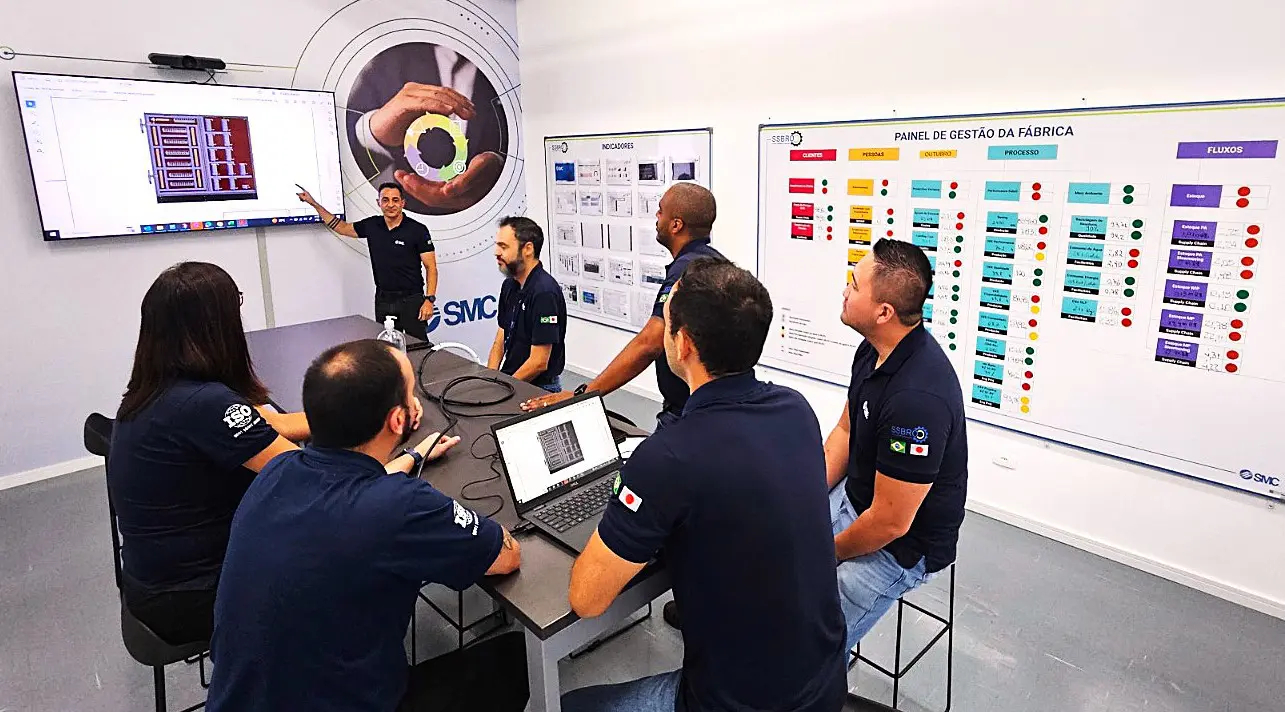
Employees began doing VSM, A3 and Daily Management (DM), discussing together the root causes of problems and possible scientific countermeasures, based on visual management.
The ‘mother’ A3
With the support of consultants from Lean Institute Brasil (LIB), this naturally gave rise to a "mother A3", designed to serve as a kind of "guide" for the lean journey. Titled "SSBRO Project of the SMCBR Operating System", the A3 started from the premise that it was necessary to improve strategic planning, methodology and lean concepts and practices in order to transform operations, with a view to increasing production volume through improvements in performance, cost reduction and higher "gross margin", a financial indicator that measures the company's profitability.
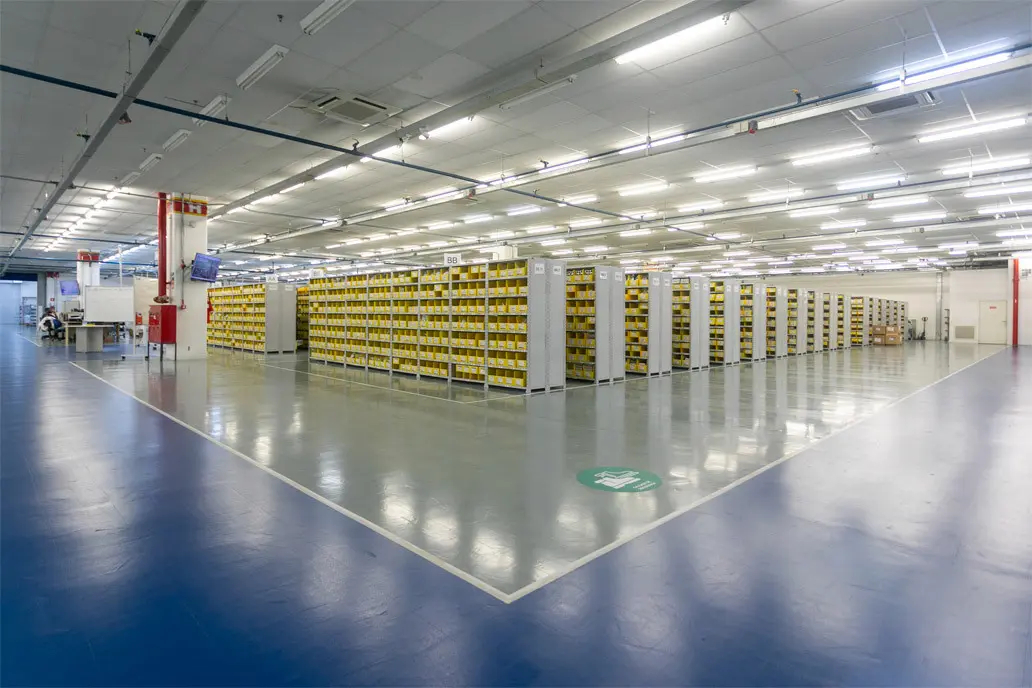
Lean helped the company “see” idle capacity at the São Bernardo plant, opening up more opportunities for growth.
While drawing up the "current state" of the A3, the company first realized that it was using only 56% of the production capacity of the São Bernardo do Campo (SP) plant. With that, for the first time, it was able to see more precisely an idle capacity of almost half the unit, which in itself impressed the team.
In this context, the purpose set was to develop a lean operating standard so that the company could, in a sustainable way, increase operational excellence and production volume, reducing waste and delivering greater added value and quality to the customer with shorter lead times. The company analyzed this challenge and concluded that the team had little knowledge of the concepts and practices of the lean system, which made both quantitative and qualitative leaps impossible.
Lean helped the company “see” idle capacity at the São Bernardo plant, opening up more opportunities for growth.
4 pillars: customers, people, flows and process
For example, there were costs that were incompatible with production demand. The lack of more appropriate and precise indicators was evident. And there was no lean-style Daily Management (DM) to check targets, results, problems and possible solutions on a daily basis. The weak synergies between the Planning and Production departments, and also between the Sales and Production Logistics areas, were also clear. It thus became clear that there were ample opportunities to increase productivity and to use an enormous capacity that had until then been idle. A series of countermeasures was then established to reach a lean “future state”. For example, training for the teams in fundamental lean concepts and practices, which could bring about a leveling of knowledge and information among everyone, aiming also to generate greater engagement and a “sense of belonging” in people.
This “mother A3” gave birth to the “SMC Brasil Operations System”, abbreviated as SSBRO, which is the name given internally to the company's lean management journey. Four pillars were defined for this program: "Customers", that is, a total focus on customers. "People", which means developing people based on the lean mindset. "Flows", which is the pursuit of excellence in the production flow as a whole. And "Process", which is based on "blaming the processes", but never the people.
"We have documented it and have been communicating intensively to all employees that this is now our management system. And that it requires a set of lean-related standards, practices and tools adapted to SMC Brasil. In other words, it is the SMC Brasil way of working. It is the creation of our lean culture in the company", summed up Brett.
Daniel Felipe de Oliveira, consultant and Head of Supply Chain and Logistics at Lean Institute Brasil (LIB), explains that, in this phase, the construction of a series of individual A3s also began across the entire Industrial Engineering and Product Engineering team. Guided by the LIB consultants, they opened specific A3s to address specific day-to-day problems.
It worked. The A3 culture caught on and has “gone viral” in the company. So much so that the company's Production and Real Estate Manager counts that, today, there is a group of 13 A3 documents “running” throughout the organization. According to the executive, some already have partial results; others are in the development phase, but all are very promising.
“The most important thing is that we have managed to ‘infect’ people with the
‘A3 virus’. In other words, we succeeded in getting employees to write A3s, in the
sense of understanding the lean process of analyzing and attacking problems”, stressed
Brett.
Mapping is a must
In addition to this "mother A3", the LIB consultants also supported the development of a broad Value Stream Mapping (VSM), one of the foundations of a lean journey. It was a natural consequence. When the lean implementation began, one of the important points that most caught the company's attention was the lack of process mapping. Especially in the processes dealing with quotations for special projects. Consequently, this was something that, in various ways, directly affected customers.
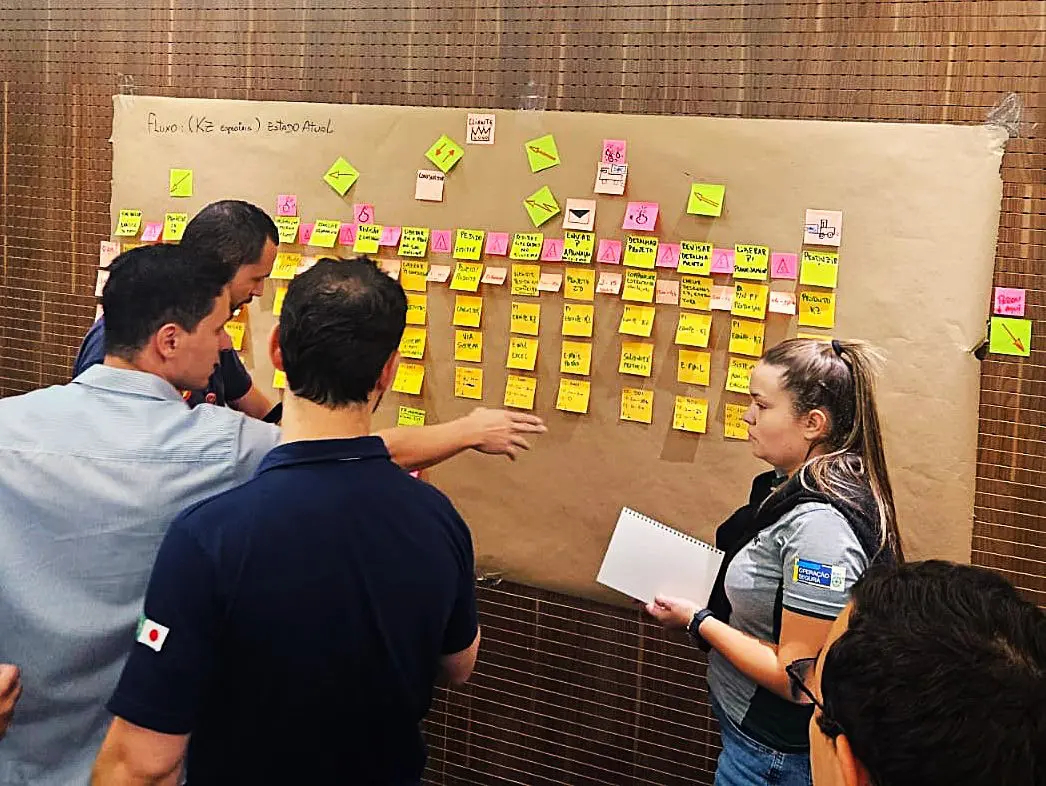
According to the Production and Real Estate Manager, right after applying VSM, in just two days, the reduction in lead time was unimaginable: from a “current state” of 83.9 days to a “future state” of 56 days.
According to the Production and Real Estate Manager, right after applying VSM, in just two days, the reduction in lead time was unimaginable: from a “current state” of 83.9 days to a “future state” of 56 days.
"We had many complaints from the sales team, mainly about delays in sending quotations and delivering finished projects, a phase that involves many suppliers and requires a number of internal processes”, recalls Brett.
So, quickly, the company organized training sessions and the application of VSM. The initial idea was to map, step by step, the entire production chain, to understand in detail and in depth the bottlenecks, the opportunities for gains and, consequently, improvements in lead time. The Production and Real Estate Manager says that, talking with the team, it was not hard to see that many were not familiar with VSM, especially with regard to how to apply the concept and pursue improvements such as:
- The possibility of seeing waste reduction;
- Opportunities for quality improvement;
- Alignment with strategic objectives;
- And, finally, operational excellence.
"We talked a lot and decided to deliver VSM training to the entire
operations team. And that was one of the best decisions we made. During the
training, people's surprise at discovering this lean practice was visible. And as
they learned and drew the ‘current state’ on brown paper with post-its,
we could see the ideas emerging. And the comments about how it had taken us so long to
notice some points that had a big impact on our process", stressed
Brett.

According to the Production and Real Estate Manager, the work sparked enormous curiosity, commitment and eagerness in the team to start drawing up the "future state" as soon as possible. "Many employees already had ideas and solutions and wanted to help us have a simpler and faster process. Everyone knew what our customers wanted. And, of course, they saw the opportunities for gains we would have", highlighted Brett.
According to him, what was truly surprising was the initial result, right after applying VSM. In a few days, the reduction in lead time was unimaginable: from a “current state” of 83.9 days to a “future state” of 56 days. "And that ‘just' from applying VSM. What's more, and perhaps most importantly, we now had a team that understood the importance of this lean concept and practice. And was very willing to apply the changes they had seen", summed up Brett.

For him, by the end of the training it was already surprising to see the rapid change in mindset, already 'infected' by a new culture, a different way of thinking and planning. “And it was SMC Brasil's lean culture that was being born", recalls the Production and Real Estate Manager.
Daniel Felipe de Oliveira, Head of Supply Chain and Logistics at Lean Institute Brasil (LIB), explains that this
phase resulted in two value stream maps for two product families. This made it possible to build a
solid, collaboratively produced diagnosis of a “current state”, a proposed
“future state” and a consistent action and implementation plan, which
is still under way, as well as the execution of a series of A3s.
Lean Leadership
With the training and the application of lean concepts and practices, such as A3s and VSM, the company began a deeper strategic planning process, aiming to reach a distinctive level. “Of course we wanted to be more competitive, exceed our customers' expectations and offer the pneumatics market in Brazil a different and much more agile way of producing special items”, summed up Brett.
In this context, as a result of the A3 and the VSM, a very specific need was soon identified to improve the mindsets and behaviors of the company's leadership team. “We had and still have technically exceptional people, but they still needed to develop in the lean way of thinking and acting, not least so that they could efficiently spread lean concepts and practices throughout the company”, explained Brett.
So LIB consultants began work to disseminate “Lean Leadership”. The initiative was led by Luciana Gomes, LIB's Head of Banking and Retail, supported by Flávio Picchi, Senior Advisor, and Mário Ferrari, Senior Lean Coach, who worked on specific aspects of this theme.
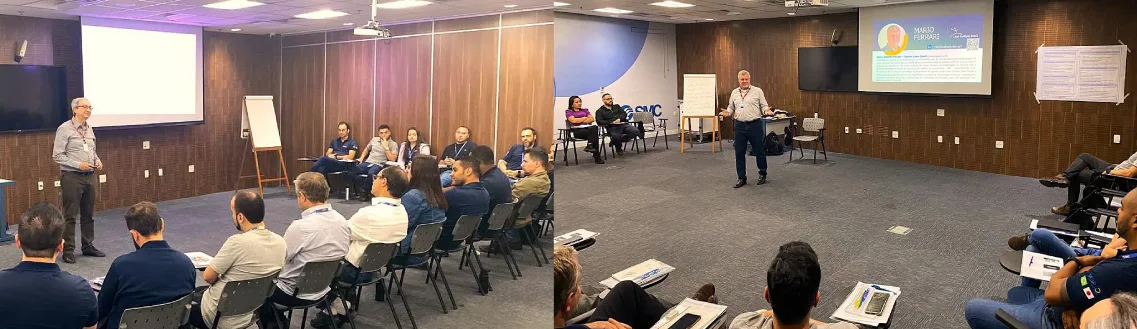
In the images, Picchi and Ferrari, LIB consultants with decades of experience in lean leadership, refine this concept and practice with the SMC Brasil leadership team
Luciana says the LIB team supported SMC employees in structuring “Individual Development Plans in A3”. From there, Ferrari and Picchi detailed their experiences in leadership, including how a leader needs to act when drawing up an A3, what the leader's practice should be when going to the gemba, and the attitudes of a “chief engineer”.
The initiative made an impact on employees: "I realized that leading means knowing how to listen to people. So I started trying to improve my communication with them in a simpler and more objective way. To generate strategic decisions that improve the team's efficiency", acknowledged Ramon Nascimento, Machining leader.
Luiz Alberto, Panels leader, said that the immersion in “Lean Leadership” made him see more clearly points he already knew he needed to develop as a leader, and even gaps he was unaware of. "For example, not underestimating the capabilities of the people you lead, not being afraid that something might go wrong, because that is part of the process, listening more than talking, setting pride aside... Because there is always someone who can teach you something new", he stressed.
Everton Jones, Assembly leader, also celebrated: "This lean leadership initiative was fundamental to add even more value to my knowledge and prepare me for new objectives and results, together with my excellent assembly team."
Enthusiastic, the company's Production and Real Estate Manager described this initiative as a “watershed” at SMC Brasil. “Because we reached both employees in leadership positions and others who do not yet hold such roles but who, we believe, could be future leaders; they are potential leaders, and we need them to start developing now, but the lean way”, emphasized Brett.
According to him, it was gratifying to witness some people's change in mindset during the training sessions or a few days later. “We clearly began to see the effort to change the mindset and to spread lean throughout the company”, said Brett.
In this initiative, Picchi, consultant and Senior Advisor at LIB, worked with employees on the essentials of “Lean Leadership”. He says that in this phase a very interesting exercise was carried out at the company's gemba, working on the idea that a lean leader must, above all, develop problem solvers.
"We showed, in practice, that lean leadership needs to 'see with its own eyes'. To encourage problems to be revealed and solutions to be sought, always in a collaborative way. To listen to, teach, support, learn from and challenge the people you lead, but with a focus on developing people", summed up Picchi.
For Mário Ferrari, Senior Lean Coach at LIB who also supported this leadership immersion at the company, it was essential for SMC Brasil's teams to internalize the importance of leadership focused on the Lean Transformation Framework (LTF).
According to Flávio Battaglia, president of Lean Institute Brasil (LIB), the LTF is today the main model for implementing lean management in an organization. It proposes five fundamental dimensions, which must always be considered so that improvements remain stable over time and keep evolving: purpose, process, people, management system and leadership, in addition to basic thinking.
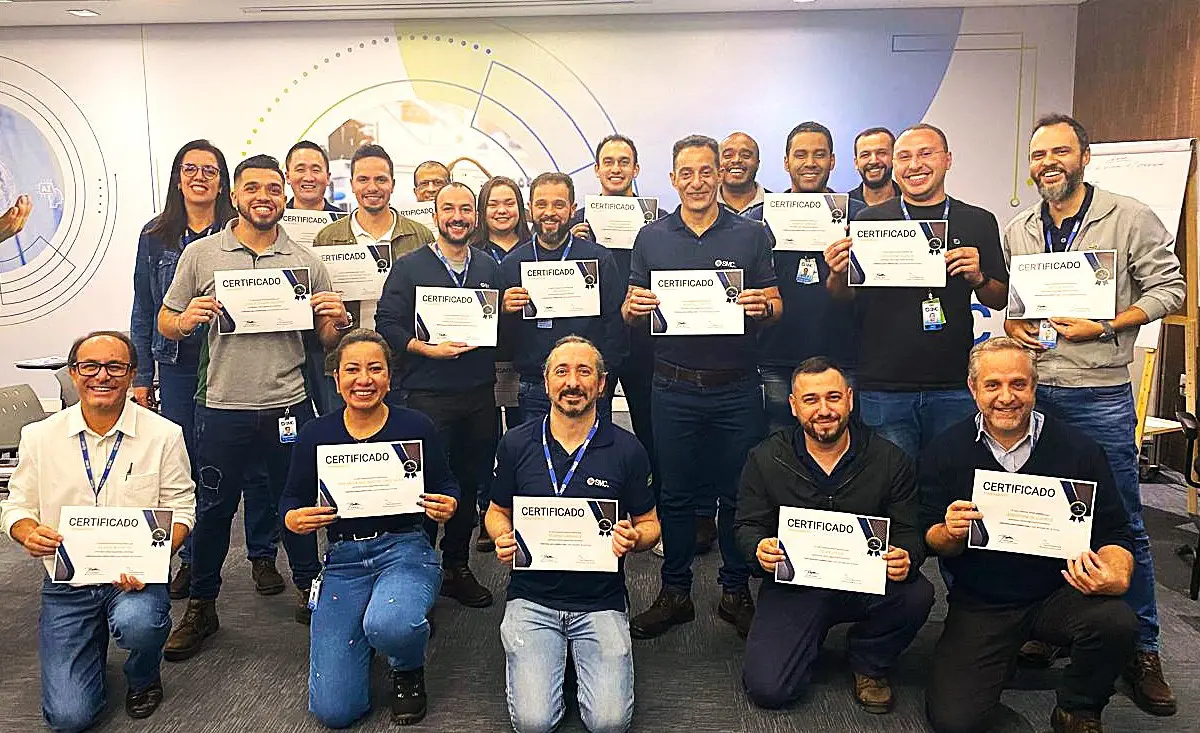
Photo caption: A multidisciplinary team of SMC Brasil employees receives a certificate from one of the lean training programs: from conceptual depth to practical application, always with results.
Photo caption: A multidisciplinary team of SMC Brasil employees receives a certificate from one of the lean training programs: from conceptual depth to practical application, always with results.
“In other words, leadership actions must be based on the LTF, solving situational problems, using lean tools and involving people in this process. That is what can consolidate a lean management model more assertively in any organization”, Mário Ferrari also stressed.
For SMC Brasil's Production and Real Estate Manager, the work done by the LIB consultants to develop the
company's leadership was very unifying. A few months on, he says
he already sees a different team in the company's daily life: more mature, concerned about the problems of the people they lead and
about their actions to resolve them. A team of leaders who can put themselves in
other people's shoes and who assess situations calmly; who separate individuals from processes and
who use more logical reasoning to reveal, discuss and resolve deviations.
Lean “contagion”
This whole powerful set – the dissemination of basic lean concepts, the understanding and practical use of powerful practices such as the “mother A3”, a detailed VSM and robust training in “Lean Leadership... – is increasingly “spreading” lean management throughout SMC Brasil.
So much so that, even after a short time on the journey, about two years, all of this is already widely used today in six areas of the company: Machining and Assembly of Pneumatic Products, Production and Materials Planning, Process Engineering, Project Engineering, Quality, and Industrial and Building Maintenance.
SMC Brasil's Production and Real Estate Manager highlights that the Machining and Assembly areas for
pneumatic products, as well as Production and Materials Planning, are the most
advanced in the lean journey. “These are areas where you can easily find lean
concepts and many of the tools we apply being used in practice. It is no coincidence that
these are also where we have the greatest return in productivity; the increase in
performance, the change in mindsets and the lean way in which leaders face
difficulties and guide teams are clear to see.”
Uniting Brazil and Japan with LPPD
João Paulo Moreira, Lean Digital Transformation manager at LIB, who also supported the journey at the company, guided the company's teams in understanding and developing Lean Process and Product Development (LPPD), the name given to developing products and processes from the perspective of the lean system.
Moreira explains that SMC Brasil has a different and challenging characteristic in this
regard. According to the consultant, part of product development is imported from the Japanese headquarters. And another part
is developed here on Brazilian soil. In this context, the goal was to spread the understanding and
practice of LPPD in order to make both processes as lean as possible.
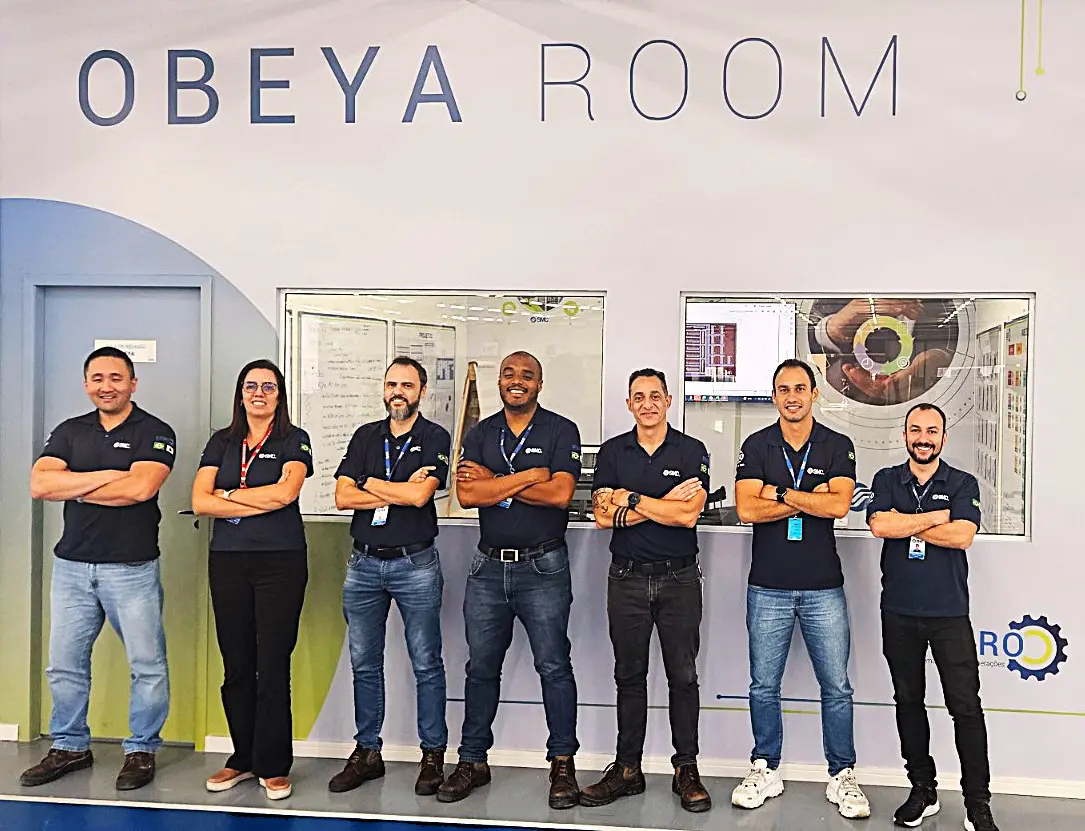
Part of the SMC Brasil team in front of the company's obeya room: a place for in-depth, scientific discussions about problems, root causes and countermeasures.
“We worked both with the team that develops solutions here in Brazil and with the team that ‘imports’ part of them. So that everyone has a total focus on the customer, seeking to understand the root causes of problems and the definitive solutions”, summed up Moreira.
According to him, the focus of the LPPD work was, first of all, to bring together a multidisciplinary team to work together, uniting, for the first time in a lean way, the Engineering, Product Development, Purchasing and Manufacturing teams.
Then everyone began working together to understand how to use design thinking and lean inception to develop products and processes without waste, focusing on a smooth cadence, without "bottlenecks" or rework, in line with pull flow. In parallel, they began to set up and use an obeya room on a daily basis, focused on project development.
Part of the SMC Brasil team in front of the company's obeya room: a place for in-depth, scientific discussions about problems, root causes and countermeasures.
Cultural transformation
For SMC Brasil's Production and Real Estate Manager, one of the main transformations of this whole journey so far has been cultural. According to him, people began to “see” the company differently. “We are increasingly spreading a new mindset that did not exist, at least not in the way it does now: seeing waste and seeking opportunities for improvement”, stressed Brett.
According to him, lean added knowledge and a different way of looking at situations that were previously seen as normal or as having no alternatives. This paradigm shift was a watershed, both for intensifying the teams' maturity and for individual development.
For the Production and Real Estate Manager, this whole lean journey, although still in its early stages, with just two years, has already managed to position and consolidate SMC Brasil as the sales leader in the Brazilian pneumatics market. “The gains and benefits we brought to our customers, with lower expenses, shorter lead times, flexibility in the production process and a culture that created a team and a unit focused on results, were essential in this process”, said Brett.
According to him, after this first move, which has already made the lean system active in the areas directly
linked to production, the company is already beginning to spread lean
to the administrative areas as well, starting preparations to
take the next step toward lean office. For Brett, a company that is not focused
on lean implementation is missing precious opportunities to ensure, more than
survival, success in increasingly competitive markets.
Quick-fire interview:
‘Our lean journey is strengthening SMC Brasil here and around the world as well’,
explains the company's CEO

José Teixeira Brandão Neto, CEO of SMC Brasil, explains in the following interview why the company's lean journey in the country has proven highly strategic: in about two years, it has generated an increase of more than 57% in production and more than 60% in productivity, as well as many other results, such as cost reduction, logistics optimization and the transformation of the mindsets and culture of leaders and their teams.
Lean Institute Brasil (LIB) - What is the strategic importance of the lean system at SMC Brasil today?
José Teixeira Brandão Neto, CEO of SMC Brasil – It is extremely important. Especially in production. SMC has a global plan called the Business Continuity Plan (BCP), under which we “open” our production to various locations around the world. So that our customers, all over the globe, can be confident that if an SMC unit somewhere in the world, due to a catastrophe or something similar, is unable to fulfill a supply order, another subsidiary will immediately take over. This is already happening. And our unit in Brazil is an important point in this plan. Today, Brazil is a strategic country in SMC's global production. And the lean system is completely tied to this, supporting a strategy of sustainable growth in production not only in Brazil but, if necessary, also worldwide, as a result of cost reduction and gains in productivity, quality and competitiveness.
LIB – In this context, which results already achieved with lean would you highlight at SMC Brasil?
JTBN – We had an absurdly high increase in production volume in the very first year of the journey, in 2022, and another significant increase in 2023. We are talking about an accumulated increase of more than 57%. And we know we are going to grow in 2024 as well. And when we talk about productivity, that accumulated growth, in 2022 and 2023, has already exceeded 60%. And we keep growing. And to achieve this we did not have to hire anyone or invest in equipment or technology. That shows how much benefit the system has brought. In addition, we are achieving a strong cost reduction of 15% this year alone. Another extremely strategic result was the reduction in delivery times. Today, there are products we can produce in as little as six hours. The customer places the order, and the part is produced and delivered on the same day. Before, depending on the type of part, it could take up to six days. So the level of productivity changed like night and day. This optimization of delivery times has given us an enormous competitive advantage. Because very often the customer has a maintenance problem and needs the part urgently and cannot wait. And we have been producing with agility and flexibility, in the sense of making the adaptations and changes that customers sometimes request. I would say that the lean system went far beyond what we were expecting in the short term.
LIB - Which areas of SMC Brasil have stood out in this process?
JTBN – Production, without a doubt. Because our sales have grown enormously over these last four years, very significant growth. Today, we are leaders worldwide and in Brazil. That is a source of pride. And the lean system is helping us a great deal to support this growth. Also in our logistics. It went from 4,000 square meters to more than 8,000 square meters of space in a year and a half. That is because our growth has been in the double digits every year. And the heart of this has been production; and the lungs, logistics. To give you an idea, our accuracy rate in “putting the product in the box” is 99.6%.
LIB - How have you perceived employees' reactions to this transformation?
JTBN – The most interesting thing is to see, in people's eyes, the pride in being part of this. It is a differentiator; it generates enormous motivation. We know that turnover in industry is high. And ours, today, is low. Because lean has engaged people. Employees feel part of the project, and then they change completely. There is very strong involvement. That is one of the factors in our success, in having implemented it so quickly and with such strong results.
LIB - Have you noticed profound changes in SMC Brasil's leadership?
JTBN – Our leaders have become very engaged in the project. I think this culture is taking root. It has been only two years of implementation. That is a short time. However, our leaders are listening more to their teams. Because knowing how to listen is very important. And another point we have noticed in our leaders is how they have improved in the problem-solving process, in a more agile way. That is extremely important. In addition, another thing I have noticed is the strategy deployment by leaders to their teams. And how this needs to be done based on respect and trust, and not just on giving orders. Because when the leader simply imposes, people will follow out of fear. That is not a leader, that is a boss. And I believe we have changed that too. About three years ago it was not like this. So we have evolved a great deal. People are sharing and discussing problems together more. And they do not see criticism as destructive, but as constructive.
LIB - What were the “pains” that motivated the company to adopt the lean system?
JTBN – It all began, still at the start of the pandemic, when I took over the management of SMC Brasil, which is a company of Japanese origin. Globally, it is very strong financially. There is no company of its kind ahead of us. And we had, and still have, some very important strategic objectives at SMC Brasil. We are one of the strategic subsidiaries of SMC worldwide. We are currently in the “top 30” of SMC's 84 operations around the world. And we had problems that I noticed as soon as I entered the production area. First, we needed to grow local production. We had cost problems. Also productivity challenges. So we decided to make a large investment in lean, with training for the whole team. We have an advantage because our manufacturing facilities are similar to those in Japan. We have first-rate machines that can support much greater growth than we need. We have all the necessary infrastructure. So what was needed was not infrastructure work, but rather work to develop human capital and knowledge, and to adopt new methodologies. So we decided to make this investment in lean.
Photo caption: for the CEO, lean was necessary for the company to go “beyond technology”, improving management, human capital and knowledge of lean
LIB - What was your first contact with the lean system?
JTBN
– I was working at a German multinational and, at the invitation of a headhunter, I decided to leave that
company and take over the leadership of SMC Brasil. At that German multinational I had already
had an initial contact with the lean system; I took part in training... So when I arrived at SMC, I
already had it clearly in mind that lean is inevitable. And it was a paradigm shift
because the investment is not small. But it is an extremely
strategic investment. I have no concerns about the focus on innovation.
That is already very strong at SMC. We invest 8% of revenue in innovation, far above
what competitors invest, which is around 2% to 2.5%. We are a global benchmark in
innovation. So much so that we now launch 10 new products a month, about 120 a year. That is
why we listen to customers a lot. So my concern was not so much with our
products, because besides being “top” in quality, they are “top” in
innovation. Instead, I really focused on management, which is extremely
strategic and something we needed to improve. And I am very happy because we are managing to transform
management at every level.







