

Building better results on lean foundations
A partnership between CTE and Lean Institute Brasil gave rise to the first Lean in Construction – Practical Application Groupprogram. Lasting seven months and with the participation of five major companies in the sector, the participants of this historic first class met at the end of March via web conference to share their experiences with the new project. See in the summary below how these companies achieved significant financial gains, through increased productivity, reduced overtime, freed-up resources and shorter service cycle times, with a consequent reduction in project delivery time, among other results achieved through the use of lean.
These five companies are ForCasa, MBigucci, MRV, Passarelli and RPS.
ForCasa
The first company to present its experiences during the program’s closing session was ForCasa, which explained how working with lean brought improvements to some processes the company had already adopted, and also enabled it to introduce and incorporate several tools for improvement in planning as well as in logistics and production gains.
They highlighted important gains obtained during the project, with an impressive increase of up to 100% in their productivity in the activities addressed in the program. In addition, better communication between departments and production, making information much more accessible to field employees, was made possible by implementing an obeya with well-structured visual management. Greater agility in solving problems began to be noticed in the company. People started practicing a routine of understanding problems and solving them while they were still small. From cost reductions to gains in productivity and quality, better organization and logistics and more appropriate planning , the company presented the different benefits this experience brought them.
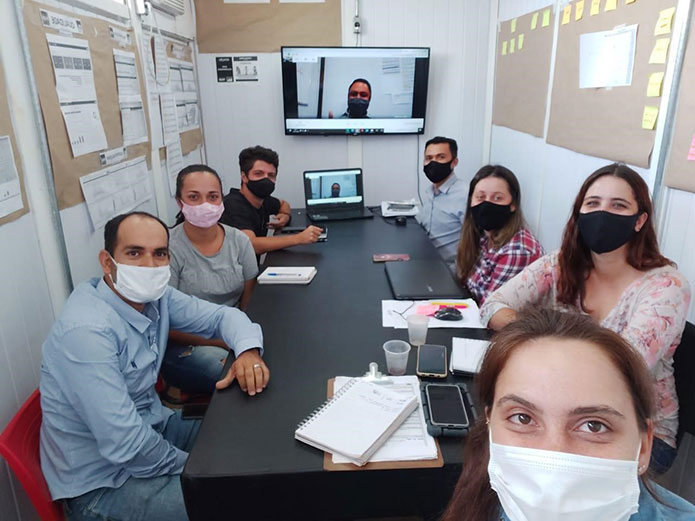
To achieve these results, they described some crucial tools and lessons learned: when doing the planning, they realized that some services had a short cycle time, but not always did the following services have the same speed of execution. They managed to avoid accident risks and overtime used to try to meet this cycle, while also gaining final product quality. All this thanks to understanding the concept of takttime. With it, for example, they could see that there was no need to build one floor of concrete walls per day, since the other services cannot keep up with that pace.
They managed to anticipate problems and considerably reduce the time to execute the services through standardized work. With this concept, they were able to understand the importance of planning each activity before execution begins, of defining together with the production team the best service sequences and the tools to be used, of assembling the kits and of defining the storage locations. Even simply placing a requisition earlier can make a big difference in productivity.
This first presentation showed us how it was possible to see even more clearly the importance of changing some concepts and the importance of integration between departments. With lean, they identified some simple day-to-day activities that took much more time than necessary, focusing on standardization, on organizing the times for picking up tools and materials, and on logistics. As a result, they adopted some measures to avoid wasted time, such as assembling kits for executing the services. They are now seeking to spread what they learned to other employees and other departments so that they can adopt lean in their daily work. In this way, they project that at least half of their job sites will be using lean by the end of 2021.
MBigucci
The second company to present was MBigucci, which brought as its pilot project a development it is building in São Bernardo do Campo/SP. The team talked about the importance of the engagement and motivation of the employees involved in the project for the results to be achieved.
During the presentation, they showed how they managed to reduce the number of overtime hours used, freeing up work hours and employees so that they could carry out more activities with the same amount of resources. They also demonstrated a significant reduction in floor production time from six and a half days to four and a half days. Another highlight from the team was the significant reduction in motion waste, equivalent to the work of one employee per week per month, and substantial financial gains.
To achieve these results, MBigucci made use of 5S, implementing some equipment, such as the debris chute, as well as changing procedures, such as reorganizing the storeroom. They also applied line of balance and the obeya, which brought several benefits associated with improved visual management on site. No less important was the use of standardized work to create a work sequence that made more sense for the company’s context, changing routines to optimize the staff’s time and effort.
Each painter works on two apartments, grouped as: units ending in 1 and 8, in 2 and 3, and in 4 and 5. They were chosen precisely because of their proximity, to avoid wasting time on excessive travel.
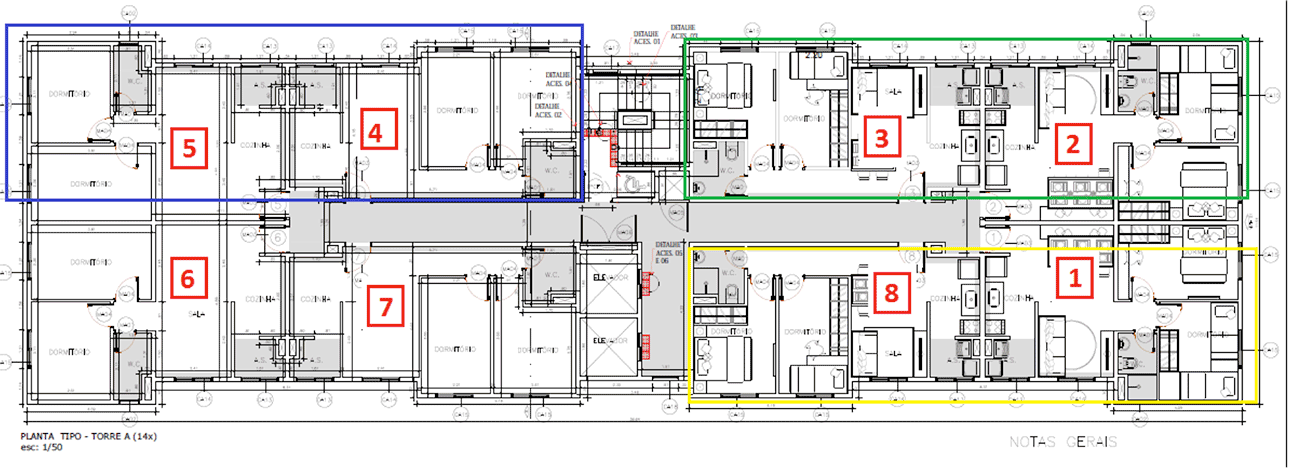
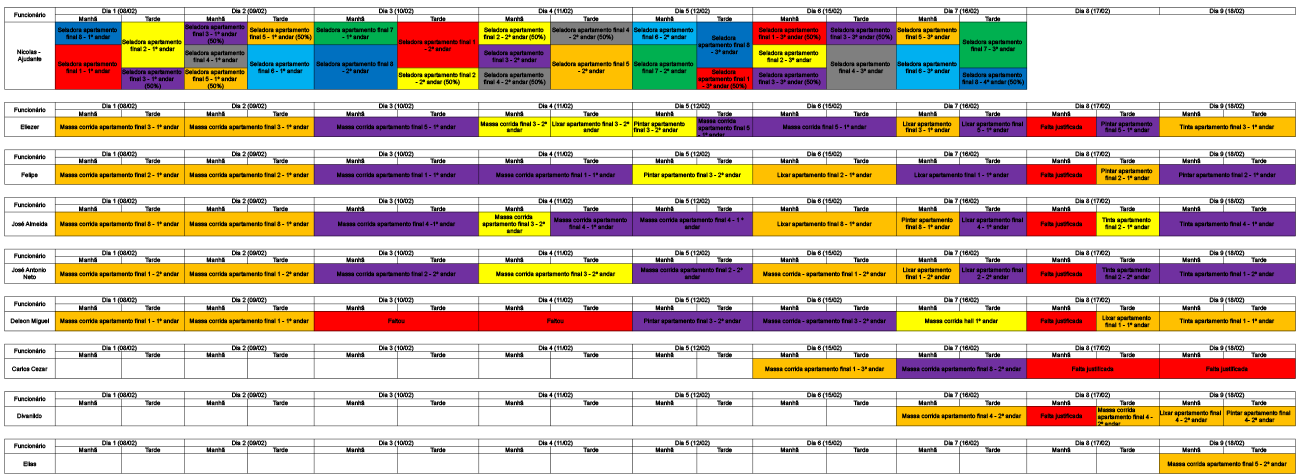
Regarding logistics, by drawing a spaghetti diagram, they noticed some simple changes that could be made to the layouts to eliminate waste associated with excessive movement of staff. In addition, they worked on an effort-impact matrix to prioritize the actions they need to take to keep moving forward with improvements.
MBigucci achieved savings of almost 400 thousand reais across all its projects and a two-month reduction in the schedule of the pilot project. In addition, significant gains from the project include changes in the way of looking at the job site and in the weekly and daily management routines, improved organization, better constraint analysis and visual management of the project, the use of the 4M´s and line of balance, and changes to the purchasing schedule. They are now spreading the Lean philosophy throughout the company. To that end, they are developing internal training programs inspired by what they did with CTE and Lean Institute Brasil. The program they developed lasts six months, and they hope that by the end of the program, in October 2021, they will have 100% of the team engaged in lean efforts.
MRV
MRV joined the project with the objectives of pursuing continuous improvement of its processes, stabilizing its operations and increasing the productivity of activities and customer satisfaction. Over the five modules of the course, they were able to understand how each of the lean tools connects with the others and how, together, they form the foundations for achieving the established objectives.
At the closing session, they talked about the gains they were able to obtain from what they learned in the course. They identified the potential to shorten the final schedule by two months, which resulted in savings of approximately 460 thousand reais on the site team, security, job site rental and utilities, in other words, through reduced site overhead costs and other savings resulting from applying 5S. In addition, better organization of internal processes, the application of the 4Ms, visible plans and goals, and delivery logistics and job site organization already implemented contribute to a leaner construction project.
These results, they stated, were amplified by presenting the content in five modules. In the first, they implemented tools focused on cultural change and stability, such as 5S, 4M and the 7 wastes. In the second, the focus was on flow. In the third, the "war room" was implemented. In the fourth, it was time to improve the kit center, train the workers, create the activity layout and standardize the process. Finally, in the fifth module, they were able to analyze routes and movement and size them accordingly.


MRV states that the changes implemented through the lean philosophy were noticeable from the first module of the consulting work, with processes evolving and generating perceptible gains. The first steps toward a new productivity reality have been taken, with a focus on efficiency to deliver quality at low cost, and they intend to sustain the concepts they learned and spread them throughout the organization.
Passarelli
Passarelli brought to the program a pilot project consisting of a development with more than 300 housing units, divided into three buildings. With new features in the building structure and very atypical and particular characteristics, they needed a new way of thinking for these new challenges. That is why they joined the project with the intention of fine-tuning concepts so that their planning could be carried out more effectively. They therefore set the objectives of reducing the project schedule, having no lost-time accidents, improving process quality while maintaining cost, and maintaining 95% conformity until the end of the project.
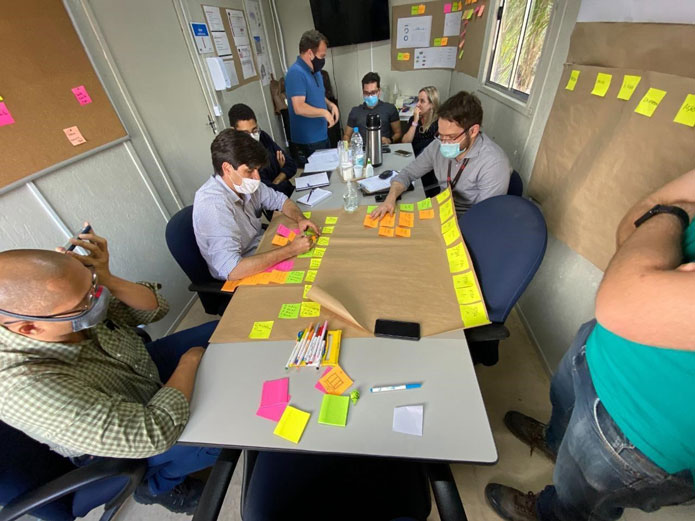
The course enabled them to do exactly that and even more, they stated, with improved quality and team communication and reduced lead time, rework and costs, as well as providing a systemic view of the project. In this way, they cut the cycle time for building each floor from ten to eight days by optimizing teams, resources and equipment. It is also worth highlighting that they showed improvements in job site safety, something of vital importance in the industry.
During the course, they paid special attention to logistics and vertical transport, implementing visual control of material orders and deliveries. They thus implemented and consolidated management routines with weekly and daily meetings for closer monitoring of the work, and a visual management system so that everyone could contribute more naturally to the process. Finally, through a value stream mapping, they discovered the importance of investing significant effort in optimizing transport, which is often the great villain on construction sites.
With the program, Passarelli was able (in addition to improving and standardizing procedures, reducing lead times, optimizing resources and reducing costs) to exchange experiences and network, create new market partnerships and improve the transition between budgeting and construction. They now seek to expand lean beyond the two projects where they already apply it to the company’s other projects, while monitoring the projects in progress. With an eye more on the future, they are considering implementing lean in the company’s main contracts.
RPS
The last company to present during the closing session was RPS, which had already had previous contact with the lean philosophy. They expected to have a deeper experience, with a true cultural change toward process optimization, waste reduction and, above all, the engagement and motivation of their people amid all the uncertainty generated by the pandemic.
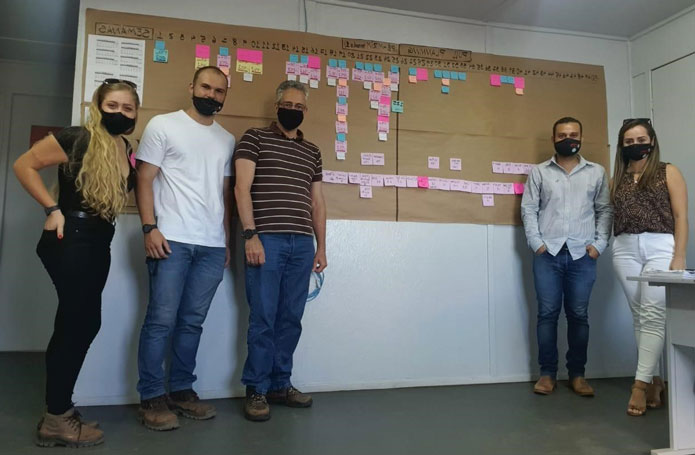
The sparkle in people’s eyes, they stated, when working with lean is the main benefit. With more engagement and motivation at work, gains in the indicators become an inevitable consequence. The company saw financial gains from applying the tools that approached the millions on just one project, with a schedule reduction of about three months, less rework with increased customer satisfaction and cash flow , and better control, all with almost zero investment.
They achieved all this by applying what they learned in three stages. In the first, they focused on improving storeroom logistics, implementing the 5S system, establishing a fixed daily routine, improving control of material distribution, receiving and inventory, and the planning of services. In the second, the focus was on lean planning, using tools such as pull planning, takt and line of balance. Finally, they focused on labor productivity, improving production with their own workforce and optimizing working hours.
The big challenge now is to implement lean in the new projects under way and to transfer what was learned from the pilot project to the other projects, as well as to ensure implementation in future projects. In addition, they want to go further and implement lean in other areas of the company as well, and not only on the job sites. They understand that they are now the multipliers who will make lean take root throughout the entire company.
The companies reported that the program focused on the building sector is an excellent opportunity for builders and developers to take their first steps toward lean transformation, taking advantage of all the concepts, tools, discussions and networking generated in the program.
With the Lean in Construction – Practical Application Groupprogram, the potential results a construction company can achieve are:
| Return on Investment | 5 to 10 times the amount invested |
| Cost reduction | Up to 4% of the project budget |
| Productivity | Up to 100% gain in the construction services studied |
| Schedule | Reduction of 2 to 3 months |
| Satisfaction | Increased collaboration and engagement of employees, contractors and the project’s administrative staff |
Take this opportunity to learn about and join the upcoming classes of lean in construction: practical application group.
Want to know more about the case of one of the companies that took part in the program? Click here and listen to the podcast.
For more information, contact us by e-mail: [email protected].







