

Lean Management makes it possible to build an entire house in 24 hours
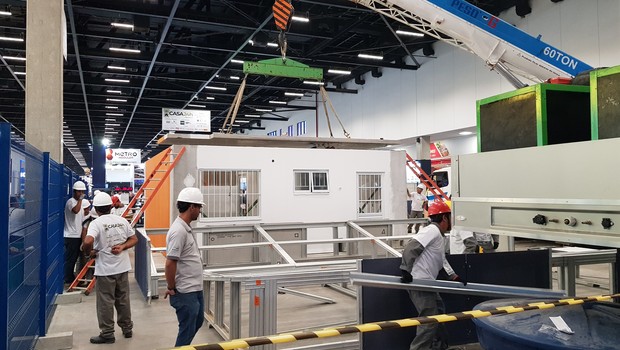
Casa 24 horas (24-Hour House), a Lean Institute Brasil project (Photo: Publicity/Lean Institute Brasil)
One of Brazil's great problems is the country's housing deficit, which, according to surveys, is about eight million homes. In other words, a great many people do not have a minimally decent home to live in, which is an enormous social problem that, as we know, ends up generating a series of others.
Of course, many factors have produced this enormous deficit: social, economic, urban, technological, etc. Likewise, the current difficulties in overcoming this problem are many. Today, however, there are initiatives that can help change this reality and that are increasingly available on the market.
On the one hand, we have the intensification of efforts that have been evolving over several years, such as the development of new construction systems, improvements in the design process, planning methods, etc. Added to all this is a great ally that has long been applied in other sectors and is increasingly being applied in construction as well, thanks to the good results already achieved.
I am talking about the application of lean management to construction projects, a subject that has been attracting more and more attention and delivering good returns in practical applications.
A good example of this is the initiative I had the pleasure of taking part in, through Lean Institute Brasil – the “Casa 24 horas” (24-Hour House). It is an innovative project, coordinated by Inovatech Engenharia, which brought together several partner organizations and different work fronts, and which is building a 45 m2 house, from start to finish, completed and decorated, over a period of 8 hours a day for 3 days, totaling 24 hours of work. And this is happening live, during a major construction fair taking place this week in São Paulo.
To make this possible, an industrialized construction system was used, moving to a high-productivity factory environment as many as possible of the operations that in a traditional system would be carried out on the construction site. There are several industrialized systems on the market with this goal, but many end up seeing their great productivity potential lost on non-rationalized construction sites, where assembly takes place with countless wastes typical of traditional construction.
To avoid this risk in the Casa 24 horas, lean management was combined with the technology, improving and ensuring high productivity and reliability.
From the design stage, for example, studies were carried out using the lean methodology known as 3P – Production Preparation Process, in which suppliers and designers from various specialties simulated all the assembly stages virtually and in small-scale physical models, seeking solutions that would maximize constructability.
Next, detailed planning was carried out, prioritizing the achievement of continuous flow, balancing and pacing the various teams involved. This plan was tested in assemblies at the factory, timing and optimizing activities and incorporating improvements - kaizens, in lean terminology - with the participation of the workers.
Finally, standardized work was developed, establishing in detail, step by step, what each worker should do at each moment. The layout and arrangement of materials were also defined so as to achieve the minimum of travel and handling and the maximum of safety.
These lean concepts applied in the “Casa 24 horas” and many others can be used, and have been used in practice, in housing or infrastructure projects, with conventional or industrialized construction systems, always leading to enormous gains in productivity, improved quality, and reduced lead times and costs.
The Brazilian housing deficit is a complex problem that requires a series of solutions. But one of them is certainly improving the management of the organizations involved.
Optimizing civil construction processes can help this sector become more productive and competitive. In doing so, it can generate more business and jobs and contribute to eliminating this enormous Brazilian ill: the lack of decent housing for all.
The “Casa 24 horas” is proof that this is possible.







