

Disconnected management flows are the main cause of the building collapse in São Paulo
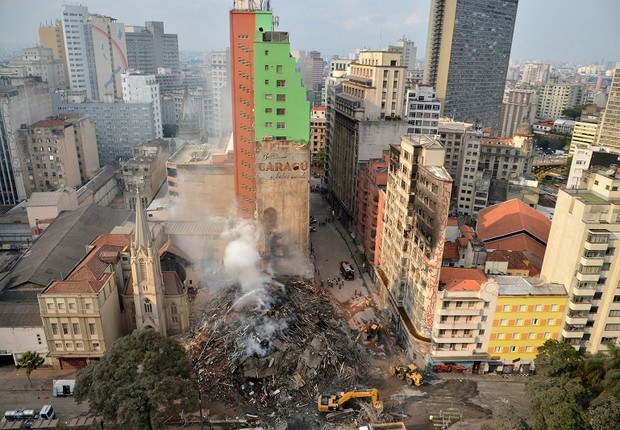
The whole country was shocked by the tragedy of the fire, followed by the collapse, of the Wilton Paes de Almeida building in downtown São Paulo. The first reaction, on social media and even in the press, was to look for the “culprits”, with the movement that organized the occupation being one of the first to come into focus, followed by the various public bodies involved.
Of course, in a situation like this, involving fatalities, the appropriate accountability is necessary, but lean management proposes that, when facing any problem, first of all we should look for the causes in the processes that generated the consequences, as this is the best way to prevent it from happening again.
An analysis of the building's history shows that the main cause of this collapse was the total disarticulation and discontinuity of various public management flows. Lost in their bureaucratic tangles, they kept postponing the solution of problems, which became bigger and bigger. They completely lost sight of more important purposes that would have demanded immediate action, such as protecting life, protecting populations in extreme situations, preserving safety and caring for public and cultural heritage.
The first broken flow that becomes evident in the news is that of the building's ownership and the management of public assets: inaugurated in 1968 to be the headquarters of a group of companies, it passed to the Federal Government because of debts. It housed the headquarters of the Federal Police from 1980 to 2003 and an INSS office until 2009; in 2010 there was talk of turning it into a cultural center; it was handed over to Unifesp in 2012, which gave up on using it; and, once abandoned, it ended up being invaded. In 2015 an auction was attempted, with no interested bidders. In 2017, it was provisionally handed over to the City Government.
After the collapse, the city government publicly debated whether it or the Federal Government should have requested repossession. Amid the comings and goings and passing of the buck, the lack of continuity, defined purpose and agility in managing the thousands of public properties like this one, which could have had a very useful purpose for society, became clear.
This sluggishness drags on for years, and public authorities build new buildings or pay expensive rents, while buildings that could be renovated are left abandoned and deteriorate.
Another clear case of neglect is the management of cultural heritage.
Considered the main work of architect Roger Zmekhol, the building was an architectural landmark of its time, bringing several technological innovations, and was listed as heritage in 1992. Even so, over many years, there was never a plan for how it could best be used in a way that would preserve this legacy. Between 2007 and 2009, a group of French architects even drew up a project for its revitalization, which never obtained support. More recently, it was suggested that it be turned into a cultural center, but by then it was too late, with the invasion and the uncertainty about how to restore it to the path of the great city landmark it could have been.
With the abandonment and invasion, the building also entered the sphere of Brazil's social problems: poverty, housing shortages and, more particularly, homeless populations at risk in the central areas of large cities.
Here, too, the problems are kicked down the road among the various municipal, state and federal spheres. Social movements, technical experts, urban planners, etc. present various proposals, such as central housing for low-income populations, social rent and others, but everything moves very slowly, and these populations remain at the mercy of their own fate.
Another aspect that has no owner is safety. Who has the power to put safety above everything, as it should be, and take immediate action?
The São Paulo State Public Prosecutor's Office had opened, in 2015, an inquiry into the building's safety, whose investigation was closed in March of this year, concluding that there was no structural risk but recording that “the building's electrical installation did not comply with the applicable standards, nor did the firefighting system”.
Photos published after the collapse show the conditions of the building before the event: the enormous quantity of flammable materials, such as wooden partitions, and the precarious electrical installations are evidence of a tragedy foretold in this and in all the other occupied buildings.
A building in regular use without a fire department certificate can be closed down. In the case of the Wilton Paes de Almeida, the lack of definition on all the issues discussed above, without a solution to the social, cultural, property and legal problem, led to living with a situation of extreme risk, first and foremost for the residents, but also for the neighbors and for all of us.
This tragedy has triggered important debates on housing policies for the homeless population, on what to do with unused public and private buildings, on safety issues, etc. In the city of São Paulo alone, the city government counts more than a hundred invaded buildings; if we think of all the large Brazilian cities, there are perhaps thousands.
We hope that the debates will also generate reflection and, above all, action on how the various management flows, which traditionally take place in silos within public administration, need to be completely revised and connected, so that priorities are defined and executed swiftly, without delays, in all dimensions and spheres.






