
Obstacles, makeshift solutions, unsafe positions or inadequate conditions put employees' physical safety at risk and persist for so long that they are no longer perceived as abnormalities.
Workplace organization and safety (5S)
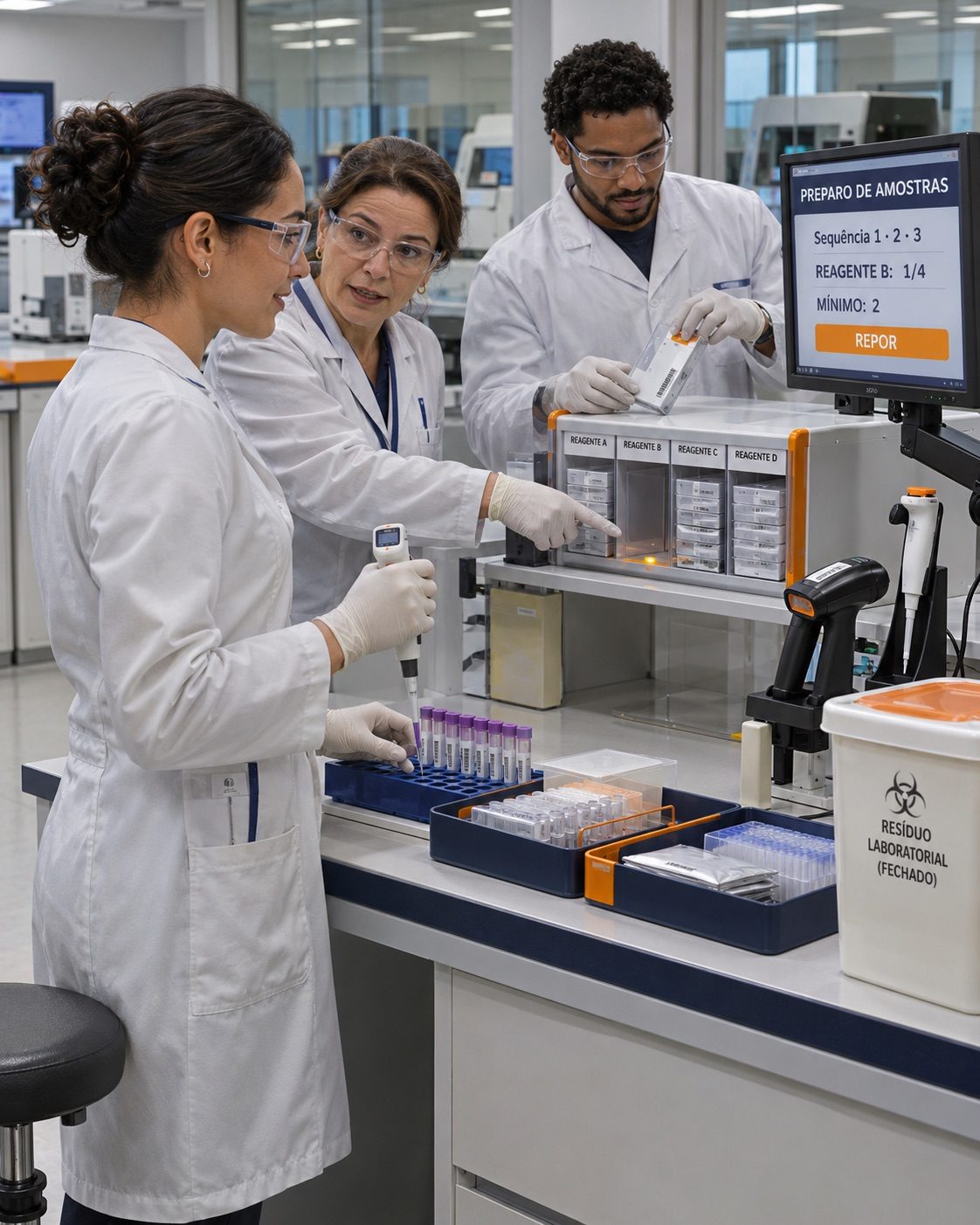
Make the workplace safer, more visual, organized and ergonomic to reduce risks, searching, movement and variation in execution. Structure the environment so that it is easily understood, abnormalities become visible and people can do their work with less effort and greater reliability.
Gemba walkLeaders + team
LDEXHSQA+1
Below minimumReagent B · 1 of 4
Pull replenishment · storeroom
Standard workstationSafe · ergonomic
Challenges
The challenge of
keeping the workplace
stable and safe
In many operations, a lack of organization and standardization in the workplace generates waste every day. The result is immediate: time lost searching for materials, operational stress, rework and, above all, a higher risk of accidents and physical injuries. Without proper visual management, execution becomes unstable and abnormalities go unnoticed.
In the lean approach, workplace organization and safety (5S) go beyond one-off cleaning efforts. It is about structuring an integrated system of visual management, ergonomics and discipline, in which working conditions make it easier to perform tasks correctly and make any deviation immediately visible so that failures can be prevented.
Tools, documents, components or resources have no clear location, forcing people to interrupt their work and rely on memory or on other people, causing line stoppages and a direct drop in productivity.
Poorly designed workstations force frequent travel, crossing paths or excessive reaching, increasing time, fatigue and exposure to risks.
Organization campaigns produce an initial improvement, but the previous state returns because there are no clear standards, responsibilities or follow-up routine.
Excess idle materials and a lack of visual standardization prevent leaders and teams from noticing leaks, operational deviations and defects at the source.
Prime work and storage space is taken up by leftover materials, broken tools and boxes with no clear indication of their use.
Transformation
What is workplace organization and safety in the lean approach?
It is a structured methodology for creating and sustaining a clean, visual, highly safe and ergonomic workplace that ensures the safe, stable and reliable execution of work.
The environment should help people quickly understand: what is available; where each resource should be; what the expected condition is; when there is an abnormality; which risk needs attention.
The approach structures this practice around rigorous criteria for sorting (Seiri), arranging at the point of use (Seiton), cleaning as a form of preventive inspection (Seiso), visual standardization (Seiketsu) and consolidating respect and daily self-discipline (Shitsuke). But the 5S program in the lean model goes far beyond the five traditional S's: it acts as the essential foundation for standardizing routines, reducing cycle times and protecting people in the gemba.
What transformation do we aim to create?
By structuring workplace organization and safety, a company builds the basic level of stability that any operational improvement needs in order to thrive.
-
For the business
Fewer interruptions, less lost time and less variation; more reliable execution; fewer conditions that lead to defects, accidents and rework; better use of space and resources.
-
For management
Greater visibility of the normal state and of abnormalities, clear criteria for organization and safety, defined responsibilities and better conditions for tracking standards and deviations.
-
For people
Less physical and cognitive effort, less searching and movement, more ergonomic and safer conditions and greater participation in shaping their own workplace.
How do we structure this transformation?
Approach
Methods and practices Capabilities developed
-
5S methodology in the gemba (practice and sustainment)
Application of the five S's connected directly to the value-adding flow: Sort, Set in Order, Inspection Cleaning, Standardize and Conscious Discipline.
-
Visual management and anomaly control
Signs, floor markings, labels and visual references make the expected state easy to recognize. Good visual management lets you quickly see what is normal and what needs attention.
-
Workstation ergonomics and motion economy
The workstation and the work sequence are analyzed in terms of posture, reach, travel, repetition, effort and ease of execution. The goal is to better adapt the work to people, not to require people to compensate for a poorly designed environment.
-
Involvement of those who do the work
The people who use the environment take part in analyzing it and building the new conditions. This improves the quality of decisions and increases the ability to maintain and improve standards.
-
Visual audit rituals and hansei (reflection)
Structuring periodic visual walks carried out by the leaders themselves together with their teams to recognize progress and correct weaknesses in the standards.
Journey
How does LIB guide this journey?
-
1
Map risks, disorder and lost time
Walk the gemba with the team to make visual records of near misses, critical ergonomic postures and bottlenecks caused by disorganization.
-
2
Apply the sort principle (conscious disposal)
Separate what is needed from what is not through the red tag system, freeing up useful space and finding the right destination for obsolete items.
-
3
Design organization at the point of use (Seiton)
Position tools, materials and devices according to how often they are used, making “a place for everything and everything in its place” a reality.
-
4
Establish cleaning with inspection (Seiso)
Identify the sources of dirt and dust, eliminate the root causes and define standards for the preventive upkeep of equipment.
-
5
Standardize visual and ergonomic conditions
Document the workstation standards (before/after photos, check routines) and apply ergonomic adjustments to workbenches and workflows.
-
6
Sustain through daily discipline
Use what was learned from the experience to transform other workstations, environments or flows, adapting the principles to the reality of each context. Build standards checks into daily rituals and audit with a focus on learning and ongoing respect.
Integrated practices
Integrated practices to
sustain safety,
stability and quality
The workplace delivers better results when its organization is connected to the way work is performed, monitored and improved.
Standardized Work
It is impossible to keep Standardized Work stable if employees lose time looking for materials/information or if tools/documents are not always in the same place and condition.
Maintenance management
Ensures that equipment and the workstation's basic conditions remain available and reliable for carrying out the work.
Daily Management
Monitors safety anomalies (Safety First) and the upkeep of the workplace's standard conditions in start-of-shift rituals.
Evidence
When the workplace stops requiring people to compensate
Company:
PO Construction
Industry:
Construction
-
Situation:
The company worked on construction sites marked by disorganization, waste and safety risks. Safety, housekeeping and the basic stability of the gemba were identified as prerequisites for creating safer working conditions and enabling teams to see and solve problems.
-
Approach:
Application of a version of 5S adapted to the reality of the gemba, with sorting and disposal of materials, organization of tools and equipment, cleaning, standardization and sustainment of the practices. Safety was treated as a priority, with management present in the workplace, recording and analysis of problems, and development of teams to propose improvements.
-
Result:
A gradual 20% reduction per year in the accident rate. Workplace organization also strengthened the teams' ability to identify waste, propose countermeasures and sustain improvements on the construction sites.
Source: When your gemba is a construction site — Lean Institute Brasil.

Frequently asked questions
No. In the lean model, cleaning is a technical inspection and safety tool. 5S is a comprehensive system of basic stability that aims to eliminate the waste of motion and waiting, prevent physical accidents and create visual conditions in which any abnormality is noticed and corrected immediately.
Because they are treated as isolated internal marketing events (“5S D-Day”) and audited in a punitive way. When the consulting engagement or the external pressure ends, the old habit returns. In LIB's model, 5S is connected to the daily work rituals of leaders and operators, becoming part of the very definition of how the work should be done.
Organized environments eliminate trips, falling objects, uncontained leaks and accidental contact with hot or moving machine parts. In addition, clear visual markings separate the flow of people from forklift and vehicle traffic, mitigating the main risks of people being struck.
It means organizing everything the worker uses within their natural reach, exactly where value is added. Frequently used tools are kept at hand; occasionally used items go on side holders; and items not used in the routine are removed from the work area, eliminating needless walking.
Yes. In services, digital environments and healthcare, organization and safety eliminate lost medical records and medications, organize inventories of sterile surgical supplies, reduce typing errors and standardize folders and digital repositories so that any team member can find critical information instantly.
During the arranging stage (Seiton), workbenches and devices are adapted to respect correct working heights, eliminate the need to twist the torso and avoid lifting heavy loads, protecting the worker's physical health.
Setting up the first reference workstations and training the teams usually takes an intensive cycle of 4 to 8 weeks, creating model areas that serve as inspiration and as a standard for expansion across the whole company.
Leaders take part by doing daily walks in the gemba, not as inspectors but as facilitators: checking whether teams have the conditions they need to maintain the standards and acting quickly to eliminate root causes when anomalies occur.
Assessment
What workplace does your
organization need to
transform and protect?
Tell us how work happens today. Our experts can help you understand how the environment affects safety, quality and productivity, and which conditions need to be redesigned to make execution more reliable.

