


Related term
Demand Amplification
A tendency observed in multi-step processes, in which the production orders received by each upstream process are more…
View termA method for speeding the flow of materials between plants, in which vehicles follow a route to make multiple pickups and deliveries at many plants.


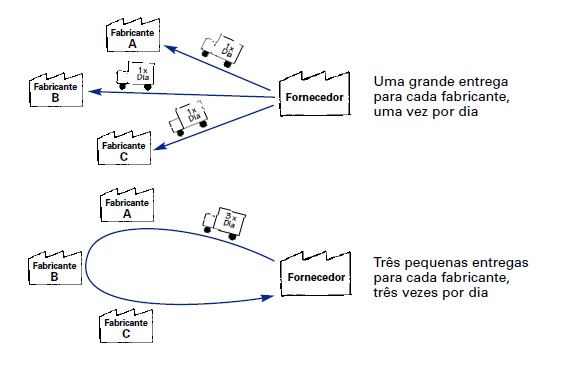
The milk run is a method for speeding the flow of materials between plants, in which vehicles follow a route to make multiple pickups and deliveries at many plants. By making frequent pickups and deliveries, with milk run vehicles linking several plants, instead of waiting to accumulate materials for direct full-truckload shipment between two plants, it is possible to reduce inventories and response time along a value stream. Milk runs between plants are similar in concept to material handling routes within plants.
Related article - "Lean Logistics". Author: Nelson Takeuchi - Lean Institute Brasil. Read the full article here.
"Milk Run - In 1996, the long-awaited project of a new plant to make a new product, the Corolla, Toyota's most popular product and its best-selling car worldwide, was defined as a continuation of the strategy of advancing into the South American market: the construction of a new plant in Brazil, more precisely in the municipality of Indaiatuba (Campinas region). So, even before this project (PJT-044N) was launched, the powerful LAD34 at headquarters began, together with TDB's logistics engineering (a task that once again fell to this writer), the preliminary logistics studies to make the project viable, since it was already known from earlier research that Brazil's logistics cost (port cost; road transport cost) was one of the highest in the world. Even without these premises, it is standard practice at Toyota for the logistics group, together with product engineering, to always be the first to start work, because two of the greatest wastes cited by Ohno-san, transportation and inventory, must be studied in detail and held at the lowest possible level. Because of the low local-content rate in the plant's logistics area, priority was given to storage space for the imported CKD kits, with practically zero space for domestic components, because from the outset the plan was to receive these parts in small lots. The logistics designed was therefore a logistics mix structured as follows:
1- Logistics mode by region:
a) Long-distance suppliers (over 300 km): Direct delivery (FOB35)
b) Suppliers up to 200 km away: Milk Run
c) Rules
E.g.: Possibility of exceeding the tolerance time.
2- Bid19: With the mode defined, the premises of the Bid19 are listed:
a. Building the best route: The carrier is free to put together its proposal with alternatives and/or even by splitting the route;
b. Control: The carrier must demonstrate its ability to monitor trucks in transit;
c. The quotation must be an open-cost breakdown in reais per kilometer driven; stopped hours (tolls, insurance, etc.);
d. The pre-selected carriers (three at most) will receive the booklet with the project scope and will have 10 days to study it and prepare their proposal;
e. The presentations (10 min) must be scheduled, all on the same day and at distinct, pre-established times. Naturally, for bidders on a Milk Run, punctuality of the presentation should be taken into account.
3- Load modulation
a) Define the equipment to be used on each route;
b) Make the greatest possible use of the supplier's existing packaging;
c) Design the load modulation with the suppliers' packaging and, if necessary, develop adapters that allow different packages to be stacked together;
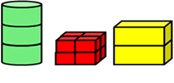
d) Define a medium-term project scope for the miniaturization and standardization of stackable packaging
Explore related terms and go deeper with real-world analyses by our industry leads.
A tendency observed in multi-step processes, in which the production orders received by each upstream process are more…
View term
See how this concept and management mindset were applied in practice to deliver real business results.
Read the full article
Build leadership and problem-solving skills at the gemba with support from our specialists.
See the training
