

Lean Logistics
This article presents the main concepts, practices and tools of lean logistics. It seeks to offer concrete examples, in particular based on Toyota's practices, referred to in the article as “cases”.
1- Introduction
Logistics is the art and science of controlling the flow of goods, energy, information and other resources such as products, services and people, from production to the market. It is not possible to imagine sales and production without the support of logistics, because this chain involves the integration of production, transportation, warehousing, handling and packaging.
Logistics is a concept that evolved from the need of armed forces to have the necessary supplies as troops moved from their base to the front. The Oxford dictionary defines logistics as: “The branch of military science having to do with procuring, maintaining, and transporting materiel, personnel, and facilities”. In military logistics, experts control how and when to move resources as needed. In military science, it is said to be a fundamental strategy to maintain a direct supply channel out of the enemy's reach, because an armed force (however powerful) becomes defenseless without a supply of food, fuel and ammunition. The defeat of the British in the American War of Independence and the defeat of Rommel's powerful German troops in World War II were attributed to logistics failures.
Logistics as a business concept evolved only in the 1950s, mainly due to the growing complexity and difficulty of providing logistics services in the early context of globalization. In business, logistics can have an internal focus (on the inbound side, called Inbound Logistics) or an external focus (on the outbound side, called Outbound Logistics), covering the flow and storage of materials from their origin to the point of consumption. In short, the purpose of logistics in manufacturing is to ensure that every machine and workstation is supplied with the necessary material, in the necessary quantity, at the necessary quality, in the necessary place. However, “necessary” is very subjective. It depends on each point of view. In some people's interpretation, the necessary quantity may be the month's quantity, while for others it may be the equivalent of 1 hour or even according to the takt1 in the lean tradition. The same can be said of the material, the quality and the location.
So let us see:
|
Necessary |
Push system |
|
|
Material |
Random storage |
Fixed storage |
|
Quantity |
30D lot |
1h lot |
|
Quality |
Receiving inspection |
Assured |
|
Location |
Distant |
Close to the Point |
I would like to mention here something this author experienced in Japan during his training (1991~92) at the Honsha plant2 of TMC (Toyota Motor Corporation), located in Toyota City, in greater Nagoya. In a Nagoya newspaper, I noticed an article that harshly criticized Toyota, more precisely the Toyota Production System (TPS3): “Toyota and its system preach an operation without warehouses, yet it keeps its inventory in trucks, causing major traffic jams around Nagoya.”
Without going into the merits of the traffic control problem, which Nagoya, like any large metropolis in the world, also has, the point is that the journalist did not dig deep enough in his research to write such an article; that is, he did not go to the genba4 of the large warehouses to check the confusion they cause to traffic. Moreover, he did not mention that this so-called inventory on the trucks is not static; it is in motion, with a departure time and an arrival time, systematically moving material in small lots and at high frequency, using compact trucks (never large semi-trailers), thus avoiding the need for warehousing and all the structure that goes with it, not to mention working capital.
Therefore, as I mentioned in the article “How to eliminate a warehouse”, this article goes to prove that the secret lies not in controlling warehouse inventory, but in how to achieve Nagareka, that is, how to create efficient logistics in which material flows like the strong current of a river.
2- Logistics in mass production and lean production systems
In the conventional transportation process, aligned with mass production, the economies of scale generated by transporting in large lots are the fuel that feeds false gains and consequently push production, a source of satisfaction for logistics operators and warehouse owners. The vision, or lack of vision, in pursuing isolated efficiency, measured by freight cost, creates the illusion of a false gain per kilometer transported. If not, let us see: is it true or false that those in charge of receiving and shipping complain about the poor use of full receiving and shipping capacity? The truth is that at 5:00 p.m. your ninety-nine shipping docks are completely taken up by semi-trailers for Outbound and Inbound, but at 7:00 a.m. the docks are deserted or almost deserted, as the “ever-welcome city pigeons” enjoy their morning breakfast, feasting on the corn kernels spilled the day before by the raw material suppliers' trucks.
The contrast to this is the area outside the shipping dock, where I see a sea of trucks occupying every street in the neighborhood (!). And worse. There is a deafening “honking” from neighbors trying to get out of their garages to take the children to school on the day of the big exam. The “no parking” sign is indeed being obeyed, but only by the tractor unit, because the semi-trailer and the B-trains take up almost the entire block.
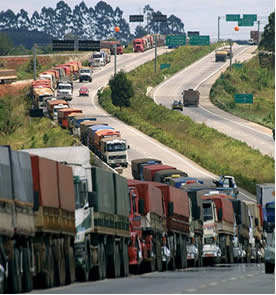
Moral of the story: during the month, Production Planning and Control, which has a wise crystal ball, ordered the supply, production and stocking of exactly the products that my customer no longer wants in the fourth week of the month, and right now is having to produce at the last minute a product that was not even in the forecast, but for which sales closed a big deal for immediate delivery. Logistics, for its part, despite insistent demands for delivery, wants to optimize freight and hold the truck at the dock, which is shared with Inbound, in order to fill the semi-trailer with the products that are still on the machine. Meanwhile, the trucks with the raw materials, arranged in a hurry, wait to enter one of the ninety-nine docks with their big semi-trailer parked in front of the garage of Mrs. “Lucinha”, who wants to get out in time for her son to still take the third exam of the day.
Is this a true story or not? It doesn't happen every day; it only happens in the neighboring industrial park, in a different segment, never in our company.
If we carried this over to the world of soccer, it would be those individual plays with dribbling in midfield without a clear objective of taking the ball toward the goal. Indeed, in the overwhelming majority of companies, each department focuses only on its individual performance, regardless of what the business needs. The buyer, for example, will seek the best purchasing opportunity in price and volume. The production department will seek maximum machine capacity for a volume that is not necessarily sellable. The sales team will make large concentrated sales without caring about the forecast mix it provided itself (most don't even provide that; it is usually values in reais or in tons). And finally, Transportation will occupy the docks for long hours with the largest equipment, at the lowest freight, requesting the loading and unloading of all material sold and purchased opportunistically.
The question is:
- Did the buyer check the inventory genchi genbutsu5and negotiate the space available in the storeroom, or did he check on his computer only the balance reported by the infamous MRP6?
- Did production seek to produce only what was sold, or did it produce at maximum capacity, everything in the monthly schedule and a bit more, and push it all to shipping? Did it bother to check whether what it produced is what is required for shipment?
- Did sales bother to set a target per SKU7? Or was the target set in tons and in reais of revenue? Were the aggressive sales actions carried out to meet the day's target, or was it met in the last days of the month?
- And finally, did transportation seek the right equipment to continuously collect small lots of cargo, or did it spend half the day looking for the lowest freight?
Whatever the case, do you agree that we will have materials sitting idle in receiving, in the storeroom, in process, in shipping and in incomplete trucks at the dock?
What decisions would be made after days of repeating the scenario above?
> Renting tents for Inbound?
> Outsourcing certain processes and ordering imported machines?
> Renting external warehouses for Outbound?
> Renting truck yards and requiring carriers to arrive
1 day in advance, for both Inbound and Outbound?
Consequence: Cash flow hemorrhaging.
In the competitive transportation model, it is high frequency in small lots that sustains and underpins the pull system. As always, it was Toyota that pioneered the implementation of Round Trip8 and Milk Run9 logistics in South America, with the coordination of the projects being the responsibility of this writer, leading a multidisciplinary team of engineers from the purchasing, foreign trade, PPC and logistics departments. At the time, in the early 1990s, one could already timidly see logistics operators (with Milk Run printed on the canvas of their siders10) working with delivery windows and with a slightly higher delivery frequency than conventional, but nothing comparable to truly controlled high-frequency, small-lot transportation logistics.
The father of TPS, Taichi Ohno, left a legacy of seven very clear fundamentals to be practiced in the company, or rather, to be fought and eliminated:
- Waste of overproduction;
- Waste of inventory;
- Waste of unnecessary processing;
- Waste of rework;
- Waste of producing ahead;
- Waste of transportation.
When I joined the company (Toyota do Brasil - TDB11), I was assigned to the Production Control Division, more precisely as the engineer responsible for PPC, logistics improvements, materials control and coordination of engineering Change Orders (OM12).
One of the first missions assigned to me was to improve all material handling inside the plant and, believe it or not, the most astonishing thing for this layman at the time was being told, as a caveat, that transportation is a waste. For an engineer who had just joined the company with almost no notion of TPS, other than having read something about a so-called kanban13 used in the production of some Japanese companies, it sounded like a paradox. Imagine the knot in the young engineer's head! How do you make improvements in material handling when you hear a caveat like that right at the start? Later I came to understand that this is precisely why logistics had to be carried out efficiently, so as to connect all processes with uninterrupted flow.
But let us talk about some logistics projects that served as trial balloons for later implementing the TPS Inbound and Outbound project in Brazil.
3- What Lean Logistics is on the Inbound side
It is JIT itself, and its objective is to keep the material flow supplied by delivering the necessary material, when necessary, in the exact quantity necessary, and packed ready for use.
- Lean logistics maintains supply by maintaining flow, not by generating inventory.
- Value creation in Inbound logistics – customer: production.
- The value of the right time - providing the supply at the moment the item is in production.
- The value of the right place – providing the input as close as possible to, or at the exact point of, consumption.
- The value of the right packaging – minimizing handling and maintaining safety.
Interested in the topic? See our Lean Inbound Logistics training
4- Inbound Case
In 1994, the CKD14 project for production of the 14B engine was implemented, replacing the robust OM-364 engine purchased from Mercedes Benz do Brasil, which until then powered the equally robust Bandeirante OJ-55 family of utility vehicles (derived from the Land Cruizer FJ-45). This project, which headquarters considered a trial balloon for major future projects in South America, had as its technical base TDB's simultaneous engineering team (36 engineers, all trained at TMC in the early 1990s). As a member of this select group, I was responsible for coordinating the project and for the PPC and logistics work. Speaking specifically of the logistics that concern us here, in ocean shipping, logistics were implemented with a lead time15 of 35 days at sea and a weekly arrival frequency of 2 20ft containers (equivalent to approximately 6.10 m) for the production of 75 vehicles/week. Naturally, anyone familiar with the automotive industry would say this is a negligible volume that could, at best, be handled with monthly rather than weekly sailings. However, that is precisely the difference between conventional mass production logistics and TPS, because the practice of this system allows no leniency toward one of the greatest wastes, which is inventory. To give an idea of the order of magnitude, one of the largest truck manufacturers in Brazil assembles this same volume daily, and on economy car assembly lines, 10 times this volume in one production shift. At TDB, 10 days of inventory of this engine's components were kept, 5 days of turnover and 5 days of safety stock (customs strikes and accidents), so any and all setbacks had to be absorbed by this inventory. This was proven in practice. I can mention the case of the sinking of the ship carrying Toyota's containers, already here in Brazil, at the entrance to the port of São Francisco, in Santa Catarina, and the loss of these containers was perfectly absorbed by the safety stock. This practice proved to us that, even over a great distance (the other side of the world), it is possible to practice a constant frequency of deliveries in small lots, making it possible to work with a low level of inventory and optimizing the company's cash flow.
The experience gained in moving materials in small lots at high frequency was fundamental in designing the logistics projects for new products and new Toyota plants in South America, mainly in Argentina and Brazil with the advent of MERCOSUR. Remember it? From protectionism to protectionism, believe it or not, it is still around, surviving.
In 1995, the introduction of a new product in South America was decided, a market still little explored by Toyota, but considered strategic because it was one of the two large markets with great potential in the world to be developed (the other was China, which later confirmed that potential with stratospheric growth).
After a thorough technical survey of suppliers and costs in the two main MERCOSUR member countries, Brazil and Argentina, Argentina was chosen, more precisely Zarate, a small municipality in the province of Buenos Aires, as the location for the new plant (TASA - Toyota Argentina S/A) for a family of Hilux utility vehicles, which would later replace the robust Land Cruiser Bandeirante produced at the São Bernardo do Campo plant. We will not discuss the merits of the choice, but Brazil, because it had a much more advanced auto parts industrial base, and TDB itself, because of its production capacity and above all its highly qualified technical staff, all trained at TMC, were designated to supply the vehicle's main component parts. Implementing logistics that consisted of importing sub-components, localizing components, assembling sets and shipping them to TASA in CKD format was a great challenge. This project was given the name PJT-AR/BR and, as a logistics case I will explain the system adopted for the project, which was implemented with the support of LAD16 and OPPD17 of Toyota Motor Corporation (headquarters). The development sequence was as follows:
a) Equipment capacity (the basis for defining the lot):
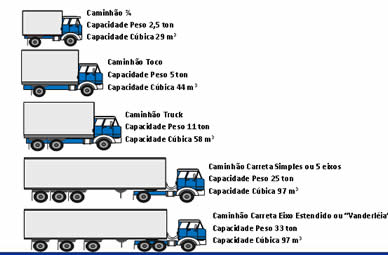
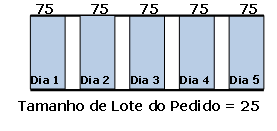
b) Lot definition (Kit):
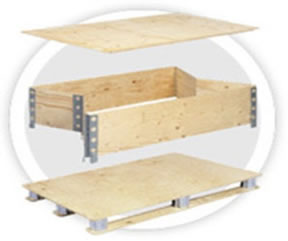
c) Development of returnable packaging:
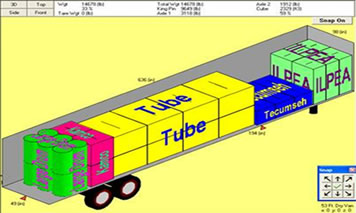
d) Load modulation:
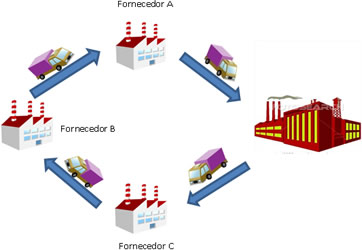
e) Route path:
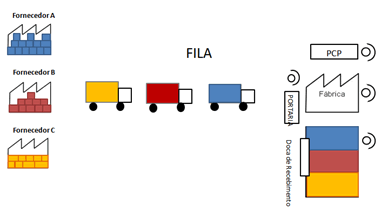
f) Amount of equipment on the route:
5- Load Consolidation Case:
The parts to be shipped to TASA consisted basically of components produced by TDB, such as stamped body parts (doors, hood, fenders, roof), chassis side members, chassis cross members, cast and machined hooks, and the assembled rear axle set (4x2; 4x4). The other part consisted of purchased external parts, such as headlights, taillights, calipers, brake discs, painted radiator grilles and chrome radiator grilles, among others, which were delivered to the São Bernardo plant in daily lots. These parts were consolidated, packed in kits of 15 (vehicles) in returnable boxes, and finally dispatched in a shipping window at 2-hour intervals.
Considering the production mix at TASA, the same mix was used in transporting the kits. And considering the best load utilization efficiency (90%), three load modulation mixes (A, B and C) were established.
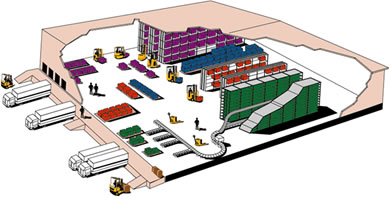
6- Packaging Development Case:
It was meticulous logistics engineering work in which easily dismantled “clip lock” boxes (panels held together by spring steel clips) were used, and internal inserts (wood and EVA) were developed to secure the parts, ensuring quality over a 2,500 km road journey on extremely poor pavement. To ensure quality, successive resistance and corrosion tests were carried out:
- Resistance test: Forklifts carrying the box with parts running over obstacles made of wooden slats, boxes dropped from a height of 0.5 m; in short, the terrible road surface to which the parts would be subjected was simulated.
- Corrosion test: Since there was a premise that there would be no degreasing process at TASA, we could not use protective oils, so exhaustive corrosion tests were developed and carried out using VCI papers and plastics, in which the parts, “wrapped” and packed inside the boxes, were exposed to the weather for 30 days (conditions to which the parts would never be subjected, either in transit or at TASA).
In short, we have reported here how the high quality standard required by TPS was ensured by TDB's logistics engineering in transporting the Brazilian parts.
7- Case Direct Delivery:
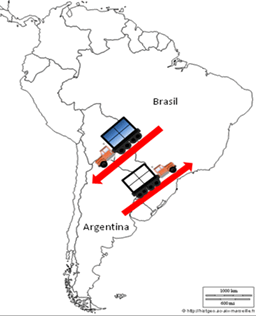
In this project (321N, better known internally as PJT-AR/BR), although the business had designated the logistics as FOB, that is, with TASA responsible for freight and collecting the parts at TDB, because they were group companies, in practice we adopted mixed-control logistics, that is, with control and responsibility for delivery in TDB's hands. This logistics was called “Round Trip”, with trucks carrying parts to Argentina and returning with the returnable boxes, so not always with good load utilization on the return, but always loaded. Since the trucks left at 2-hour intervals, for a total of 4 trucks per day (1 shift), this meant there was a convoy separated by 2-hour intervals between them. Today, with demand high, this logistics is carried out with 16 trucks at 1-hour intervals between them.
We can define this direct delivery logistics as a major paradigm shift, because, despite the 2,500 km distance separating two plants in different countries, and with no need for full truckloads or a large volume of the same product, it can be carried out in kits of small lots and with high delivery frequency.
On the bureaucratic side, to make it possible to strictly meet the 3-day lead time, the export document is prepared 24 hours in advance (export procedure) and sent to the (Uruguayan) border by courier, in order to ensure rapid export clearance; that is, with this measure, the clearance procedure will be ready when the truck reaches the border after 2 days in transit through Brazilian territory.
8- Control
Whatever the logistics modality adopted (direct delivery; collection; consolidation; cross docking18), control is the fundamental part of any and every logistics operation. In fact, many “experts” sell logistics projects and, with rare exceptions, the overwhelming majority fail on this point. I see many trucks with the “phrase” Milk Run printed on their eye-catching siders; I have seen distinguished speakers from logistics operators presenting Milk Run projects; and carriers taking part in BIDs19 guaranteeing on-time20 deliveries (naturally building fat into the L/T). However, none of them presents coherent visual control to the people who will operate the system. If not, let us see: when we visit a shipping or receiving dock, we can rarely see whether the operation is on time, late or early. It is also very easy to present a project saying there must be control of the windows, but how is this done in practice? In reality, the question is how I am going to control the window without controlling the whole chain. Obviously, if I do not control the truck's departure at the origin (in the Inbound case) and also along the route, I cannot guarantee its arrival. I often hear in companies' morning meetings the person responsible for supply explaining about critical materials expected to be received that day, and when I ask when and at what time the truck left its origin, the answer is invariably: I don't know, I entered the date I need it and it is the supplier's obligation to meet the deadline; all I can do is stand at the gate waiting for “my loved one to arrive”. And that is still the good side of the story; what happens in most cases is spilled milk, that is, missed deadlines, zero inventory and the operation stopped for lack of material.
The minimum controls required are:
- Control board for trucks in transit and the arrival window: Plan x Actual;
- Material receiving control board (supplier, type, quantity): Plan x Actual;
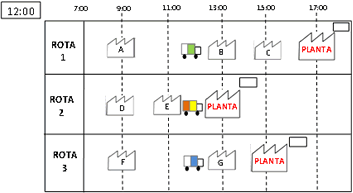
- Help chain and contact flowchart for each supplier and carrier;
- Internal help chain flowchart;
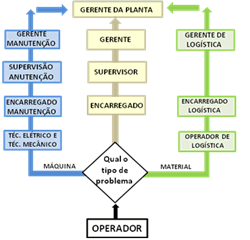
In short, everything must be planned, visible and surprise-proof.
9- Planning case
When the monthly order is received, with the premise of a fixed month N and forecasts for N+1 and N+2, there may be a tolerance of plus or minus 10% and 20% respectively.
Despatch Plan: Based on this order, which is received on D20 of N-1, the monthly dispatch plan is drawn up (broken down into daily plans), which in turn is deployed into the vanning plan21 following the modulation mix, and this in turn is deployed into the production plan and the orders to suppliers.
10- Receiving Window
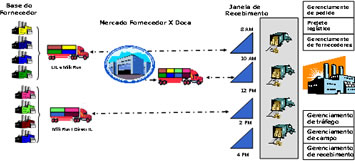
The receiving window, contrary to what it may seem at first glance, is not just an arrival sequence for trucks to enter; it is an important integral part of systemic nagareka and of (low) inventory.
The window, as throughout the logistics chain, must be set up with a Pitch22 similar to the takt and to the production mix of the customer process, so that flow is maintained without interruption, keeping material moving.
The moment material becomes stationary is the moment it turns into inventory. When setting up the window, the rules must be established clearly and rigidly, as follows:
- The sequence of the receiving window schedule must follow the sequence and pace of consumption, which is that of the customer process;
- The ideal window schedule is one that follows a fixed, leveled program of load volume and thus maintains a fixed number of trucks received, distributed evenly over a working day equal to that of the customer process, that is, following the same pace and work shift;
- In a company that has not yet reached a leveled stage of work in its business chain, that is, where there is variation in both volume and mix within the month, implementing a fixed window schedule is a little more complicated, but it is still possible to implement a flexible window that fits within the pre-established schedule.
It would be a window somewhat reminiscent of an airport schedule, that is, there may be some variation in the mix of trucks to be received, but fitted into the schedule with pre-established times. Naturally, it is an operation that will carry a reasonable dose of MURI23 due to MURA24 and thus result in some undesirable MUDAs25 but that is the price to be paid for the lack of HEIJUNKA26. I usually call this type of schedule flexible windows; it would be a manageable intermediate stage on the way to a fixed window schedule in the future (we have practical cases of implementation in companies among the projects developed by Lean Institute Brasil).
In the Hilux project 321N case both the collection window at suppliers and the receiving and dispatch windows were always kept fixed. As always in TPS, everything is binary: either it is or it isn't.
11- Cross docking
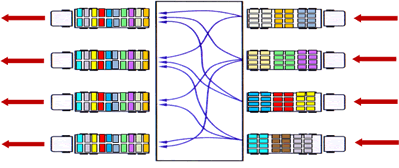
This is a logistics modality similar to a depot, that is, an improved version of simple load consolidation. But unlike load consolidation, in this modality there must be no storage: trucks arrive at a platform made up of receiving and dispatch docks. The loads are then quickly transferred directly from one truck to another, so that, despite the extra handling, intermediate inventory is avoided and the logistics operation is optimized with good load efficiency. It is widely used over long distances with different origins and destinations, that is, materials with a common destination are quickly consolidated on the platform itself. Therefore, the main merit of this modality is speed and transportation in small lots and/or split lots.
Once again, control of truck arrival, departure and transit is fundamental for us to be able to synchronize the operation. To implement it, the use of Standardized Work is recommended, implemented after a thorough analysis of the SWCT (Standardized Work Combination Table). Yes, that's right, it is yet another paradigm shift. The SWCT is not applied only where man and automatic machine work are involved; it can indeed help in an analysis aimed at synchronizing the logistics operation.
12- Milk Run Case
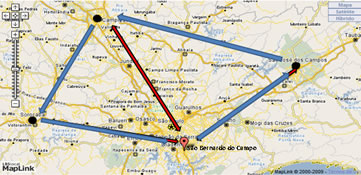
In 1996, the long-dreamed-of project for a new plant to produce a new product, the Corolla, Toyota's most popular product and its best-selling one worldwide, was defined as a continuation of the strategy of advancing in the South American market: the construction of a new plant in Brazil, more precisely in the municipality of Indaiatuba (Campinas region). So, even before the launch of this project (PJT-044N), headquarters' powerful LAD began, together with TDB's logistics engineering (once again entrusted to this writer), the preliminary logistics studies to make the project viable, since it was already known from previous research that Brazil's logistics cost (port cost; road cost) was one of the highest in the world. Even without these premises, it is standard practice at Toyota for the logistics group, together with product engineering, always to be the first to start work, because two of the greatest wastes cited by Ohno san, transportation and inventory, must be studied in detail and held at the lowest possible level. Due to the low local content in the plant's logistics area, priority was given to the storage area for imported CKD kits and practically zero area for domestic components, because from the outset the receipt of small lots of these parts was envisioned. The logistics envisioned was then a mix of logistics, structured as follows:
1- Logistics modality by region:
a) Long-distance suppliers (over 300 km): Direct delivery (FOB27)
- Curitiba (PR): 1 Supplier
b) Suppliers up to 200 km: Milk Run
- South Minas Gerais route: 3 Suppliers
- Campinas region route: 5 Suppliers
- São Paulo region route: 7 Suppliers
- São Paulo interior route (Tatuí and Jundiaí): 2 suppliers
c) Rules
- Stopped time at supplier windows: 15 min + 5 min tolerance.
- Anomalies: Report and request guidance from the control center at TDB.
E.g.: Possibility of exceeding the tolerance time.
2- Bid: With the modality defined, the Bid premises are listed:
- Setting up the best route: The carrier is free to put together a proposal with alternatives and/or even splitting the route;
- Control: The carrier must demonstrate its capability to control trucks in transit;
- The quotation must have an open cost breakdown in reais per kilometer driven; stopped hours (tolls, insurance, etc.);
- The pre-selected carriers (three at most) will receive the booklet with the project scope and will have 10 days to study it and prepare their proposal;
- The presentations (10 min) must be scheduled, all on the same day and at different pre-established times. Naturally, for Milk Run bidders, punctuality in the presentation should be taken into account.
3- Load modulation
a) Define the equipment to be used on each route;
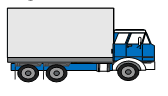
b) Use the supplier's pre-existing packaging as much as possible;
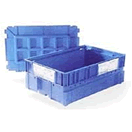
c) Design the load modulation with the suppliers' packaging and, if necessary, develop adapters that allow stacking between different packages;

d) Define a medium-term project scope for miniaturization and standardization of stackable packaging.

13- Conclusion
We have presented the main elements of Lean Logistics with practical examples from Toyota. There is not just one single way to implement a logistics project, whether Inbound or Outbound; one must study sets of logistics formats that interact with one another, making the synchronization of the operation as harmonious as possible, like the strong flow of a river, that is, without damming (idle material generating inventory), focused on consistency and the shortest Lead Time.
Appendix
- Takt = Available production time divided by customer demand.
- Honsha Plant = Formerly Koromo plant, one of the plants of Toyota Motor Corporation (TMC).
- TPS = Toyota Production System.
- Genba = Japanese term for “actual place”, usually used for the shop floor or any place where value-creating work takes place.
- Genchi genbutsu = Practice in force at Toyota that consists of fully understanding a given condition through direct personal observation of reality.
- MRP = Material Requirement Planning.
- SKU= Stock Keeping Unit. Designates the different items in an inventory, usually associated with an identifying code.
- Round Trip = Complete trip, that is, the trucks carrying loads were used on both the outbound and return legs.
- Milk Run = A method of speeding the flow of materials between plants in which vehicles follow a route to make multiple pickups and deliveries at many plants.
- Siders = Truck body covered with sliding curtain side closures.
- TDB = Toyota do Brasil.
- OM = Engineering Change Order = Change in product specification and/or design.
- KANBAN = A signaling device that authorizes and gives instructions for the production or withdrawal of items in a pull system.
- CKD = Complete Knock Down = Set (of parts) completely disassembled.
- Lead time = How often a part or product is completed by a process, as timed by observation.
- LAD = Logistic Administration Division.
- OPPD = Overseas Production Planning Division.
- Cross docking = A facility that sorts and (re)combines a variety of items from various suppliers to be sent to various customers.
- Bid = Competitive tender to contract the best service.
- On time = Means that a process is being done at the right moment, that is, it is neither late nor early; it is at the right time.
- Vanning plan = Loading plan.
- Pitch = The amount of time needed in a production area to complete a container of products.
- MURI= Overburdening equipment or operators by requiring them to work at a more intense or accelerated pace, with more force or effort, for a longer period of time than they can withstand.
- MURA = Unevenness in an operation.
- MUDA = Any activity that consumes resources without creating value for the customer.
- HEIJUNKA = Leveling the type and quantity of production over a fixed period of time.
- FOB = Free On Board: Pickup and freight paid by the customer.
Nelson Eiji Takeuchi
He is a project manager at Lean Institute Brasil. An engineer, he worked for 15 years at Toyota do Brasil, including 1.5 years of OJT at Toyota Motor Corporation headquarters (Japan) focused on TPS, Production Control, Logistics and Procurement. At Toyota do Brasil he started as a Mid-level Engineer and rose to the position of Industrial Administration Area Manager, managing Production Control; Logistics; Foreign Trade; Procurement; Quality Control; Facilities Engineering; Environment; Occupational Safety; Projects; etc. He also worked at ARTEB as Manufacturing Manager, at Sumidenso as PPC / Procurement Manager and at NEC do Brasil as an engineer.
Acknowledgments
To Juliana Santo for technical support, Tamiris Masetto for text revision and José Roberto Ferro for his encouragement. Thanks to their invaluable collaboration, the publication of this article has been possible.







