


Related term
Demand Amplification
A tendency observed in multi-step processes, in which the production orders received by each upstream process are more…
View termThe location where a predetermined standard inventory is kept to supply downstream processes.


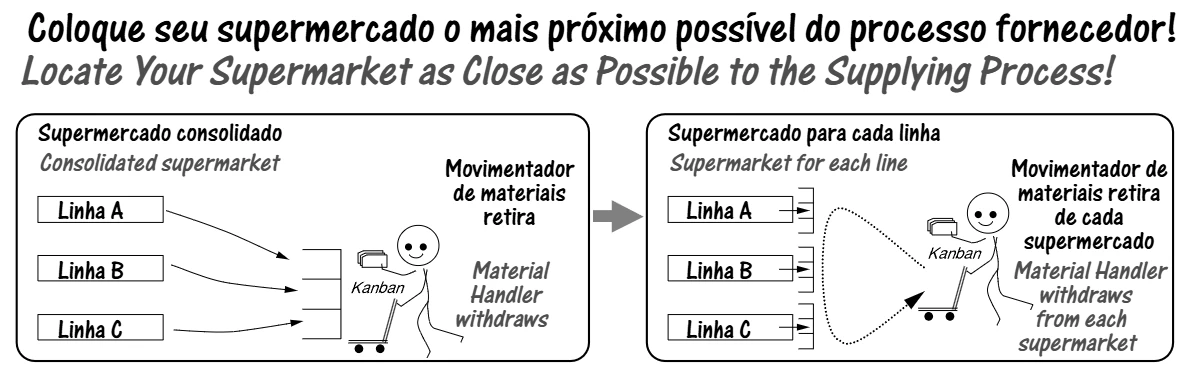
In lean vocabulary, a supermarket is the location where a predetermined standard inventory is kept to supply downstream processes. Supermarkets are usually located near the supplying process to help it see its customers' usage and requirements.
Common implementation mistake
Setting up a consolidated supermarket far from the lines to save the material handler's work. The purpose of supermarkets is to connect physically separated processes as a flow and to identify and solve problems more quickly; reducing the material handler's work is not the main objective. A supermarket next to each line makes it clear, for example, which line is producing defects.
Each item in a supermarket has a specific location from which a material handler withdraws products in the precise amounts needed by a downstream process. When an item is removed, a signal to make more – such as a kanban card or an empty bin – is sent to the supplying process. That is why a supermarket is not only a storage place: it creates pull by requesting replenishment, that is, by filling the gaps created when the customer withdraws product.
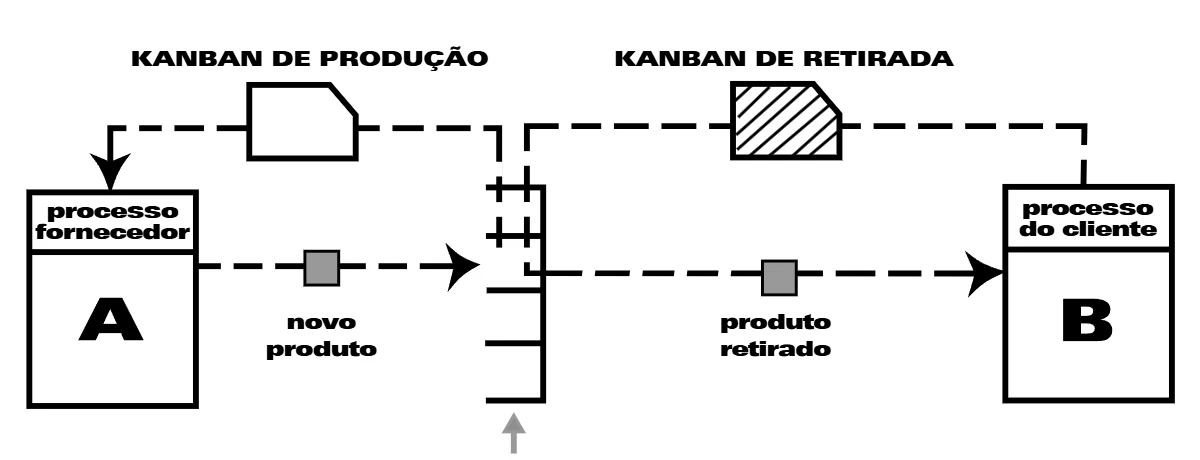
A supermarket is used where continuous flow is not possible between two processes. It holds items in a quantity that varies between a minimum and a maximum, determined by the size of the interruption it is meant to absorb, and it must always be linked to a pull system: when the quantity reaches a low level, a replenishment order is generated for the material's supplier.
How to apply it in your organization
Toyota installed its first supermarket in 1953 in the machine shop of its main plant in Toyota City. Taiichi Ohno, a company executive, took the idea from pictures of American supermarkets, where products were placed on shelves at specific locations for customers to take. Ohno visited the U.S. in 1956 and later remarked that the supermarkets he saw on that trip impressed him more than the big American factories.
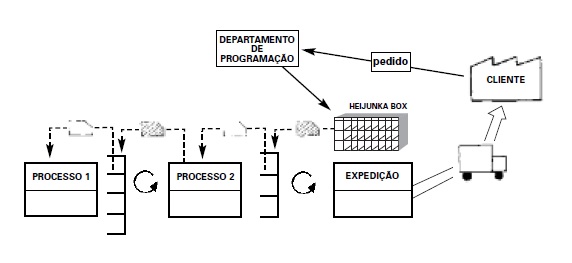
The supermarket system is the most basic and most common type of pull system, sometimes called “A-type pull.” It differs from building directly to shipping (“B-type pull”), used when order frequency is low and the customer lead time is longer than the lead time from the pacemaker process to delivery. B-type pull keeps inventory at lower levels, but it requires a reliable stream and a short lead time.
Key takeaways on the topic
To learn more (articles in Portuguese)
Explore related terms and go deeper with real-world analyses by our industry leads.
A tendency observed in multi-step processes, in which the production orders received by each upstream process are more…
View term
See how this concept and management mindset were applied in practice to deliver real business results.
Read the full article
Build leadership and problem-solving skills at the gemba with support from our specialists.
See the training
