

How to hire a lean consultancy: 10 essential criteria before deciding
Many companies try to optimize processes on their own or focus exclusively on short-term cost reductions, but end up frustrated when they realize the gains quickly disappear. True lean thinking is not an isolated project, but a philosophy that requires a living, sustainable management architecture.
To avoid the common mistake of neglecting the structure needed to sustain results, it is essential to have the support of specialists who deeply understand this transformation. In this context, knowing how to choose a lean consultancy becomes the first decisive step toward success. In this article, we present 10 fundamental criteria for selecting the ideal lean consulting firm, ensuring a solid foundation for your lean program and results that last over time.
Why hiring a lean consultancy is a strategic decision
Unlike one-off projects that only seek to "fix" isolated processes, a true lean consultancy promotes a deep structural change. While temporary interventions deliver short-lived results, systemic transformation acts on four pillars vital to the long-term survival of the business:
- Organizational Culture: The focus shifts from finding who is to blame for errors to understanding the problems. The consultancy shapes a continuous improvement mindset at every level, where each employee becomes an agent of change.
- Strategic Leadership: Leaders are trained to abandon command-and-control and take on the role of mentors. They learn to lead by example in the Gemba, supporting teams in problem solving and in aligning purpose.
- Governance and Management: Lean establishes a new management architecture, connecting top management's strategy to daily operations through follow-up rituals and clear performance indicators (KPIs).
- Financial Results: The impact on the balance sheet is a consequence of the systematic elimination of waste and increased efficiency. This generates not only cost reduction, but also frees up cash and resources for reinvestment in innovation and growth.
Choosing a lean consulting firm with a systemic view means stopping firefighting and starting to build a unique organizational capability: the ability to solve problems and generate value continuously, regardless of market fluctuations.
What should you evaluate when looking for a lean consulting firm?
Many market approaches focused on "one-off optimization" and on the isolated application of tools deliver immediate results, but these tend to fail or regress after two or three years. This happens because such interventions usually ignore the development of the system as a whole, failing to create a solid foundation to sustain the lean program.
When selecting your partner, assess whether the proposed methodology balances these three pillars. A consultancy that focuses only on the technical side may produce quick gains, but only integration with the social and strategic sides will ensure that the transformation becomes part of the company's DNA.
1. Focus on developing Lean Leadership
True lean transformation is not imposed from the bottom up; it must necessarily begin with top management. An excellent lean consulting firm does not just deliver tools, but focuses on the simultaneous development of hard skills (methods and analyses) and soft skills (behaviors and mindset).
The goal is to build Lean Leadership capable of acting in the Gemba not as an auditor, but as a mentor. This requires the consultant to equip leaders to support their teams, act with deep respect and ensure the psychological safety needed for problems to surface and be solved without fear of retaliation. Without leaders who live the principles every day, any change in processes will be temporary.
2. Customized solutions vs. 'cookie-cutter recipes'"
Be wary of consultancies that offer identical solutions for different problems. In lean thinking, what works for one organization may not be the answer for another. The ideal lean consulting firm does not carry out a "mass rollout" of standardized tools, but works in a situational and customizable way.
This means the consultant must dive into the specific context and unique challenges of your business to design the journey. This approach requires a balance among the three faces of lean — technical, social and strategic — ensuring that the solution respects the organization's current maturity. In addition, customization involves understanding the profile of the local lean leadership, adapting the pace of the transformation so that it is absorbed and sustained by the company's culture, instead of being just an external package imposed on operations.
3. Integration of the three faces of lean
A good lean consulting firm knows that real transformation requires aligning three interdependent elements. Ignoring any one of them opens the door to processes regressing. The ideal consultancy should balance:
- Technical Solutions: Focused on improving flow and process efficiency through tools and methods such as continuous flow and value stream mapping (VSM).
- Social Solutions: Centered on people development, respect and the behavioral change needed for continuous improvement, through the establishment of solid routines, such as daily management, that support the work.
- Lean mindset and strategic thinking: Which ensure that improvement efforts are aligned with the organization's purpose and business challenges, using scientific thinking (PDCA) for problem solving at every level.
Focusing only on tools brings quick, visible gains, but they deteriorate soon after the consultants leave. For improvement to become self-sustaining, your partner must have mastery of the three faces of lean, ensuring that the technical side is sustained by the culture and guided by the organization's strategy.
4. Presence and practice in the Gemba
Real improvement does not happen in air-conditioned meeting rooms or only in indicator spreadsheets. The lean methodology teaches that it is essential to go to the Gemba — the place where value is actually created for the customer — to observe processes up close and understand day-to-day problems at their core.
A top-level lean consulting firm does not limit itself to delivering diagnostic reports; it must teach through practice, working side by side with the operational team. This physical and advisory presence makes it possible to identify waste that is invisible to untrained eyes and ensures that the proposed solutions are technically feasible and accepted by those who do the work. When choosing your partner, make sure they "get their shoes dirty" in the operation, because that is where the transformation comes to life.
5. Connection with Strategy Management (Hoshin Kanri)
Many companies make the mistake of optimizing isolated processes that do not move the business's main needles. A high-impact lean consulting firm must ensure that every improvement made in the Gemba is connected to the organization's overall goals.
Assess whether the consultancy uses Hoshin Kanri (or Lean Strategy Management) to align purpose, processes and people. This method is essential to ensure that improvement efforts, from the C-Level to the front line, support the company's strategy in a deployed and coherent way. Without this connection, you run the risk of having "islands of excellence" in an ocean of stagnant results.
6. Proven experience in your industry
Every sector carries unavoidable "structural waste" inherent to its own operation. A common mistake is trying to apply a purely factory logic to service or healthcare environments. That is why an excellent lean consulting firm needs adapted methodologies that understand the nuances of each vertical: whether bed turnover in Healthcare, jobsite logistics in Construction, channel integration (Omnichannel) in Retail, or production cycles in Agribusiness and in the Supply Chain.
Because lean thinking is universal but its application is specific, Lean Institute Brasil has developed specialized practice areas to ensure that the language and methods speak directly to your business. Explore how we apply lean in different sectors:
- Lean Healthcare: Optimization of hospital flows and the patient journey.
- Lean for Supply Chain and Logistics: Efficiency in warehousing, transportation and supply chain.
- Lean Digital: Agility and value in the development of technology products and IT.
- Lean in Construction: Reduction of lead times and waste on the construction site.
- Lean in Agribusiness: Operational excellence from farm to table.
- Lean in Manufacturing: The classic foundation applied with cutting-edge technologies.
- Lean in Services: Elimination of bureaucracy, lean information flows and increased productivity in administrative areas and service companies.
- Lean Financial Services: Optimization of transactional processes, reduction of errors in financial operations and improvement of the banking and insurance customer experience.
- Lean in Oil and Gas: Focus on operational excellence, safety and efficiency in complex exploration, production and refining environments.
- Lean in Insurance: Optimization of the policyholder journey, agility in claims adjustment, reduction of errors in underwriting processes and efficiency in backoffice operations.
When choosing your partner, check whether they have real success cases and consultants who understand the technical and cultural challenges of your specific area.
7. Use of established frameworks
The foundation of an excellent consultancy should be guided by structures tested globally and validated in thousands of organizations around the world. One of the greatest differentiators of Lean Institute Brasil is its exclusive use of the Lean Transformation Framework (LTF), a structure tested globally and validated in thousands of organizations around the world by the Lean Global Network.
While many consultancies focus only on isolated tools, LIB uses the LTF as a solid foundation for lean programs. This exclusive framework makes it possible to accelerate short-term gains while simultaneously developing people and systems for a lasting transformation. It is the only one that addresses the five essential dimensions in an integrated way: the purpose of the change, process improvement, capability development, the management/leadership system and the basic mindset of the organization. When evaluating a partner, check whether they use a robust framework or base their actions on intuition alone.
8. Genuine concern with sustainment
The biggest challenge of any transformation is not achieving the result, but maintaining it. The ideal continuous improvement consultancy should structure the governance, the routines and the lean management system so that knowledge is not diluted by staff turnover or the passage of time.
It is essential that the partner help the organization balance the demands of "today" (immediate results and deliverables) with the structural adaptability needed for "tomorrow". This means creating audit mechanisms, standardization and review cycles that ensure processes do not regress to their previous state. When choosing your consultancy, ask: "How will this system keep working two years after you leave?". The answer should involve creating a self-sustaining organizational culture.
9. Transition and development of problem solvers
The role of an ethical and effective lean consulting firm is not to solve every problem for the organization, creating a permanent technical dependence. On the contrary, the focus should be on knowledge transfer and building internal capability.
The consultant should act as a mentor, using scientific thinking to turn managers and employees into autonomous problem solvers. Through the PDCA method (Plan, Do, Check and Act), the team learns to identify root causes and to lead continuous learning cycles on its own. When evaluating a partner, make sure their ultimate goal is to make your company capable of evolving on its own, ensuring that the improvement culture survives the end of the consulting contract.
10. Co-creation culture
Especially in service sectors and digital environments, where value is often intangible, the lean consulting firm should act as a facilitator of a co-creation culture. This means that solutions should not be imposed unilaterally on the operation, but rather developed together with those who carry out the process.
The ideal consultancy promotes the co-design of the customer journey, using empathy to deeply understand the pain points of those who use and those who operate the service. By building mechanisms collaboratively, the consultant ensures that the improvements make sense for the team's day-to-day work, increasing engagement and the likelihood of a successful implementation. Choose a partner who knows how to listen and who values the collective intelligence of your own organization.

Figure 1 — Experienced consultant coaches an operations leader at the daily management board, discussing KPIs and improvements in the gemba.
Common mistakes when hiring a lean consultancy
Many companies fail not for lack of effort, but because they fall into strategic traps during hiring. To ensure ROI (Return on Investment) and the effectiveness of the transformation, avoid:
- Choosing on lowest price alone: "Cheap" consultancies usually focus only on superficial delivery of tools, without the depth needed to change the management system.
- Looking for quick solutions (the "shortcut"): Lean is not a quick fix. Be wary of promises of deep change in a few weeks that ignore the need for genuine cultural change.
- Not involving top leadership from day zero: Without the sponsorship and active participation of the C-Level, improvements die at the first hierarchical barrier. Leadership must be the main champion of the example.
- Treating lean as an isolated project: Lean is a management philosophy, not an event with a start and end date. Seeing it as a "project" prevents it from becoming the company's standard way of working.
- Not planning for sustainment: The most critical mistake is hiring only the implementation and forgetting to structure the governance mechanisms and routines that will keep processes running after the consultant leaves.
- Not developing leaders with new skills and practices: Lean is, first and foremost, a management system based on behavior and thinking, not just on tools. Since the Toyota Production System, structured by Taiichi Ohno, continuous improvement has depended on leaders capable of developing people and solving problems. Without leadership, lean becomes just a tool and is not sustained as a culture
The Lean Institute Brasil way of consulting
The choice of a partner for the lean journey determines whether your company will have just a passing improvement or a sustainable evolution. The approach of Lean Institute Brasil (LIB) applies all the criteria mentioned above, prioritizing what we believe is the greatest asset of a transformation: the people of your organization as protagonists.
Working hands-on throughout Brazil, our methodology is rigorously guided by the Lean Transformation Framework (LTF). We do not deliver ready-made packages or external reports; we focus on joint construction, where our specialists act as mentors side by side with your teams in the Gemba.
We believe that when people are engaged in building the solution, they take ownership of the knowledge and become active agents of change. Excluding employees from this process is what creates resistance; on the other hand, LIB's co-learning partnership model removes barriers, facilitates the necessary adjustments and encourages much more innovative and creative thinking.
As founding members of the Lean Global Network (LGN), we connect your organization to the best practices in the world. Our mission goes beyond traditional consulting: we work to develop people's capabilities, making them autonomous and able to sustain results and solve increasingly complex problems.
By choosing LIB, you count on the institution that is the official reference for lean thinking in Brazil, ensuring that the transformation is deep and aligned with the state of the art in management worldwide.
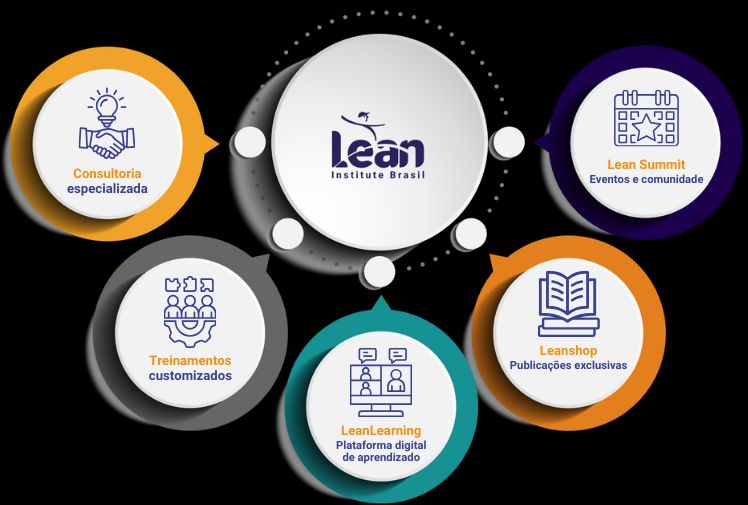
Figure 2 — Summary circular view of LIB's pillars: consulting, customized training, learning platform, publications and events.
Conclusion
Choosing how and with whom to implement lean thinking is a strategic decision that will shape the future and resilience of your organization. It is essential to understand that knowing how to choose a lean consultancy is not a decision based only on cost or on immediate productivity gains.
The focus should be on the potential for organizational learning and the future adaptability the partner can provide. A valuable consultancy does not just deliver a project with an end date; it leaves as its legacy a company capable of evolving on its own, with prepared leaders and a culture focused on problem solving. By prioritizing the building of internal competencies rather than just isolated efficiency metrics, you ensure that your lean journey is, in fact, a sustainable and profitable transformation.
Ready to start a real transformation in your company? Talk to the specialists at Lean Institute Brasil and discover how our methodology can help your organization reach new levels of excellence.


