ANDONMANIA IS GOOD FOR BUSINESS AND FOR SOCIETY
Remember the last time you had a fever? It was bad, wasn't it? You should know, however, that you ought to “thank” the fever. If it weren't for it, things could have been much worse for your health...
Far from being a disease, fever is a reaction the body has to signal that something is not right inside us. It is like a “warning”, an alert our body gives us so that we can find out what is wrong with our health, what the problem is and, of course, what the solution is.
Now imagine if everything important had a “warning” that alerted those concerned when things were not working as planned? In the Lean System there is a technique – one of the foundations of this management system – that does exactly that: it signals immediately when a process stops working the way it should.
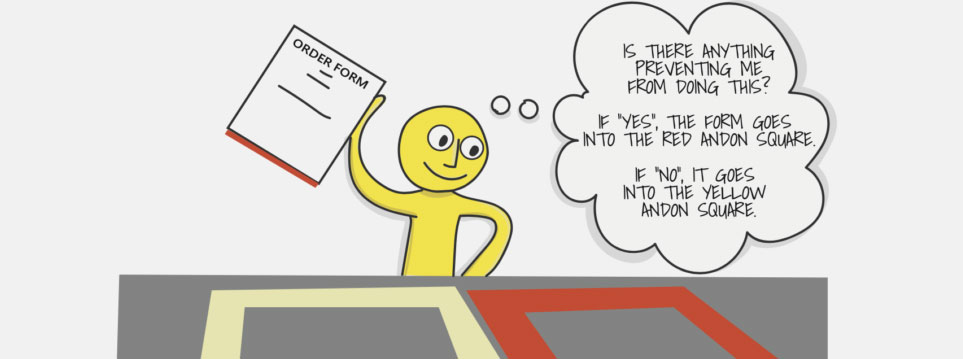
We are talking about “Andon”, a concept that, in more technical terms, means a “visual management” device that signals when something abnormal or outside the expected standard occurs. A typical “andon” widely used in manufacturing, for example, is usually a set of lights (normally green, yellow and red) or an illuminated board with rows of numbers corresponding to the workstations or machines on a production line.
The light comes on when a problem is detected by a sensor on one of the machines or at one of the workstations. For example, when a machine breaks down or a workstation stops working, the “andon” gives the alert with a red light. This signal can be triggered automatically or by an operator. Some systems are much more sophisticated, with sounds, etc.
The most important thing, however, is that this warning reaches the responsible teams immediately, so they can go there, solve the problem and get the machine or workstation working normally again, as planned, thus eliminating lost time and reducing losses for the company.
This alert system – it should be made clear – is not meant to “find culprits” for problems, but rather to alert the right people so that the failure is fixed, to turn the “abnormality” back into “normality”.
Today, on a good share of large companies' shop floors, especially those that follow the lean system, this type of equipment is already commonplace. But it could and should go further. For example, even in companies that already follow the lean system, the “andon” is often restricted to production lines only, when it should be adopted throughout the company. This concept can and should be expanded to every kind of productive sector.
For example, in the administrative area, which can indeed devise mechanisms to make it immediately evident when a person has problems in their work and their “production” is behind. In these cases, the difficulties with standardizing the work often make it hard to know whether we are having a “normal” day or whether there is some problem.
We can go even further. How about we start thinking about entire cities organized with the “andon” concept in mind as well? For example, urban problems could be handled more effectively. A water main has burst and water is leaking and being wasted? An “andon” would signal this quickly and instantly to whoever needs to know, leading to a fast correction of the problem and an end to the waste.
Today, this communication is slow and goes through several channels. And the response is almost always even slower. Police officers may be spending more time than necessary in safer areas while regions with more crime go unprotected? “Andons” could flag this, signaling a possible imbalance in distribution and thus quickly redirecting personnel.
We could think of hundreds of other uses. And on many other fronts. Always in the spirit of quickly making visible a situation of abnormality, something different from what was planned, forecast or expected, through simple and direct devices.
And, even more importantly, it should allow the situation to be resolved as quickly as possible and return to “normal”. The “andon” is only the first part of an effective help and problem-solving system. In short, a good dose of “andonmania” could be very beneficial. Not only for companies, but for society as a whole.
Source: Revista Época Negócios