
How NUMMI changed its culture
I received a lot of questions online and offline about last week's column on the imminent closing of NUMMI. One question in particular came up many times: "What did you actually do to change the culture so drastically and so quickly at NUMMI?" It's one thing to say, broadly, "We instituted the Toyota production and management systems". It's another to describe more specifically what we actually did that resulted in that tremendous cultural change.
I'll explore this topic more deeply this week in my usual way - by describing what I learned and how. (By the way, this is why I write these columns in the first person. We have unconscious biases in our perception and reporting. Writing in the first person helps you, the reader, see and judge my biases for yourself.
Thanks, Mike, for reminding me to make this point. Also, I always try to make it clear when I'm providing facts versus an interpretation or opinion.) And, to do justice to this important topic, this column is much longer than your typical weblog. So, consider yourself warned.
I worked for Toyota, not for NUMMI or GM, and I was based at the company's headquarters in Toyota City, working with the NUMMI and GM people when they visited Japan, while visiting NUMMI itself periodically.
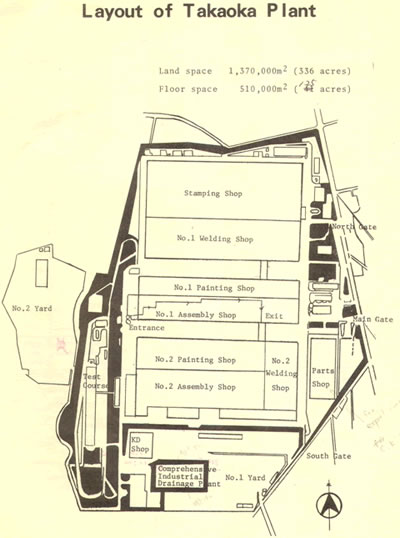
Sketch of the Takaoka plant, in mid-1984. It had been producing the Corolla since it opened in 1967.
As it was for many others, NUMMI represented an incredible learning opportunity for me personally. Before I could help Toyota teach GM or any other company, they had to teach me first. So, starting in late 1983, Toyota put me to work at headquarters and at the Takaoka Plant (shown above, as it was in 1984), NUMMI's "mother plant" that produced the Corolla. I worked in all the main processes of a vehicle assembly plant (as illustrated in the simple chart below, which they used to orient me to what I was about to experience). Then, working with my Japanese colleagues, I helped develop a training program to introduce the Toyota system to NUMMI's American employees.
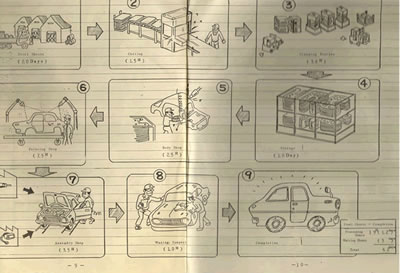
Production flow at the Takaoka Plant, in mid-1984. Takaoka was often called the most efficient vehicle assembly plant in the world.
To recap briefly from last week, GM was pursuing a few very tangible business objectives with NUMMI. It didn't know how to build a small car profitably. NUMMI was also a chance to put an idle plant and workforce back to work. And, perhaps the least important item at the time, but still real, they had heard a bit about the Toyota production system (Len Ricard and a few others had studied Isuzu thoroughly, which had learned from Toyota). This would be a chance to see things up close and personal, a chance to learn.
On the other side of the fence, Toyota was under pressure to build vehicles in the U.S. It was late in bringing its production to the U.S. Honda and Nissan were already building cars in Ohio and Tennessee, respectively. They could simply have chosen to do it on their own, which would have been simpler and faster. But Toyota's goal was to learn, and to learn quickly. What better way than to start with an existing plant, and with partners helping them navigate uncharted waters?
NUMMI's learning opportunity for Toyota
At that time, the workforce at GM's old Fremont Plant was considered extremely "bad". Many considered it the worst in GM. The workforce had a terrible reputation in that period, going on strike frequently - even wildcat strikes - filing grievance after grievance, and even sabotaging quality. Absenteeism routinely exceeded 20%. And, oh yes, the plant had produced some of the worst-quality vehicles in the GM system. And remember, this was in the early 1980s. So being the worst in the GM system back then meant you really had to be very, very bad.
So Toyota had many concerns about transplanting perhaps the most important aspect of its production system - its way of cultivating employee involvement - to begin with. How would workers with such a bad reputation support us in building quality? How would they support the concept and practice of teamwork?
And, as it turned out later, the "militant" workforce was not a major obstacle. Many problems did arise, but they were ultimately overcome. In fact, the union and the workers not only accepted the Toyota system, they passionately embraced it. We took the plant's quality from the worst in GM to the best in the company - not just from bad to good, from worst to best - in just one year. Exactly the same workers, including the old troublemakers. The only thing that changed was the system. The production and management system.
The workforce
About 85% of NUMMI's workers at startup were UAW members from GM's old Fremont plant. Another 5% or 10% came from the nearby Ford plant in Milpitas, which had also closed. One myth about NUMMI over the years is that the old problem workers from the GM days were weeded out. Even at GM, it was generally believed that the new employee assessment process had filtered out the radicals who caused so many problems in the past. That is not true. The old problem workers, the leaders of earlier strikes, were still there. But they were no longer troublemakers. And the absenteeism that regularly reached 20% or more? It immediately dropped to a steady 2%.
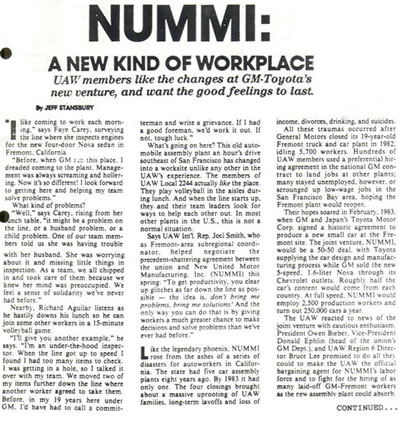
And look at this article from the summer of 1985. The significant thing about it is the publication it appeared in - "Solidarity."
Excuses, excuses
From the very beginning there were those who tried to explain NUMMI's success away with excuses. "Well, the plant had been closed and the workforce laid off, so of course they were motivated ..." "NUMMI developed an elaborate screening process that eliminated all the workers who caused problems. Only docile 'cooperative workers' were rehired".
But if being rehired after being laid off is enough for a successful change, successful transformations must be happening every day. And, realistically, it simply isn't true that the troublemakers were cut.
Others try to explain GM's initial failure to implement TPS as Toyota's failure to bring over the best and latest TPS technology. Toyota kept the best stuff - the secret sauce - behind locked doors".
Well, I was inside the rooms when the doors were locked. And I can assure you that nothing was hidden.
So, what is culture and how did we change it at NUMMI?
Once observers accept the idea that NUMMI was, without excuses, caveats or qualifiers, a successful transformation, the question arises: "OK, so how did you change the culture? What did you do that transformed such a problematic workforce into excellent workers?"
That's a great question.
It's one thing to say that the culture changed because we adopted TPS or changed the managers or the management system, but it's another to define exactly what really changed the culture.
The person who put the concept of "corporate culture" on our collective radar screen was Professor Edgar Schein of MIT. And, interestingly, there is no one more skeptical than Schein about claims of easy "wholesale" changes to corporate cultures. Although Schein teaches that culture is enormously important, he also argues that you don't change culture by trying to change it directly.
For a long time I have been using a pyramid that I later discovered is almost the same as Schein's model. Trying to capture what I learned about how the culture was changed at NUMMI, I developed this simple model:
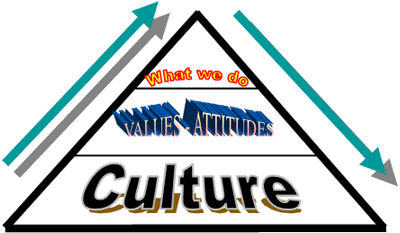
The typical Western approach to organizational change is to start at the bottom, changing the culture by trying to get everyone to think the right way, so that their values and attitudes will change and they will naturally start doing the right things. This was represented by the arrow on the left side, going from bottom to top.
What I learned was more powerful at NUMMI was to start with behaviors, with what we do. Define the things we want to do, the ways we want to behave and want each of us to behave, provide training, and then do whatever is necessary to reinforce those behaviors. The culture will change as a consequence. That's the arrow on the right side, going from top to bottom.
This is what it means: "It's easier to act your way to a new way of thinking than to think your way to a new way of acting".
José Ferro, of Lean Institute Brasil, studied with Schein as a graduate student at MIT and, seeing my pyramid, said it was slightly wrong. The whole pyramid is the culture; the base represents its basic assumptions about how the world works. That made sense to me. It was only then that I learned these ideas had been fully articulated by Shein a long time ago. (That was just one of the many times I thought I had a brilliant idea only to discover that someone smarter had thought of it a long time ago.)
So Schein's pyramid would look like this:
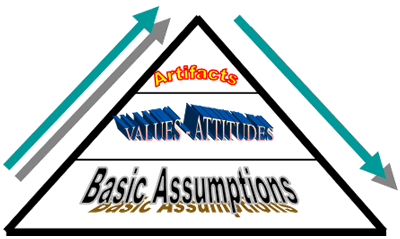
Schein himself describes culture as "The pattern of basic assumptions that a given group has invented, discovered or developed in learning to cope with its problems of external adaptation and internal integration, and that has worked well enough to be considered valid and, therefore, to be taught to new members as the correct way to perceive, think and feel in relation to those problems".
Perhaps this definition from the Chambers dictionary is easier: "Culture: the state of being cultivated".
So the question now becomes: how did we change the culture at NUMMI by changing behavior?
The best example of how the culture was changed at NUMMI - there are others - is the famous andon stop-the-line system on the assembly line. (In an upcoming column I'll describe in detail how my team leader helped me whenever I had trouble completing my standardized work on the assembly line at Toyota's Takaoka Plant in Japan.) All the GM and NUMMI people who trained in Japan experienced learning and working with the stop-the-line system (or some variation of it). One of the decisions to be made in setting up production at the joint venture was whether or not to install the stop-the-line system. For Toyota, of course, this was not a decision - it was a given. The andon system exemplifies Toyota's focus, belief, investment and commitment to developing means of supporting employees to work in harmony with equipment and processes in order to build in quality.
The history of Toyota's andon goes back to the days of the group's founder, Sakichi Toyoda. Mainly through ideas of reengineering, he identified some textile companies in the United Kingdom and the United States, and developed an automatic loom that stopped whenever a thread broke. In addition, he developed an automatic shuttle-changing device that not only changed the shuttle dynamically (without stopping the loom, the most exceptional innovation in his loom - the other parts existed in one form or another in other looms), it had a simple sensor that detected when the thread was about to run out, and then changed the shuttle before it ran out.
In addition, he designed a simple andon device that popped up to notify the worker whenever a loom stopped for any reason. The combination of innovations allowed a single worker to monitor several dozen looms, resulting in an enormous increase in productivity AND quality. And, critically, it established a way for people and machines to work together in a kind of "harmony", with the machines doing what they did best, supporting people in doing what they did best (thinking) while building in quality at the source.
To this day, the principle and practice embodied in Sakichi's old loom represent one of the pillars of the Toyota way of working. (andon and stop-the-line are elements of one of the two pillars of the Toyota Production System - jidoka. For more information on jidoka (and there is much more), see Chapter 3 of Kaizen Express.
A basic principle of Respect for People is the conviction that every employee has the right to succeed every time they do their work. Part of doing their work is identifying problems and making improvements. If we, as management, want people to succeed, to identify problems, and to make improvements, we have an obligation to provide the means to do so.
But some of our GM colleagues questioned the wisdom of trying to install andon at NUMMI. "You intend to give these workers the right to stop the line?", they asked. Toyota's answer: "No, we intend to give them the obligation to stop it whenever they identify a problem".
With standardized work, every worker on the assembly line knows precisely what his job is. He is given the knowledge and skills to know when he has encountered a problem (an abnormality that prevents him from successfully completing his standardized work), to know what to do when he encounters such a problem, and he knows exactly what will happen when he calls for help. His team leader will show up to offer help within his work cycle.
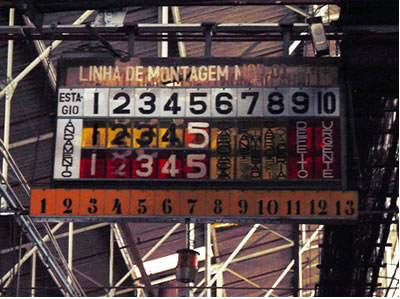
An old andon board from the assembly plant (of Toyota do Brasil). Each number represents an area along the assembly line. When a worker pulls a cord located directly overhead, the appropriate number lights up, signaling to the team leader that one of his workers had encountered a problem. Note: the line didn't actually stop immediately; only after it had reached a certain point (called the “fixed position”) would the line stop, and only after the Team Leader had decided to let it stop.
This translates into a promise from management to the workforce: "Whenever you have a problem completing your standardized work, your team leader will come and help you within your work cycle". That's a big promise for a workforce of a few thousand workers whose work cycle is something like one minute. But Toyota has learned that this is necessary to enable workers to build in quality and to be engaged in problem solving and making improvements.
How the NUMMI Way was different from the Old Way
This is what changed NUMMI's culture. Given the opportunity - and the challenge - to build in quality, NUMMI's new-old workforce couldn't have been more excited about the opportunity to show that they could build quality as well as any workforce in the world. Quality, support, accountability - these aspects were built into the design of every job.
Compare that with my first experience observing work on a Big Three assembly line.
In early 1995, at an assembly plant on the outskirts of Detroit, I watched a worker make a big mistake. A regular automated process was down for the day, so the worker was getting by with a workaround. And with the workaround, he managed to put the wrong part on a car. He quickly realized the mistake, but by then the vehicle had already moved on, out of his workstation. Then I saw something extraordinary.
There was nothing the worker could easily do to correct his mistake! Delete the word "easily" from the situation. There was NOTHING he could do. Unlike the NUMMI/Toyota process of making it: (1) hard to make a mistake to begin with, and easy to do the work correctly, (2) easy to identify a problem, to see when the mistake or other problem occurs, (3) easy, and part of the normal course of doing the work, to notify his supervisor about the mistake/problem, and (4) comfortable with the knowledge of what will happen next, which is that the supervisor will quickly determine what to do about the situation.
But for the Big Three assembly line worker there was, in practical terms, NOTHING he could do about the mistake he had just made. No cord to pull. No team leader nearby to call. A red button was located about 30 steps away. He could walk over and push the button, but that would immediately shut down the entire line. He would then indeed have a supervisor showing up to "help" him. But he probably wouldn't like the "help" he would get.
So he did nothing. To this day, no one knows what happened there except that worker and me. (A good alternative would have been simply to put a tag on the vehicle with the problem, so it could be fixed later. That alternative was not available to him, or he didn't know about it, or he chose not to use it.) But the contrast with the NUMMI/Toyota process couldn't have been more dramatic.
So what changed the culture at NUMMI wasn't abstract notions of "employee involvement" or a "learning organization", or even "culture". What changed the culture was giving employees the means by which they could do their jobs successfully. By clearly communicating what their jobs were and providing the training and tools to enable them to perform them successfully. The challenge of building in quality, combined with providing the enablers to do it successfully, transformed NUMMI's new-old workforce from the worst into the best. The transformed workforce couldn't wait to show the world that it could build quality as well as anyone.
The andon stop-the-line process is just one example, but it's a good one for two reasons. First, it relates directly to how people do their work RIGHT NOW. For each of us, every day, every moment of work comes up in front of us. How are we prepared to respond? The andon system is not just a set of manuals and training principles - it is how the work is done.
Second, in practical terms, the most important and difficult "cultural change" that needs to happen in a lean transformation revolves around the broad concept of problems. What is our attitude toward them? How do we think about them? What do we do when we identify them? What do we do when someone identifies and exposes a problem? The andon process (and the whole foundation of jidoka) is about building quality by exposing problems. Sometimes those problems are of our own making. They can be a very personal and threatening matter.
No problem is a problem
Every person in a supervisory role, including team leaders, visited Toyota City for two or more weeks of training at the Takaoka plant. The training included long hours of lectures but, more importantly, hands-on on-the-job training in which they worked together with their counterparts to learn what their job would be when they returned to California. At the end of each training tour, we asked the trainees what, of everything they had seen at Toyota, they would most like to take back with them to Fremont. Their answer was invariably the same: "The ability to focus on problem solving without accusations and without trying to pin the blame on someone. Here it's the 'five whys'. Back home, we're used to the 'five whos'". Call attention to the problem to solve it, or to the behavior to change it, but not to the individual for simply being "wrong". (That doesn't mean the Takaoka trainers weren't tough on problems. They were. And if problems recur or the same individual repeats the same mistake, individuals will be reprimanded vehemently and clearly.)
"Problems" were indeed viewed in a completely different way. Americans like to answer "no problem" (or "no problems") when asked how things are going. A phrase known and enthusiastically used by every former NUMMI member was the Japanese word for "no problem", which, spoken with a typical American accent, sounded a lot like "Monday night" ("mondai nai"). So, when the Japanese trainers tried to ask how certain problems were being dealt with, you could hear NUMMI's American employees cheerfully shouting "Monday night!". The Japanese response to that was, "No problem is a problem". There are always problems, or issues that need some kind of "countermeasure", or better ways of doing a given task. And seeing those problems is the crux of the manager's job.
The first instance I know of a Toyota manager uttering the now-famous quote "No problem is a problem!" was Mr. Uchikawa (whom I also mentioned last week). As general manager of Production Control—arguably the single area of greatest operational expertise at Toyota - Mr. Uchikawa had a team of six very smart mid-level GM managers working for him. Being young and very smart GM managers, they had a ready answer whenever Mr. Uchikawa asked them to report on how things were going - "No problem". The last thing they wanted was their boss poking his nose into their problems. Finally, Mr. Uchikawa exploded, "No problem is a problem! Managers' job is to see problems!"
The famous tools of the Toyota Production System are all designed around making it easier to identify problems, easier to solve problems, and easier to learn from mistakes. Making it easier to learn from mistakes means changing our attitude toward them. THAT is the lean cultural change.
But questions remain
But there are in fact some unanswered questions that persist despite NUMMI's success. Questions about how a company, your company, can actually do this.
NUMMI was an undertaking that mixed old and brand-new facilities. It occupied old buildings with an old workforce, but NUMMI was truly renewed, with a new name (the name "NUMMI", for New United Motor Manufacturing, Inc., was meant to sound charmingly like "New Me"), bosses, operating system and character. But what happens when you walk into an ongoing operation that has its own ways of doing things, ingrained traditions, and perhaps an unstable or even chaotic environment?
Training - anyone who supervised anyone at startup began their NUMMI career with an experience in Toyota City, following a mentor, seeing firsthand how Toyota does it, absorbing the culture and learning their job, their role. In the early years, about 600 NUMMI individuals - anyone who supervised anyone - visited Japan for at least two weeks of intensive training.
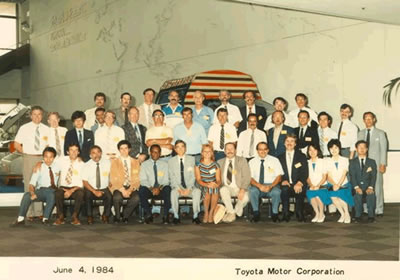
This photo is of the first group of production supervisors (Group and Team Leaders) who visited Toyota in Japan for two weeks of intensive training in June 1984.
This was combined with some 400 three-month tours by Toyota trainers from Japan who would work side by side with their counterparts at NUMMI. It was an enormous investment that few thought they could afford. Is it possible to succeed without THAT kind of huge investment? And what if you didn't have (as NUMMI did) access to a plant that was a model of lean production to learn from?
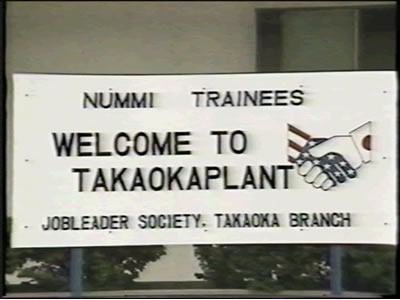
Toyota's Team Leaders informally organized themselves into something they called the Work Leaders' Society (Hanchokai). The arrival of the NUMMI trainees was a major cultural event for the Takaoka Plant workforce (and, ultimately, for all of Toyota), just as it was for the NUMMI people.
Product and process - all the physical side. The truth is that there was a huge difference between assembling an Olds Ciera and a Corolla. Compared with the products the plant's workers were used to, the Chevy Nova practically assembled itself. Add the processes, layouts and work routines designed by Toyota, and a dramatic improvement in performance was practically assured.
Management. I have always pointed out, as I did above, that NUMMI's workforce was the same workforce that had been there before. That's true. What I sometimes don't have time to add is that, yes, the workers were the same, but the managers ... all the managers were new. They may have come from GM, from Toyota or been hired from outside, but they were new to NUMMI.
And it is the management process that really makes all this carefully designed product and process design work well.
The management question
If we look at GM's constant struggles and some of Toyota's more recent struggles, we have to acknowledge that there are many questions about management that remain unanswered.
I left Toyota in 1994. At that time, GM still hadn't learned how to build a small car profitably. Nor had it "learned" the Toyota Production System. Many GM individuals learned TPS very well, but GM as an institution still didn't know what to do with it. It took until the late 1990s for them to start making progress.
The first GM people who returned were quickly swallowed up by the GM system. The company knew they needed to be put together, as a group, to have an impact, but they were usually scattered throughout the organization. But GM kept sending people and they kept learning. By the late 1980s, NUMMI graduates had created a GM version of the Toyota system - they called it Synchronous Production - and were training people on a large scale. In the 1990s, GM decided to get serious about it and put the whole system into operation. Making that decision was very difficult in the U.S. They first went to Europe, then to Latin America and, after they felt they really knew what they were doing, finally implemented the system in the U.S. Today GM has plants that are arguably very similar to Toyota's in terms of quality and productivity. World class.
Looking back, it took GM about 20 years to make serious visible progress in its lean learning (that's just my opinion - my GM friends may disagree with this assessment, but the company certainly took at least 10 to 15 years). Perhaps that's the time frame required. Much of the progress was made possible by the sheer loss of customers to competitors and by critical mass. As more and more people learned at NUMMI while more and more old-time employees retired, the situation eventually changed. A tipping point.
There are still serious questions about GM's success in fully absorbing all of NUMMI's lessons. The first concerns people and management. Are people committed, at every level, to exposing problems and making improvements? Are managers committed to developing their subordinates and encouraging their ideas? Are GM's new world-class plants continuing to improve and adapt, or are they just operating according to their beautiful new design? There is no steady state, so things are either getting better or getting worse. Which is the case? The way GM embraces the human side of lean thinking is the key to how these questions will be answered.
The second revolves around another aspect of management's role: defining and crafting a vision or sense of purpose that can guide the organization over the longer term.
Deming called this constancy of purpose. Its opposite, the destroyer of all change efforts, is the POM, the program of the month. Can there be any doubt that keeping both eyes on Wall Street's 90-day evaluations - 90-day evaluations for an industry that operates at a pace closer to four years - is one reason for Detroit's decline? And it is no coincidence that most Detroit CEOs - and almost ALL of GM's - have been finance people. You can't run a global automobile company based on short-term Return on Investment calculations. I have great hope for the future of the New GM, but I must say it was a disappointment that every person Obama appointed to the Auto Industry Task Force was a finance person who knows nothing about the auto industry. And now GM's new chairman is a telephone guy? His first remarks, as reported in the press, could have been lifted verbatim from Roger Smith's playbook of the early 1980s. He has seen the problem: GM needs "solid product line managers". Good luck, New GM.
Purpose, Process, People
In a past column, "Survive to make money or make money to survive?" I used LEI's Purpose, Process, People framework to examine GM's learning from NUMMI. Contrary to popular opinion, GM learned A LOT from NUMMI/Toyota about process, with a much greater level of success than most observers realize. Its plants now have world-class quality and productivity. But I would suggest that GM never went far enough on the people part. Remember the scene last year in Washington of the UAW chairman sitting side by side with the CEOs of Detroit's Big Three? Too bad they hadn't tried working together as they did many, many years ago.
Perhaps even more important, could it be that GM's sense of its own purpose was completely different from Toyota's? The question "What are we doing here?" is an important one for an organization, and one that receives notoriously inadequate attention. I suggest that the difference in purpose between GM and Toyota can be summed up simply: Are we here to survive to make money or to make money to survive?
Both Toyota and GM want to make money. Of course. And both want to survive. But the difference between a corporate purpose of surviving to make money versus making money to survive is one that makes a big difference. And, if learning is the essential element in judging NUMMI's impact, it may just be that purpose is not something you simply learn.