Andon squares – 5S in the office
Many years ago I hired an accountant to head the debt collection department of the company I was running. On paper, she had all the skills and all the experience needed for the role, and she presented herself well in the interview.
When she settled into her new position, I was very impressed with her organization. Her desk was always clean and tidy, and she was punctual, pleasant and helpful (I must confess that I often wished the person in charge of creditors were as neat and organized).
At the beginning of the third month, I began to notice that we were not collecting debts as we had before. I had a meeting with her to discuss the matter, and the excuses she gave seemed reasonable. As time went by, I came to realize that we had a problem. Shortly before one of our meetings, a letter of resignation landed on my desk. She left the company the next day.
With her abrupt departure, as we tried to bring her work up to date, we had an unpleasant surprise. We realized that she had not filed anything or responded to requests for three months. She had simply been placing all the paperwork very neatly in the bottom drawer of her desk. What a clean and tidy desk, we thought! It took a lot of time and a lot of effort to get everything sorted out again.
Now, when I walk through an organization and see that everything is clean and tidy, I wonder whether it is real or just an illusion of efficiency. Without seeing the drawers and storage areas, it is impossible to tell.
During our lean transformation, a similar problem arose with the use of those plastic trays where we put documents. Team members were hiding their problems in these trays – not with the intention of hiding them and never solving them, but with the intention of dealing with them later, when they had time. We all know how much the procrastination monster loves this kind of thinking and how it always makes us dig an ever deeper hole.
When looking at work being done in a factory, on a vehicle or on any other physical item, it is relatively easy to see and observe the work. Paperwork, however, is much more challenging, because it is easy to pack a large amount of work into a tray without anyone noticing.
Invoices, inquiries, quote requests and remittance advice documentation can be left in a neat pile until someone needs the document, which usually triggers a great deal of searching for it.
During the lean transformation of the administration department of our service center, we had to make the work visible so we could see how we were doing. Otherwise, it would have been impossible to develop flow or identify bottlenecks.
The very design of these trays encourages the accumulation of work: they contain organized spaces that create the illusion of efficiency. To get out of this, we had to work on something a little less comfortable.
To understand the process, I talked to a service advisor who had great difficulty keeping his paperwork under control. I went through the paperwork with him at his desk. As I asked questions, I recognized that there were only two answers for the documentation on his desk. For some documents, nothing prevented him from completing the task; for others, a senior supervisor would need to help with information or approval.
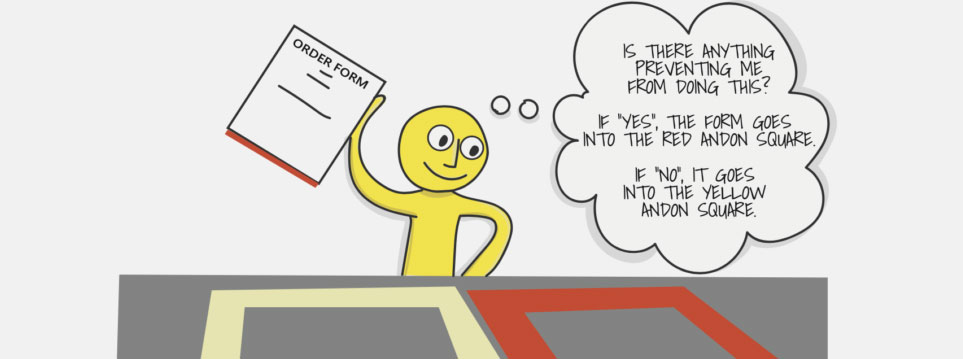
We cleared all the work off his desk, removed the trays and marked two squares on his desk using adhesive tape – one red and one yellow. Yellow represented “nothing is preventing this work from being done,” while red signaled an “obstacle to completing the work.” Yes, I could have used trays instead of a square of tape stuck on the desk, but I wanted to make the space uncomfortable and make it easy to see when there was a pile of papers.
The red andon signaled to the supervisor that this was a problem requiring assistance: they had to help the service advisor move the paperwork from the red square to the yellow one so he could complete the task.
Next, we did this throughout the office, with two squares for each desk, and all filing was done centrally and visually so that everyone could access it and understand the progress of the work.
It became the service advisor’s job to sort the documents into the two squares. It became the supervisor’s job (a task we now call andon response) to constantly check the red squares and help the service advisor move from red to yellow.
Initially, the supervisors were not very happy with the changes, because this put pressure on them to work on the red squares, and these were overflowing. After dealing with the initial backlog of problems, however, they realized that:
- They could tell when their service advisors were struggling to keep up or when they were overloaded with work that day.
- They had fewer confrontations with dissatisfied customers.
- Problems were solved before they became emergencies.
- It was easier to locate documents.
- They had better days at work than they used to have before.
And the service advisors began to understand that:
- They had more time to serve the customer.
- It was easier to concentrate on the work to be done.
- They made fewer mistakes.
- They went home without needing to work overtime and with all of the day’s work done, which gave them peace of mind.
- They, too, had better days at work than they used to have before.
During the first three months of implementation, I spent a lot of time on site. I was constantly observing how the squares were doing, especially those belonging to the service advisors, to see how we could help them in their work and with the problems that constantly landed on their desks.
It was not only the service center that benefited from this change. As a leader, whenever I walked through there, I could see how their day was progressing and what was causing problems.
We often think that 5S is only applicable to factories and workshops, but this is an example of using 5S in an office, applied to administrative work. Having 5S in this place created a visual management tool that allowed us to see much more than “the clean and the tidy”: it allowed us to see the work and how it was progressing.
5S supported us in developing the flow of documentation within the service center, speeding up the time it took to return the vehicle to the customer and helping us live up to our motto: fix it right, the first time and on time.
Developing flow took time and effort, but – looking back – it is clear to me that it would not have been achieved without the andon squares.