
Designing the best possible process
On many occasions during our work supporting organizations in their lean efforts, we face the challenge of having to visually represent processes that we cannot observe in action – for example, because they represent a future state that does not yet exist. In such circumstances, without the guidance of the gemba, it can be difficult to understand how to carry out a process.
Situations in which we may encounter this problem include:
- Unstructured or poorly defined processes, in which each person who contributes to the process does the work differently. This is particularly common in administrative environments, where we see the execution of the process being personalized and adapted to the skill set or requirements of the process owners. In this case, the results tend to be more important than the process itself.
- Processes needed to introduce a new product or service (perhaps coming from another part of the business) or for diversification purposes. The processes may exist, but not in the context of our business, as in the example of an organization introducing into a plant a product that was previously produced at another location.
- Product or process development activities and project management in general, in which the uniqueness of each process (they are linked to innovation and creativity) makes them difficult to define.
- Complete restructuring of processes.
I remember finding myself in one of these situations when I took part in a process mapping exercise for customer complaint management at a company that designed and produced components for other manufacturers. The complexity of the system, due to several departments working in a disconnected way and the use of different IT platforms (CRM, MRP, production planning, quality control and so on), led to a complicated process that was difficult to monitor and, in the customer’s eyes, excessively slow. “Tweaking” the process so that it better met the customer’s needs seemed impossible, and the team decided to redesign it completely, keeping the customer’s requirements as the main focus – instead of focusing on the available resources and the company’s modus operandi. As a result, there was a 35% reduction in the activities required to execute the process and a 70% reduction in lead time (we also received a few phone calls from worried customers asking whether something “strange” was happening in the business).
This situation is so common that it is worth identifying a structured way of dealing with it. I am not claiming that the approach I will describe in this article is the best one for tackling this problem, but I must admit that every time I have used it, I have seen positive results both for the process itself and for the learning of those involved.
Of course, as lean thinking teaches us, any problem-solving initiative needs to start with defining the value expected or required by the customer (and, indeed, identifying the customers themselves) and then with the sequence of activities that enable that value to be created. We then need to find a way to establish continuous flow and customer pull, thus entering a cycle of continuous improvement that pursues process excellence. This is what Dan Jones and Jim Womack wrote in "Lean Thinking". Within Total Quality Control (TQC), there is a tool that connects all these aspects, known as SIPOC.
SIPOC makes it possible to define and study a process by identifying the key elements needed to execute it. It stands for “Supplier (Supplier) – Input (Input) – Process (Process) – Output (Output) – Customer (Customer)”.
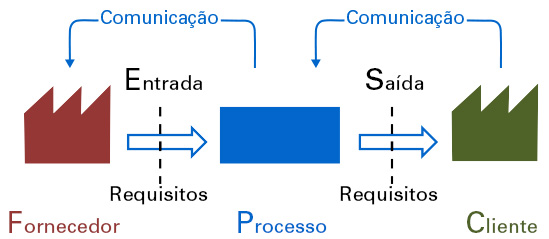
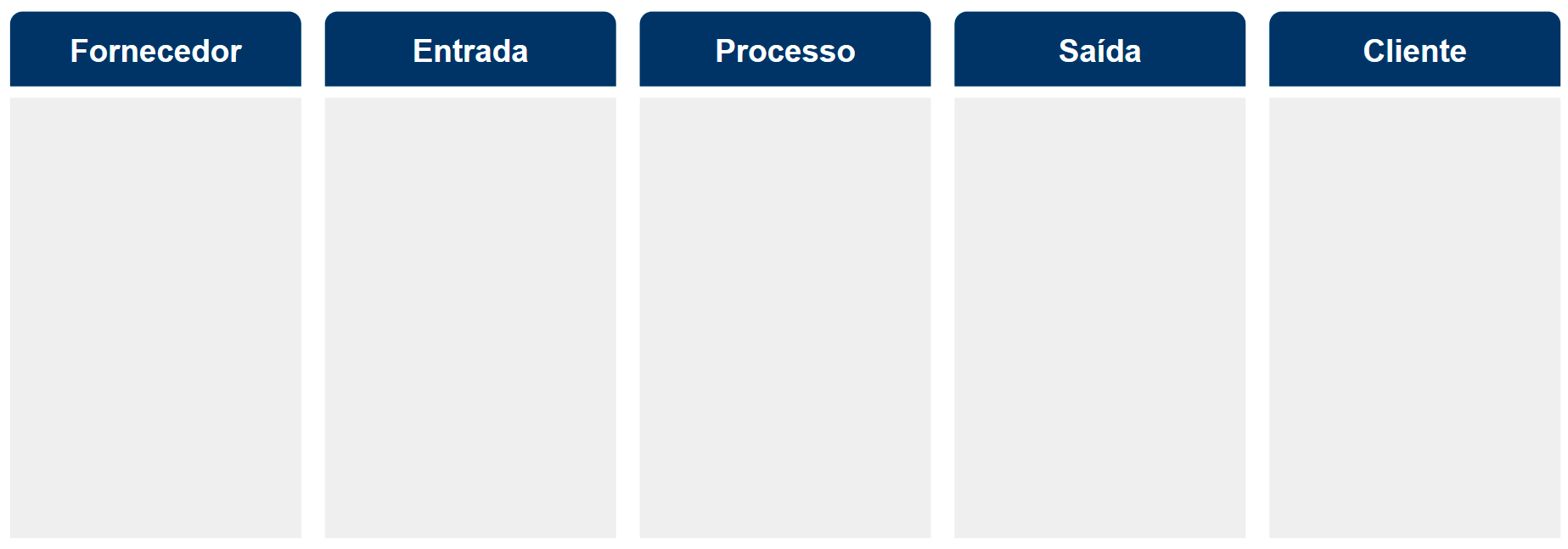
This tool, which is most commonly used in the world of Six Sigma and in project management, is simple but very powerful. It starts by defining the beginning and the end of the process. Then we can draw five columns – one for each of the tool’s five elements – on a sheet of paper.
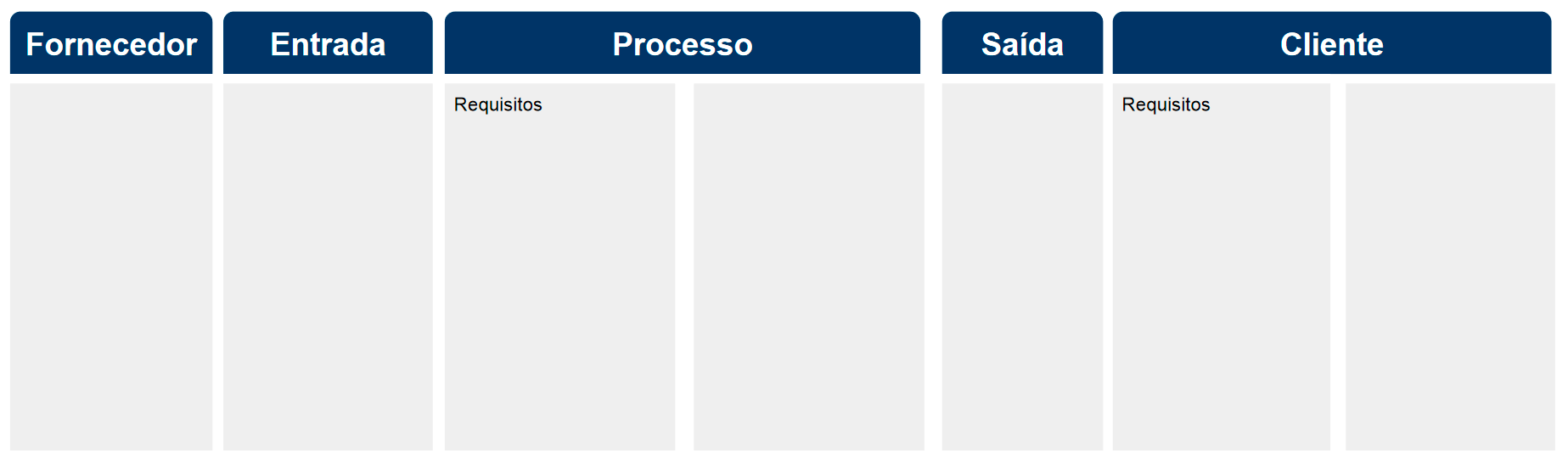
In a different version of the tool, two extra columns are included, covering the specific requirements of the inputs needed to execute the process and of the outputs needed to satisfy the customer. This will help us define the process even more clearly.
Finally, we fill in the columns, indicating the relationships between the different elements of the table. In the traditional approach, POCIS is the order followed:
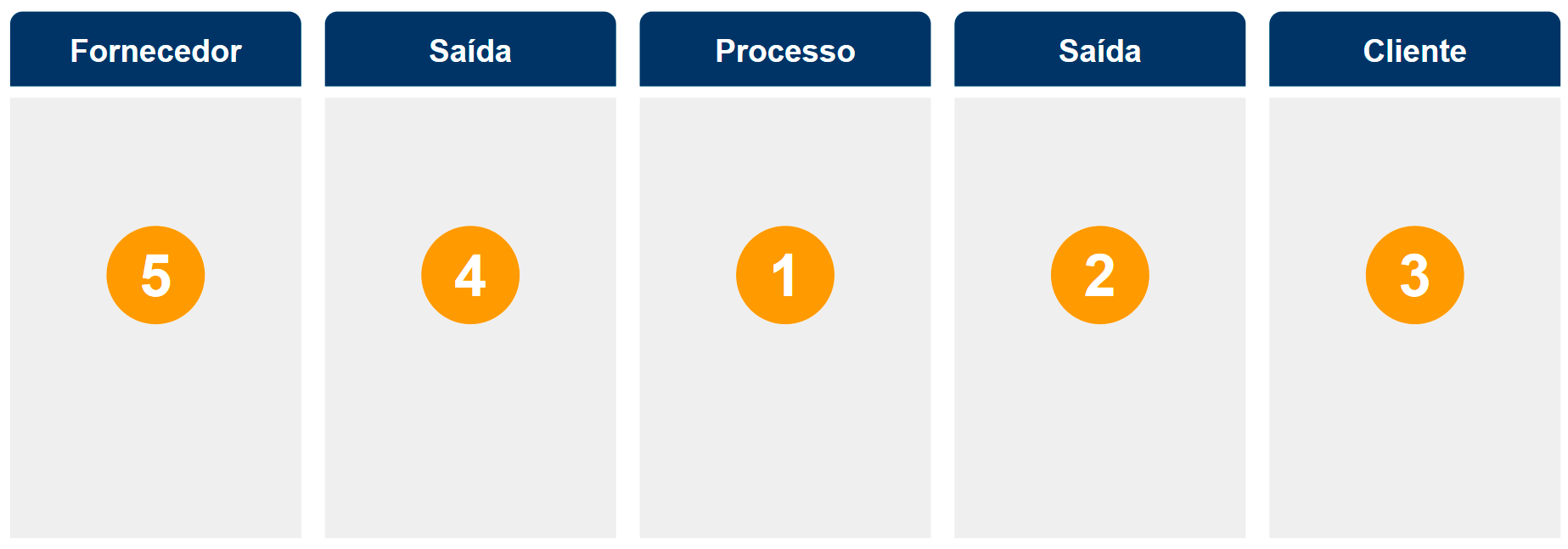
In fact, a variant of the tool is becoming increasingly popular, which changes the order of execution and corresponds to the acronym COPIS. This is a way of emphasizing the importance of the customer in defining the process.
So we start by identifying the customers of the process – and this includes the users, the buyer and the internal customer. In certain cases, we even need to reflect the needs of customers such as the public administration or even society as a whole (for example, for dangerous, unhealthy or potentially harmful activities that may have a social impact). If we can identify all the customers we need to serve, it will be much easier to understand what their expectations are.
Different customers may expect different things from the process. For example, for a product such as a sandwich, the user will focus on things like food safety, quality and price, while the process owner (the seller, in this case) will look at margins, selling prices and the ability to win a large market share. A good characterization of the process must take both types of customer into account to ensure that we can remain their favorite supplier. Therefore, we need to specify the results required by these customers – the value they expect. We have to translate them into measurable aspects and clear objectives to ensure that the execution of the process responds to the right parameters.
To effectively define value for the customer, we have numerous tools at our disposal, such as VOC (Voice of the Customer – in English, Voice of the Customer), surveys, market research reports and, in many cases, a rigorous analysis of customer complaints and of the sales funnel. When including a value item, it is important to connect it to the customer it is intended for and to what that customer expects from it. This way, we will have more control over the system and will be able to check whether the requirements are being met (do not forget that we are living in an environment of great volatility, uncertainty, complexity and ambiguity – VUCA –, in which customer requirements change all the time).
Now it is time to define the process. To do this, we start with the final product and identify, one by one, each of the activities needed to achieve what is proposed in the “Output” column. At this point, it is a good idea not to be too detailed in defining the activities, to avoid complicating their visual representation and limiting the effectiveness of this tool. In any case, we begin to connect the activities to one another, in sequence, until we can guarantee that all the outputs identified in the SIPOC are delivered.
Here, it is worth bearing in mind what we will find (this chart refers to a simplified process, of course):

The interconnection of activities creates a scenario in which a given activity (say, P3) is simultaneously part of the process (one of the steps it consists of), the customer (of activity P2, with the specific requirements I3, which, in turn, are part of O2) and the supplier of activity P4. It is very common for intermediate outputs to appear, required by internal customers (the next step in the process), without having been identified in the preliminary study of the customers of the overall process. In the SIPOC, this situation will translate into outputs appearing in certain activities that will become inputs to the following steps. That is exactly why I recommend carrying out this process step by step, from the end to the beginning of the process, using sticky notes on a piece of brown paper hung on the wall to allow the result to be updated easily.
At this stage, for each activity included in the process, it is necessary to identify the specific requirements to ensure that the operational result defined by the inputs is achieved (or at least to minimize the risk of variation in the results).
Finally, for each input coming from outside the system (one that is not the output of a previous step), we need to identify the best supplier that can provide it under the conditions defined in the requirements.
The following image shows a simplified example of the SIPOC exercise for preparing coffee for a family’s breakfast using a drip coffee maker.
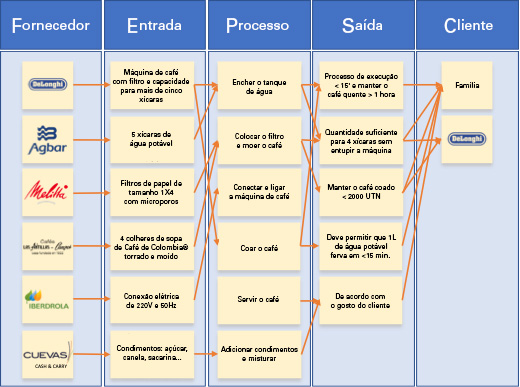
It is worth pointing out that the very mechanics of running this tool facilitate teamwork and everyone’s participation, since people are invited to place Post-its on a board and discuss as the table is filled in.
The processes we usually work with in real life, however, are much more complicated than those described so far. One of the biggest difficulties they present is identifying the sequence of activities. There is not just one that leads to the desired result, so which one should we use? How do we know we have chosen the right path? To answer these questions, we can rely on another popular project management tool: the precedence diagram. This graphical tool makes it possible to represent all the possible ways of completing a process based on different possible sequences.
For example, let us imagine a very simple process that we all know intimately – waking up in the morning and getting ready for work. This process begins when the alarm goes off and ends when we leave the house, with the goal of getting ready and arriving on time. These are the activities we need to carry out:
- A: Wake up
- B: Make breakfast
- C: Eat breakfast
- D: Tidy the kitchen
- E: Take a shower
- F: Dry your hair
- G: Go to the bathroom
- H: Brush your teeth
- I: Check the traffic report
- J: Get dressed
- K: Grab the backpack and car keys
- L: Put on shoes and a jacket
- M: Make the bed
- N: Leave the house
This sequence is not the only possible one, nor necessarily the best for all of us. The precedence diagram visualizes the interdependencies between activities to tell us which ones need to be done first. We need to make breakfast before eating it!
We can classify the dependencies as:
- Mandatory – they are inherent to the nature of the activity, and we cannot change them.
- Discretionary – without any obligations, they respond to a preferred sequence arising from different situational criteria.
- External – they derive from external determinants on which we do not usually act, such as the availability of a certain type of resource.
I recommend starting with the mandatory ones, since the others may depend on unfounded decisions (“I’ve always done it this way!”) and cannot be put into practice without in-depth knowledge of the process. This gives us the following diagram:
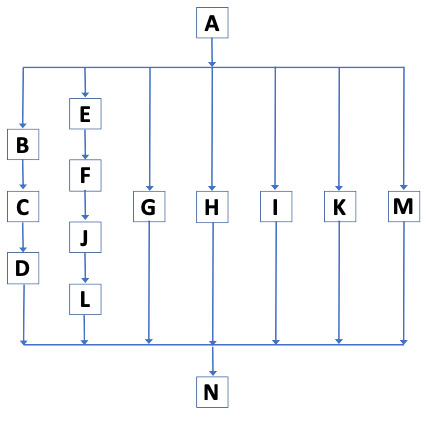
What the diagram shows is that the process always has to start with “wake up”. From that moment on, we have options: we can “make breakfast”, “take a shower”, “go to the bathroom”, “brush our teeth”, “check the traffic report” or “make the bed”, but we cannot “eat breakfast”, because we need to make it first. And so it goes on. Using the diagram, we can obtain the different possible sequences of activities based on what we want to achieve. For example, I will only grab my backpack and car keys as the second-to-last activity before leaving the house, because if I do it at any other time it will be harder to carry out the other steps.
Therefore, to limit the amount of unnecessary movement, when we go into the bathroom, we should complete all the tasks that can be done there. Likewise, I can avoid idle time if I make the bed while the coffee maker brews the coffee. In both cases, we would be acting on the lead time and the cost of the process. With a precedence diagram, we can control how we carry out a process and adapt to changing circumstances easily and quickly.
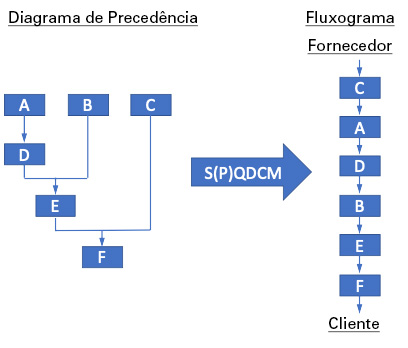
Once we have defined the sequence of tasks we need to obtain the desired result, we can translate it into our value stream map to continue with our analysis and improvement of the overall process – the only condition is that, without access to a gemba, all the data related to operations and work in progress need to come from an estimate (but that is another story).
By combining SIPOC with precedence diagrams and value analysis, we will be able to design a process that we can improve and get the most out of, while developing knowledge about the work in order to consistently deliver maximum value to customers with minimum use of resources.