The challenges of taking lean to suppliers: the Bosch experience
Companies that set out to bring Lean Manufacturing concepts into their business face, after the first results achieved internally, the challenge of extending the same management principles to their suppliers.
The opportunities identified when mapping a given value stream clearly show the importance of adding value all the way from the supplier to the end customer. Suppliers' lack of alignment with Lean principles significantly reduces the potential gain for the stream, in addition to causing turbulence that contaminates internal manufacturing.
In order to report Bosch's experience in taking Lean to other links of the production chain, we present below a summary of the work carried out over the last 4 years with about 30 suppliers taking part in the FFGA Program (“Fit For Global Approach”), whose basic principle is to bring lean concepts to them.
Our experience allows us to clearly separate three groups of companies in the sample taking part in the program, which we characterize in figure 1 below:
Characteristic |
Group 1 |
Group 2 |
Group 3 |
Support areas |
Defined and technically capable |
Few managers accumulate functions |
Accumulation of functions and undefined positions |
Human Resources |
Structured, with a focus on developing managers |
Loosely structured, focus on technical training. |
Back Office functions, focus on technical training. |
Management |
Established corporate governance process |
Concentrated mostly in the hands of the company owner |
Purely family-run and conflict-ridden |
Strategy |
Medium and long term, shared with the organization. |
Short and medium term, not shared. |
Short term, focus on “firefighting”. |
Command Style |
Y |
X |
X |
Controllership |
The function exists and manages results, supporting operations. |
Acts more as an auditor than as a generator of data for business improvement. |
Purely conventional accounting |
Figure 1. Typology of the companies taking part in FFGA.
All these companies share the common characteristic of being family businesses struggling to survive and resisting a genuine process of cultural change. To a large extent, they go bankrupt because of family conflicts rather than economic problems; few survive from the first generation to the second, and even fewer from the second to the third*.
How do companies embrace lean concepts through help received from a customer?
When we offered suppliers 2 years of consulting and about 380 hours of training, we expected immediate acceptance on their part. However, the decision-making process about participating did not happen that way. We recognized 3 different points of view:
1. the supplier genuinely recognizes a great opportunity for growth and gain for its business.
2. the supplier adopts a defensive position along the lines of “let's see what Bosch is after”
3. the supplier positions itself so as to “please” or, better put, “not displease” the customer.
In general, in all three cases, there is an understandable initial distrust, which has only been eliminated as the program progresses and through the FFGA team's position of ethics above all. What is observed inside the suppliers is not brought back into Bosch, thus preventing anything from being used against them, for example, in commercial negotiations. In other words, we work with Bosch's purchasing area and not for it.
Participants are chosen by Bosch's business areas, in agreement with the Purchasing Board, a decision reinforced by a prior visit from the program manager in order to assess the supplier's willingness to participate.
The methodology used in the program is based on an experience similar to Toyota's, which holds that the gains to be shared in financial terms must result from improvements implemented through the elimination of waste, with the customer's support. The rules must be clear to both sides so as to avoid unnecessary conflicts.
How does the work unfold in each type of company group?
Given the scenario presented, and because we believe that the process of cultural change is slow (as Bosch's own internal experience with lean shows), the program lasts two years and has a workload of about 400 hours. There are seven modules with a logical implementation sequence, all aimed at underpinning the concepts of lean thinking. The table below gives an idea of the content:
Module |
Duration |
Lean Tools |
104h |
Preventive Quality Tools |
96h |
Lean Value Management |
28h |
Integrated Logistics |
16h |
Work Standardization |
60h |
Technology Support |
8h |
People and Business Management |
72h |
Total |
384h |
Figure 2. Topics and workload of the training sessions delivered.
As the figure shows, we concentrated a great deal of effort on training aimed at developing the company's managers (by manager we mean every employee who leads people). There are 70 hours devoted to this subject, and the program's first training session is aimed at owners, directors and managers. Over two days, with the support of an external consultancy, the discussion covers the process the company has committed to, the expectations and difficulties, and, most important of all, the attitude expected from this group to drive the process.
We cannot forget the complex aspects characteristic of family businesses, such as the close ties between the family, ownership and management of the business, the difficult management of family relationships alongside economic ones, and the desire of the founder and successors that ownership and management of the company remain within the family.
The training is applied in a standardized way to all companies, and only over the course of the activities can we detect each one's more specific needs. This detection is done during the training sessions and, more specifically, through the internal projects generated for each topic covered. For example, a quick setup project may meet immense resistance to increasing setup frequency, especially in stamping shops and plastic injection molding companies.
At this point, revisiting value stream mapping concepts, and showing that we can never lose sight of optimizing the flow as a whole, can reinforce a change in behavior, or at least an attitude of “let's try it”! So there is no standard recipe. The task is to do the same thing in a different way, seeking to respect the idiosyncrasies and culture of each company. The goal is not to confront this culture, but to use it to facilitate the process of changing the management philosophy. After all, we are not the owners of the business, and we have neither the right nor even the power to change a success story.
Once, at a seminar where I presented our program, I was surprised by a comment from a colleague at another company, who claimed not to believe in this kind of approach with suppliers. In his opinion, actions that interfere with the management culture are inadvisable. So I asked how we could make the supplier aware of the need for change if we do not help it learn to see the advantages of a process that is typically about changing the management culture.
Our experience of several years, as well as Toyota's, has shown and continues to show that growing by sharing knowledge with the supplier is the best path to survival in the future, if not the only one.
Lessons learned to leverage implementation
The 4 years of work begun in April 2003 have in fact been extremely rewarding in terms of mutual learning, because in addition to enriching the content of the FFGA program with ideas and suggestions from several suppliers, we have also gained greater maturity in finding faster and more consistent ways to convey and consolidate Lean concepts among the participants.
We started the program with 4 suppliers, which at the time were chosen solely with a view to improving their quality indicators, and over the following 3 years we broadened the selection criteria, also focusing on the potential to become a more significant supplier in terms of volume, mutual dependence, technical capability and improvement of the management process more broadly.
In one of our training sessions we reinforced our critical reflection on the Latin trait of firefighting with “creativity”, since we are experts at correction rather than prevention. In order to take advantage of the lessons learned and try to minimize the risks of a short-term view and a focus solely on correction, several changes were made to the program content, as follows:
- We increased the workload of the value stream mapping training, including two days to discuss lean manufacturing concepts, requiring those driving the program to read the book “Lean Thinking” before starting the activities. In this way, we show that lean production is much more than mapping or kanban. It is a change for the business!
- We increased the focus on the people management module. People are the ones who make things happen!
- We made the process of defining product families and the value stream mapping tool the basis for all our actions. In this way, we created a model flow and area for applying Lean tools.
- We developed an interesting simulation exercise that we use from the start of the program in order to discuss the concepts, advantages and disadvantages of pull and push production. To this exercise we added a kind of lean accounting to value the results and focus on the waste in both processes.
- We trained our team in project management, since we always have eight suppliers active in the program, with different projects running at the same time.
- We structured systematic follow-up visits for the projects at each supplier, with constant follow-through
- We emphasized more strongly the financial gains for the supplier's business as a whole
- In the goal deployment training, we help suppliers deploy their goals while planning for the application of lean thinking tools
- We made official the A3 Sheet used by Toyota for each open project, whether or not it brings gains in terms of money. Objective, current state, future state, timeline plan and indicators are the key to success!
- At the start of each year we open a macro A3 with each supplier, tying together the overall goals and objectives for the period.
With these actions, we have seen the effectiveness of our projects increase over time, and we have been reaping more positive results from the program's activities.
Results and Making the Process Last
The investment made by Bosch in supplier development has translated into consistent improvement in the indicators that assess their performance, as shown in figure 3.
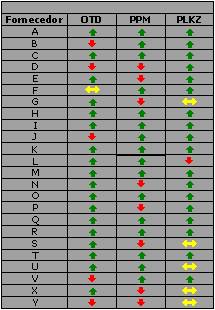
OTD – On Time Delivery; PPM – inside Bosch; PLKZ – Bosch Disturbances / 0 KM / Field
Figure 3. Main results of the FFGA program
(Quality and Delivery: comparison of start X current status)
The results in terms of cost reduction were shared with the suppliers, and there was a significant, lasting improvement in the delivery reliability and quality indicators of the products supplied, throughout our internal value-adding chain as well as with our customers.
The nine suppliers assessed so far by our purchasing headquarters in Germany have exceeded the minimum score to take part in international quotations. But, unfortunately, it is not all a bed of roses! We cannot claim that we are fully satisfied and that lean concepts have been effectively absorbed by the organization.
The implementation difficulties reported in this article have confirmed that a great deal of transparency, discipline and commitment from the organization is needed. At least 2 years are required just to take the concepts to all levels, but this is totally insufficient to make them last or, paraphrasing Toyota, to make them an integral part of the company's DNA. At the Lean Summit 2006, I asked James Womack how long, in his experience, could be considered ideal for reaching the DNA stage. The answer was “at least five years, with a lot of dedication and determination from the company's top manager”, which only reinforces the premise that lean implementation is a typically “top-down” process!
Going back to my comment about the reasons that lead a supplier to join Bosch's FFGA program, our initial expectations were not always confirmed. Suppliers that seemed extremely interested in the program improved their results and management system, but definitely did not incorporate lean concepts into their business, and will certainly lose in the future what they gained during the program.
Others, whose interest we underestimated at the beginning, surprised us with excellent results, extended the concepts to management as a whole, reaped excellent rewards, innovated and even started initiatives to take the concept one more link along the value-adding chain.
In fact, this “fever” to be able to say “my company is Lean”, “we think lean” and finally “we run our production based on our customer's takt” hides the enormous difficulties encountered in actually carrying out the process of cultural change in managing the business that lean demands.
Breaking dogmas and paradigms, obtaining the commitment and not just the involvement of managers, working as a team, moving from autocratic to more democratic management are just some of the difficulties faced by those who truly set out to carry out a Lean transformation in their companies, or to help the other links of the chain move in the same direction.
In short, “the penny still takes a long time to drop”, which in fact reflects some of the inertia we see in our country when it comes to investing in improving infrastructure, carrying out tax reform and other actions that could undoubtedly quickly take Brazil to another level of international competitiveness.
Our program aims to serve, by the end of 2008, 32 suppliers chosen by Bosch's business units, and the last group of four companies will begin participating in August 2007 for assessment in early 2009. Our expectation is that at least 30 to 40% of the total will make Lean their management tool, which, judging by the international track record, already seems to us a rather ambitious goal.
Finally, continuing to complain about Chinese competition or waiting for trade barriers to protect Brazilian companies will be an irreversible mistake!
What we need is to make things happen! Improving the management of their businesses, gaining competitiveness by eliminating waste, is the way.
Lean Manufacturing will certainly underpin this change of focus.
* Passos, Edio & Bernhoeft, Renato & Bernhoeft, Renata. Família, Família, Negócios à Parte. Editora Gente