Defining lean is useful, lean definitions are useless
Starting a conversation on Twitter or LinkedIn to discuss a possible definition of “lean” is like opening a beehive. Many in the lean community strongly defend well-established positions around the differences between lean, TPS and OpEx. This article does not intend to do that; it is, in fact, more of a personal journey of how my definition of “lean” has changed over 20 years of learning in the gemba.
My children are 18 and 16 years old, respectively, and they still have a hard time explaining what I do at work. That's my fault, not theirs. The most recent definition of lean I received came from my son over dinner:
“Is it about looking at a process and figuring out how to make it more efficient, make better use of materials and make it easier for the employees?”.
Not bad considering he formed this view by osmosis. That is what made me reflect on how my personal definitions have changed over time. Since 1994, I have spent most of my time in factories, and I worked for almost a decade in consulting for Toyota Group companies and for others unrelated to Toyota.
I periodically reflected on my “current” definition of lean as a kind of PDCA. The nine definitions below span 20 years of evolution and reflect my many levels of understanding.
Before I begin, I thank everyone who has influenced me – the Japanese Toyota trainers I have had over the years (especially Muraoka-san), the works of Jones, Womack, Shook, Smalley and Dennis, and many others, too numerous to mention.
It all began, as it did for many, I believe, in 1998 with this chart:
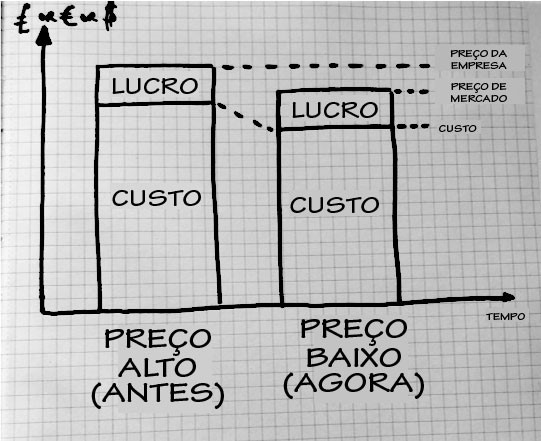
Definition 1) the elimination of waste to reduce costs…
A decent answer at the beginning, before a broader understanding appeared, moving from pure cost to flow. This shows me starting to consider the value stream, but in a very basic way.
Definition 2) the elimination of waste to reduce costs… and reduce lead time.
I began to focus on reducing the time between “paying” and “getting paid”, that is, moving material quickly through the factory so the money is in your account, not someone else's. Working capital improves by having less inventory on hand and by shipping quickly to generate an invoice for your customer.
I was fooled, like everyone else, by the apparent panacea of VSM, and then I moved on to non-production environments to really think in terms of value. So my definition changed again…
Definition 3) delivering more value using fewer resources.
I'm sure I picked up this definition somewhere on lean.org. I liked it for a long time, because it connects us end to end, from one customer (the consumer of the product/service) to the other (all of us trying to conserve finite natural resources).
One drawback of definition 3, however, is that it doesn't mention “people”. I was coaching hundreds of people in the gemba, but I hadn't fully grasped the expression “monozukuri wa hito zukuri” (making good people to make good things, broadly speaking). Apologies for this, but the next definition is quite long.
Definition 4) delivering more value using fewer resources and developing people's capability to run the right experiments in the right way within their control.
I took several steps forward when I began to understand PDCA more deeply, instead of just repeating the words and coaching a weak version of it. Look anywhere in TPS, and two things are needed for a high level of capability:
- The ability to self-diagnose the gap (in your gemba and in your skills).
- The ability to run a decent, directionally sensible experiment to close it.
That is why kata is so fashionable. In other words, (a) + (b) = self-reliance – a state of thinking and acting that I try to teach people. The beauty of “self-reliance” lies in its fractal quality for different spans of control at different levels of the business. At the highest level, we arrive at… lean as strategy. Thanks again to the Ballés of the world for their recent work articulating this.
In the next definition, I reached my maximum word count:
Definition 5) delivering more value using fewer resources, developing people's capability to run the right experiments in the right way within their control for the benefit of the organization, given current and future market conditions.
Then I began to think about hoshin (in English) and the fact that almost everyone in a company has more work to do than time available, a basic problem of load versus capacity.
Naturally, the load side of the equation is inflated by significant amounts of muda, muri and mura. But today, if you have 11 hours of apparent work to do in 9 hours, your time for kaizen is limited.
Time has always been scarce, so any kaizen effort yields more if it contributes, along with other efforts, to a common goal. I often draw a picture of alignment that my former manufacturing director sketched a few years ago (see below). It shows the power of hoshin alignment to harness many small improvements.
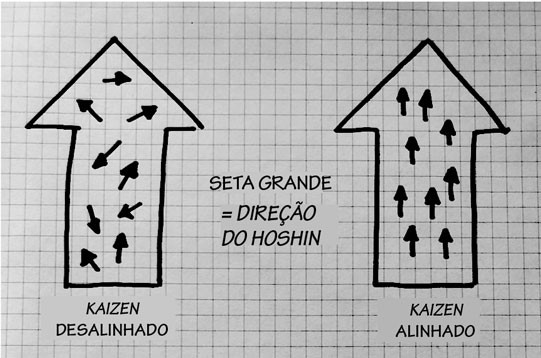
These two arrows led me to another definition:
Definition 6) Alignment of effort, from the customer to the shop floor and to everyone else.
Interestingly, the definitions are coming thick and fast these days, as I think about it. I restated definition 6 with 7 below:
Definition 7) Lean is about connecting your gemba to the customer in a value stream in some way.
The fundamental skill for making definition 7 a reality is “sensitivity”, I think. “Sensitivity” and “gemba sensitivity” have a very specific meaning when you spend time around strong Japanese manufacturing companies. It is about being in tune with your area, being present and alert, understanding the process and the product to the point where you deeply understand the SQDCP risk points and the change points in whatever work is being carried out.
So my next definition was:
Definition 8) “lean is about developing sensitivity”.
Even so, I wasn't happy, because although we are considering people now, there is no mention of collaboration across functions. Successful lean transformation requires us to look left and right, up and down the organization, to better understand how we fit together and whom we need to serve better.
I don't see much harm in developing the ability to recognize your internal customers' challenges to understand their perspective, as long as it stimulates action through mutually beneficial collaboration and kaizen. Which brings us to…
Definition 9) “Sensitivity and collaboration in the gemba aligned with the customer to deliver value”.
Ironically, I'm not sure I like how this definition sounds. In trying to go back to old concepts, I fear it sounds like management speak!
Actually, I'm not sure having a definition is important, but the act of reflecting every now and then on your lean understanding is probably useful.
Dwight D Eisenhower once said something profound: “planning is useful, plans are useless”. Lean is similar, I think: “Defining lean is useful, lean definitions are useless”.