

Orry Fiume: a lean strategy can really improve your ROI

Wiremold, which appears in the seminal book “Lean Thinking”, is the classic lean success story. Using lean as their main strategy, Wiremold's leaders were able to increase the company's value from 30 million dollars to 770 million dollars in 10 years, through internal growth - developing their people - and external acquisitions - honing their lean transformation skills. Although Wiremold's lean journey is well known and has been widely documented, a crucial part of the story has not been told until today: the perspective of the chief financial officer.
In fact, this reflects a larger knowledge gap in the lean movement. No one disputes that lean works, sometimes spectacularly, as in the case of Wiremold. And yet it remains as hard as ever to convince top financial managers to adopt lean thinking. Much of this is due, we believe, to the fact that the financial story of lean has not been explained, which is precisely our intention in this research article.
Art Byrne, retired CEO of the Wiremold Company and author of “The Lean Turnaround”, likes to say: “The winners will be those companies that focus on their processes, not on their results”. We can infer from this statement that in order to focus on processes, a company needs to reorder the importance of its indicators, with operational indicators coming first, and the traditional, financial and results-oriented ones coming afterward. It's not that Art wasn't interested in achieving good results. He was. But he knew that, in order to achieve them, he needed to focus on the physical changes that created improved financial performance. He arrived at Wiremold confident in the fact that lean is a strategy, not a manufacturing tactic, and that every process in the company had to be in line with lean principles.
From Art's arrival in 1991 until the sale of the company in 2000, the company achieved impressive results:
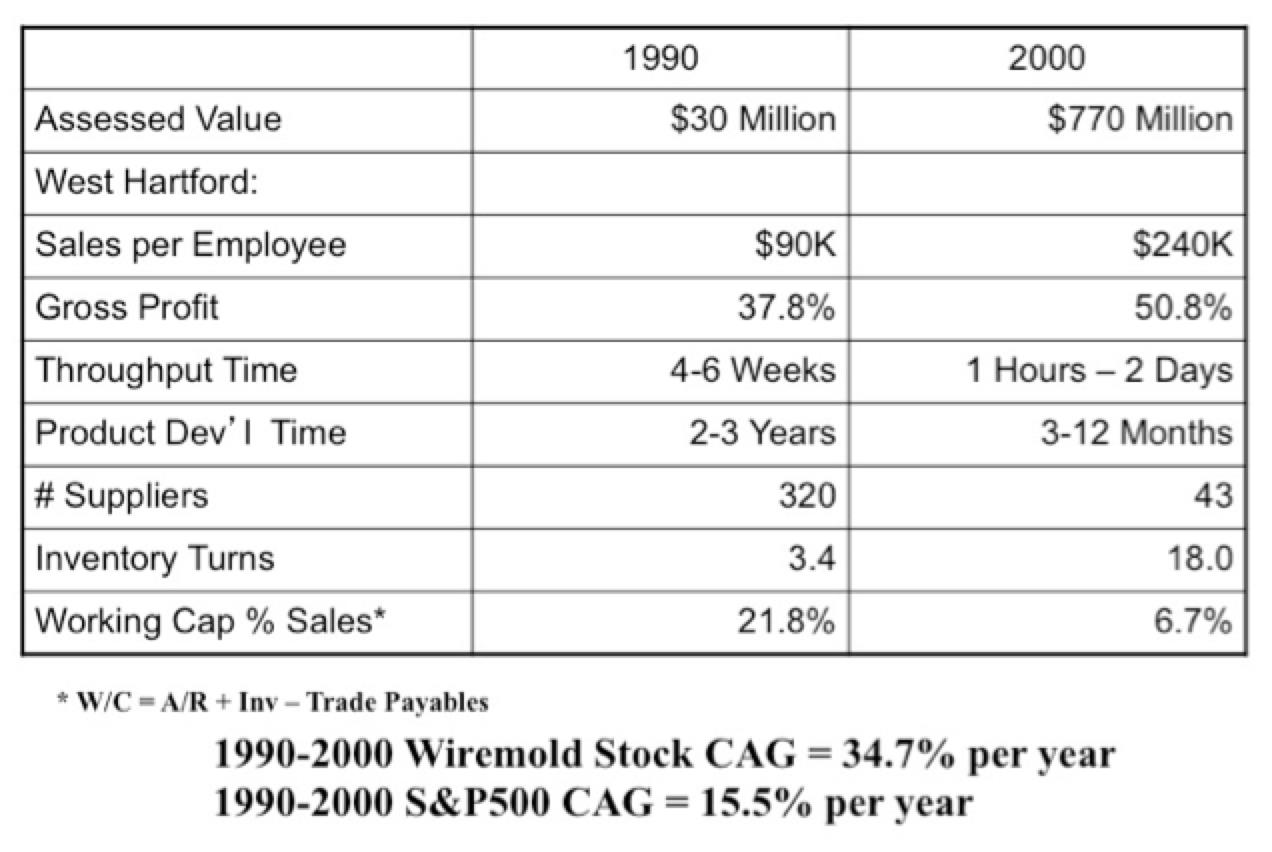
Despite the extraordinary results that Wiremold and other lean companies have achieved, there is still a lot of skepticism about Art's focus on processes as a driver of financial results.
Many consider one of the main “results” indicators to be Return on Investment (ROI). This single number tries to reflect the results of a company's efforts to effectively use its investments and achieve maximum benefit (return). The most widely used ROI calculation is shown in the classic Dupont Model (E. I. DuPont de Nemours & C0, Inc; “Guide to Venture Analysis,” 1971):
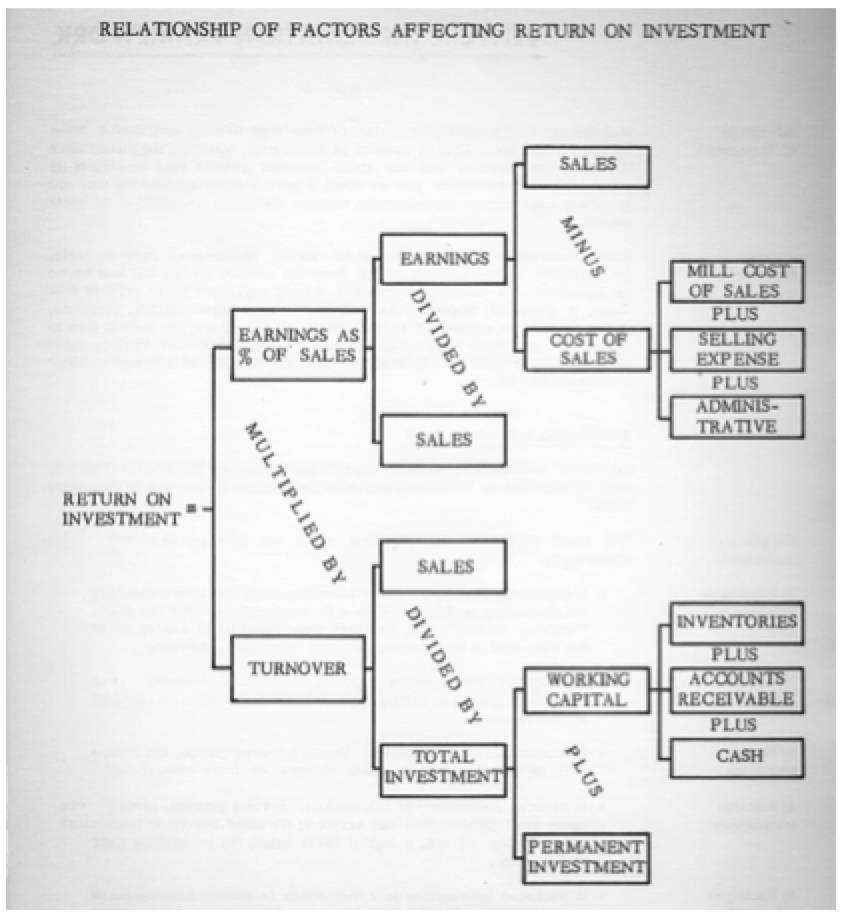
Since ROI is the single number that reflects the results of almost all of the company's activities, it cannot be improved directly, which would be like trying to increase your car's speed by moving the speedometer needle. It can only be improved by improving the elements that make up the calculation (for example, the items described at the outermost level - on the right-hand side - of the model).
The ROI model is so influential in business that it is sometimes applied to select individual investment choices, in the belief that if each investment yields a satisfactory return, then the return across the whole company will be satisfactory (note: the Internal Rate of Return - IRR - or “payback” models are sometimes used as substitutes for ROI). Unfortunately, life is usually not the way we would like it, and the ROI achieved is lower than promised. Once this happens, pressure builds to “improve it”. Since the investment has already been made (the machine has already been bought, the acquisition has already been completed), the traditional way to improve ROI is to try to “increase” the benefits, which usually translates into cost reduction, which in turn usually translates into pressure to reduce “headcount”, since this is seen as the easiest cost to reduce with the most immediate impact on increasing ROI - on paper.
Of course, if you cut operating costs to improve the return on the wrong investment, you are likely to further deteriorate the outcome of the investment and will have the opposite effect, even though this shows up somewhere else in the end. A hard lesson of lean is that, by making processes work as they should and learning to make them more flexible, investment is rarely necessary.
The real question is not “can ROI and lean coexist?”, but “can a lean strategy improve the chances of achieving a superior ROI?”. And the answer is an unequivocal “yes”.
When we look at the ROI diagram, we see that it is earnings as a percentage of sales multiplied by the turnover rate. On a daily basis, this revelation is not very useful. We need to go back to grade-school math to see what it means.
ROI = Earnings/Sales X Sales/Investment
Therefore, ROI is influenced by (1) sales, (2) earnings and (3) investment. Please note that sales is in both the numerator and the denominator of the equation, and therefore receives extra weight. Toyota's early story was not “how do we reduce costs?”. Rising from the ashes of World War II, the question was: “How do we increase production to meet growing demand using the existing investment?”. This was not a financial question (ROI), but rather a logistics question. Toyota asked itself: “how do we increase the flexibility and speed of production in order to meet greater demand without new investment, since we have no money to invest?”.
The answers they found created an approach that focused on the knowledge of the people doing the work to eliminate work that did not add value for customers (waste), thereby providing a source of growth from the same assets - people and facilities. Whether they thought about the effect this would have on “ROI” is debatable, because they were clearly focused on doing the things that were necessary for their survival: satisfying the customer with limited resources. The net effect, however, is that they discovered a new “lens” through which they could see virtually everything that impacted ROI. And because of the multiplier effect built into the ROI formula, they created a way to achieve exponential increases in ROI. Each of these things is discussed below.
Looking at the ROI formula, we start with earnings as a percentage of sales, which is the result of sales minus costs divided by sales. And costs are the sum of materials, “labor”, overhead and delivery, and these costs can be classified as production, selling or administrative. In other words, it is Earnings Before Interest and Taxes (EBIT). Let's start with the cost elements.
COSTS
Accountants like to classify costs as production, selling, administrative and “other”. In reality, the costs incurred are materials, people, facilities (buildings and machines) and other. In addition, many manufacturing companies still use standard cost accounting as their cost management system.
Materials: In most companies, the production process generates a considerable amount of wasted materials. Such waste may occur because of poor product design or poor manufacturing practices, or both. Either way, materials are wasted. However, in many organizations this is not recognized, since the accounting system builds a “yield” factor into the material standards based on historical averages. As long as the company stays close to its historical average, the accounting system shows little, if any, material usage variance. In other words, the waste has been institutionalized by the standard cost system, and the small variance leads to the belief that “there is no problem”. If a manufacturing company's typical material costs are 60% of the cost of sales, and waste is 5%, eliminating the waste can improve the cost of sales and EBIT by 3 percentage points. For most companies, this is not insignificant. How can you achieve “right the first time” in order to reduce waste. In a batch model, many defective products can be made in a single process step, but they will not be discovered until the batch is used in the next process step, which can take days, weeks or even months. Following this logic, thousands of items may be defective and need rework, if possible, or may be thrown away. Over time, the cause of the defects often becomes impossible to determine. When a lean strategy is used and flow lines are established, a defective product is discovered immediately, and the amount of wasted material is close to zero, since the discipline of stopping the line requires that a countermeasure be put into action before production continues. Lean improves product quality exponentially and virtually eliminates wasted materials, thereby improving the “earnings” element of ROI.
People: Although accountants at many manufacturing companies like to say that “direct labor” is less than 10% of total costs, the reality is that the total “people cost” is the number one cost, whether it is called “direct”, “indirect”, “selling” or “administrative”. Most companies think of people as a cost. There are many historical reasons for this, but the bottom line is that this way of thinking has been codified in accounting rules. From an accounting perspective, many people are classified as “period cost”, “variable cost” or “flexible cost”. And since that is how people are accounted for, that is also how they are treated. Almost every company says some variation of “people are our most valuable asset”, but when you see how they treat their subordinates, you realize these are empty words. Management's historical approach to people is to treat these costs as “variable” and to “calculate” the workforce (hire/fire) in order to keep people costs as a constant percentage of sales. In a people-centered company, people are the only asset that can appreciate. They are Human Resource Capital. Other capital, such as buildings and machines, depreciates over time. As lean creates a learning environment and people's skills increase, people become more valuable. They learn to improve their own work to eliminate time spent on non-value-adding activities and free up their own capacity to do more value-adding work. Lean empowers people to change the historical equation. The “cost” of people can be held as a constant amount so that it becomes a variable percentage of sales. Because lean is a growth strategy, as discussed below, much of the increased demand can be met by the existing workforce. Labor cost becomes a smaller percentage of sales, and profit increases. The definition of productivity is the amount of output versus the amount of resources needed to manufacture that amount. In 10 years, Wiremold doubled the size of its business at the West Hartford plant without increasing the number of people employed in the factory. By teaching its people how to identify and solve problems, it achieved a continuous flow of annual productivity improvement in its people resource. Most of Wiremold's 13% increase in gross profit, as shown in the table above, was achieved through business growth without increasing the number of people.
Facilities (buildings and machines): The annual cost of facilities is merely an accounting phenomenon. The real cost is reflected in the investment, and the period cost is a calculated depreciation of those investments based on their estimated useful lives. We will leave the discussion of facilities for the discussion of investments below.
Other: This general category is made up of miscellaneous items (for example, office supplies, insurance, property taxes etc.). In total, miscellaneous cost usually represents the smallest category, but it can still yield significant cash savings. For example, and this is typical in many companies, each Wiremold department bought its own office supplies, with one person in each department responsible for this task. When these people were invited to take part in a kaizen event to look at supply usage with the goal of reducing its costs by one third, the team's improvement efforts resulted in a 48% reduction in supply costs. There are many other examples of improvements in the use of these other resources, and the amount of time spent improving any of them will depend on its importance to the individual business. For example, energy costs are substantial for a foundry and will be subject to considerable improvement efforts. Meanwhile, they are of lesser importance to some service companies and will have a much lower priority.
SALES
As a growth strategy, lean focuses on the regular, and relatively rapid, introduction of new products. Although growth can be achieved by winning market share (an expensive method, since it can lead to price wars), the preferred method is to increase the size of the market through new products or more value for the customer and to capture all of that market growth. When Art Byrne came to Wiremold, he set several goals, one of which was to double in size every three to five years: half through organic growth and half through selective acquisitions.
In reality, the company doubled in size in four years, again in another four years, and was on its way to doubling for the third time when it was sold in 2000. Wiremold focused on improving two complementary processes simultaneously: production and product development. It realized that if customers don't believe that quality and delivery promises will be kept, they won't even listen to news about new products. So the goal was to “fix the base” (for example, customer service, production, logistics etc.) and accelerate new product development. By “improving the base”, quality was improved, and “on-time delivery” rose from 50% to 97%. Customers were now willing to listen to news about new products. Thanks to the adoption of Quality Function Deployment (QFD), the new product introduction cycle shrank from years to months. Over time, the rate of new product introduction accelerated from 2 to 3 per year to 4 to 5 every two months. Wiremold went from a historical growth rate that tracked GDP growth (typical of the American electrical industry) to accelerated growth. This made the economy grow. And yes, it also allowed it to gain market share by developing products that offered more value to customers. When you look at the ROI formula, sales are in both the numerator and the denominator of the equation. Therefore, the need to accelerate sales growth is imperative.
Investment is made up of Working Capital plus Permanent Investment (buildings and machines). How can a lean strategy have a positive impact on each of these elements?
WORKING CAPITAL
Although the accounting definition of working capital is Current Assets minus Current Liabilities, as can be seen in the Dupont formula, for all practical purposes working capital is accounts receivable plus inventory minus accounts payable. Almost everything else in working capital is the result of some accounting rule (for example, prepaid insurance, deferred taxes etc.).
Accounts receivable: If you ask most CFOs whether they know their accounts receivable days outstanding, they will probably know by heart without needing any report. However, if you ask them what those days should be based on the company's sales, they will look at you with a blank expression. And there is no accounting report that will give them the answer. It is not unusual to find companies with delinquency 50% or more above what it should be based on their payment terms. They consider this normal. When a company focuses on the root causes of late payments, it discovers that a small portion of it is caused by customers having financial problems or “stretching” payment. Most of it comes from customers who do not pay on time because of a problem the company created and has not yet solved. These problems are usually invoice discrepancies, incomplete shipments, incorrectly shipped products, damaged products etc. When the people who work in the processes that cause these defects find out what happened and learn how to change their processes to eliminate these problems, customers pay on time. A medical equipment manufacturer once focused its attention on accounts receivable and reduced its delinquency from 57.8% to 43.3% over an 18-month period: a 25% improvement, which generated a significant amount of cash.
Accounts payable: Of course, a well-known way to reduce the drain on working capital is to delay paying suppliers - something we see happen every time there is a crisis in the industry. However, this is also the best way to drive businesses into bankruptcy by disrupting the supply chain with unreasonable cash pressures. Good relationships are critical for suppliers to embrace the ideal just-in-time supply chain of 100% on-time deliveries with the minimum possible inventory, so increasing accounts payable is simply not a lean option and is not considered here. If we expect vendors to deliver quality products on time, we need to pay on time.
Inventory: Although inventory is classified as a current asset, for many companies it can be considered part of their permanent investment (similar to plant and equipment). For example, Wiremold's historical inventory turns were between 3.3 and 3.4 times. Despite the specific items sold from inventory (at widely varying rates), the total amount of inventory on hand at any given time was approximately the same. We accepted this as normal.
In a traditional batch-and-queue environment, large quantities of individual parts are created or worked on at each process step. These large batches are usually moved to work-in-process storage areas between processes, resulting in products whose total processing time is measured in minutes, but which can take weeks to be transformed from raw materials into finished goods. When Wiremold reorganized into value streams and moved its equipment into flow lines within those value streams, inventory between process steps was not necessary. As discussed above in the materials section, this adjustment not only improved quality but also reduced the amount of inventory stored throughout the process.
Wiremold's lean strategy resulted in drastic reductions in inventory levels. Its largest division, the Wire Management Division, carried finished goods inventories because its distributors expected immediate shipments as soon as they placed their orders. Even so, inventory turns improved from 3.3 to 18. This represented approximately a three-week supply of raw materials, work in process and finished goods. Some of two other divisions, which supplied products to intermediate customers and therefore did not carry finished goods, had inventory turns above 30. Regarding our discussion of ROI, reducing inventory reduces investment.
Improving working capital by reducing accounts receivable through better management of on-time delivery and reducing inventories by making production processes more flexible (improved on-time delivery and inventory reduction go hand in hand in a lean transformation) usually has a drastic impact on the amount of capital, since the cash used to finance accounts receivable and inventory is freed up. These capital gains are usually the first sign of a lean process and are very useful for sustaining future improvements. For example, if Wiremold in 1993 had had the same inventory turns it had in 1990, it would have had $16.7 million dollars of inventory. Instead, inventory was reduced to just $5.6 million dollars, freeing up $11.1 million dollars.
PERMANENT INVESTMENT
Permanent investment consists of machines and buildings and, although it is often forgotten, it is at the heart of Toyota's just-in-time thinking. Kiichiro Toyoda coined the term “just-in-time” in English while inventing new ways to improve production without using more investment, and he specifically tried to realize his belief that “the ideal conditions for making things are created when machines, facilities and people work together to add value without generating any waste”. Just-in-time is a countermeasure developed to reveal the excessive use of investment, which, in turn, reveals that much labor productivity is the result of investment productivity (and not the other way around).







