

A foundation for lean programs
Where should we look for results in lean? In hindsight, it is easy to say that it enabled us to achieve this or that – stories are always told after the fact. Companies we have followed closely have doubled or tripled their revenue over the last 15 years, maintaining profitability and navigating endless crises, from COVID-19 to IPOs. Their CEOs will tell you that lean was an essential part of this success, but they will also express frustration at how hard it is to get their own managers to see lean as a priority while events are unfolding. Looking back, it is obvious that lean is a fantastic support for a company's ambitions, but when you are in the midst of turbulence, this is not so clear, because the pressure to just get the tasks done, deliver immediate results and hope for the best is constant.
Imagine you are a middle manager in a service company. A major customer regularly complains about your delivery time (lead-time) and price. When you look at each dissatisfied e-mail, nothing seems out of the ordinary — there is always a valid contextual reason for what happened and, clearly, you are no worse than your competitors. So what do you do?
- Apologize, explain and promise to do better next time… and go back to the day's work, with your usual routine of "emergencies"? (Path 1)
- Or apologize, explain and promise improvements through a program of gemba walks and kaizen events, to understand what is really affecting this customer and how to improve both the business and the relationship? (Path 2)
Of course, there is also a third path, which is to back off, ignore everything and hope the problem goes away, as long as people show up for work and do their part (which is what actually happens in most places). Your CEO tells you to follow Path 2, but:
- You don't have the time or resources right now.
- You are not sure how to do it.
- You don't see how it would solve your long list of immediate problems.
And these points are absolutely valid. As a sensei once told one of us: “You have to balance today and tomorrow. If you only take care of today, you will have no tomorrow, but if you only look at tomorrow without taking care of today, you will have no tomorrow either.”
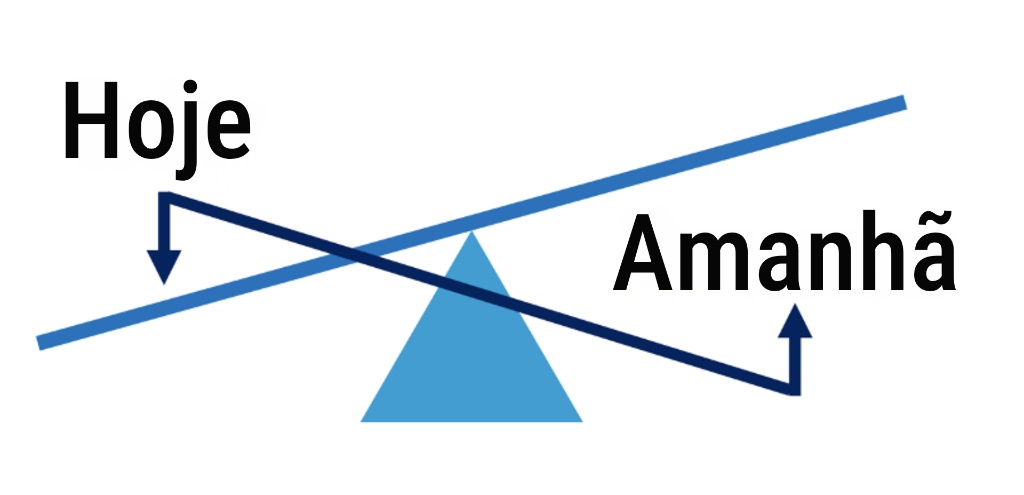
The question is: how? Here is what we know so far:
- Traditional management lets you “surf” market conditions. You grow and make money when the market is favorable; you stagnate and lose money when it is tough; and, eventually, some unexpected crisis can knock you down completely. Until that happens, financial markets react hypersensitively to positive short-term projections, and act with total ruthlessness in the medium term, when actual results do not match the promises.
- Point optimization through cost-reduction projects is common because you can easily project the return on investment (ROI): here are the points we need to improve, here are the consulting resources we can invest in, and this is the return we expect (and many consultants are eager to sell it to you). However, we also know that these programs always fail within two or three years (the savings never really show up in the accounts, and what was changed under consultant pressure reverts to normal) and often make the overall situation worse, weakening the company instead of making it more robust.
- Lean transformation programs deliver on their promise for CEOs who are fully committed to understanding, practicing and teaching lean, but they are a minority. In addition, such results are hard to quantify because it is often impossible to separate the impact of lean from market conditions — unless you have the clarity to compare “with lean / without lean”.
So what do lean CEOs look for in lean? Where do they look for it? How do they try to find it?
CEOs know that if the business is viable, its basic value proposition is right — with different levels of market margin (some markets are profitable for all competitors, like tech until very recently, while others have very low margins, like anything to do with the automotive sector). They also know that their performance will be affected by how the business is run day to day and by how it responds to market shocks. In addition, they know that, to ensure business continuity, they need to renew their value proposition through innovation, which requires difficult and risky decisions.
In this sense, and building on Jim Morgan's formula for a successful management system, I would argue that, from the top, performance breaks down into three key components:
- The business's positioning in its market.
- The organization's culture.
- The company's operating systems.

These, in turn, are supported by actionable mechanisms:
- Smart choices to improve market positioning.
- Leadership behaviors to sustain a positive "we can do it" culture (can-do).
- Improvement activities to continuously strengthen the operating system.
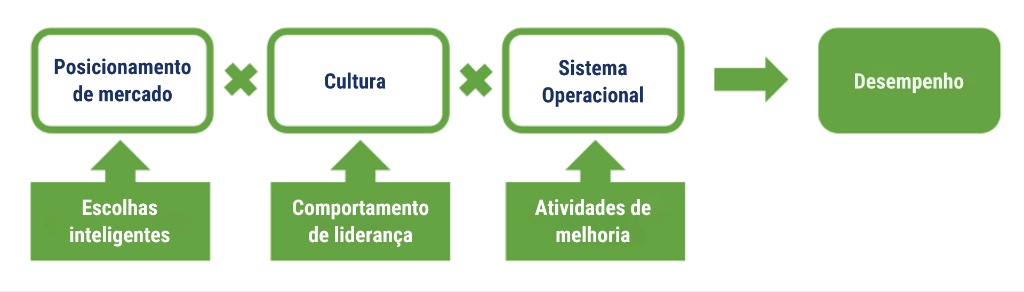
For a lean CEO, the mindset offers a framework for dealing with these more complex dimensions of management:
- A lean strategy of quality and a broad variety of products/services to serve all segments, with flexible operations to better respond to variability.
- The Toyota Way as a reference for leadership behaviors.
- The Toyota Production System as an integrated system of improvement activities that make the operating system evolve continuously.
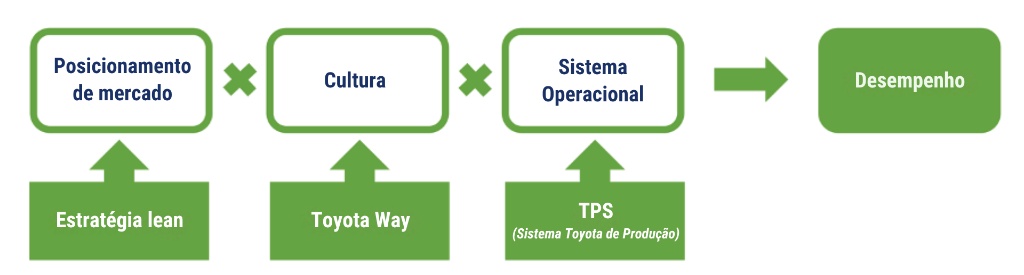
In short, what CEOs look for in lean is not just daily operational performance, but adaptability to respond to the inevitable crises that will occur in their markets in a VUCA world (Volatile, Uncertain, Complex and Ambiguous) and the strategic capability to open up future options for innovation and change of direction. To pursue this, they strive to clarify strategic challenges (which challenges do we face, which do we ignore, what are our options, how do we tackle them?) and to develop internal leaders who, in turn, will support a lean culture. They recognize that piling up lean projects will not solve the problem and that they need a more robust transformation program of lean activities to go along with their operating system.
What would such a program look like? Thirty years of studying how Toyota does it in practice and running countless lean experiments give us a fairly clear idea of how to structure a robust program.
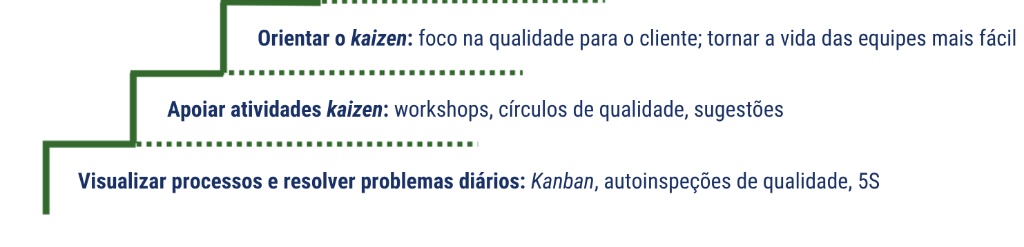
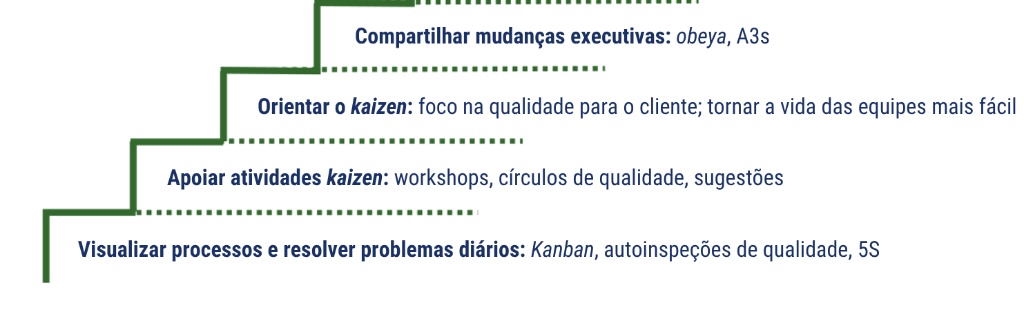
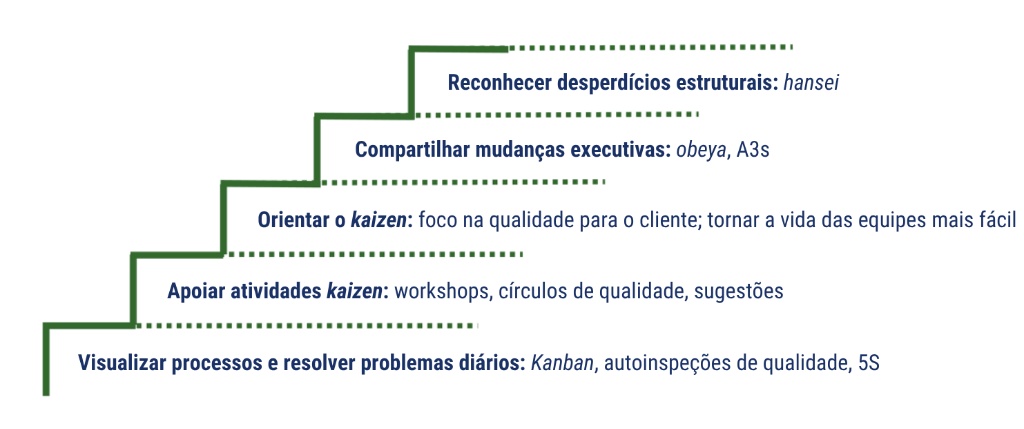
It starts, of course, with the essential foundation of going to the gemba and visualizing processes to solve day-to-day problems:

The next step is to organize and support kaizen (continuous improvement) activities for everyone every day, such as kaizen workshops, quality circles, suggestion follow-up and so on.

The third step is to teach frontline managers to distinguish the kaizen that is "good" — which delivers value to customers or makes life easier for teams — from the kaizen that is "bad", which reinforces bureaucracy. This is an essential step to start building the right kind of culture, developing the leadership strength to turn toward customer satisfaction and employee engagement, instead of "patching up" problems and reinforcing control and micromanagement.
This leads us to look at executive changes. Department leaders and function heads make changes to their processes all the time to optimize how their own areas work, but, in most cases, one person's solution becomes someone else's problem (just imagine what happens when HR changes a policy). These functional changes create cross-functional problems that can paralyze the company. However, these problems can be avoided through honest communication between areas and can be mitigated by kaizen opportunities.
This brings us to the fourth step of the program: making executive changes visible across functions and solving the problems that arise for the teams.
The fifth and final step is the shared recognition of the business's structural waste.
We are not talking about the trivial waste of losing time looking for your favorite pen, but about the understanding that, whatever operating system is adopted to deliver value, it will always carry unavoidable waste, which most companies consider a “normal cost of doing business”.
A car dealership needs to hold inventory;
A B2C business will inevitably lose some dissatisfied customers;
Large industrial facilities will always have idle capacity;
And so on.
As the program makes it possible to discuss kaizen opportunities based on visualizing TPS, this structural waste comes to be progressively recognized and understood by the leadership team, which can then direct kaizen efforts toward eliminating it. This is the truly transformative part of the program.
From this perspective, it becomes clear that lean projects that are not part of a broader transformation vision (focusing only on optimizing this or that process) can make the company less adaptable, not more.
In this scenario, the company may even recognize the structural waste present in its operating methods, but it will see this waste reappear continually with each new external change, because it is intrinsically linked to the way the business works. Therefore, adaptability is the result of fighting this waste all the time, in continually changing circumstances.
The same sensei who taught one of us the importance of always seeking a balance between today's needs and tomorrow's also asked us to constantly observe an operator's steps at their workstation: “one meter, one step, one cent”. And he was right, of course.
The smallest change on the production line affects how operators have to move around the value-adding work. But it took me decades to realize that this only applies to production conditions where the takt time is high.
Operators who, for example, build one complex machine a day will not be so affected by a few extra steps, but rather by missing parts or engineering errors.
The types of waste, such as Ohno's famous seven wastes, are tied to a specific operational configuration. They are an excellent starting point, but what about the waste of speaking to the customer in the wrong tone in a B2C company? Or choosing the wrong sales channels (as Nike recently did when it moved away from physical stores and tried to do everything online, severely damaging its brand presence)?
To reap the benefits lean promises, we need to look beyond the toolbox (without ignoring it) and ask ourselves some fundamental questions: what are we looking for with lean? Where will we look for it? What do we expect to find?
Daily process performance, achieved through greater control, is not transformative — often, it only generates more bureaucratic pressure. What truly transforms is the combination of lean strategy, lean leadership behaviors and a lean operating system, capable of generating both performance and adaptability.
Getting there, however, requires completely rethinking how we “do lean” in practice and learning from the many experiments and from all our accumulated experience with lean initiatives. True Lean Thinking is the path to greater performance, greater engagement and, ultimately, a more sustainable society. We must look to the horizon and pursue this path so that, one day, we can truly find it.







