

Improving the learning process in Italian high schools using lean and scrum
Traditional teaching approaches are increasingly considered obsolete
Education systems around the world are under enormous pressure to provide students with the knowledge and skills they will actually need to become productive members of society and reach their potential. Traditional teaching approaches - based on lessons delivered in the classroom, homework and regular tests - are increasingly considered obsolete, since they do not develop fundamental capabilities such as teamwork.
The need for education reform is so urgent that even international institutions, such as the European Union, are considering it. With the Lisbon protocol, the EU identified a set of key competences that should be developed during a person's studies and that are considered essential for the future: learning to learn, planning, communication, collaboration and participation, acting autonomously and responsibly, problem solving, identifying correlations and connections, and gathering and interpreting information.
There is more. The global challenges we face (such as climate change and mass migration) and the almost unlimited access to information through the web (with the heightened sense of responsibility and the need for critical thinking this requires) mean that our education systems need to shift their focus from knowledge to competences.
At the Istituto Lean Management, in Italy, we saw an opportunity after discussing this topic with several high school teachers and looking at it in greater depth. In particular, we realized how most of the skills listed by the European Union in its document correspond to the kind of capabilities that lean thinking develops in people during a transformation (most of them based on value creation, learning on the job and a structured relationship between teacher and learner).
So we asked ourselves: could lean somehow be applied in high school (with students between 14 and 18 years of age)?
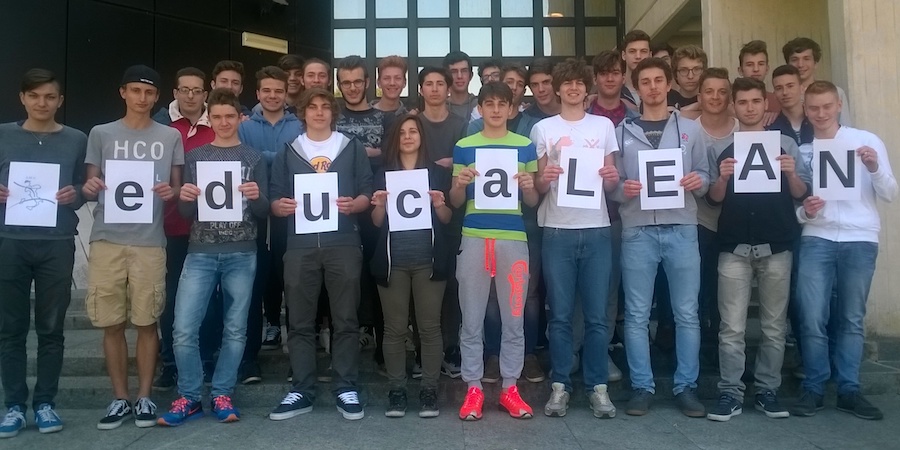
The educaLEAN project was born with the goal of experimenting to find out whether lean thinking could contribute to improving and modernizing education
That is how our “educaLEAN” project was born, with the goal of experimenting to find out whether lean thinking could contribute to improving and modernizing education. Our experiments would focus on lean principles, such as teamwork, visual management and autonomy in problem solving, together with traditional lean tools, such as kanban, work leveling (heijunka) and PDCA.
Once the subject of study had been defined by the teacher, we wanted the students to be able to carry out the related analyses autonomously (independence in problem solving), in small groups (teamwork), with the teacher's help when needed (pull learning), and managing everything in a visual and leveled way. To do this, it was decided to structure the operational part of the project using the scrum methodology.
ANALYZING THE CURRENT STATE
When we looked at the current state and at the problems we would have to face during the project, we were able to identify many critical aspects we would need to keep in mind:
- Would teachers be open to questioning the classic teaching paradigm? What would they think of their new role? What subjects would they choose to try out this new approach?
- Would students have difficulty accepting this different teaching method as a legitimate way of learning a lesson? How would we make sure they did not study only what they wanted to? How could we ensure they would not merely copy and paste instead of analyzing the topic in depth?
- How could we strike the right balance between autonomy in learning and ensuring that students followed a path? How would we guarantee a common level of learning?
- How would we assess the level of knowledge and skills the students would reach? And how would we ensure that the best-performing students did not leave those who struggled more behind?
educaLEAN is made up of three main elements: learn, apply and reflect
Reflecting on these challenges, we were able to structure our project around a set of countermeasures we wanted to test to see whether we could overcome the barriers we had identified. educaLEAN, therefore, is made up of three main elements:
- LEARN - We provided in-school training on lean principles for the teachers involved in the project. After that, a group of students learned the scrum method through a simulation game.
- APPLY - This is the core of the process we designed, based on scrum: the teachers would have to define the subject of study and the most suitable learning paths, the length of the sprints (“study units” usually of 12 to 16 hours, held three to four times a week), and a set of questions that would lead to an in-depth analysis of the subject. The students, divided into groups, must define the tasks to be completed by placing them on a schedule, estimate the difficulty of each task using a Poker game with the Fibonacci sequence, assign tasks (such as homework) to team members and define the state of the analysis of the subject visually through a scrum board and a burndown chart. They also need to ensure that completed tasks are shared (alignment to ensure everyone passes the final exam), especially regarding the skills and knowledge acquired by the group members. The process usually ends with a competition or event in which each group answers the questions assigned by the teacher and presents its work to the others (in the case of the group studying robotics, the questions included: the development of robotics over the last century and its current state; industrial robotics in Italy and in two foreign countries; the social impact of automation; five English words about robotics everyone should know; three risks and three opportunities arising from robotics). The material developed is then put together in the form of a book that will complement the textbooks the students usually use, thus becoming a resource for the whole class.
- REFLECT - Two reflections on the progress achieved take place here: one during the APPLY phase, through retrospectives led by the scrum master of each group, with the teachers attending the meetings; and another at the end of the APPLY phase, carried out by the teachers to analyze the level of skills and knowledge achieved individually by the students and to identify any corrective actions needed before the next subject is tackled.
AN EXPERIMENT
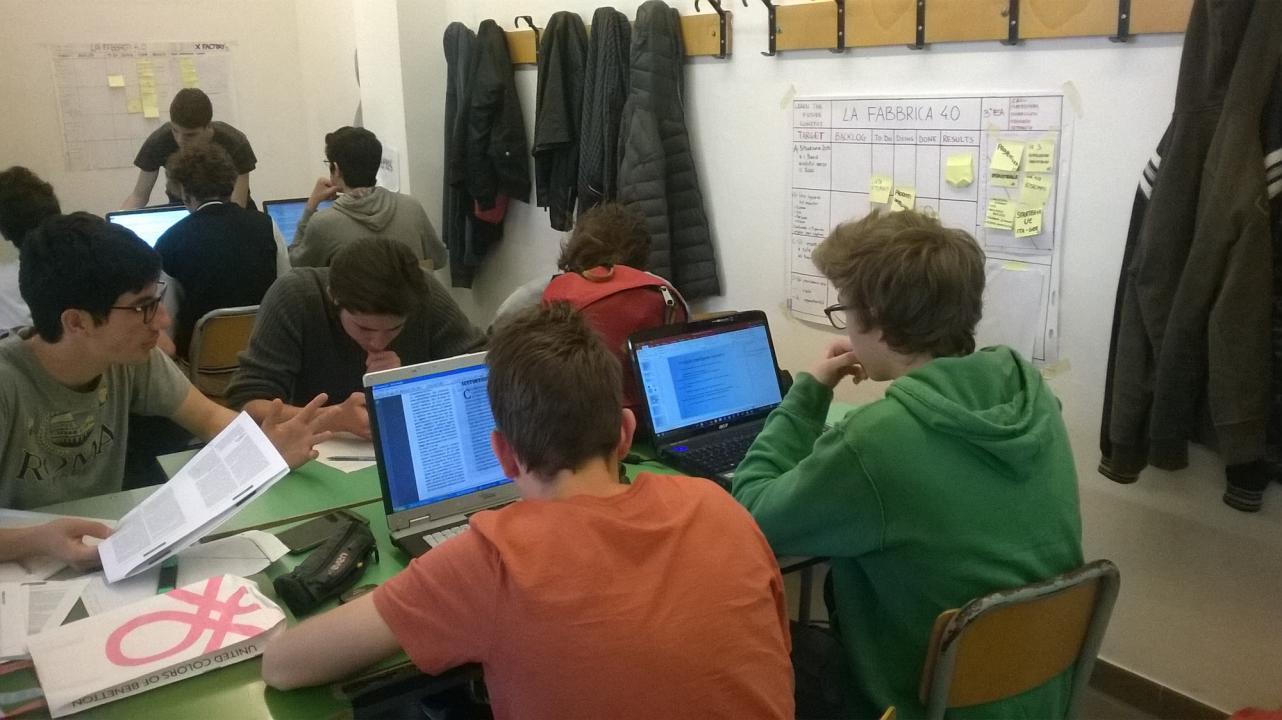
After finalizing the educaLEAN method, we ran our first experiment. It took place in May 2016 at the Istituto Tecnico Industrial A. Rossi (a technical high school) in Vicenza. Ten classes were involved, for a total of approximately 20 students and 10 teachers. The Istituto Lean Managemente provided assistance throughout the project.
The subjects chosen in the various classes did not come from their curricula, but were certainly relevant to the kind of subjects the students were studying. They included robotics, manufacturing 4.0, the sharing economy and innovative materials. The students worked on these topics for an entire week following the steps of the APPLY phase and respecting the typical cadence of the scrum method (an “accelerated” simulation of three four-hour sprints).
After reviewing the experiment, the Unioncamere Veneto (the union of chambers of commerce of the Veneto region) decided to adopt the method for a project, sponsored by the regional School Board, that took place in schools between 2016 and 2017. Called “educaRSI” - a play on words referring to the Italian verb educarsi (to educate oneself) and to RSI, the Italian abbreviation for Corporate Social Responsibility - the project required the participating classes to study the topic of corporate social responsibility from five different angles: a company's relationship with the environment, with employees, with society, with consumers and with the whole world. Nine high schools were involved (25 classes, 400 students and 40 teachers). During the project, the students also had the opportunity to ask questions of business leaders.
The EducaRSI initiative ended with a regional competition during which each school had to give a 12-minute TED-style presentation on what had been developed by the student groups during the experience, which was then judged by a panel made up of representatives of the Regional Government, Unioncamere Veneto, the Istituto Lean Management and the companies that took part in the project.
The results of the investigation conducted by the teams were very interesting, highlighting good skills in research, analysis and reprocessing of content.
The experiments were successful, as they engaged students and teachers, allowing them to acquire specific skills related to teamwork and visual planning. The results of the investigation conducted by the teams were very interesting, highlighting good skills in research, analysis and reprocessing of content.
The experiments taught us some important lessons. First of all, the teachers were pleasantly surprised by the effort the students put into the project and by their ability to analyze the subject in depth thanks to the teamwork-based approach typical of scrum and to the support of the ILM. Second, the students were happy to take part in the planning and learning phases. They showed a great ability to deepen their understanding of a subject (also using the web) and an effort to make sure no one was left behind in their understanding of the topic.
NEXT STEPS
Many questions remain open, especially regarding the application of this scrum method to everyday teaching (particularly for scientific subjects, as both students and teachers commented). Going forward, we intend to formalize the methodology in this direction and carry out more experiments in the classroom.
This will allow us to address many aspects of using scrum in schools that are not yet clear at the moment, such as the role of teachers, the students' approach to assessment and how to manage the relationship with parents, in particular to help them understand how we are trying to develop skills, and not just technical knowledge.
The Istituto Lean Management is already working with a group of teachers from two high schools (ITIS “A. Rossi” in Vicenza and ITIS “G, Marconi” in Verona) to try to use the method during lessons. The first results are very positive: the students show a high degree of engagement, and the level of knowledge and skills developed through this method seems to be higher than what can be achieved through a traditional teaching approach.
For more information on the educaLEAN initiative, contact Giuseppe at [email protected]







