

My Lean Child
Lean is an alternative management model that has traditionally not been one of the main concerns of the education system. Our schools are focused (rightly so) on student growth and on making the most of the teaching resources available. Nowadays, however, they tend to see demand grow continuously while resources become ever scarcer. Could lean thinking, with its focus on productivity and on improving quality and efficiency, have something to offer our public primary schools?
I recently visited Baerland Skole, near Stavanger, perhaps the only primary school (out of almost 3,000) in Norway to have made a serious attempt to learn from lean thinking. There are others around the world, of course, but the fact is that most schools would not turn to the industrial sector for advice on how to improve the efficiency of teaching.
Many teachers simply reject the idea of learning from the automotive industry, where high-speed assembly lines and standardized work procedures represent an environment very different from that of a primary school. However, it is now known that the principles of lean thinking can really be applied to practically any circumstance. Perhaps the skeptics would change their minds if they saw what Baerland Primary School is doing.
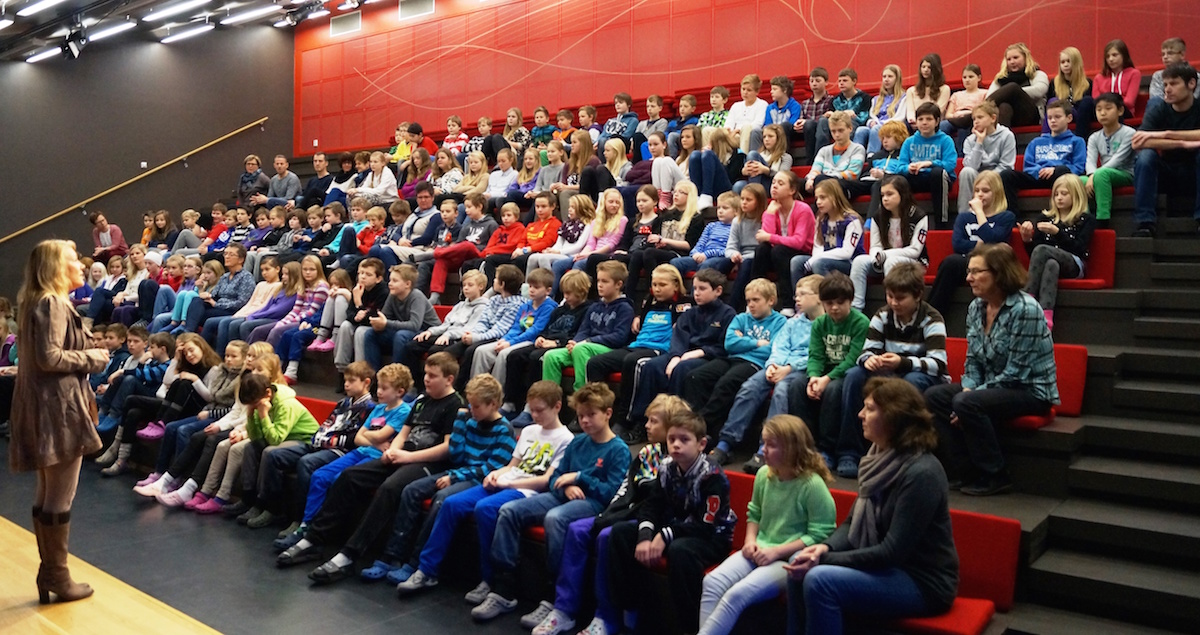
Baerland Primary School employs 25 teachers and 10 teaching assistants, who teach about 300 children from first to seventh grade. The school certainly does not look like a factory, but in fact principal Tom Gilje began to come up with the idea of applying lean principles at his school during a discussion with some of his family members who work with lean in industry.
In 2012, he invited his staff to join him on a study trip to Roskilde, Denmark, to learn more about what lean could potentially offer a public school (and the education sector). He believes that "the commitment of the teachers was absolutely crucial to introducing lean at our school". The first question that had to be answered collectively was "why should your school look to Toyota in order to change?". Together, Baerland's teachers agreed on two main objectives for their lean implementation:
- Increase student learning.Give students more time for learning and teachers more time for teaching, and increase the quality of teaching.
- Improve the teachers' work environment.Create a more attractive work environment at the school and remove "time thieves" in classroom administration.
In other words, the purpose of applying lean at Baerland Primary School was simply a noble attempt to "produce learning in a more effective and efficient way". The first steps included lean training for a small team of teachers with a local lean consultancy and a pilot implementation. Today, Baerland Primary School is particularly focused on three lean practices:
- "5S" workplace organization.
- Continuous improvement.
- Standardization of the best teaching practices.
WORKPLACE ORGANIZATION
5S starts with the teacher, not the student.
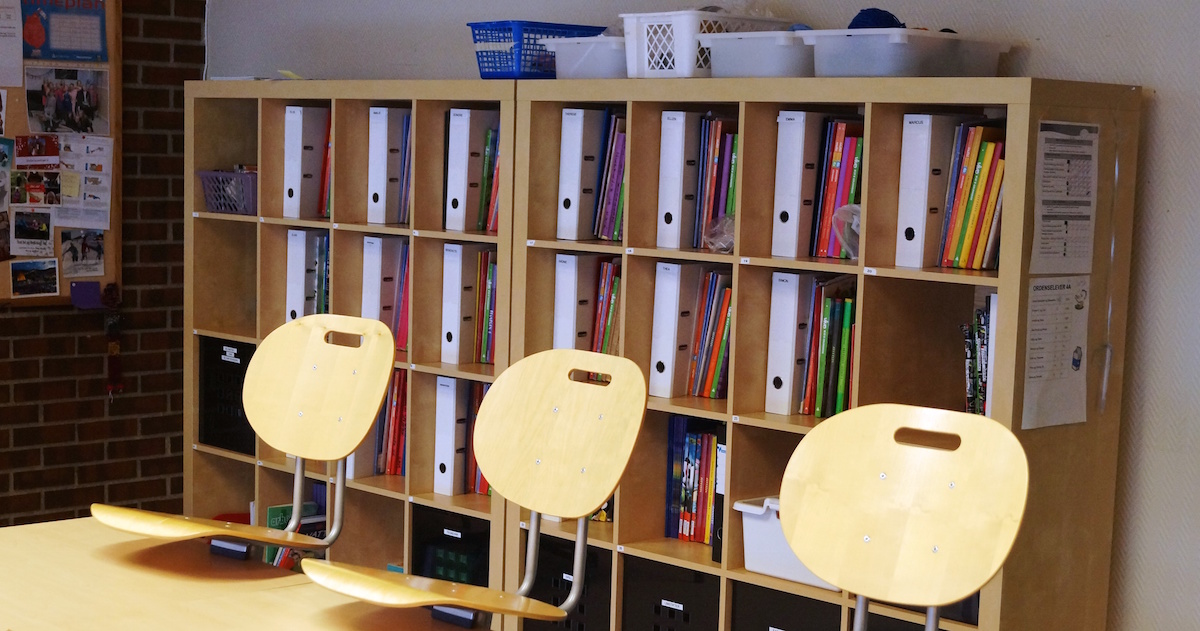
It is more than cleaning; it is about maintaining an organized and efficient workspace, free of clutter and of time wasted on searching and preparation. 5S faces additional challenges in a school environment, because the school is a public place with many users. For example, after the regular school day, there may be after-school care, cultural school, public events, sporting events and other meetings and events. Each of them has its own requirements (for example, room layout) and unique materials, and - not to forget - the users are mostly children.
Without adequate and intuitive 5S systems, schools can quickly become a paradise for waste. Baerland Primary School uses tape markings and visual instructions ("one-point lessons") to keep the school in an orderly state. "5S is more than cleaning a cupboard," explains Principal Gilje, "it also questions whether or not the cupboard is necessary". Baerland has also implemented a simple solution to avoid accumulating material and waste over time: when something has not been used for a while, it is marked with a date and moved to "the final resting place?" - a physical place where unused objects are kept for a few days before being removed from the school if they are not claimed. One result of these activities is that Baerland has now become a particularly attractive school.
CONTINUOUS IMPROVEMENT
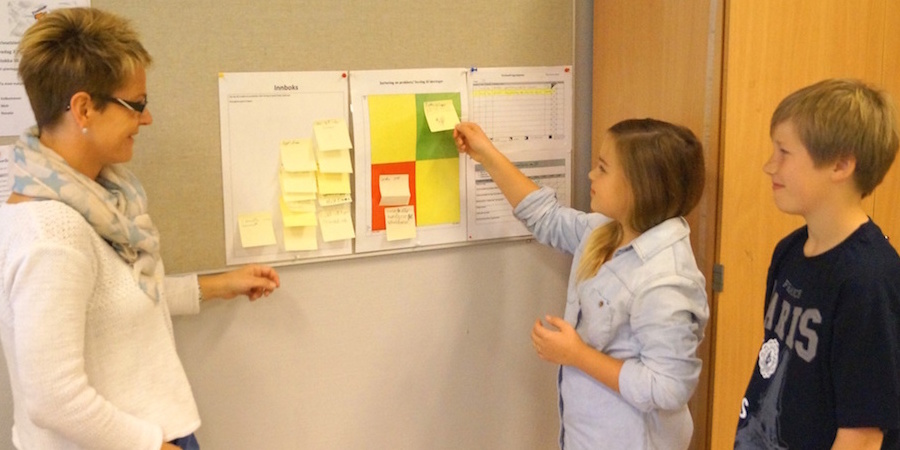
Every morning, all of Baerland's staff get together for a five-minute morning meeting. These meetings focus on operational tasks and allow for rapid problem solving. Staff also hold weekly improvement meetings in front of the team's visual boards, which show the key performance indicators. Improvement suggestions and complaints are raised using post-its. Baerland Primary School has also experimented with value stream mapping (for the local curriculum development process) and uses A3 thinking to ensure communication and problem solving.
The children also take part in improvement activities. At the school, "class councils" have been replaced by "class improvement meetings" (from 4th grade on). These meetings take place in front of the visual improvement boards. So far, the school has implemented more than 1,200 improvement suggestions. The focus is on getting a little better every day.
STANDARDS FOR TEACHING
The most challenging lean practice to implement at Baerland Primary School has been standardization.
Many teachers were afraid that standardization would kill creativity and would not allow them to accommodate the needs of a dynamic and unique classroom with all its different individuals. It is easy to understand this concern if we imagine a Toyota assembly line as the target for standardization at the school. However, Baerland does not aim to reach the extent of standardization that Toyota implements. Instead, the school is trying to agree on some common practices for teaching (for example, how to start and end a class effectively), with the ultimate goal of increasing the quality of education.
"Our sector has always depended on the teachers," explains Principal Gilje. "We need to go beyond my plan to get to our plan". Teachers are now encouraged to share best practices with one another with the aim of improving the overall learning experience for students. From a child's perspective, learning could be easier if the approaches were more coordinated. The best teachers should not keep tips and recommendations about teaching to themselves in order to remain the most popular among the school's educators, but should make their extraordinary teaching skills explicit so that others can learn. The goal is to make the "desired teaching standards" clear, so that one can learn simply by paying attention to them and improve the quality of teaching.
LOOKING TO THE FUTURE
Baerland Primary School wants to become one of the best schools in Norway by spring 2019. Gilje and his colleagues believe that the lean program adapted at Baerland can help create the ideal conditions for good teaching to thrive, but they also know that lean alone is not enough to improve learning.
Principal Gilje sums up his experiences so far: "I believe it will take a few years before we can see a clear improvement in learning. But at least we have already achieved more efficient administrative operations and a better organized workplace, and the teachers are happy with the changes".
In conclusion, successfully applying lean in a primary school requires the careful selection and adaptation of a series of lean principles and practices. I believe that, in this respect, Baerland Primary School is a very good example. They understand that students are not "customers" or "products" in the traditional sense of the terms (both are common misunderstandings in lean implementations in education). They are not customers because they take part in the learning with the teacher (in other words, they are part of the system that creates value), and they are certainly not products to be equipped with knowledge in the same way that parts are assembled onto a chassis in a car factory. Naturally, applying lean thinking in a school is not the same as applying it in the automotive sector, but that does not mean the education sector cannot find inspiration to improve productivity in an industry that is still the most competitive in the world. Wouldn't the future be better if we increased the efficiency of our teaching-learning process?






