

Under our eyes
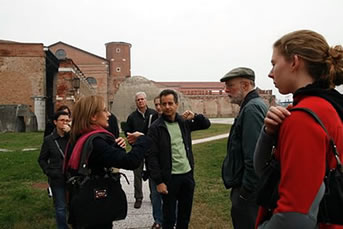
Jim Womack (right), Arnaldo Camuffo (center right), Scientific Director of the Lean Enterprise Center in Italy, and John O'Donnell (center), Executive Director of the Lean Global Network, visited the Arsenale in Venice on November 14, 2009.
During the 1400s, the Venetians made a remarkable leap in their way of thinking about how to organize design and production. They adopted a standard design for their war vessels (called galleys) and began to think systematically about how to produce these ships in high volume. By the mid-1500s, they were fabricating in advance and supplying the parts for the hundreds of vessels they built each year. Then, when the military gave the order, prebuilt hulls were caulked at the first production station and launched into the water. They then floated through the various assembly stations for installation of the masts, rudder, decking, seats, oars, cannons and all the other items needed to complete the most complex manufactured product of that era. Thus we have the first known example of production "flow" through a sequence of processes using standard designs. And, in 1574, when King Henry III of France paid a visit to observe the process, the Arsenale could caulk and complete final assembly of a vessel in just one hour. (Fortunately for us, the basic layout of the Arsenale has not changed since the 1500s, so it is still possible to imagine how the work was done.)
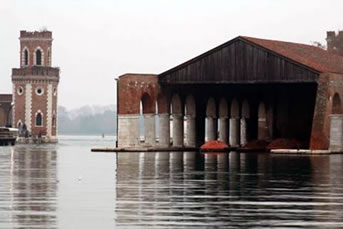
One of the floating assembly corridors at the Arsenale, Venice
As I walked through the Arsenale and reflected on what its designers and production workers contributed to human knowledge and best practice, I found myself wondering what we will add on our watch 500 years later. By my reckoning, our watch (or at least my watch) is the period since 1979, when the practices developed at Toyota, Honda and their hundreds of suppliers in Japan were transferred for the first time to new countries and new industries.
It seems to me that we have already achieved several points of lasting value:
- We have transferred and adapted lean process tools for production, product development, supplier management and customer support to a wide range of sectors in many countries.
- We have tested all the management tools - policy deployment, A3 analysis, and standardized management with kaizen - that are needed to introduce and sustain these process tools.
But we have not combined all these tools and management methods in more than a handful of organizations, and even these companies are struggling in the turbulent conditions the world economy apparently will continue to serve up. So what would be a reasonable expectation for the rest of our watch, which in my case is probably the next 10 years?
It is not realistic to expect that all organizations will become lean. And that wish makes no sense in my view, because lean thinking will keep evolving as the customer problems that need solutions change. The journey never ends as long as there is ever-changing life.
But can we hope to reach a fundamental intermediate destination? Specifically, can we create at least one complete lean enterprise in every major sector and activity by 2020? When I use the term lean enterprise, I mean an organization that focuses clearly on the customer problems it seeks to solve and implements product development, fulfillment, supplier management and customer support processes tied together by lean management to solve them economically.
This is certainly a broad goal, and it seems all the more daunting in light of the recent struggles of our exemplary lean companies. But we already have most of the knowledge, so no fundamental invention is needed. And all the elements of the lean enterprise have been tested individually in real organizations. So the question is whether we think we can. And the only way to find out is to carry out a wide range of experiments across the global Lean Community, freely sharing our findings in the spirit of PDCA. For my part, I will keep thinking that we can, until our experiments conclusively prove otherwise.







