Lean in Materials Recycling at Cooperativa Aliança
 ...  |

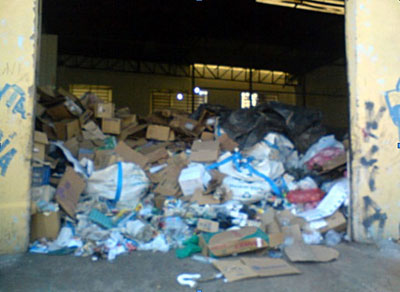
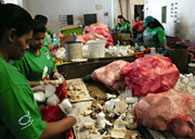
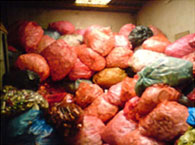
| The purpose of this article is to show how applying some lean concepts helped improve productivity, income and the work environment at Cooperativa Aliança in Sumaré, São Paulo state. We hope this example can help inspire similar initiatives in other communities, bringing them results as significant as those presented here. Cooperativa Aliança was formed in 1999 from a work and income generation project implemented by the NGO "Ecologia e Dignidade Humana" (EDH) of Campinas. Aliança is dedicated to collecting, sorting by type, baling and selling recyclable materials, received as donations from companies, homes and condominiums in the Campinas and Sumaré region. Work at the Cooperative involves intense physical effort, since all handling of materials, including bales weighing more than 100 kg, is done manually; it is also a dangerous activity, due to the handling of sharp and potentially contaminated objects. These conditions are aggravated by little awareness of the need to use PPE and by poor hygiene conditions. The jars, bottles and countless types of packaging received often contain organic residues that cause dirt and bad smells, making the work environment even more hostile. Even so, the Cooperative offers employment and income opportunities to a workforce that is often marginalized and finds it very difficult to be accepted by the formal labor market, owing to low education, lack of professional qualifications and personal problems in the past. One of the NGO's members contacted Lean Institute Brasil (LIB) at the end of 2008 to propose the possibility of working together and, in February 2009, Aliança began to apply lean concepts, with LIB's support, in order to improve its processes and results. The original state - until February 2009 Considering the very precarious general conditions, Aliança's needs at the start of the work were very basic. Pay was low and the work environment was disorganized and not very productive. In addition, relationship problems were frequent and draining, with little team spirit and sense of interdependence among the cooperative members. Material was received loose in the incoming inventory (Image 1) and later placed in bags (transport units holding about 30 kg of material), going on to a weighing step and then to individual separation (sorting) tables, whose number varied between 10 and 14, depending on the number of people available to work.
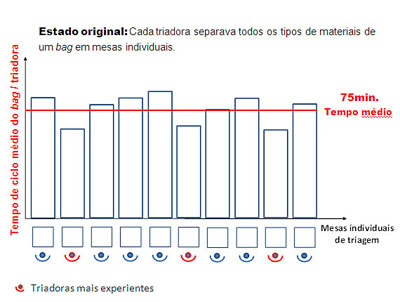
Each sorter received a bag and separated the 40 possible types of recyclables, with an average cycle time of 75 minutes per bag, as illustrated in Chart 1:
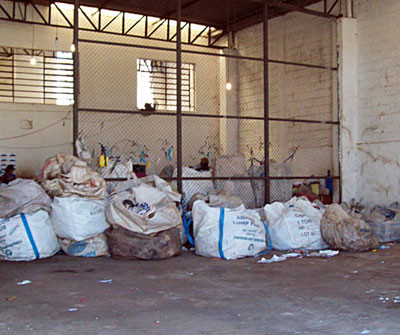
The material separated into plastic sacks was moved to the storage area, from where it was taken to be pressed and turned into bales, which are then sold to customers. The reject (organic waste) from each table was weighed to make up the estimated calculation of individual production in kilograms, on the basis of which the cooperative members were paid. With production organized this way, average productivity was 180 - 220 kg/sorter/day and fortnightly income was around R$140.00. The lead time, that is, the time elapsed between receiving the material and shipping it as bales, was 37 days, 20 of them in the incoming inventory. To help the Cooperative make its activities more effective and productive, it was necessary to use simple tools based on visual resources that would be useful for creating a minimum of workforce stability, standard work and organization of the physical space in the shed. Applying lean concepts: current state (from March 2009 to March 2010) With the analysis of the original value stream, some changes were proposed to reduce the lead time and increase productivity, shaping the cooperative's current state. To reduce the 20 days of incoming inventory, it was necessary to control the volume received for about a week, sending collected material to other cooperatives. In this way, it was possible to organize and clean the collection area. From then on, material began to be unloaded from the trucks directly into the bags, making it easier to move it to the sorting tables. This helped improve material flow and the organization of the area (Image 2).
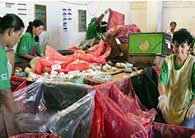
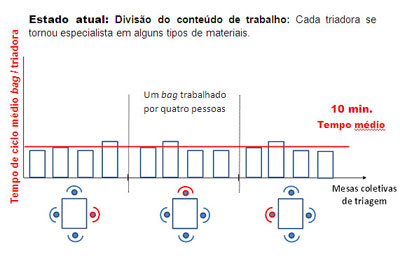
The separation of materials, previously individual, began to be done at 3 collective tables, with 4 people at each (Image 3), and the operators became specialists in certain types of products (about 10 per sorter). This division of labor increased productivity and enabled less experienced sorters to achieve good output with materials that are easier to recognize and handle, initially, while the more experienced ones - one per table - separated more laborious materials, thus setting the pace of sorting.
With the collective tables, the average cycle time dropped from 75 to approximately 10 minutes (Chart 2).
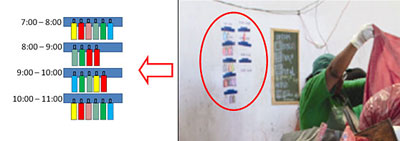
The output of the sorting tables came to be measured by the number of bags sorted and recorded on visual tracking boards (Figure 1). When the sorting of each bag is finished, a key ring is hung on the holder marked with the hourly interval corresponding to the production time. In this way, information on production status can be checked hour by hour. The same happens with the bales that come out of the presses.
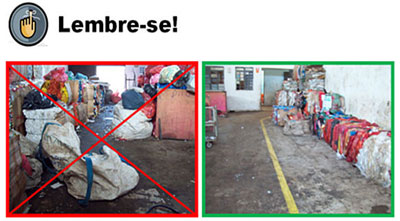
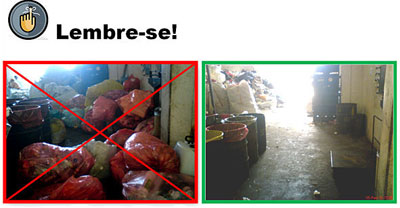
The lead time fell from 37 to 9 days, on average 5 days of bales, 2 days of sorted material and 2 days of incoming inventory. The impacts of variations in the content of the bags and in workforce qualifications were also diluted among team members, making production more uniform and steady. In August 2009, the tables were grouped to form a single collective table, which was possible thanks to the more homogeneous qualifications among the sorters. Pay was no longer linked to individual production in kilograms. In the current situation, after fixed costs are covered, the rest of the money obtained from selling the materials is divided among the cooperative members in proportion to the number of hours each one worked, with the value of an hour of work being the same for everyone. With the end of the individual production calculation, weighing the bags before sorting and weighing the reject from each table became unnecessary and were eliminated. Regarding the need to raise awareness of the importance of organization and cleanliness in the work environment, the cooperative members received basic training on the five senses (5S). To support the implementation of the concepts presented in the training and contribute to the organization of the areas, a system of weekly evaluations was developed, in which organization standards are audited based on reference photos, as in the examples of the bale inventory (Figure 2) and the scale area (Figure 3):
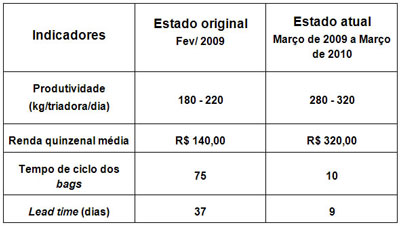
To minimize the effects of workforce instability, an "Integration Plan" was developed, through which new cooperative members receive general information about the Cooperative's history and operation, instructions on the work to be done, the necessary safety and hygiene precautions, etc. To help convey the content and give newcomers context, an illustrated guide with the key steps of the integration process is used. Results The changes to the sorting layout provided a productivity gain of around 68%, going from 180 - 220 kg/sorter/day to 280 - 320 kg/sorter/day, already in the first fortnight after implementation. The average cycle time of the bags was reduced from 75 minutes to 10 minutes and the lead time from 37 to 9 days. The cooperative members' fortnightly income, in turn, increased by 130%, going from R$140 to R$320 on average. The data are in the table below:
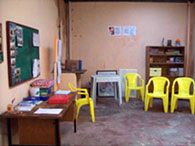
As a result of the improved flow and the general organization of the shed, there was also a gain of approximately 20 m² of space, which turned a materials storeroom (Image 4A) into the Cooperative's training and meeting room (Image 4B).
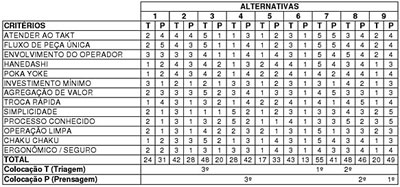
As an additional step, a study of inbound logistics was carried out, with the aim of reducing transport distances and optimizing the use of the collection truck. All collection points were identified and, after a detailed analysis, the previously "random" route was replaced by one in which points located in the same region are collected on the same day, minimizing distances and transport costs. In parallel with the physical improvement of the work environment, there was positive progress in the cooperative members' commitment to productivity, as well as in their relationships with one another. The creation of the collective tables, in this context, contributed to the natural strengthening of team spirit at Aliança. The next steps: the new physical facility Through EDH, the Cooperative received financing from the Brazilian Development Bank (BNDES) to build its own shed and buy machinery and equipment. The layout of the new shed and the production processes of Aliança's future state were developed with the help of the lean 3P tool (Production Preparation Process), with which points are assigned to rank the possible alternatives according to various criteria, such as productivity, simplicity, cost involved, safety and ergonomics, among others, aiming at a future state that prioritizes continuous flow and value creation in the sorting, baling and material handling processes. The 3P analysis with the proposals' scores is shown in Table 2:
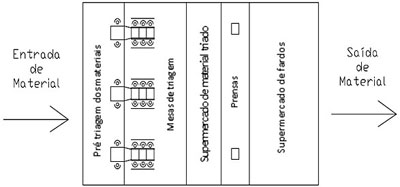
Once the proposals were ranked in the 3P analysis, the layout of the new "lean shed" was drawn up, shown in Figure 4, in which the steps are arranged so as to reduce the need to move materials, facilitating flow.
With the new facilities and well-trained staff, sorting productivity in the future state is estimated to be 40% higher, and 65% higher in the material baling process, considerably increasing the cooperative members' income. Conclusion: The implementation of lean concepts at the Cooperative, even before easing some of the serious issues, helped make the cooperative members aware of the existence of problems and of the importance of recognizing them as opportunities for continuous improvement. As in any lean transformation, however, changing culture and habits has been one of the biggest challenges. Even so, it is possible to see that the cooperative members' perception of how to see and solve problems has become clearer and more autonomous since the activities began in 2009. The Cooperative's reality is still quite difficult, despite the advances described in this article. Manual work remains very heavy and pay falls short of needs. On the other hand, there are good prospects for the next steps, thanks to the financing of the new shed and the estimated increases in efficiency and income that the future state will provide. Building the new physical facility, however, is not enough to solve all of the Cooperative's serious problems; to achieve workforce stability and sound management, it will be necessary to run the activities in an increasingly effective and productive way. Until then, however, there is still a lot of work to be done. Acknowledgments. Thanks to everyone who helped prepare this article, especially Maria Cristina Amoroso Lima, who initiated Aliança's contact with Lean Institute Brasil and was responsible for implementing the lean project at the Cooperative; to Aliança's cooperative members, for their willpower and courage in facing the changes; and to my LIB colleagues Diogo Kosaka, the project manager, and Alvair Silveira Torres Júnior, who supported the development of the concept for the new shed. I thank EDH for the opportunity to work as an intern during the initial stages of this project. | |||||||||||||||||||||||