

Dojos change minds
A year and a half ago, our plant in Caxias do Sul, in southern Brazil — which makes fifth wheels for trucks, the part that connects the tractor to the trailer — was facing safety problems. JOST has clear safety guidelines, but people struggled to follow them. Whether crossing the aisles using the safety walkway or holding the handrail when going up or down stairs, there was a clear lack of adherence to safety rules. This resulted in a series of accidents that, together with several quality problems, led the organization to question its approach to training and developing people.
Traditionally, our training method involved taking people to a training room, showing them a few slides and assuming that this would be enough for them to understand and internalize the standards they were supposed to follow in their daily work. Of course, this did not work. Even leaders failed to follow the safety rules, setting the wrong example and failing to fulfill their responsibility toward frontline workers.
What could we do to make people part of the solution, transform their behaviors and, along the way, develop a more solid and effective approach to training? The solution came in the form of a dojo – a structured learning environment where employees practice and develop their skills through hands-on training and problem-solving activities. Knowing that Toyota, Embraer and other excellent companies use dojos to develop their employees, we made some visits and carried out a benchmark analysis. We realized we did not have the knowledge needed to develop a dojo, so we partnered with Lean Institute Brasil.
LIB has developed an effective approach for this that is being used in many organizations. It is based on the key elements of three learning theories — behaviorism, constructivism and cognitivism — together with the practices of Training Within Industry (TWI).
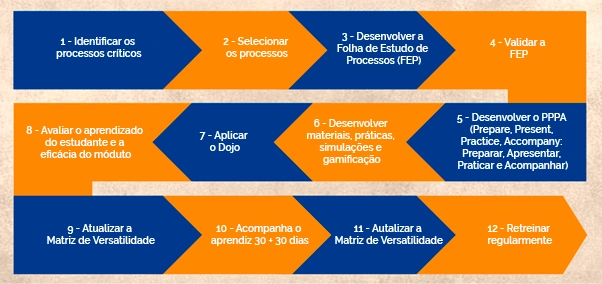
The implementation of the dojo, as designed by LIB, follows a clear set of steps organized into three main stages: structuring the project, developing the dojo trainers and standard material, and creating the actual dojo space (which should be as similar as possible to the real environment at the gemba).
How did it work?
The first step for us was to raise leadership awareness. We knew that senior management needed to sponsor the project for it to succeed. Once we secured that support, we were ready to run our first pilot.
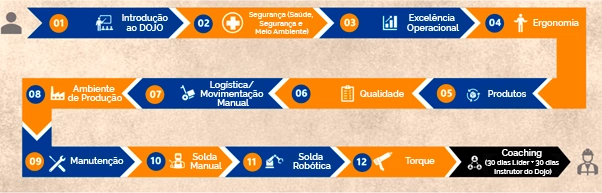
It focused on the first three modules (there are 12 in all): introduction to the dojo; health, safety and environment; and operational excellence. Collectively, these modules comprised eight hours of training, during which roles and behaviors, safety, standardization, waste and the help chain were discussed.
With LIB's help, for each module we tackled, we developed a process study sheet and identified the main deliverables of each module. Then we decided how to prepare the dojo space to offer the best possible training and ensure that people truly internalized concepts and practices. A document is prepared providing a roadmap for people as they work through each module.
The dojo space (which is, by definition, flexible and adapts to the specific needs of each organization) changes according to circumstances, with certain simulations or devices (such as screens for quizzes designed to test people's understanding of the standards) taking center stage.
The first training we offered in the new space was for managers and the leadership team, to ensure they were clear on the five golden rules. After that, we went full steam ahead. Since the initiative was launched, in July 2023, an impressive 400 people have gone through dojo training. This incredible dissemination of knowledge was the responsibility of four dojo instructors (to develop them, LIB provided a 16-hour training; prior experience with the processes was also a prerequisite), supported by a team of multipliers. As our implementation progressed, we began to dig deeper into activities – such as welding – that were creating specific quality problems.
The four dojo instructors were selected based on the skills we identified as necessary during our benchmarking exercise. We looked at how they communicated, what experience they had on the shop floor, and so on. We tried to give these positions to internal people: one of our instructors, for example, has been working in the process for 10 years. That kind of experience is invaluable!
All new employees now go through the dojo when they join the company. I recently received a message from one of our team leaders, who told me that a new hire had complained that a document that should have been displayed at their workstation, as mentioned in the dojo, was not there. This is a sign that the dojo is really working. In fact, onboarding has become much easier: we have had high staff turnover in recent months, and having a system to onboard people quickly and effectively has proved very useful.
Results
We are the first client with which LIB has used this approach, and the results have been so impressive that we are currently introducing other departments to the use of the dojo. Safety accidents have disappeared, adherence to the five golden rules is increasing (something hard to measure, but impossible to ignore at JOST today), and the number of quality defects started to fall even before the team formally began to address quality. In the last quarter of 2023, compared to the same period of the previous year, the number of customer complaints fell from 24 to 9. This is how behavior change becomes powerful! For example, at the end of 2022, 83% of the employees surveyed said they did not use the handrail when going up or down the stairs, whereas six months after the dojo was implemented, 93% said they always use it! Interestingly, the number of unsafe conditions reported by team members increased by 110%, proof that their understanding of what constitutes a risk has grown.
In recent months, news of our dojo's success has spread and other companies in the JOST group have been visiting us in Caxias do Sul to see what we have been doing. Two of these companies have already begun implementing their own dojos. Our German COO also visited us, and there are now talks about applying the dojo to the entire JOST group, worldwide.
Overall, we are reducing the time needed to bring a team member to maturity in their understanding of the standards. We are also noticing that our people have started asking questions about the work, a sign that the company culture is changing. That is what we were hoping for. The dojo is a safe space to discuss problems, a fundamental part of that "show respect" principle that is so crucial in Lean Thinking.
As we look ahead, our next steps are clear. We will continue to tackle the dojo modules, gradually involving maintenance, ergonomics and welding. By the end of the year, we plan to complete the 12 steps of the roadmap. We also plan to work more closely with leadership, reinforcing the message so that we can truly change their behaviors.
People often assume that the dojo is a place that works on people's hands, their practical skills, but that is only one part. It is in their minds that we are seeing the biggest change!
Change only comes when you work for it! Achieve change in a practical way with our Lean Training Program!







