

The roots of lean
Summary
The Training Within Industry Service (TWI) was launched in 1940, during World War II, with the aim of increasing production to meet the needs of the Allied war effort. The TWI Service was led by the Four Horsemen, as they came to be known during World War II: Channing Rice Dooley, Director of the TWI Service; Walter Dietz, Associate Director; Mike Kane, Assistant Director; and William Conover, Assistant Director. Three of these four men first met at a training center during World War I, using methods developed by Charlles Allen. Allen's training methodology, originally developed for the shipbuilding industry during World War I, would become the key to the methods developed by the Four Horsemen during their service with TWI.
From Allen's Four-Step training method, the "J programs" would evolve and have a major impact on the manufacturing industry of the United States during the war. The "J programs" were:
• Job Instruction (JI);
• Job Methods (JM);
• Job Relations (JR);
• Program Development
These programs were brought into industry by a broad network of trainers set up across the country by the TWI Service. They focused on the interface between supervisors and workers and proved to be of unmatched value to the industries supporting the United States war effort.
After Japan's defeat, the occupation forces realized that, for the country to rise from the ruins left by the war and to prevent chaos in a defeated nation, Japan would need help rebuilding its industrial infrastructure. The program developed by the TWI Service was exactly what was needed to help Japanese management achieve this goal.
A seasoned former TWI trainer and his group were hired to go to Japan and begin the training process. They used the cascade process (training trainers who could become the core for training more trainers) to start the program. Many Japanese agencies took this training and carried it nationwide. The massive training in the TWI program over the following decades in every plant of Japanese industry made the principles taught become an integral part of what is known today as Japanese Management. The centerpiece of these methods is kaizen, which has its origin in TWI and in Charles Allen.
A review of some philosophies of Japanese management and of kaizen proves that they really did evolve from the training methodology developed roughly ninety years ago in the United States. The techniques evolved through the TWI programs during World War II and their infiltration into Japanese industry by the Allied Occupation Forces. They continued to evolve in postwar Japan up to the present day to become some of the most successful techniques in use in factories today. The following table compares the basic Four-Step training across this century.
Step |
Charles Allen |
TWI |
Kaizen |
||
Job Instruction |
Job Methods |
Job Relations |
|||
1 |
Preparation |
Prepare |
Stop |
Get the Facts |
Observe and Time the Current Process |
2 |
Presentation |
Present |
Question |
Weigh and Decide |
Analyze the current process |
3 |
Application |
Try Out |
Develop |
Take Action |
Implement and test a new process |
4 |
Test |
Follow Up |
Apply |
Check Results |
Document the new standard |
Table 1: Comparison of the Steps
SOURCE: Created by the author.
The twisted irony of these management principles is that, even though they have their roots in the United States, American companies today are reluctant to use them at the level of success that some of their Japanese competitors do.
What TWI Was and Why It Was Created
What was the Training Within Industry Service, TWI? What does it have in common with modern manufacturing techniques? The answer is everything. For those who have heard of Lean Production, Japanese Management methods and Kaizen, TWI can be considered ground zero of these manufacturing philosophies, which have become the most promising techniques in industry today.
The TWI Service was created and developed for the industries supporting the United States war effort during World War II. TWI was launched in August 1940 by the National Defense Advisory Commission (NDAC) and was eventually transferred to the Federal Security Agency (FSA), in order to function as part of the new War Manpower Commission (WMC), on April 18, 1942. TWI would remain under the command of the WMC until its operations ceased, which happened in September 1945.
TWI was one of the first emergency services organized after the Fall of France on June 20, 1940. As war had been declared, the Allied Forces (even before the United States entered the war) needed large quantities of war supplies. This need sharply increased production levels in every type of industry. The United States government took note of this issue and began taking the first steps in an attempt to help cover the demand for war materials. Many factories saw a significant increase in their orders, both for conventional products and for new products, which exceeded the factories' capacity to respond. It was also clear that, if the United States entered the war, the situation could become even more critical. The TWI Service began operating with the aim of increasing production to meet the gigantic demand that was overwhelming the factories. It was focused on war contractors and other manufacturers needed for war supplies, which kept growing in number as companies converted to war production.
TWI established a nationwide network of industry professionals to teach valuable techniques to the manufacturers of war materials. The network was made up of a volunteer support group, some full time and others part time, from private factories that lent their people. The real work had to be done by industry, within industry. This emphasis was essential to create a legitimate organization that could be accepted by the factories. Moreover, for the same reason, TWI was never forced into any industrial facility; on the contrary, it was only used when invited and accepted by the factory's management.
The Four Horsemen
The Four Horsemen, as they became known for their leadership and the services they rendered, were Channing Rice Dooley, Director of the TWI Service; Walter Dietz, Associate Director; Mike Kane, Assistant Director; and William Conover, Assistant Director. Dooley and Dietz were both Purdue University graduates and had long experience in factories, and they had also previously served the government on training matters during World War I. Both generously agreed to leave the management of their companies to coordinate and develop the TWI program. During their assignments in World War I, they worked together and both were familiar with Charles Allen's Four-Step training method (as will be explained later, this training method became the backbone of the TWI program). Kane had been involved with industrial training for most of his career and had worked directly with Charles Allen in training shipyard workers during World War I. He knew Dooley and Dietz from the events of World War I. Conover had also been involved with industrial relations and training during his professional career.
The Four Horsemen were the leadership and the driving force of the TWI Service, and it was their vision and experience that helped the TWI programs become a great success. Although it took the combined contribution of a large number of people from the factories to develop and deploy the objectives of the TWI Service, the Four Horsemen understood the magnitude of the task and what would be required of industry and government to evolve and guide the process.
The Results of TWI
The effectiveness of the TWI Service was highly visible throughout the war. The Training Within Industry Report: 1940 – 1945 gives us many details of the programs' results and tells how TWI monitored the impact of its services throughout its existence. Below is the table with the results collected by TWI at seven different intervals while it provided its services.
Note: 25% or more of plants reporting results
|
March 1943 |
September 1943 |
February 1944 |
November 1944 |
April 1945 |
July 1945 |
September 1945 |
Increased production |
37 |
30 |
62 |
76 |
64 |
63 |
86 |
Reduced training time |
48 |
69 |
79 |
92 |
96 |
95 |
100 |
Labor saved |
11 |
39 |
47 |
73 |
84 |
74 |
88 |
Reduced scrap |
11 |
11 |
53 |
20 |
61 |
66 |
55 |
Reduced product complaints |
No data |
No data |
55 |
65 |
96 |
100 |
100 |
Table 2: TWI Results in Industry
SOURCE: War Production Board, Bureau of Training, Training Within Industry Service, September 1945, Training Within Industry Report: 1940-1945, (Washington D.C.: U.S. Government Printing Office), page 92.
The number of plant employees going through the five courses, with two-hour sessions for each training program, was very large. Even though the number of those who attended the sessions does not necessarily represent the results directly, it gives us an idea of the magnitude of the reach achieved by the TWI Service during its brief five-year existence. Considering that all the programs had to be developed and that the TWI Service actually started collecting data late in its first year, the number of people trained is quite impressive.
When the TWI operating service ended its activities on September 30, 1945, the following overall totals were announced:
Job Instruction, JI 1,005,170.
Job Methods, JM 244,733
Job Relations, JR 490,022
Union Job Relations 8,856
Program Development 1,829
Total 1,750,650
These people were trained in 16511 plants and unions, in all types and sizes of war industries and essential services...
How TWI advanced during World War II
The purpose of the TWI program is clearly stated in the following review bulletin:
To help war industries find out what their real manpower needs were, by training within industry each worker in how to make the best possible use of his skills up to the maximum of his individual abilities, thereby making it possible to keep up the pace of production to meet the demands of war.
This objective would guide the TWI leaders as they continued to develop the best means to be applied during the five years the program existed. The development process was very laborious, but it resulted in excellent, field-tested methods and procedures.
The First Effort
The first effort was carried out with the aim of using the TWI network of people to advise industrial plants on how to solve many of their respective problems. The TWI leaders quickly realized that this method might not be the most suitable for serving the growing number of companies requesting assistance. Although it is true that much of TWI's initial effort went into promoting its services, there was a strong increase in the use of its resources. TWI developed bulletins, surveys and speeches in order to "sell" its programs. This process was not easy, since many factories had not yet felt the need for training programs or even thought they would not have time available for it.
Even with the need to sell TWI's services, the efforts to spread them were still very timid. As the TWI leaders soon discovered, problems arose because TWI members had to work as consultants in manufacturing industries, which kept asking for help to solve their various internal problems. This quickly overloaded the resources of the TWI network in just two editions of the program. Trying to solve problems in the role of consultants consumed an enormous amount of time, which was not acceptable if TWI members were supposed to help the war supply industry as a whole. Companies needed help to solve internal problems with manpower, materials and equipment – from internal disputes to safety problems. In addition, the number of defense-oriented factories continued to rise sharply. Even though conditions during this period of the TWI service moved toward a chaotic situation, an important lesson could be drawn from it all: TWI should keep its focus on vigorously helping factories in the war effort.
The Second Effort
The initial chaotic period of trying to organize the TWI Service served to redirect it toward a new plan and focus. A passage from Walter Dietz's book explains what was done.
The regional heads met in Washington, where they exchanged experiences and discussed new ideas. It was decided to make a major change in the whole working method, and some items of the original plan, such as consulting for companies on a large scale with internal training problems, were dropped. Instead, the needs of supervisors became the main focus, since the shortage of experienced labor forced countless factories to hire many people who were not qualified for the job.
The new objective was to give TWI the direction it needed to succeed for the rest of its work. The focus on supervisors and their relationship with workers would be the critical factor needed to support the war effort. This factor is also one of the main foundations from which Japanese management methods evolved. This correlation will be illustrated below.
TWI's leadership realized that the methods developed would need to be taught satisfactorily by trainers on a large scale, with different levels of experience and skills, in many different factories. Moreover, this information would be passed on to an enormous number of supervisors with widely varying levels of experience and knowledge. It was a thoroughly daunting task, and the training methods would have to be absolutely bulletproof. To deal with this problem, Charles Allen's Four-Step method played a significant role.
The Origin of the TWI Methodology
The central pillar of the TWI Service training program was developed from the methodology introduced by Dooley, Dietz and Kane. All three gentlemen had been involved in providing training services during World War I. They used their own experiences to develop the TWI training programs during World War II.
Charles R. Allen
During World War I, the Emergency Fleet Corporation of the United States Shipping Board implemented an urgent training program to help shipyard workers due to an enormous and unexpected increase in the demand for the number of workers needed. Because of this demand, only inexperienced workers were available, and it was necessary to train them.
Charles Allen had a vocation for being an instructor; he developed and presented his idea of industrial training before World War I and later published his book in 1919.
In addition, Allen was given by the Emergency Fleet Corporation the mission of directing the setup of the training program, to address the immense need for training workers in the shipyards. Allen used his Four-Step method, as described below, to prepare the workers:
... every complete teaching lesson requires 4 steps or training operations known as step 1- Preparation, step 2- Presentation, step 3- Application and step 4- Test (or Inspection). These steps are always taught in this given order – The purpose of step 1 is to get the learner ready to learn, of step 2 is to instruct him, of step 3 is to check for errors and of step 4 is to make a final inspection of the Job Instruction.
Charles Allen's methods and philosophies also describe how to choose the best instructors, what it means to be an industrial instructor, what one needs to know and do, and details of the essence of what is or is not effective training. These and many other lessons from Allen are thoroughly linked to one another, especially in the methods and practices of the TWI program. In fact, in the first pages of his book, Allen makes his reasons clear:
This book is intended, therefore, to serve two purposes - to serve as a manual for instructors in industrial plants and, in addition, to be used as "instruction notes" in instructor training courses.
Allen's Four-Step Method was the basis for all the training programs developed by TWI during World War II. It was a known and proven method that had endured for 30 years. Apart from a few dated phrases, the methods presented in Allen's book are as valid and applicable today as they were at the beginning of the century (World War I) and in the middle of the century (World War II).
The Importance of Training
Allen recognized and emphasized the importance of proper training in factories. He detailed how improperly trained workers can be costly and showed the cheaper method of using only well-trained employees from the start.
... Three factors in efficient production... The instructor, because it is through effective instruction that we can ensure efficiency in training. The man, because when properly trained, he does the best work. The job, because productive efficiency comes from well-trained men doing good jobs.
To achieve the best training, four principles must be applied: standards must be set, correct instruction must be established, continuous training must be maintained, and training cannot end after a short time. These principles must become an integral part of the company's business process. These items seem to be common sense, but how many companies have this kind of program running at a high level, and how many even use one?
Allen devoted much of the book not only to his Four-Step training method, but also to training methods and effective training conditions. He illustrated much of his work with shop-floor examples, emphasizing the importance of getting the learner's "interest," or making the learner want to learn. He also covered in great detail the importance of selecting the right people to be instructors, how the instructor should or should not teach, and how the instructor should develop, organize and deliver the training. Even though Allen's training methods are "straightforward" and seem like common sense, they are not very common in today's factories.
The Four-Step Method
Charles Allen's Four-Step process was the basis for the TWI training program. The first step, Preparation, aims to create minds willing to learn; it works as a connection between the worker's past experiences and the lessons that will be taught to him. However, the learner may not have any industrial experience, so a good instructor must find an analogy or story with which to lead the learner to relate what is being taught to something he already knows. Allen emphasizes that even when teaching the simplest technique or job, Preparation is the key to increasing the effectiveness of training. It may be suggested that holding on to a previous experience, even one considered simple or only indirectly related, leads the learner to think that he should do it with his own hands, showing "interest" on his part. It is mostly for this reason that Allen devotes many chapters of his book to methods for increasing the learner's interest.
The second step, Presentation, in Allen's own words, serves "to lead them to 'get' the new idea that the instructor wishes to ´add ´ to what he (the learner) already knows."
Presentation gives the person in training one part of the knowledge, and each of these parts is only a small piece of a larger lesson. The instructor must make an effort not to pass on too much information at once. This makes it possible to focus attention on the single point that must be taught. The format of this step, Presentation, is that of a well-organized process established primarily to teach with methods chosen to achieve the best lesson on the best subject. The process of developing the Presentation was selected from a wide variety of methods, as detailed throughout the book, based both on the types of work and on the characteristics and knowledge level of the learner. The effectiveness of developing the best Presentation method depends entirely on the instructor's skill in the following areas: selecting the appropriate method, organizing the points to be taught, and emphasizing the most important points.
Application, the third step, will establish whether the learner will be able to "do it." Even if the learner is on the right line of reasoning (step 1) and the instructor has done an excellent job of presenting the lesson (step 2), there is no certainty that the newly acquired knowledge can be put into practice. Allen emphasizes in step 3 that learning has no value unless the person can actually do it, and do it correctly. The Application step has two purposes:
1. ...since the power to apply a thing is different from simply knowing it, he must be trained in actually applying or putting into practice what has been presented.
2. ...to check the stage of knowledge the learner has understood on all points of the lesson.
Another important point considered by Allen is that no matter how well the lesson has been delivered, errors will arise and must be corrected at this stage.
The final step, Test, is nothing more than simply allowing the learner to do his job without help, but under the inspection of an instructor. If the learner fails to do his job independently, it means that the instructor did not implement the appropriate teaching method. The method must be improved and applied once again. He emphasizes that if each of the steps was carefully and properly developed and taught, then the learner should not fail during the Test step. Failure is entirely the instructor's fault. Allen explains emphatically how common this situation is and that truly instructing is not an easy skill to learn. A great deal of practice and experience is part of developing a good instructor. The person who can successfully go through the four steps with a learner can be considered a rare and valuable resource. The last step is much more a test for the instructor than for the learner.
Allen's Four-Step method of instruction is a series of building blocks, each of which depends on the previous one in order to succeed. Allen's explanation of the Four-Step method shows that it is a method of correctly joining and linking a series of One-Point lessons, which are common today in many companies that use lean principles or Japanese management methods. Each modular lesson within the complete lesson must have a single, focused point, and it must be understood by the learners within the overall context of the course. Even though the explanation of the Four Steps takes up only four chapters of Allen's book, all the other chapters present ideas, philosophies, examples, procedures and methods on how to understand, prepare, develop and deliver the Four Steps successfully, or simply how to be an effective instructor.
The Courses
The link between Charles Allen's methods and the TWI Service training program comes directly from the TWI leaders. Kane was a member of Charles Allen's Emergency Fleet Corporation group during World War I. Dooley and Dietz had enlisted in the War Department and knew Allen and Kane, as well as Allen's training methods. In fact, in The Training Within Industry Report 1940-1945, significant discussion was devoted to Allen's work and his emphasis on making very clear the differences between "teaching and telling" and "instructing and showing." The importance of teaching and instructing instead of telling and showing became the main foundation of the TWI programs, learning by doing, which means solving problems on the job with the help of a properly trained instructor. The goal of learning by doing would become an integral part of TWI's training philosophy.
The Five Needs of a Supervisor
TWI continued "selling" its products to manufacturing plants. To be able to explain to the factories why the programs were beneficial, TWI developed a philosophy that was conveyed continuously, becoming a standard part of the TWI Service. This philosophy was known as:
Every Supervisor Has Five Needs:
1. Knowledge of the Work;
2. Knowledge of Responsibilities;
3. Skill in Instructing;
4. Skill in Improving Methods;
5. Skill in Leading.
The first two needs were the responsibility of the industry or company to establish for the supervisor. This position covered equipment, products and the capacity needed to produce them, as well as company policy, agreements and schedules. TWI assisted companies by training supervisors so that they could meet the last three needs. As will be discussed further on, each of the three "J programs" focuses on one of these three needs of the supervisor. These skills must be learned and practiced in order to meet and increase production levels, especially under the circumstances present at that time in the United States.
The "J Programs"
The "J programs" , as they came to be known, were modeled on Allen's Four-Step training method. Kane used the Four-Step method during one of TWI's early programs. The lack of trained lens grinders and polishers resulted in a severe shortage of lenses, and this led to calling in the TWI Service. Kane used the Four-Step method to develop a Seven-Step method combined with "key points," created to reduce the time required to train lens grinders and polishers from years to months. The key point concepts were developed during the lens crisis. Kane discovered that, even though there was an enormous number of operations to learn in order to manufacture lenses, only a small part of the operations was difficult to master. Moreover, only a few steps within the vital operations complicated the way they had to be understood in order to master the techniques successfully. As Dietz would later point out, "In essence, "Key Points" mean simply this: much of the supposedly complicated work in any industrial operation is relatively simple". By combining his modified "Steps" with the newly developed "Key Points," Kane not only significantly improved training for the lens crisis, but also created what would become the supporting pillar of the TWI training program.
Job Instruction (JI)
Charles Allen's Four-Step method for industrial instruction was used to develop the five sessions (two hours each) of the Job Instruction training program. The first two sessions covered the presentation and discussion of the instruction method developed, and the last three sessions were used for actual practice of the method. All participants were to use a method of instruction taught with the members of their departments, for actual application of the methods presented, and then come back and report to the group during the sessions on what happened. This day-to-day application was based on the slogan adopted by TWI, "If the worker hasn't learned, the instructor hasn't taught". This approach was yet another philosophy that the TWI Service borrowed from Charles Allen. Allen repeatedly reinforced his points, or better yet, his attitudes, in his book and in his own instruction sessions. The TWI mission would incorporate this approach during the development and implementation of its training programs.
The Job Instruction program would not be officially launched until it had been used, evaluated and revised countless times. In fact, all training programs were to be developed in the same way. TWI would develop the instruction method by using it in several factories and then using the "feedback" from these companies, together with its own assessment of how efficiently the task had been carried out. This approach was used to develop a powerful method to be used successfully in all factories, and moreover, it was a method developed for industry by industry. The leaders of the TWI Service, even though they themselves had come from industry, believed that "for industry by industry" was critical to the acceptance and success of the program.
Job Instruction focused on instructing workers rather than "letting them learn". This focus was present even before the training program was developed and continued throughout the existence of the TWI Service. A training manual developed by the Western Eletric Company during the war was published by TWI, and its focus was once again emphasized. It also drew on Charles Allen's Four-Step method and the job analysis technique to develop good training methods. The manual that was developed, Job Instruction: A Manual for Shop Supervisors and Instructors, read like a summary of Allen's book and contained references to two of Allen's training books in its bibliography. The manual stated:
Good instruction is helping people learn without getting in the way of their learning methods. Poor teaching can actually limit their learning.
The Job Instruction training manual was developed to tackle one of the first issues addressed after TWI refocused its efforts. With the growing increase in demand and consequently in production, combined with the decrease in experienced workers, training new employees became a critical factor. TWI introduced Job Instruction training to help ease the problem. With Allen's Four-Step method as the centerpiece of the training, significant improvements were made in a large number of war production facilities.
The Job Instruction training manual refers to the Job Instruction Cards and their use during training sessions. Everyone who went through the training received a card. The front of the card showed the procedure the instructor or supervisor should follow to be "prepared" to instruct. On the back was the four-step method of How to Instruct. The small pocket card was an important training tool. The training card was to be carried by supervisors at all times, as a reminder of and a reference to the methods they had been trained to use in their jobs.
Photos of the original Job Instruction cards are shown below.
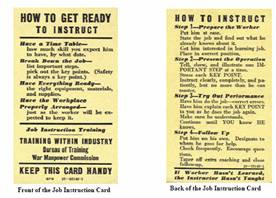
Figure 1: TWI Job Instruction Card
SOURCE: War Production Board, Bureau of Training, Training Within Industry Service, 1944, Job Instructions: Sessions Outline and Reference Material (Washington D.C.: U.S. Government Printing Office), Inside back cover.
Job Methods (JM)
The objective of Job Methods training was to give supervisors a technique for achieving obvious improvements in the work area using a practical method rather than a technical one. Using this philosophy made it possible to apply a universal procedure successfully in all types of war plants.
...the aim of helping supervisors produce greater quantities of quality products in less time, by making the best use of the manpower, machines and materials available at the time.
The Four-Step method was once again used to develop the training procedure. Within the method, the procedure of breaking down jobs was critical for developing a new and improved way of doing the job. A simple demonstration of assembling a radio shield was used during the training session to show how to analyze the "present" method and implement a new way for the "proposed" or improved method. The target of the Job Methods program was to keep supervisors from ideas that were incomplete or poorly formulated. By following the four-step Job Methods procedure, supervisors would achieve improvements during the process and create workable solutions before presenting them to process management. An outline of the course, just as in Job Instruction, was printed, and trainees were given a small pocket card to serve as a reference whenever needed. The card is illustrated below. A similarity to the method used to implement KAIZEN can be seen in the steps detailed on the card. The reason for this will be discussed later. Job Methods proved to be another successful program for the TWI Service.
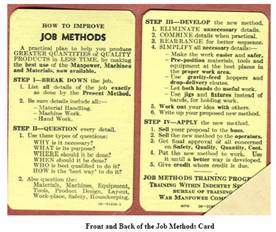
Figure 2: TWI Job Methods Card
SOURCE: War Production Board, Bureau of Training, Training Within Industry Service, 1944, Job Methods: Sessions Outline and Reference Material (Washington D.C.: U.S. Government Printing Office), Inside back cover.
Job Relations
The Job Relations program was implemented mainly to meet the following need:
...that supervisor needed a great deal of help in human relations – the art of dealing with people.
Although the need was part of a human relations problem between supervisors and their subordinates, the term "job" was used to name the program, to relate the program to the job, as all the "J programs" were. With this emphasis in mind, the theme that problematic relationships produce poor results in production and good relationships lead to good results on the job would become the underlying objective of the procedure developed for Job Relations. The program placed great emphasis on teaching the importance of understanding and solving small problems before they grow too large and spread. During the development of Job Relations training, some universal and fundamental elements were discovered. These elements became the foundation of the Job Relations program, the most vital skill that any supervisor must be able to have: People Must be treated as individuals.
As with the other two "J programs," the Four-Step method was used to develop the Job Relations procedures, thus securing principles that were not so clear-cut. The training sessions consisted of explanations of the principles using cases taken from everyday life, involving a fictitious supervisor and worker. Each of the four steps would be presented in a showing of a case study and how the supervisor solved the problem. This method was used to present the lesson to the group. Each participant was then required to use the process in his area of responsibility, and afterward report the results back to the class. Once again, a Job Relations card was made and given to each training participant to serve as a reference. The outline of the main points of the Job Relations process is listed on the card, as shown below.
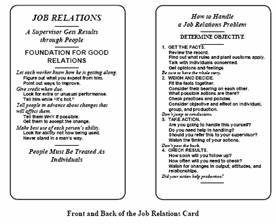
Figure 3: TWI Job Relations Card
SOURCE: Adapted from Bird McCord, "Job Instruction," Robert L. Craig (ed.), 1976, The Training and Development Handbook – A Guide to Human Resource Development, 2nd ed. (New York: McGraw-Hill), p. 32-22.
Union Job Relations
In February 1945, the TWI Service launched the Union Job Relations training manual. The development and introduction of this manual resulted from many unionized plants using copies of the Job Relations manual to train their union stewards. The Union Job Relations manual was a modified version of the Job Relations manual, with its focus on union stewards rather than supervisors. Four union problem cases were also used to teach what was needed. The basic format was the same as that of the Job Relations manual. Union leadership across the country gave great support to the "J Programs," considering them a great help to their members.
Program Development
Program Development was organized with the aim of showing factories how to set up and administer training within their own facilities using their own people. As was now standard for TWI, the Four-Step method and Key Points were used to present the procedures for plant employees to solve their production problems themselves, through a training program using the "J Programs" as a basis. Program Development was created using information gathered from many experts within industry, to keep TWI's premise, "for industry by industry". A series of conferences was used to obtain information, set down the outline of the main points and develop the procedure into an acceptable and usable form. Several iterations of Program Development XXX during its evolution, including different names for the program and changes in its outline. As soon as its final version was released, the Program Development card was available and the four steps of the method were listed as they appear in the following illustration.
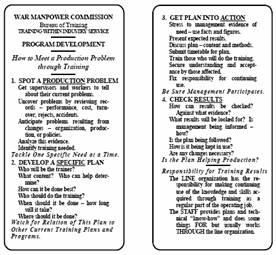
Figure 4: TWI Program Development Card
SOURCE: Adapted from Walter Dietz with Betty W. Bevens, 1970, Learn by Doing: The Story of Training Within Industry (Summit, NJ: Walter Dietz), p.26.
The introduction of Program Development followed a familiar path for those facilities that had already received the supervisory programs.
The P.D. Institute Conductor followed standard TWI practice, described a production problem and then demonstrated how a director in training solved it through the use of the four-step method.
Program Development would be the last service that TWI would develop and disseminate. By the time the last revision of the program was completed, the end of the war was foreseen, and this meant that the end of TWI was also approaching.
The Multiplier Principle
An important technique used by the TWI Service was the key to spreading the training programs on a large scale throughout all the war facilities in the country. This technique became known as the Multiplier Principle. A simple statement read:
Develop a standard method, then train people who will then train other people who will repeatedly train groups of people to use the method.
Using the multiplier principle allowed TWI to certify more than 1.7 million and trainers throughout the United States during its brief five-year existence.
Along with the multiplier principle were TWI's requirements for strict adherence, to follow the training programs exactly as planned. Trainers were expected to follow the manuals exactly as they directed or they could lose their licenses. The manuals had an exclusive layout to be read at most within five steps of a walk, so the trainers could easily have a reference as a basis and, moreover, could read them during the training sessions. Each manual had reference sections explaining information in detail, changes of font and symbols to show exactly what the trainers should do, emphasize and even what to write on the blackboard. The Job Instruction manual had the phrase, WORK FROM THIS IMPORTANT INFORMATION – DON'T TRUST TO MEMORY, on every page as a reminder to strictly follow the format of the book. Each of the manuals of the three "J programs" had a letter from Dooley to the War Production Trainer, which contained the following statement:
To ensure a uniformly high standard, you must ALWAYS work from the outline. Never deviate from it. Do not trust your memory, regardless of the number of times you have presented the plan. It is not difficult, and if you follow the instructions, you will not fail.
All these methods, together with the multiplier principle, allowed TWI to present a well-standardized curriculum to a large number of factories, using many trainers with a wide range of experience and skill. This technique was the method of maintaining quality control over its services. TWI realized that, once the Job Instruction training program had been developed, as with the other programs, trainers must follow the sessions strictly as intended in order for success to occur.
The Kaizen Technique
The most interesting aspect of what TWI accomplished, besides of course the great success that North American factories achieved during the war effort, is KAIZEN. Kaizen has become one of the most recognized and widely used techniques of Japanese management methods, or of the Toyota Production System, TPS. Even though kaizen is just one of many tools and/or philosophies of lean production, its origin can be traced back to the beginning of the 20th century. In short, Charles Allen's Four-Step method can be considered the grandfather of kaizen.
Job Methods – The Original Kaizen
Briefly reviewing the previous topics, the objective of Job Methods was to give the supervisor a means of improving production using a practical method rather than a technical one. TWI wanted to give supervisors, and succeeded in doing so, a simple but effective method for making improvements in their work areas as an ongoing process. The purpose of the pocket cards was to keep their ideas together with the procedures, available to the supervisor at all times. The term kaizen is usually translated as continuous improvement for the better or simply continuous improvement. The point TWI emphasized about Job Methods could literally be the definition of kaizen today.
Management must be shown that Job Methods was not an attempt to turn supervisors into professional engineers. Job Methods will help supervisors make many small improvements in the jobs closest to them. TWI needed to emphasize these points to management, and trainers needed to guide supervisors toward the improvements that might be close at hand, those that could be made without rearranging machines, tools or the department layout.
This statement is not only an important piece of news about the purpose of Job Methods during World War II, but it is also what kaizen aims for in factories today. Masaaki Imai, who wrote about Japanese management methods and worked to bring these methods to the West, said that "Kaizen is the philosophical foundation that underpins the pursuit of improvement in Japanese management". Research and writings by Alan Robinson of the University of Massachussetts also confirm that Job Methods is the precursor of Kaizen in Japanese management methods. Referring to Job Methods training, Robinson says:
The goal of this program was to teach supervisors the importance of continuous improvement and its techniques.
Further details on how the TWI programs spread through Japanese industry will be explained in their own section. As will be seen, it is evident that Job Methods is the basis of today's kaizen methods.
Shingijitsu and the Kaizen Workshop
Masaaki Imai's book, Gemba Kaizen, and Jeff Liker's book, Becoming Lean, used TWI material as a reference. Research into these documents led to The Training Within Industry Report: 1940-1945. As detailed previously, the reports defined the program, how and what would be developed, and those who would be involved during the five years of TWI's existence. The report also refers several times to Charles Allen's work, thus acknowledging his influence on TWI's leadership. The most significant correlation between kaizen and the TWI programs was the main elements of the Job Methods four-step method, which were the same as the kaizen training material offered by the Shingijitsu consulting group in its 5 Days and 1 Night seminar in the early 1990s.
For those not familiar with the Shingijitsu Consulting Group, they were a Japanese consulting group specializing in helping companies implement lean production techniques. They were brought to the West by Masaaki Imai in the late 1980s and continue their consulting services to this day. Several disciples of Taiichi Ohno of Toyota and associates founded the Shingijitsu group. Their specialty was the kaizen workshop, which has grown significantly in the factories of North America and Europe since its introduction.
Listed below are phrases frequently heard and listed for anyone who took part in the kaizen workshops. They highlighted the elimination of waste, the implementation of work improvements and the sustaining of improvement activities.
• "The answers to Why? and What? Identify unnecessary details to be eliminated."
• "The answers to Where?, When? and Who? Create links for combining and rearranging."
• "The answers to How? The source leads to the development of today's "one best way" through simplification."
• "Work out your ideas with others."
• "Operators also have good ideas, often as many as we have – sometimes even more!"
• "Improvements have no value unless they are put into practice."
• Put the new method into practice – use it until a better way is developed."
• Remember that there will always be a better method. Keep looking for more improvements."
• "We cannot run the risk of 'being too busy' to look continuously for improvements."
• "Improvements must be made now!"
The interesting thing about these common kaizen workshop phrases is that they were actually taken from the 1943 Job Methods training manual used by the TWI service. Moreover, it seemed that the kaizen workshops were merely an extension of past TWI training sessions. Both use the same methodology to implement improvements and both emphasize the learning by doing method. Anyone who has been through the Shingijitsu group's workshops can attest to the hours, even at night, spent making changes in the workplace; learning by doing.
As with many good and useful ideas, they are not generally new. This may attest that kaizen is not new. In fact, kaizen is more than fifty years old when Job Methods is taken into account. Industry could be celebrating kaizen's Golden Anniversary; however, once again, this may not be true:
The principles of Job Methods are not new. They were developed thirty years ago.
This statement is part of the Job Methods training manual (1943) and refers to the development of Charles Allen's Four-Step method, aimed at obtaining instruction techniques. So we may be close to the ninetieth anniversary of the original principles of kaizen. It is surprising that an industrial philosophy considered modern and of foreign origin is actually an old homegrown practice that was simply forgotten.
TWI MAY BE LEAN'S (NOT SO DISTANT) UNCLE
Reviewing the information detailed above, the impact of the TWI Service on Japanese management methods becomes clear. How did this program spread through Japanese industry? How might other areas of modern management have been affected?
John Shook, who went to work at Toyota in 1983, may have the answers. He was directly involved in transferring the management methods and production system (TPS) to North America. He highlighted the influence of TWI in one of the most efficient factories in Japan (and in the world).
I discovered them in a roundabout way in the process of "adapting" some Toyota training materials to make them suitable for NUMMI. When I found myself struggling with some concepts of a certain training program, my Japanese colleague came out of a file room with a yellowed, dog-eared, coffee-stained copy of the original English-language training manual, exactly as they had received it (minus the coffee stain) thirty years earlier. To my surprise, the Toyota program was going to undergo a great transfer experience to NUMMI exactly as the Americans had taught it to the Japanese decades before.
The Spread of TWI in Japanese Industry
The introduction of TWI into Japanese industry began with the end of World War II. During the Allied Occupation of Japan after the end of the war, General Douglas MacArthur was in command. His Occupation authorities soon realized that, because of the almost complete destruction of Japan's industrial base, civil unrest was feared to have high potential. Instead of punishment, as many people in the West wanted, they realized that rebuilding Japanese industry was critical. The main objective of the reconstruction was to eliminate the intense militarism that existed before and during the war, and to instill a democratic attitude within industry. Some of the members of MacArthur's Occupation leadership were interested in the TWI Service and its success in the United States. They realized that the TWI programs were exactly the kind of initiative that would help the reconstruction and introduce democratic principles throughout Japan. In Alan Robinson's book, Corporate Creativity, he discloses a 1949 memorandum that described the situation in Japan at that time:
Supervision is ordinarily an unplanned and empirical process, and... job training is characteristically done by placing a new man alongside an experienced worker to absorb all of his skills he can. Such practices are incompatible with modern industrial methods and with achieving high production per worker.
Perhaps the most worrying point of this statement is not related to the situation in Japan in 1949, but rather to the fact that it describes many of our factories today. This method is a common practice for today's supervisors in our modern industry!
The Occupation authorities moved ahead and brought the TWI programs to Japan. The work was entrusted to TWI Inc., of Cleveland, Ohio. The company was led by Lowell Mellon, who had been a TWI trainer in the United States during the war. His job was to teach the courses in Japan while implementing the multiplier principle. Mellon, together with three other trainers, spent six months training thirty-five "master trainers" and laying the foundations for the multiplier principle to be effective. Soon after Mellon's departure, many government agencies continued to spread TWI training throughout Japanese industry. By around 1995, almost 100,000 TWI trainers had been certified. The official figures do not reflect the real total, because many trainers received their training certificates and returned to their companies, setting up the TWI program there. One example is Toyota, which implemented TTWI, Toyota Training Within Industry. Takahiro Fujimoto provided a detailed analysis of how the Toyota Production System grew within Toyota, and highlighted the influence of TWY on the Toyota management system:
As for management techniques, Japanese carmakers continued to learn North American techniques related to scientific management, including (TWI)...the education of first-line quality control supervisors and continuous improvement (kaizen) also began in 1950, following TWI.
Another interesting fact that Robson reports is that, even though Job Methods training was brought to the Japanese around 1950, it remained unchanged during its first twenty years. Many of the most senior executives of Japanese companies today were the young professionals at the end of the war who became responsible for rebuilding Japanese industry. They were trained and influenced by the TWI programs (and many others) and carried these methods with them throughout their careers. As we will see further on, TWI's infiltration into the management of Japanese industry has continued to have an impact to this day.
Learning by Doing
As seen earlier, the principle of learning by doing was the foundation on which TWI was built. All the training programs were developed based on the learner's use of the procedures in real sections on the shop floor and on presenting them to the group – learning by doing. Throughout The Training Within Industry Report: 1940-1945, this phrase is used and strongly emphasized. In fact, one of the "four essentials" on which the training programs were created was:
It must be built on the principle of demonstrating and practicing, much more on "learning by doing" than on theory.
This was Charles Allen's influence; his Four-Step method was designed to create the best possible environment to allow a perfect learning-by-doing situation for the learner. This characteristic is what the TWI Service successfully developed and spread in the United States during the war, and it is also what the Occupation Forces brought to and implemented in postwar Japan. This was a very fundamental aspect of the TWI programs, the subject of the book published by Walter Dietz, Learn by Doing. These practices prevail to this day.
The author's experiences with learning by doing came from his first job after graduating from college, Aisin Seiki. Aisin is a Toyota Group company and one of Toyota's largest suppliers. When Aisin relocated to the United States to supply the Toyota plants, the author was a production engineer who was constantly told to "go do it yourself," or to "go work on the production line and try doing it with your own hands". This situation may not be the most organized form of Charles Allen's or TWI's learning by doing, but it was the origin of this process. The Japanese engineers with whom the author worked not only emphasize "go do it yourself," but also recount how they were given the same guidelines when they were newly graduated engineers. After struggling with some CNC machine manuals written entirely in Japanese and accidentally managing to operate some functions, the author had accidentally learned by doing. The author also spent a good deal of time working as an operator on the shop floor. As will be seen, this is another technique used to train through the learning by doing philosophy.
Another example of a learning by doing method is mentioned by John Shook in his article in the book Becoming Lean. John's section, Lessons from the Toyota Production System, describes his first lesson:
Learning by doing translates as: build some cars. After a few weeks of orientation, I was put to work assembling Corollas at the Takaoka plant, which was a great experience, although I did not appreciate many aspects of it at the time.
John's experience with the method was gained working on Toyota's automotive lines, including stamping, body shop, paint, and finally assembly. This practice is used to give engineers and managers a deep understanding of the processes that would be their responsibility. There is no better way to understand something than by actually doing it, learning by doing.
As shown above, learning by doing, considered to be a Japanese style of training, has its roots in the TWI programs brought to Japan after World War II.
Supervisor Development
TWI also introduced the use of supervisors into Japanese industry. Although supervisors have always had and continue to have a critical role in manufacturing, the growing use and role of team and group leaders can be traced to TWI's focus on the role of the supervisor, or the interface between supervisor and operator. For those familiar with the strong support provided by group leaders at Toyota, this tie to TWI training is common. The team leader plays the role of trainer, leader, counselor, relief operator, and requester and implementer of improvements. These functions correlate with the three "J programs" and with what they taught supervisors.
1. Job Instruction Training (JIT) taught supervisors the importance of proper training for their workforce and how to provide this training.
2. Job Methods Training (JMT) taught how to generate and implement ideas for continuous improvement.
3. Job Relations Training (JRT) taught the spirit of leadership and human relations.
As both TWI and Charles Allen emphasize, the supervisor (instructor) must have much more than knowledge of the work. He must also have the skill to develop a procedure and to instruct the learner to receive, understand and apply the functions of the job. TWI also, through Job Methods and Job Relations, required supervisors to lead people to use their ideas to improve and increase production. Today, the role of the team leader or supervisor in the Japanese management philosophy reflects the role that the TWI Service presented to industry for supervisors.
Top Management Support
Anyone who has read about or worked to implement lean knows the absolute support that management must give for lean to succeed. This requirement is the most important part of any kind of change. Another interesting aspect of the TWI program is its requirement of steadfast management support in the manufacturing plants where the training took place. Top management support for TWI training had to be given directly, before any training took place. TWI developed guidelines for its own responsibilities and those of the host company. The model developed by TWI for this plan is illustrated below.
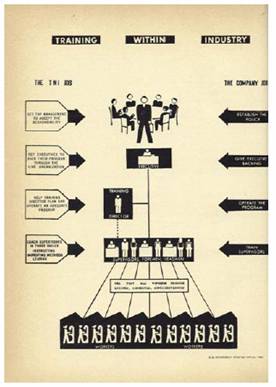
Figure 5: Requirements and Responsibilities of TWI and the Host Company
SOURCE: War Production Board, Bureau of Training, Training Within Industry Service, June 1944, Management and Skilled Supervision (Washington D.C.: W.S. Government Printing Office), Back cover.
This requirement was also part of the "for industry by industry" attitude maintained by TWI's leadership. In fact, chapter five of The Training Within Industry Report is about the need for help from management, under the title Working With Management.
In 1943 TWI established the policy of starting a program in a plant only after the executive group and the supervisory organization had been carefully informed of the TWI programs. This executive group also had to be fully aware of its responsibilities in making these programs work. It can be readily appreciated that a busy president may enthusiastically approve a program, but the plant superintendent, if he does not know the possibilities of the program, can be a barrier.
TWI's leadership had an excellent understanding of the need for top management support. They also realized that, to obtain this support, they would have to "sell" the program to management. TWI developed a method for doing this. They presented training as a management tool and focused their improvements on sales results, not on techniques. They understood that many managers were really interested in the financial results, in how much the company's income could improve or worsen. This focus helped TWI make the initial sales and continue to offer support, given the large number of executives who needed to turn their operations into a nationwide success.
Coaching
Another idea from the Japanese management philosophy is to use "coaching" to guide and lead employees. This term is discussed and taught to all levels of management as a great, improved and modern method of managing people. It is considered a shift from the "old" authoritarian style of management to the "new" coaching style. Even so, the use of coaching as a management method was repeated throughout the TWI Report. In fact, there was a section of the report devoted to coaching and its continued use. TWI gave five points to guide industry trainers in the coaching process while teaching the "J Programs"; Walter Dietz restates them very well in his book.
1. Give reasons and advantages.
2. Understand the principles.
3. Select a problem and work on it together with the worker.
4. Ask him to work on another problem on his own.
5. Give him credit for good results and good effort.
The TWI report goes on with a brief definition and an explanation of what it means to coach someone in the work environment. It also shows the relationship between coaching and the programs themselves, and emphasizes how they support the Multiplier Principle.
Coaching simply means helping someone do better what he or she is already trying to do.
The objective of the TWI program, and the objective of coaching, is not to solve problems, but rather to develop the ability to solve any problem when it arises.
All this means a personal working relationship – you cannot coach by telephone, or through a letter, or through a conversation. You have to work with a man. His boss is the best person to work with him, at the workplace. He can show him how to do the job better – not just criticize, but explain why his good work succeeded so that he will do the same again...
Today, companies like to publicize their "new" techniques for giving their managers a better way of leading their employees. Coaching is nothing new in factories, as the TWI report reveals; perhaps it has just been forgotten for the time being. With the Four-Step method, the four horsemen learned the value of coaching on the shop floor from Charles Allen.
The men will eventually see the instructor as a "coach" much more than as someone responsible for production... under good management... the men will not be afraid to ask, and questions will be on the agenda; there will be a lot of discussion and little argument, the men will be at work whether or not they are under the instructor's eye, and all conditions will be considered businesslike and "natural".
Elimination of Jobs Due to Kaizen
Although the TWI Service kept its focus on the training it had developed and on its distribution throughout the country, many questions were frequently raised during Job Methods training. In fact, three questions were so common that TWI formulated standard answers for them. One of these questions is also one of the most common to come up today when kaizen is implemented in a plant. "What should be done if workers are eliminated as a result of the change in methods?" TWI emphasized that this remained the company's responsibility. Although TWI adopted this policy, it issued a standard "suggestion" to companies in this situation.
In dealing with this specific situation during the war period, it is recommended: that no one be laid off as a result of the change in method, but that the affected worker be transferred...
This TWI suggestion is in line with the standard answer recommended by everyone who leads kaizen workshops today.
The 5W 1H and the Five Whys
Job Methods is the source of the 5W 1H, which stand for Why, What, Where, When, Who and How. This technique is used to break down a job and develop a new and improved method by questioning everything involved in the operation. The use of these questions was Step 2 of the four-step Job Methods procedure and was a transition between the old and new methods. This questioning technique used by Job Methods was intended to support the breakdown of current procedures, in order to help discover better methods of doing the work.
The first sessions of Job Methods training were frankly designed to develop the questioning attitude among supervisors, with the result of drawing out of them ideas that had already been considered closed. Detailed questioning of the breakdown proved that it is possible to go further below the surface and develop ideas that could never have emerged on the basis of suggestions.
In Making the Breakdown in Job Methods, it was learned that to really analyze the details, it is very helpful to look first at the verb (which is usually the first word in the detail). For example, the breakdown of an assembly job that has these two details: "Reach for the box on the floor" and "Pick up a screw". The first step in the questioning process is to ask "Why is this necessary?" If you ask "Why is it necessary to reach for the box on the floor?" the answer would probably be "to be able to pick up the screw". If you limit yourself to the verb and say "Why is it necessary to reach to the floor?", you will immediately be led to consider the possibility that the box of screws should have been up on the workbench.
The 5W 1H are still used today in kaizen to discover improvements. The use of these questions has remained virtually unchanged since the TWI service included them as part of Job Methods training. Although Toyota uses the 5W 1H today, it also uses a modified version as a direct problem-solving technique: the 5W 1H or 5 Whys and 1 How. This method is most commonly referred to as the 5 Whys.
When a problem occurs, if the way of probing for the cause is insufficient, the measures taken may fail to be clear. At Toyota, we had the then well-known 5W 1H. The 5 W were not the conventional "who, when, where, what and why"; every word was replaced by "why" and we said "how?" In this way, we looked for the true cause that was hidden behind several other causes. It is essential that we come face to face with the true cause.
For anyone who has been trained to use the 5W, the sequence listed above from the 1945 Job Methods procedure is considered the basic process. It also makes sense to use the 5W to solve problems or even to support kaizen. Kaizen, on the other hand, is the solution to work problems – or improvement.
Elimination of Waste
As an extension of the 5W, Job Methods talks about work improvement or, in today's terms, the elimination of waste. Additional discussion is given in the TWI report on job breakdown techniques and how they support the four steps of Job Methods. As we have pointed out, the main lines of the Four-Step method closely resemble the methodology used in Kaizen workshops. Paying attention to the details of the operation, questioning every step presented that is involved in the work, developing new methods (combining, rearranging, simplifying) and applying the new methods are part of both processes, Job Methods and the Kaizen workshop. Basically, the original standard is in place, then it is questioned, then it is improved – this is the essence of Kaizen. The focus of both methods, Kaizen as well as Job Methods, is on eliminating waste (removing unnecessary or non-value-adding activities from the current process).
This improvement is not achieved by increasing speed, but rather by eliminating unnecessary details.
Use these methods until a better one is developed.
Perhaps this is why Masaaki Imai writes in his 1986 book, Kaizen:
I would like to propose, here, KAIZEN as the most important concept behind good management. It is the unifying thread running through the philosophy, the systems, and the problem-solving tools, all developed in Japan over the last 30 years. Its message is one of improvement and of trying to do better.
The TWI Service was doing nothing more than spreading good management practices as something important for improving production.
Why North American Industry Lost TWI
So the questions are finally asked: why did the United States, the developers, implementers and teachers of such a simple and successful program, lose it, only to be strangled by the technique in manufacturing decades later, with no idea of what was behind the miracle of Japanese management? This questioning is interesting. There is no simple, straightforward answer to these questions. But there are certain factors that play an important role in why this happened.
World Industrial Leader
At the end of World War II, the United States was at the top of world industry. It achieved this not only by winning the wars in the Pacific and in Europe, but also by supplying products to meet the needs of Americans as well as those of their allies, before and during the war. An incredible industrial potential had been built up. The United States, owing to its determination as a country, large quantities of resources and natural barriers (the Pacific and Atlantic Oceans), became the leading Superpower, and without damage to its physical structure. In fact, the US was in good shape, with high morale and with an industry stronger than ever before. This reputation was earned through the many "boys" who also fought in the war abroad.
The Return of the "Boys"
With the end of the war, the men who had fought in distant lands would return home and to the factories where they had worked before the war. The TWI Service no longer existed; it was no longer needed with the war won, and consequently it was deactivated. The TWI leaders noticed what was happening and realized well in advance that the end was inevitable. In fact, they tell in the reports how they always felt that the end of their services was very near. This "feeling" lasted approximately five years, much longer than they had supposed.
The adjustment to return civilian production to normal levels was also a major task. The men who returned from the war campaign had not been trained in TWI methods, and TWI's national support network no longer existed. With the United States leading world industrialization and with the men, not trained by TWI, returning to their former occupations, the critical need for TWI's services had ended as well. Once this situation was sealed, it would be natural for those returning from the war to go back to their previous routines. This situation may be the biggest contributor to the loss of everything that had been achieved by the TWI Service. In fact, the TWI leaders had this concern, and in the reports they pass on information about how everything could change as soon as the war campaign ended.
Looking at the simplicity of the TWI programs, it seems that, since they represent common sense, their development is possible without much work. But it must be remembered that a great many non-essentials had to be eliminated.
The TWI program was developed through opportunities never possible before – the country's war industries were the laboratory, the experimental workshop and the testing ground. Development work would continue as long as TWI existed – no program is perfect and no program is good enough unless it meets the needs that created it. Just as needs change, any program must keep evolving.
It seemed that Dooley, Dietz, Kane and Conover could perceive the impending danger to the TWI programs after the conclusion of the war, an event that would end the need for TWI. As may be recalled, a good part of TWI's efforts was spent selling the need and the services to company management, even with the critical demand of war production. TWI's leadership always wondered whether perhaps as much time was spent selling the training as was spent conducting it. With this combination, the loss of the "need" and the return of the untrained "boys," it seemed that the fate of TWI's principles was to disappear from the industrial scene, and time proved this to be true.
Resistance to Change
One final factor must be considered as a contributor to the disappearance of TWI: resistance to change. People's resistance to change seems to be natural. Many individuals will work to stay in a comfort zone, even if they are pressured to change. This opposition has been the norm in factories.
A technical reporter for American Machinist magazine tells a story of when a friend of his was trying to show a chief toolmaker a new tooling system; he was accused of going door to door peddling useless new methods. He was not selling anything; he was only trying to show what was happening in industry. The curious thing about this story is that it dates from around 1904.
Industry has always resisted change. This is illustrated in the books Lean Thinking and Becoming Lean. Both books contain information and stories about the difficulties of introducing change in factories. In the case of these books, it is the implementation of lean that led factory people to resist change. Overall, today's difficulty in implementing Japanese management methods and lean philosophy may be a repetition of the difficulty the TWI Service faced when it tried to introduce the same philosophies into factories sixty years ago. Japanese management and lean philosophy are much broader than the TWI programs were, but they all have the same origin.
Conclusion
The arguments detailed above are probably not the only reasons why TWI's methods and philosophy resemble the practices of Japanese management and lean philosophy; many things contributed to their development. But one thing is certain: TWI played an important role in the evolution of Japan's management practices and of lean philosophy, sometimes directly, as through Job Methods, and sometimes not so directly. In the end, much survived in Japan because they were superior techniques used in a comprehensive way to help companies gain a competitive advantage. The need for change in Japan arose after the war, and it remains to this day.
Although US companies failed to continue using the methods developed and delivered by the TWI Service after the war, today's factories generally resist change, unwilling to try the Japanese techniques of kaizen. But in fact, kaizen or Japanese management methods are not specifically Japanese or American techniques; they are the result of an evolutionary process to which both contributed significantly. Based on direct intentions and unexpected circumstances in industry, the practices have advanced toward what they are today. Perhaps this is the idea that began with a man named Charles Allen, continued with the contribution of thousands of people on both sides of the ocean, and will continue to evolve as more is learned about how to apply it - learning by doing.
Even today the doubt exists: "Can these techniques be implemented successfully?" Many factories incorrectly assume that Japanese management methods and kaizen are effective in Japanese companies because of the unique Japanese culture, but this is not true.
Frustrated by their inability to replicate Toyota's performance, many visitors assume that the secret of Toyota's success must have cultural roots. But that is not the case now.
We have shown that these modern production techniques are, in fact, methods roughly one hundred years old that have evolved over the years while keeping their intrinsic objectives unchanged. It is ironic that, although the United States developed the methods that form much of the foundation of Japanese management and lean philosophy, its industry has been struggling for the last twenty years to fully implement these philosophies in current systems. The future success of American industry may depend on whether we can do what we have done.
Jim Huntzinger began his career as a production engineer at Aisin Seiki, when the Toyota Group supplier moved to the United States. He spent eight years at Briggs & Stratton in engineering and management, implementing lean in production and business practices. He was also a consultant for five years, helping companies implement lean. Jim is currently heading the continuous improvement practice at Flexware Innovation, Indiana. He has done in-depth research on the evolution of manufacturing in the United States with an emphasis on lean.
BIBLIOGRAPHY
Allen, Charles R. 1919. The Instrutor, The Man, and The Job. Philadelphia and London: J.B. Lippincott Company.
Colvin, Fred H. 1988, (originally published in 1947). Sixty Years with Men and Machines. Bradley, IL: Reprint by Linday Publications.
Dietz, Walter with betty W. Bevens. 1970. Learn by Doing: The Story of Training Within Industry. Summit, NJ: Walter Dietz.
Fujimoto, Takahiro. 1999. The Evolution of a Manufacturing System at Toyota. New York: Oxford University Press
Graupp, Patrick and Kazuhiko Shibuya. 2000. Job Methods Improvement. Japan: ASA Publishing.
Imai, Masaaki. 1986. Kaizen: The Key to Japan's Competitive Success. New York: McGraw-Hill.
1997. Gemba Kaizen: A Commonsense, Lost-Cost Approach to Management. New York: McGraw-Hill.
Japan Management Association. 1986. Kanban: Just-In-time at Toyota. Cambridge, MA: Productivity Press.
Labor Division. Office of Production Management. Training Within Industry Service. August 1941. How To Train Production Operators. Washington D.C.: U.S. Government Printing Office.
Labor Division. War Production Board. Training Within Industry Service, undated. Job Instruction: A Manual for Shop Supervisors and Instructors. Washington D.C.: U.S. Government Printing Office.
January 1943. The Training Within Industry Program, Bulletin No 1. Washington D.C.: Government Printing Office.
Liker, Jeffrey K. ed. 1997. Becoming Lean: Inside Stories of U.S. Manufacturers. Portland, OR: Productivity Press
McCord, Bord. "Job Instruction." Robert L. Craig (ed.). 1976. The Training and Development Handbook – A Guide to Human Resource Development. 2nd ed. New York: McGraw-Hill, pp. 32-3 – 32-24.
Robinson, Alan. 1991. Continuous Improvement in Operations: A Systematic Approach to Waste Reduction. Cambridge, MA: Productivity Press.
Robson, Alan, and Dean M. Schroeder. Winter 1993. "Training, Continuous Improvement, and Human Relations: The U.S. TWI Programs and the Japanese Management Style." California Management Review Vol. 35, pp. 35-37.
Robinson, Alan, and San Stern. Summer 1995. "Strategic National HRD Initiatives: Lessons from the Management Training Program of Japan." Human Development Quarterly Vol. 6, no. 2, pp. 123-147.
1997. Corporate Creativity: How Innovation and Improvement Actually Happen. San Francisco, CA: Berrett-Koehler Publishers.
Spear, Steven and H. Kent Brown. September-October 1999. "Decoding the DNA of the Toyota Production System." Harvard Business Review. Reprint 99509. pp. 96-106.
War Production Board. Bureau of Training. Training Within Industry Service. 1943. Job Methods: Sessions Outline and Reference Material. Washington D.C.: U.S. Government Printing Office.
1943. Job Instruction: Sessions Outline and Reference Material. Washington D.C.: U.S. government Printing Office.
June 1, 1944. Job Relations: Session Outline and Reference Material. Washington D.C.: U.S. government Printing Office.
June 1944. Management and Skilled Supervision. Washington D.C.: U.S. Government Printing Office.
June 1945. Program Development Institute. Washington D.C.: U.S. government Printing Office.
August 1945. Union job Relations: 10-Hour Session Outline and Reference Material. Washington D.C.: U.S. government Printing Office.
September 1945. The Training Within Industry Report: 1940-1945. Washington D.C.: U.S. government Printing Office.
Womack, James P., and Daniel T. Jones. 1996. Lean Thinking: Banish Waste and Create Wealth in your Corporation. New York: Simon & Schuster.






