

Daily management to execute strategy
A company had its strategy defined, with goals and actions deployed to every area and level of the business. Follow-up on the actions was the responsibility of each area, and the results were collected and centralized in the company's IT system.
The board met monthly to review the results. However, almost every time there were results below expectations, which caused enormous discomfort. In trying to understand the reasons for these disappointing results, the meetings ended up turning into attempts to find the real culprits, with fingers pointed in every direction.
New emergency decisions were made to put out fires and mitigate the situation, which often, instead of solving things, ended up making them worse the following month.
What was going on? The company's sophisticated information-gathering system did not seem to allow a real understanding of what was happening. And when some decisions were made, it was already too late. As a result, the annual results were compromised.
The company needed to implement a new method for following up on actions and results that would ensure the proper execution of the strategy and allow a faster and more effective response to any deviations: daily management.
It is so important that at the Lean Summits held so far, it has always been one of the highlights of the event — for example, in the Strategy and Management System "track", in the session "Daily Management to solve problems and develop people".
Your leadership can go further. With the Lean Leadership corporate program, your team learns to apply agile and lean methods in practice, raising the performance of the entire business. Talk to a specialist and see how to transform your management.
What is daily management (DM)?
Daily management is the ongoing process of ensuring that work is being done the right way and at the right time so that the business can achieve success as defined by the company's strategy.
It is the day-to-day follow-up of the actions, defined according to the strategy deployment, to check whether the expected results are being achieved and, if not, to take corrective action in time.
It thus allows everyone to know clearly whether performance is good or bad on a daily basis, hourly if necessary, or weekly or monthly, as the case may be.
It allows everyone at every level to quickly see the deviation or problem that is preventing the goals from being met. And it makes everyone equally responsible for taking the steps needed to correct these problems quickly.
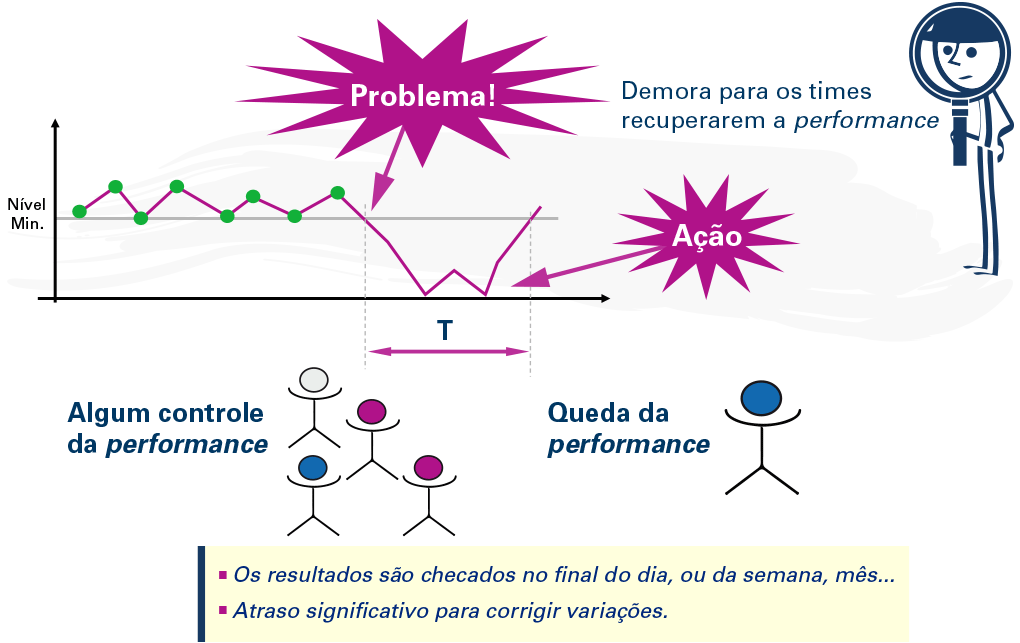
The figure below shows traditional management, without daily management, in which there is a delay in implementing a corrective action to return to the expected performance.
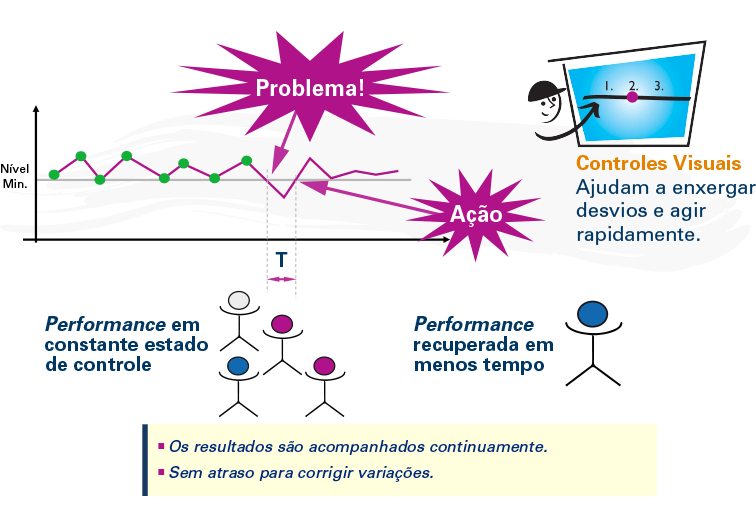
Introducing daily management makes the follow-up of results continuous and thus reduces the time needed to make corrections and bring performance back to the expected level, with few losses, as the figure below shows.
Interested in the topic? See our Daily Management training
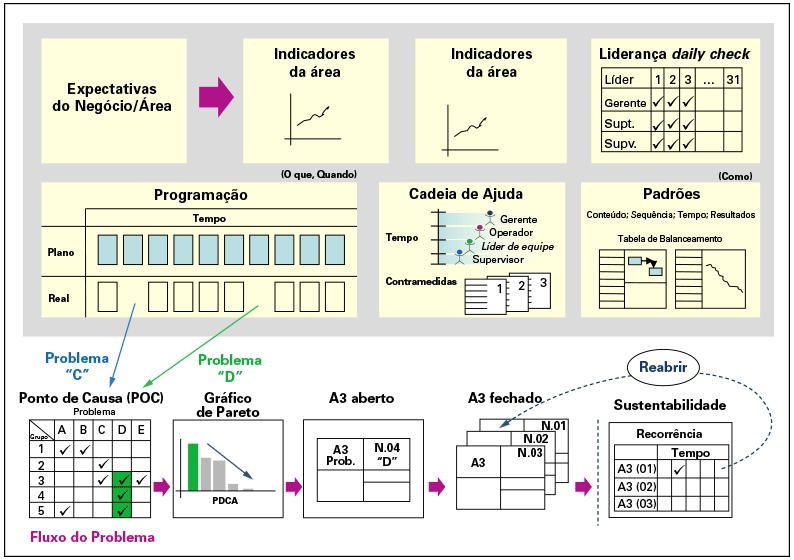
Start with strategy deployment to all levels
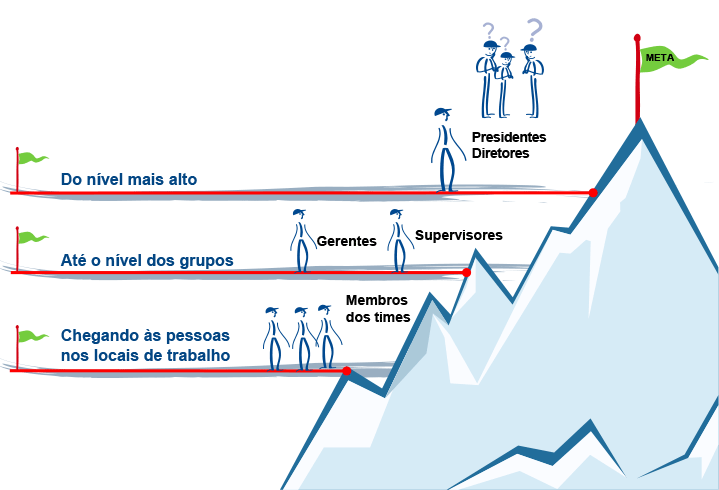
Daily management begins with a solid process of defining and deploying the strategy, starting by making explicit the company's purpose and its “true north”, the company's priorities for the near future, say 12 to 18 months.
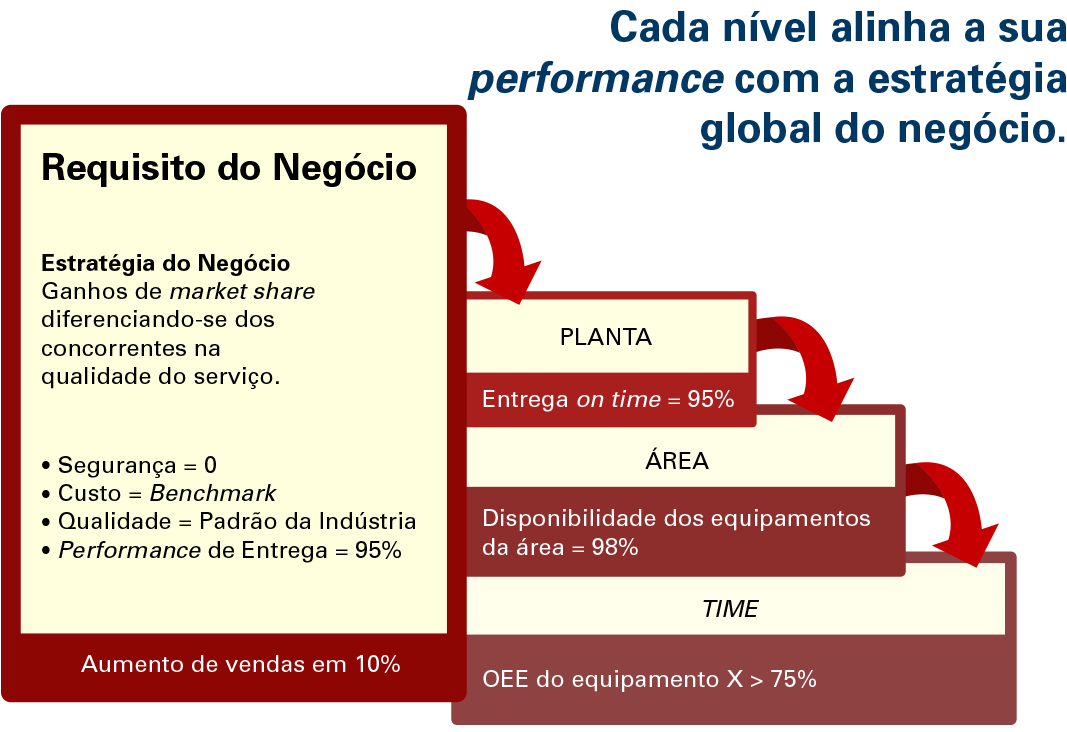
This must be deployed into specific indicators at the macro level, cascading down to the functional levels, to the work cells and to each person.
Everyone in the company must know the priorities and challenges for the full success of the business and what will be measured so that, proactively, decisions emerge that enable the correct delivery of what was planned and make it possible to engage everyone, each at his or her level of responsibility.
Thus, the indicators must measure and guide which results are to be achieved and what to do when something goes off plan.
From then on, the entire organization, its production, administrative, sales and support areas, must set up visual management boards in a visible, easily accessible place close to the workplace, to allow for meetings to be held daily, or as often as necessary.
The figure below illustrates how the indicators are deployed to each level of the company.
How DM works
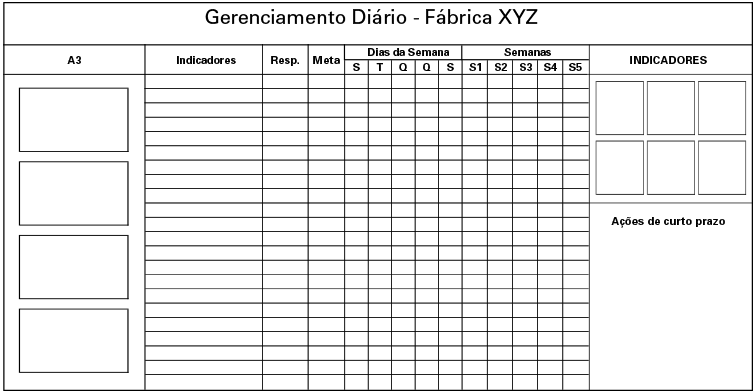
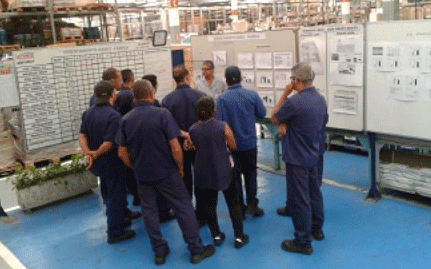
Using a board like the one shown above, filled in with data updated every day or as often as necessary, the team of the department, area or cell gets together to discuss the numbers achieved compared with what was expected, or whether a given action plan was carried out as planned.
This meeting should be led by the area's leadership according to the different levels of the organization. In a production area it may be the supervisors and their team leaders. In the sales area, on the other hand, it may be the director with his or her managers.
The meeting should be quick and objective (approximately 30 minutes), with everyone focused and concentrated on contributing with regard to the problems revealed on the board and the gaps that must be worked on through rapid PDCA cycles.
During the meeting, the leadership should act as a “conductor”, able to properly involve all members of the team. The focus should be on evaluating and comparing what was planned with what was achieved.
The leader must know how to ask, seeking to help clarify the situation with exploratory questions such as “What happened?” until he or she feels that the group has a good understanding of the situation, and then move on to exploring the root causes by asking why.
Participants are expected not to bring superficial answers without a good analysis of the root causes and countermeasures for the problems, which must be analyzed beforehand, since decisions and consensus on countermeasures are expected in the meeting itself so that the result can be recovered right afterwards.
The leader should avoid providing the answers or making suggestions, even if he or she has a good idea of what could be tried, because developing employees' capabilities is equally important.
This activity therefore also becomes a means of developing people, changing the way they think, how they solve problems and how they work as a team.
The visualization must be simple to ensure clarity and focus and to make it easy for everyone to understand, as in the previous example: on target = green, off target = red. Discussions should concentrate on the red points and on the search for effective countermeasures. And not on trying to point out culprits or whoever might be responsible, or on generating endless discussions without objectivity and focus.
DM makes it possible to encourage teamwork and to engage everyone in what is fundamental for each person: their work. And it connects everyone to the company's essential needs at that moment, its true north.
Everyone is responsible for keeping the numbers on plan and for having problems corrected quickly.
That is why, in the daily meetings, when everyone is standing in front of the daily management board, the typical questions to ask are: “Did I do the right job, in the right quantity and at the right time?”; “How do the current results compare with the planned results?”; “What is the problem”; “Why was there a deviation from the plan?”; “What was the cause?”; “What kinds of improvements are needed?”; “How can I contribute?”; “What kind of help will be needed?”.
The aim should be to create an environment in which hiding problems makes no sense and is not acceptable or even possible. On the contrary, exposing problems, questioning and solving them effectively becomes the way of working.
The consolidated results, which may be for a day or a work shift, reflect, in cases related to operations, how effective the hour-by-hour follow-up was. If, for example, on a production line, the hour-by-hour result stayed on plan, at the end of the shift and of that day, what is consolidated on the management board will consequently be the desired result.
Find out how lean consulting in manufacturing can optimize your processes, eliminate waste and raise the operational efficiency of your plant. Take the first step toward leaner, more profitable production. Visit and learn more!
But problems happen all the time, and the more time spent understanding and solving them, the greater the consequences. For DM to be effective, then, the problems need to be solved. But solutions are not always immediate, nor are they always within the knowledge and skill level of those involved.
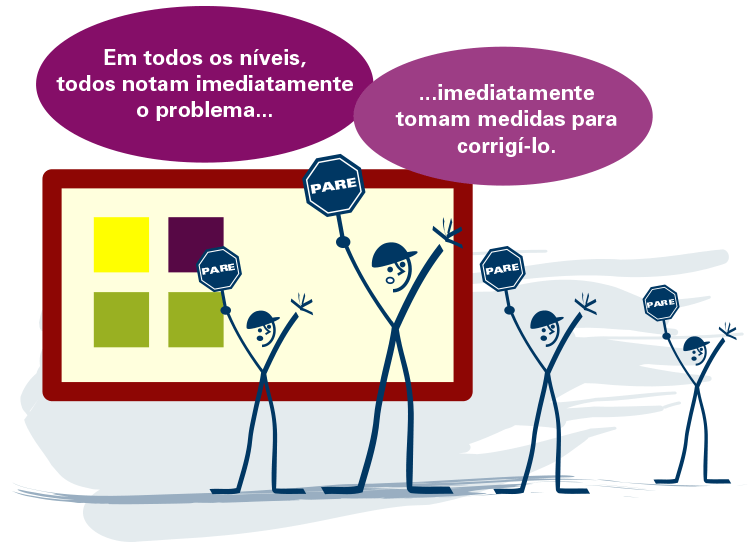
That is why it is essential to structure the help chain: calling on specialists to solve problems, level by level, each with his or her responsibility and time for resolving the problem defined. Each individual must know what to do, how, when and whom to ask for help when something is not as expected.
In this way, each employee must be able at least to try to solve the problems that hinder his or her performance. If unable to, he or she must call a leader, who should also try to solve it. If the leader cannot do so within a given time, he or she must call another level, perhaps supervision, or an outside group such as maintenance or quality. If the problem persists, the manager is called in to intervene and, if unable to solve it, can call the director or even the president if something very serious happens.
The help chain therefore inverts the traditional pyramid organization, which becomes a chain supporting value creation and problem solving.
Would you like to know more? Read Jim Womack's article Keeping the pace
Examples: production area and sales area
We will show two examples for illustration purposes, one in a production area and the other in the sales area.
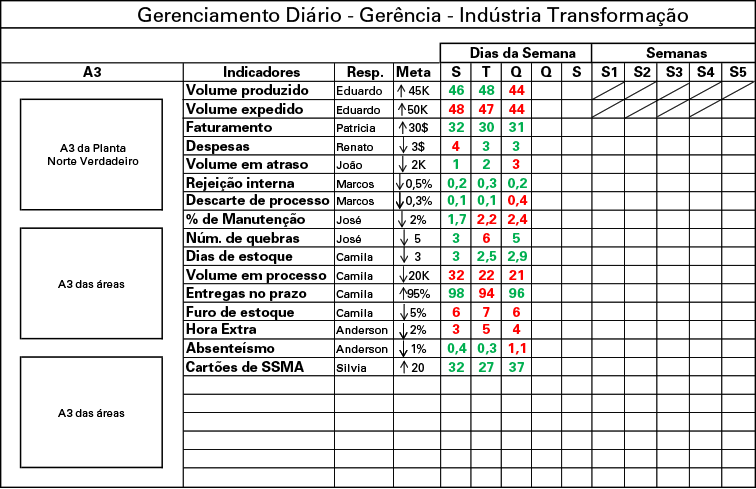
In the first, the plant management-level board, created from the planning and deployment of the strategy, shows indicators in the following dimensions:
Production Volume, Financial, Quality, Delivery, People, HSE.
These numbers were derived from the strategic A3s created from the True North. On the board, for each of them, there is a defined goal that must be met daily in order to succeed in what was planned, in delivering value to customers with the resulting results for shareholders.
The meeting takes place on a Wednesday, and some problems on the board below are chronic (such as low shipped volume, excess inventory and excess overtime). If nothing is done to correct these anomalies, the result will be compromised. What happens in practice is that visible problems allow the team to clearly understand them and focus on attacking them, with simple containment actions and structured PDCAs that will drive more robust actions. Nothing may exceed the maximum deadline of 5 days for execution.
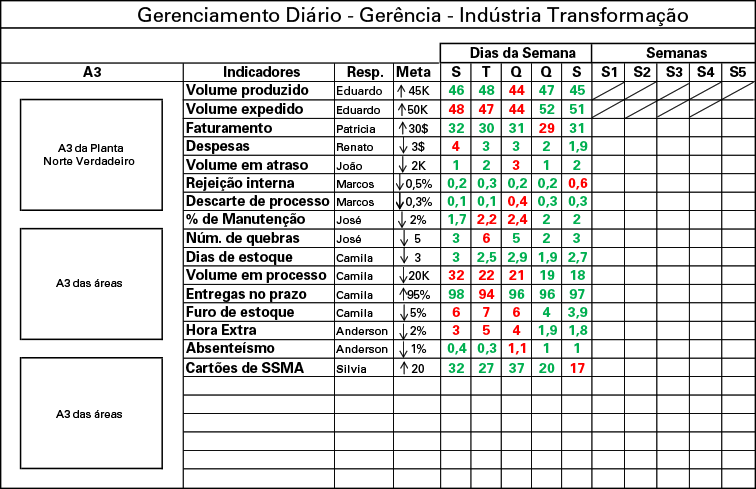
In the following meetings, as a result of the decisions and actions taken to solve the problems, we can see in the same example below that the problems that were chronic have been solved and that the group, in this case at Friday's meeting, will discuss only two points with results below plan – internal rejects and number of HSE cards.
In the second example, in the sales area, the board created for daily management shows indicators in the following dimensions: volume by region, contribution mass, net margin, order status, market share, sales leveling, expenses, customer visits, service.
Using the same method as in the previous example, on the board there is, for each of them, a clear quantitative expectation regarding the expected results.
At Wednesday's meeting, in addition to one-off problems and widespread low performance, four other problems turn out to be chronic (orders with pending issues, sales of product KLM, expenses and customer visits), requiring quick correction; otherwise the result for the first week of the month will be poor and the month-end close against plan will fall short of expectations. Another problem, which would be cause for celebration in companies without daily management and a lean culture, is total sales volume being much higher than forecast. Yes, this is a problem, because it causes unevenness, is likely to compromise delivery, generate unnecessary costs and cause customer dissatisfaction.
Without daily management, it would be just one more number lost among so many others that make up a company's portfolio of indicators. In addition to one-off actions for each number below target, some actions for the chronic problems were defined:
1. Orders with pending issues: Task force of the sales administration team with salespeople to close the orders with pending issues.
2. Sales of product KLM: Promotional actions (without compromising margin) to increase sales of product KLM – actions include: banners at points of sale, use of promoters.
3. Expenses: Analysis of expenses that can be postponed without compromising sales.
4. Customer visits: Cancellation of some meetings to allow a greater presence at customers.
5. Higher sales volume: Reduce order capacity for the South, North and Northeast regions for 1 day.
Market share is also an indicator below expectations, but because it is purely a result indicator with little daily movement, there is no specific direction for correcting it beyond the combined actions themselves, which will cause sales and coverage to increase. In this case, the sales director asked for it to be kept, since there was a specific A3 to address it and he wanted everyone to be reminded of the objective daily.
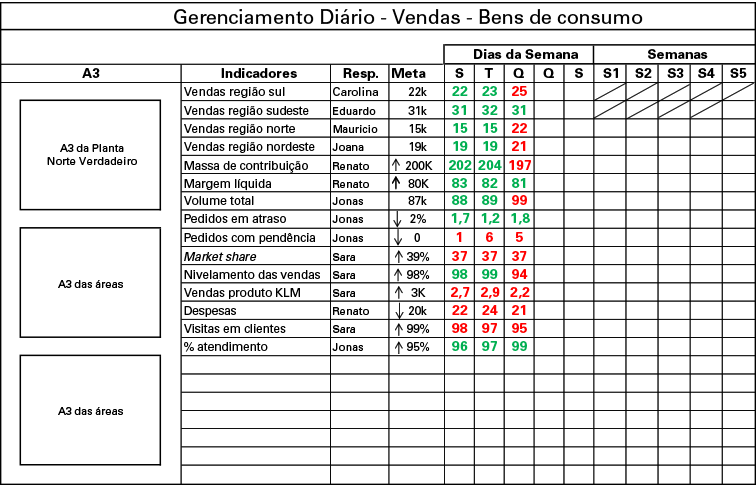
In the sales area, the reaction to the numbers tends to be slower, unlike the quick response that occurs in plant operations. If these discussions were held only at the end of the month, the time for response and recovery would be even longer, with fatal consequences for annual performance.
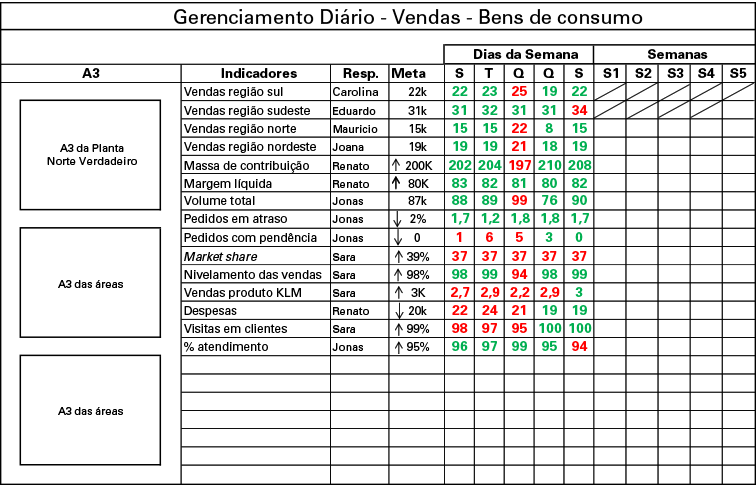
In the following meetings, a reaction can already be seen indicating that the actions taken together were effective.
Remember: transformation does not have to be expensive or slow, it just has to be strategic. Hire our lean services consulting and start reaping improvements from the very first mapping of administrative processes.
Conclusion
What DM aims for is the follow-up and execution of the strategy at all levels to ensure that deviations appear clearly and are attacked at the source, as quickly as possible.
A company that does not practice DM, that is, that does not have a structured, continuous method for following up daily on the actions and results set out in the strategic plan, is unable to detect the problems that arise, expose them and solve them.
It is therefore unable to correct them, hurting results and failing to generate people's engagement and involvement with the strategy, and also missing the opportunity to generate learning for its employees.
A company that uses DM, on the other hand, is able to see deviations as soon as they occur, can quickly start problem solving to ensure the expected results and revisit strategies, keeping alive the engagement and development of the people who do the work that creates value. It thus becomes an inexhaustible source of learning for the organization, ensuring not only current performance but also building the capability to face future challenges.
Daily management is a powerful method for ensuring the effective execution of strategy. Without it, strategy deployment, however solid the horizontal and vertical agreements and however correct the choices and definitions of indicators, has a high chance of failing, because problems will arise in its implementation.
Take the opportunity to check the calendar of Lean events and choose the right course for each of your company's challenges. Train your team with specific programs in healthcare, manufacturing, logistics, services and more — with proven methodologies.
Acknowledgments
To Tamiris Masetto Manzano for editing and reviewing this article and to Nêio Mustafa for art direction.







