

Leader standard work: one of the keys to sustaining performance gains
Not every successful business follows a lean approach to management. In fact, most of the five hundred companies listed by Fortune magazine are not run very differently from how they were fifty years ago. They follow a top-down, management-by-objectives style that essentially tells managers at each hierarchical layer of the business: “Hit your numbers and you will be rewarded. How you do it is not important.”
Managers follow this approach because it is what they learned from their predecessors and, honestly, most of the time it works. The main flaws of command-and-control management are that it takes a long time to make sustainable changes and it discourages collaboration, which is the opposite of what companies need to do in today’s hyperactive global markets. In a traditional organizational hierarchy, problems accumulate and fester until they are big enough for managers to notice them. When fixes are made, the changes tend to be limited in scope, and performance often slips back to its previous state after leaders move on or attention shifts to another problem.
Breaking traditional management behavior requires a change in mindset, but, more fundamentally, it requires a change in how managers allocate their time every day. By embracing the practices of leader standard work described in this article, executives and managers at lean companies can begin to create a culture that:
- Solves problems quickly, creatively and permanently.
- Collaborates instinctively.
- Achieves continuous gains in performance.
- Develops the next generation of leaders.
- Achieves better financial results.
Kaizen for management
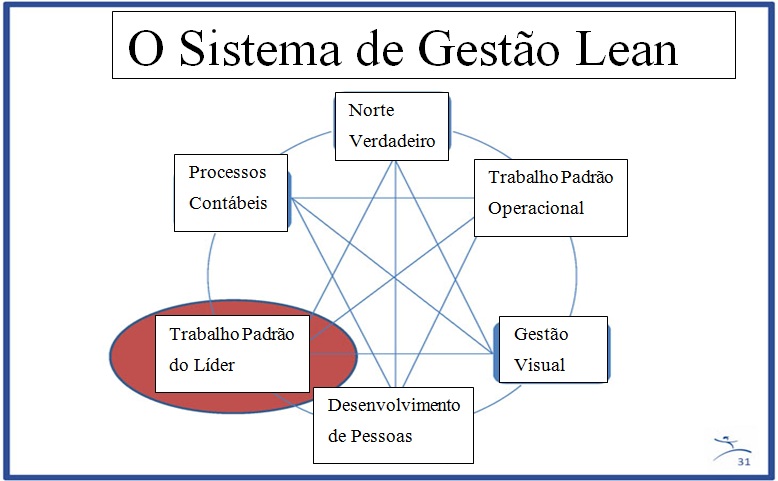
For lean companies, leader standard work shifts the focus of managers and employees away from primary problem solving and onto building a problem-solving culture in their organization. Always evolving, it also represents the current best waste-reducing method for planning and controlling the activities of the business. Leader standard work is part of the infrastructure of a lean management system that includes: the pursuit of true north, standardized work, visual management, people development and accounting systems.
- Daily team reflection.
- Gemba walks.
- Rapid response to abnormalities (andon).
- Mentoring.
- Strategy deployment.
Reflection: Setting aside time to reflect is not a practice that comes naturally amid the daily pressure to get things done and sell products and services, but daily team reflection meetings keep everyone focused on the work that needs to be done, on the way everyone agreed to do it and on where the next improvement will come from. Usually held at the start of the workday, these meetings are where supervisors, team members and managers review the basic questions “How did we do yesterday?”, “Where was there waste?” and “Which ideas do we need to develop today?”. Team leaders can focus on a particular problem, asking for suggestions and solutions, and introduce simple problem-solving tools as needed. Practiced daily, these reflection meetings slowly build the team’s ability to identify root causes and implement permanent solutions through the well-known problem-solving process, PDCA (plan, do, check, act).
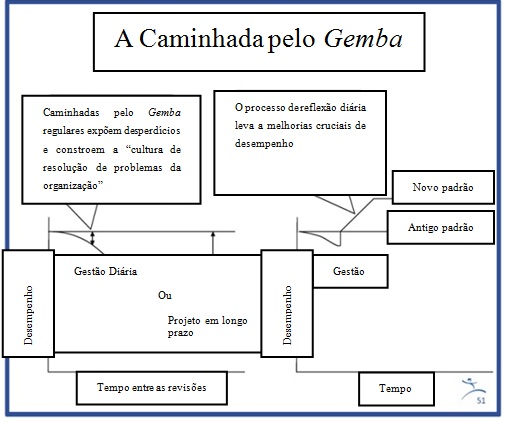
Gemba walks: The basic idea of a gemba walk is to go to the place in the organization where people create value. When the management team goes to the gemba daily – following a regular route at a standard time, possibly using a checklist to keep track of problems – it achieves three objectives.
First, by analyzing problems at the exact place and moment they occur, it helps maintain baseline levels of performance, which serve as the foundation for future improvements (see the figure). When the work is planned (standardized), as seen in visual process adherence and process performance tools, gemba walks can happen quickly.
Second, by modeling the appropriate behavior, the management team creates a culture that focuses on solving problems rather than blaming others. By not jumping to conclusions – a coaching behavior that, admittedly, takes time and practice to learn – and by humbly asking open-ended questions (the 5 whys), responsibility for problem solving falls to the people and teams doing the work. This leverages employees’ innate creativity. Once people switch off “autopilot,” a new side of them can emerge, a much happier and more engaged side.
Finally, because daily work is under control, managers have more time to concentrate on the long-term strategic issues that will move the organization forward. Our experience has shown us – this may seem a bit counterintuitive – that the repetitive aspect of gemba walks and other elements of leader standard work leads to more innovative thinking and achievements. Instead of forcing creativity, constantly looking at the process allows creativity to emerge, resulting in new work methods and new standards that surpass the old ones.
Rapid response to abnormalities: The andon cord, which originated in the automotive industry, represents more than a quality control tool. When management responds to the flashing light indicating that an abnormality has occurred and helps solve the problem quickly, it sends several signals to employees.
First, it reinforces the understanding that the gemba is where customer value is created, which is what matters most to the organization’s managers. Next, because problems are expected and are opportunities to learn and improve, it supports the message that hiding or ignoring problems undermines performance. And, lastly, it also reinforces the understanding that the people who do the work are responsible for ensuring it is done the right way, not supervisors, managers or some quality inspector.
Individual mentoring: Reflection on performance and mentoring must happen at all levels to further build a problem-solving culture in an organization. Far removed from the traditional “performance review,” this element of leader standard work may require a great deal of teaching for managers and supervisors to unlearn previous behavior. It is not so much about achieving specific objectives – although that remains important – but is more focused on day-to-day learning and growth. Such reflection may revolve around overall performance, when managers ask their direct reports: “How did we make the business better this week?”, “How have you become more valuable?”, “What have you learned?” and “What can I do to help you?”.
Or it may address specific problems: “What problem do you see?”, “How is the customer affected?”, “Where is the waste?”, “Why?”, “What have you seen us do about it?”, “What was your role in it?”.
By building each person’s problem-solving ability, this kind of reflection and coaching develops the next generation of leaders. Because such a culture can be more encouraging and rewarding on a personal level for supervisors and employees – ask anyone who has left a company for another that is managed more traditionally –, it tends to attract and retain the most talented people.
Strategy deployment: Strategy deployment is an execution planning tool. Management begins by connecting the company’s vision (or True North, which rarely changes) and three to five crucial objectives to the annual improvement priorities. These priorities are then linked to key performance indicators and assigned to specific projects (articulated in A3s), each with clear responsibility and accountability.
Monthly progress reviews help ensure that both daily process improvement activities and the efforts that support the future attainment of the crucial objectives are working synergistically to keep the organization on a straight path toward True North. The approach gives the leadership team a structured process for managing strategy.
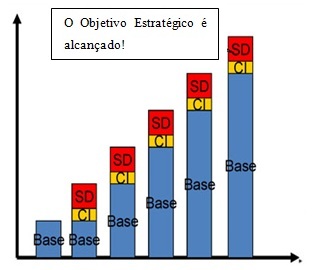
The bar chart illustrates how daily (CI) and strategic (SD) improvements form the foundation of future performance and the achievement of future objectives.
Create your own leader standard work
Lean advocates often talk about how the challenge of eliminating waste and delivering more value to the customer is a “never-ending journey.” But often, after the first few years, once many lean practices have been implemented – including operational standardized work, 5S, visual management, work cells, error proofing, etc. –, companies reach a destination. They hit a plateau of performance improvement. Leader standard work is an element of a lean management system that can lift the organization above that plateau.
The use of leader standard work should not be limited to the behaviors and practices described here, of course. These activities are simply what emerged when leading companies continuously applied the kaizen methodology to make their management processes more effective. That creativity never ends.
Joe Murli is an instructor at the Lean Enterprise Institute (LEI) and has been helping companies for eighteen years to implement lean tools and concepts integrated with the management systems that make them successful.






