

“Raise the bar” for yourself
Our book Raise the bar- From zero to 1 billion shares the lessons we learned while scaling Groupe Aramis up to its IPO on the Euronext stock exchange. The title itself sums up our main insight, with a twist. It is easy to interpret it as “raising other people's expectations,” but our main lesson is the importance of raising the bar for oneself. The balance between securing today's performance and adapting the company for tomorrow is a constant test of leadership and, as customers, markets and the world evolve, there are no set answers. Best practices can inspire and make you look at your own situation differently, but in truth they don't help: they are yesterday's best practices, and what we need to figure out is where things are heading in the coming years.
We were taught that scaling a company was simply about structure and processes. Structure as captured in an org chart: specialized departments linked together through a hierarchy. Each department head is in charge of running their department according to budget objectives coming from above, as well as making the investments needed to adapt it to present circumstances and, at best, to the future. Processes are mainly rules about how to do things to obtain a consistent result. Work is, in general, seen as prescribed. Defined actions are part of the process, which is constantly optimized to benefit from economies of scale or automation.
The premise is that if we set up the right structure and follow the right processes, we will achieve continuous performance. Following this reasoning, when things change, we need to restructure to adapt to the new market conditions and redesign our processes. Consulting has become an entire industry for taking organizations through these changes. However, are these premises true? Or have they become an ideology, a program that must be implemented regardless of its consequences?
If we look at the twenty years since Aramis was founded, we cannot really see many organizations thriving. What we see are multinationals dominating their markets through sheer financial power, increasingly questionable customer service delivered by inflexible digital systems, and disgruntled employees without a clear mission and with jobs that sometimes lack purpose, feeling like nothing more than a cog in a bureaucratic machine. Within the structure-and-process perspective, if customers complain, they expect too much. And if the process fails, it has to be the employee's fault. In this mindset, processes are the solution and people are always the problem (why can't they just follow the process and be happy with it?)
In the early days of expanding the Aramis business, selling new and used cars over the Internet, creating a structure (new positions and departments and org charts of who reports to whom) and defining processes (with detailed maps and instructions) was our approach too. But as complexity increased and we felt the company was becoming more and more rigid and unable to respond to clear challenges, we learned to go to the gemba to see the problems for ourselves and investigate the causes.
At the gemba, you hardly see structures or processes. What you see are people and systems. People respond to requests from other people, and they do so using systems. Both people and processes are specialized, so at some point there is a handoff, and the sequence of handoffs creates a process. For example, in our case of selling cars through a website, the salesperson who talks to the prospective customer is unlikely to be the same person who unloads the car from the truck when it arrives or who prepares it for the customer to receive it. One can imagine a small point of sale where the same person would do all three jobs, but with size, specialization makes sense.
This specialization, however, breaks the smooth, continuous flow of both the customer experience and the work, and creates endless friction points in the process handoff areas. The sales team is constantly balancing the special needs of the customers sitting in front of them and the instructions from their own hierarchy (often expressed concretely as incentives to sell this or that). The preparation team deals with schedule changes, whether from customers or logistics, and unforeseen problems with the car that they may or may not solve on their own. And as process segments become desynchronized, employees easily get into conflicts over who should do what, who did what wrong and who is to blame for each setback.
The second lesson from the gemba is that performance does not come from perfect processes, but from engaged and curious people. Some teams handle setbacks smoothly, taking care of customers first and helping one another in the areas of overlap to find the “least bad” solution to intractable problems. They handle contradictory priorities wisely and have each other's backs. Other teams, on the contrary, seem to take every task and responsibility in its narrowest sense, get in each other's way and seem to enjoy playing the blame game. It is fascinating to see the sudden negative impact a single grumpy new member can have on a high-performing team - it all comes down to people.
It all comes down to people's judgment, to be precise. Organizations are full of contradictions because no structure or process can be designed perfectly for current market conditions - and these change faster than organizations can change. But some people, both leaders and employees, handle these contradictions better than others. They understand the priorities and make the right decisions so that everyone enjoys the experience. We have seen some customer service agents turn customers who were angry about a real process failure on our part into enthusiastic promoters: they listened, empathized, compensated. Yes, it would have been better if the problem had not occurred, but the skill and emotional intelligence of the customer service team can make all the difference.
Just as it is considered common sense that organic growth must be supported by structure and processes, conventional business thinking holds that, to grow successfully through acquisitions, you must quickly deploy the same systems everywhere and then recover synergy costs by centralizing the execution of these systems in shared support centers. This theory still prevails, even though the success rate of acquisitions remains extremely low. Looking at it from the gemba, we realized that what makes people and teams perform is their relationship with their tools. When they understand their tools and systems, how they work, what they show and what biases they have, they make sound decisions. Change the system for them and they will need to learn everything all over again from scratch - often unwillingly.
Instead of imposing single systems on our acquisitions - as with the synergy of structures or processes - we took a different, gemba-based approach to integration (by the way, we rarely speak of “acquisitions” and “integration” internally. We prefer to speak of “joining the group” and “working together.” We know that words carry weight, and we find it easier to preserve and increase employee commitment). We focus on people. First, we regularly discuss with the leadership teams the key lean issues of our business: what really satisfies customers in each culture? How do we buy the right car at the right time to keep lead times and inventories low? How do we avoid excessive costs by focusing on quality and getting closer to doing it right the first time? How do we ensure that tools and systems work for every team member wherever they are? And for each of these problems, how do we involve team members in recognizing the problem and finding local solutions?
Then, as frontline teams deal with these typical problems, we have them share their experience and local countermeasures through company-wide communities of practice, where people discuss their perspectives, insights and initiatives. With these communities of practice, we see people from different cultures and backgrounds progressively converging and building together a common understanding of how to run the business better. This, in turn, stimulates a natural convergence of systems and tools, as systems evolve in the same direction and tools are shared across the company. The synergies we seek are those of better judgment shared across the business, in different local circumstances and with people with different backgrounds, but progressively adhering to the same theory of success.
How can you encourage better judgment overall? This is the central question of leadership. Structures and processes will not help. Good judgment is a matter of interpretation, of seeing the facts differently, often in the light of experience, and making the sensible choice - not necessarily the prescribed choice. Judgment also means taking risks. It means taking the lead to fix a flaw in the process. This, in turn, means risking being blamed by the structure, which considers its role to be enforcing compliance rather than serving customers.
At the gemba, you realize that your overall performance is closely tied to those magic moments when someone has the right insight and takes the right initiatives that save the day. Then you also realize that, in terms of fixing processes, you need the same good judgment from people to come up with sensible kaizen ideas - ones that can be converted into full process improvements. What you also discover is that these insights and initiatives are born mainly from conversations within teams. When they have the right conversation, they will do the right thing. When they have the wrong conversation (or no conversation at all), they won't.
To understand the view of people and systems, we started looking at relational protocols - the social norms that guide how people interact with one another and with the systems in place. These protocols are as affective as they are cognitive: who can easily talk to whom? About what? In what tone? What kinds of emotions are considered normal or abnormal within the team? For example, are frustration or anger part of the relational protocol and frequently expressed, or are they a sign of an abnormal situation that needs to be addressed? Likewise, are the willingness to help and expressing satisfaction at work part of the relational protocol, or are they rare events? With regard to kaizen, are suggestions encouraged and followed up, or frowned upon and ignored?
These relational protocols cannot be defined by either structure or process, no matter how hard the advocates of structure and process try to do so. They are purely human interactions, ways of relating to one another, and they have a strong emotional component. For example, the degree of trust conveyed by the company culture, or the feeling of togetherness as opposed to the feeling of competition, are emotions. Moreover, as the company grows across different cultures, the emotions considered normal and abnormal vary from country to country.
Leaders - as we learned the hard way - have a disproportionate impact on such relational protocols. Someone brings bad news and you react with anger, perhaps directing some of it at the messenger? People will conclude that it is fine to react angrily to bad news. Do you express frustration because a problem is not being solved or not being handled the way you would like? People will think that frustration is ok in their interactions with others, and so on.
Raising the bar for ourselves means deeply understanding what Isao Yoshino, a Toyota sensei, described to us in Japan as “showing your back,” understanding that, as leaders, everyone is always looking at your back, while you are looking elsewhere, to see how you react - what is considered “ok” or “not ok” when reacting emotionally to situations.
Basically, raising the bar means being more patient with people on the shop floor describing their activities until we discover the real key point of knowledge; reacting more calmly when we are told that something, once again, is not working as expected; being more generous with appraisal and thanking employees more often for doing a good job. It means taking responsibility for these invisible relational protocols that lie behind every interaction in the company and that, ultimately, are responsible for real performance - as well as for our own capacity to adapt.
People are the solution, processes are the problem. Practicing lean for years at the gemba taught us this. What makes lean lean, we learned in Japan, is neither the bureaucracy nor the company's systems, but the elusive spirit of kaizen that some people have and others don't. The feeling that when something goes wrong you ask yourself what YOU could have done better before blaming someone else. The relentless eye for muda and unnecessary work, and the effort to involve people in finding new ways to eliminate it. From this point of view, the elements of TPS - customer satisfaction, just-in-time, reacting to every defect, leveling workloads, studying standards, trying kaizen, developing mutual trust through stability - are all relational protocols about how to deal with customers , logistics, hierarchy, workloads, procedures, problem solving or systems.
Each element of TPS offers opportunities for kaizen, visualizing a clear challenge, such as responding better to customers, reducing lead times, and so on. These opportunities can be seized or ignored. As leaders, it is our job to create a kind of culture in which kaizen comes first and is a positive emotion that people experience together (the pleasure of bringing value closer to customers). This, we now know, will not happen by itself unless we ourselves demonstrate and model it. If you want a more lean company, you must be the change you want to see happen.
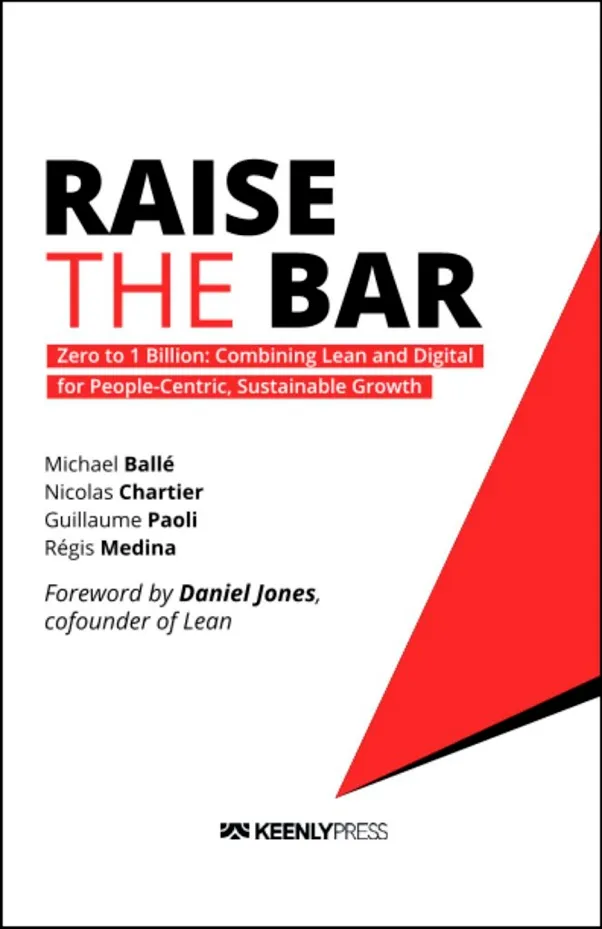
Get a copy of the book Raise the Bar here!







