

Building a learning hospital
Today, I am visiting the Hôpital Sainte Anne in Paris. Accompanying me is Guillaume Couillard, head of GHU Paris Psychiatrie & Neurosciences (which includes Sainte Anne) and co-author of L’Hôpital Apprenant (The Learning Hospital), together with Michael Ballé and Anne Lise Seltzer. Next to him is Louise Manteau, who leads the kaizen office.
A complex work environment
Guillaume and Louise begin by sharing some numbers. The GHU serves 60,000 patients in 170 units spread across Paris and its surroundings, mainly people with psychiatric disorders – a complex and often misunderstood area of healthcare. The organization has 5,600 employees, 600 of whom are physicians. Outpatient care accounts for 85% of the work, but the hospital also manages almost 2,000 beds.
As explained in L’Hôpital Apprenant, hospitals must constantly balance tensions between administrative constraints, nursing needs and medical decisions. Psychiatric hospitals face an additional challenge: they depend on fixed annual government budgets and are often portrayed by the media as the “forgotten corner” of the French healthcare system. In addition, working in a psychiatric hospital does not always match nurses' career expectations, which makes attracting talent difficult. It is, therefore, a rather complex scenario.
Continuous improvement to tackle complexity
Guillaume took over as general director of the GHU in September 2020. At the time, he had already successfully experimented with continuous improvement practices, first in Nancy and then in Lyon. When he arrived in Paris, he realized that segmented actions and one-off training would not be enough to drive change in such a complex group with multiple stakeholders. He would need to establish a culture of continuous improvement from day one – something easier said than done.
He made three critical decisions:
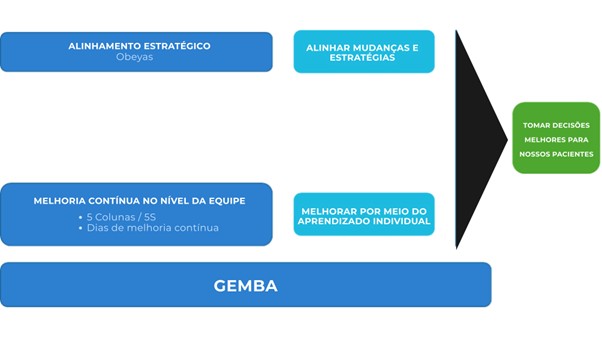
- Define the hospital's overall mission: “Make better decisions for our patients and support our nursing staff.”
- Launch a broad program of individual learning through problem solving.
- And tirelessly walk the gemba to reinforce the two points above.
Strategic alignment at the top
With all this information in mind, we head to the main obeya, on the floor below. This is where Guillaume articulates his strategy for the GHU (taking better care of both patients and nursing staff) and holds one-on-one meetings with each of his directors.
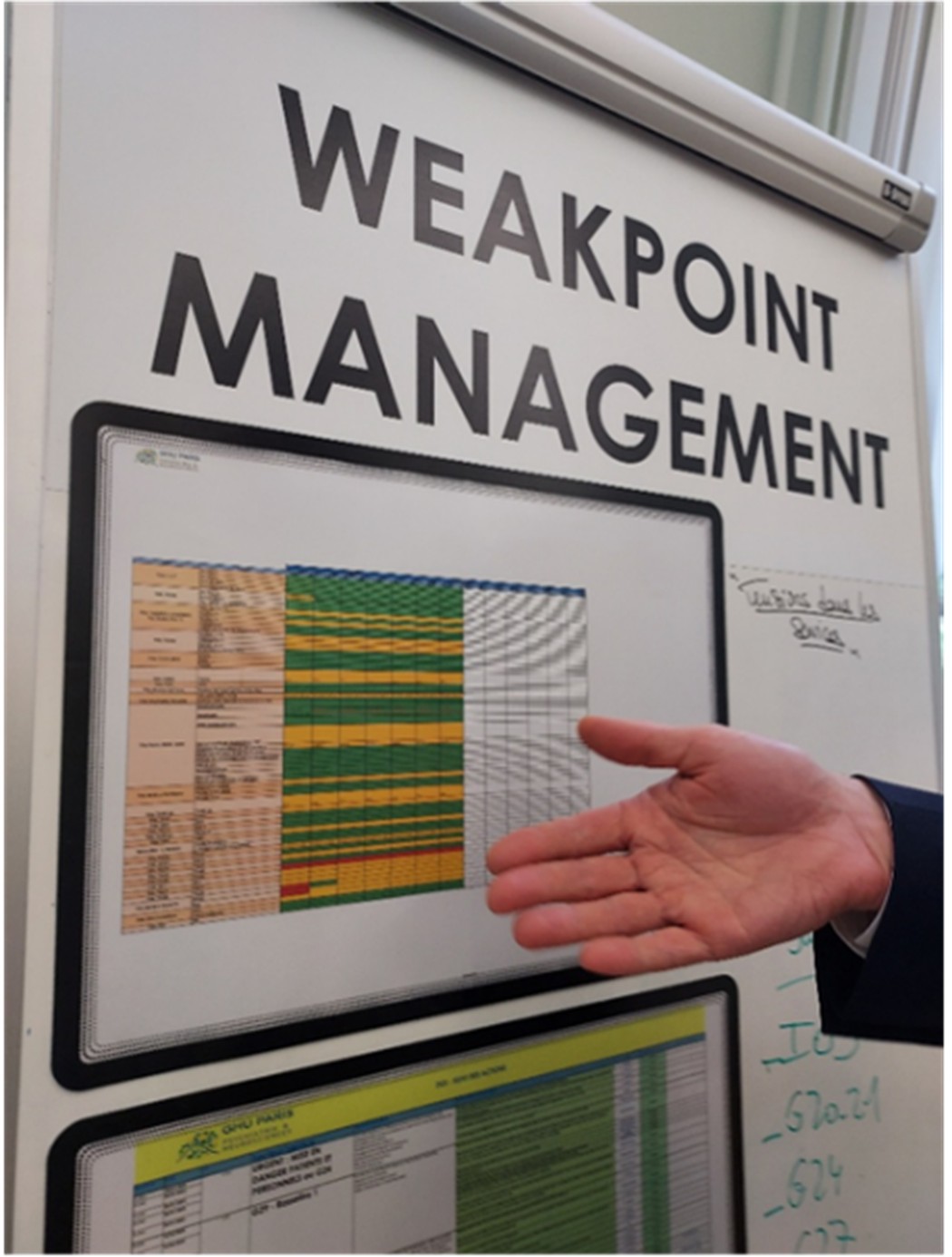
We look at indicators (KPIs) that monitor unavailable beds, waiting time until the first appointment, time spent in nursing areas, staff satisfaction level (70% positive ratings), and so on. Guillaume closely follows regular staffing reports to identify units with severe nurse shortages – ensuring they receive attention and support.
The rest of the obeya reflects a simple and effective approach. Each director – whether of Nursing, IT or Maintenance – manually updates a board with their goals and the changes they are managing (in progress, completed or merely planned). Why focus on changes? Given the tensions already mentioned between administration, nursing and medical staff, Guillaume knows that one area's solution may be another's problem. Changes are therefore discussed individually (to understand and challenge) and also at the COMEX, where colleagues can question risks. “Discussing changes is a great opportunity to create alignment and reinforce the strategy,” says Guillaume.
The COMEX, he explains, has a fully standardized agenda to keep the focus on the mission. It begins with a patient story (a complaint, a problem, an incident). Then a director reports on their latest gemba visit. Next, they discuss current or planned changes in their areas. And they set aside time for learnings from a recent kaizen. By the time they reach the final items, the essentials have already been addressed.
Guillaume says he stays firm on the mission and on the “how,” but is more flexible about the speed of application. Recently, he began encouraging Functional Analysis in the one-on-one meetings: “I want them to reflect on their role and impact, considering the needs of internal and external customers, to determine the functions their department should develop,” he explains.
After the visit to the obeya, I accompany Louise to see the other departments of the Hôpital Sainte Anne. She wants to show how they develop their own obeyas connected to the central one. Indeed, in Nursing we find the same explicit patient-oriented mission and the same change-tracking boards. But, crucially, we now see how the mission translates into the specific context. Support from middle management is one example, while the reflection on temporary workers — which cannot be resolved by Nursing alone — will be referred to a cross-functional working group. The routine of one-on-one conversations and collective challenges is the same, and the overall mission regarding patients remains unchanged.
Next, we go to Purchasing and Logistics, whose mission is more focused on supporting the nursing staff (making their work easier so that they, in turn, can make better decisions for their patients). But they go further.
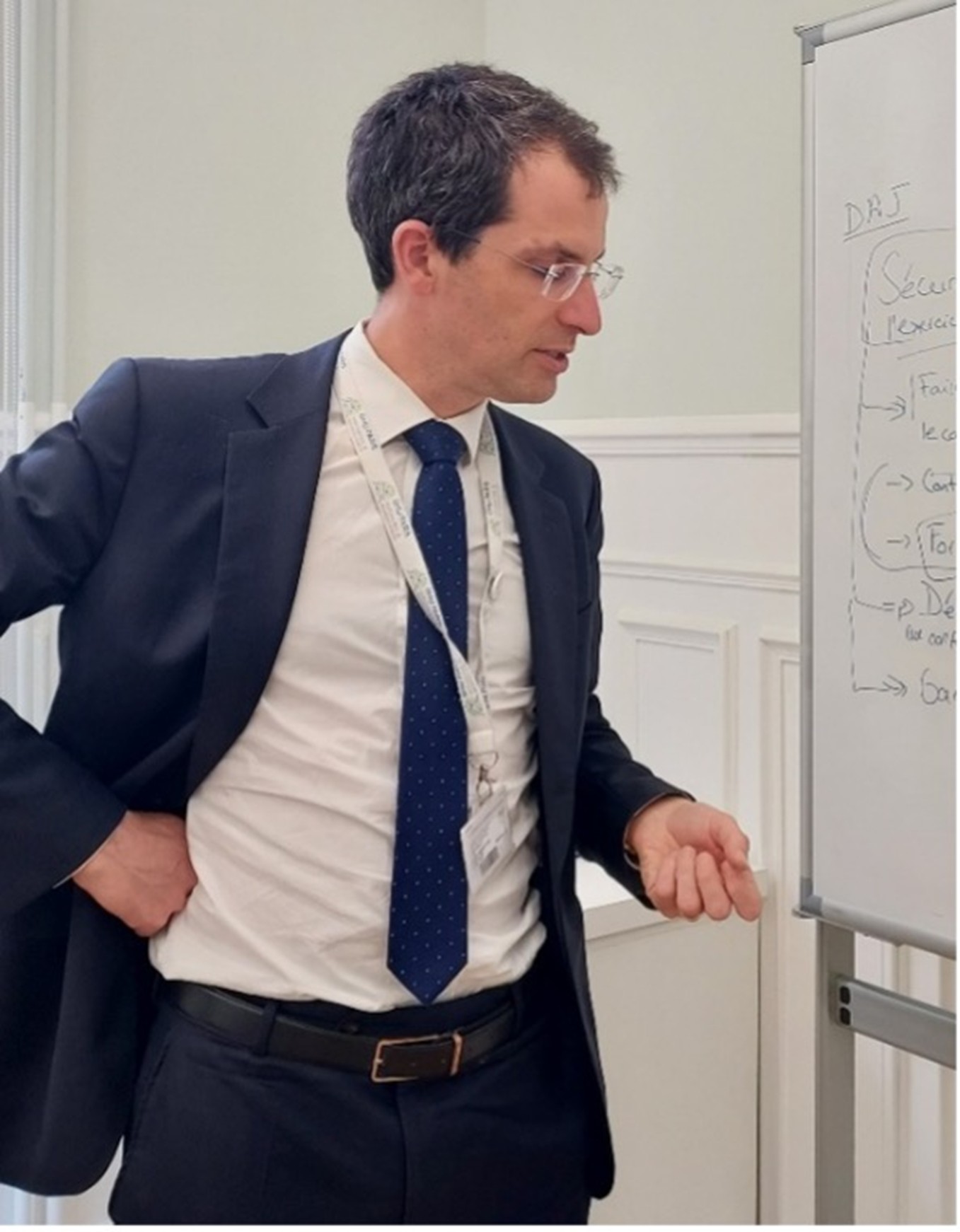
Guillaume Couillard
Five-column PDCA throughout the organization
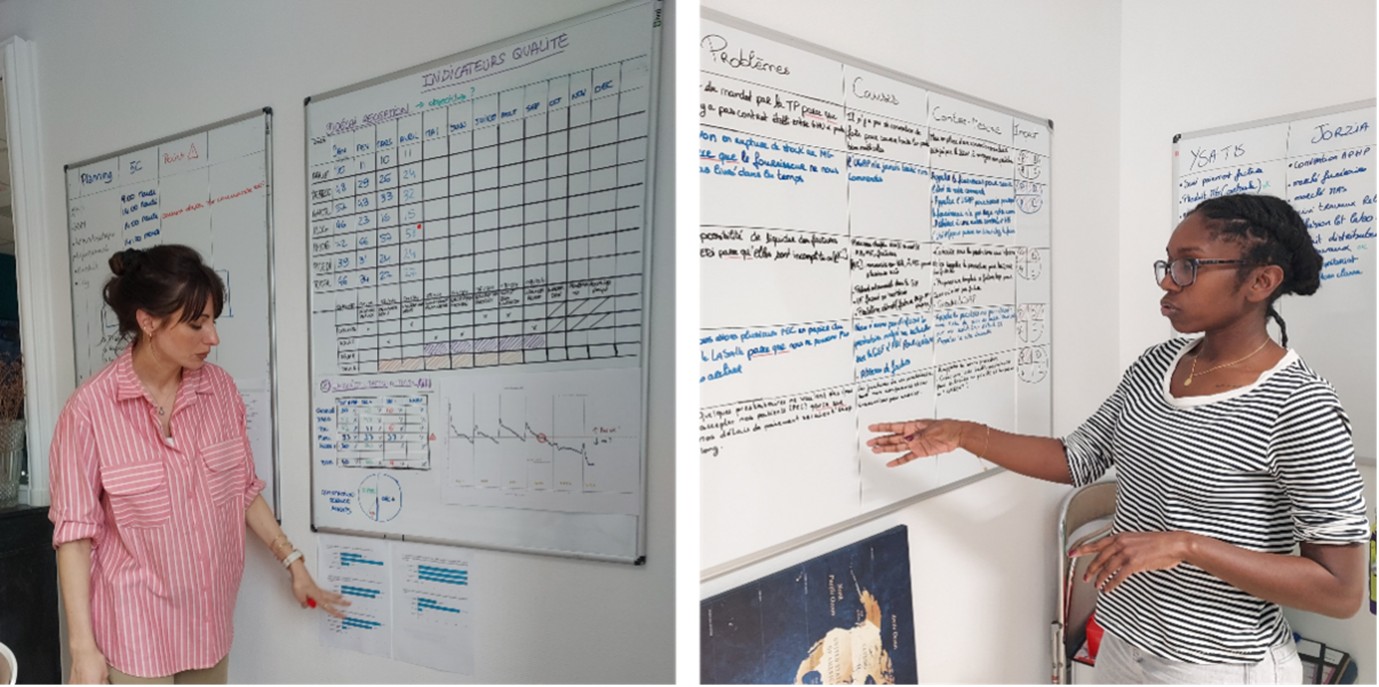
Cristina, on the left, and Ysatis, on the right
Cristina is the Purchasing and Logistics manager. Standing next to the board, she enthusiastically explains the second element of the three-pronged cultural transformation launched by Guillaume: continuous learning at all levels, through a simple five-column PDCA – date, problem, cause, countermeasure, impact. She shows us, for example, how adapting tools and routines to each specific type of purchase made it possible to significantly reduce the time between a purchase request and its receipt.
Ysatis, another member of the Purchasing team, struggles with late payments and breakdowns in information flows. Her 5Cs, as they are now called in the hospital, aim to reduce the time nursing staff spend on administrative tasks and to convince key suppliers to stay.
Back with Guillaume, I am now visiting a Medical and Psychological Center. He constantly visits all the hospitals in the group, at a pace of one or two a week. I am struck by the number of people taking part in this visit: physicians, nursing staff, psychologists. Proof that this culture of continuous improvement is taking root, I would say.
I am witnessing here — last, but certainly not least — the third element of Guillaume's initial strategy for cultural change: genchi genbutsu (“go and see for yourself”) during regular gemba visits. I watch him ask questions about patients, observe the admission process, and challenge the team about delays or about roles and responsibilities. The conversations are informal but serious. They take place standing up, in front of a board, sometimes on the nursing ward itself. He also takes advantage of an imminent software change to engage the team in committing to preparation, risk management and problem solving.
“When do you plan to get together around a 5C for a learning moment?” Guillaume presses the team, eager for them to commit to a date and a regular cadence for the learning sessions. After the visit, he confirms that he insists on keeping a takt time for the 5C, because it generates commitment. “It is scheduled every week, not just when people find the time. When takt time is adopted, improvement accelerates,” he tells me.
He also takes time to explain a 5C process to the team: the simple example of a dehydrated patient in a waiting room is used to show how to select the problem they want to discuss, confirm the cause(s), analyze the countermeasures that were implemented and learn from it. “We don't use the 5C to actually solve the problem,” Louise will explain later. “But rather to discuss how it was solved, after the fact, and draw lessons from it.”
Tireless Genchi Genbutsu brings energy and focus
Guillaume has managed to carry out 350 such gemba visits in three and a half years. He estimates he has between 100 and 150 gemba sites to visit, including support functions. He is careful not to overload the teams (or himself) with action plans: the purpose of the visit is to provide a space for reflection and an opportunity to share challenges and the real conditions experienced by patients and staff.
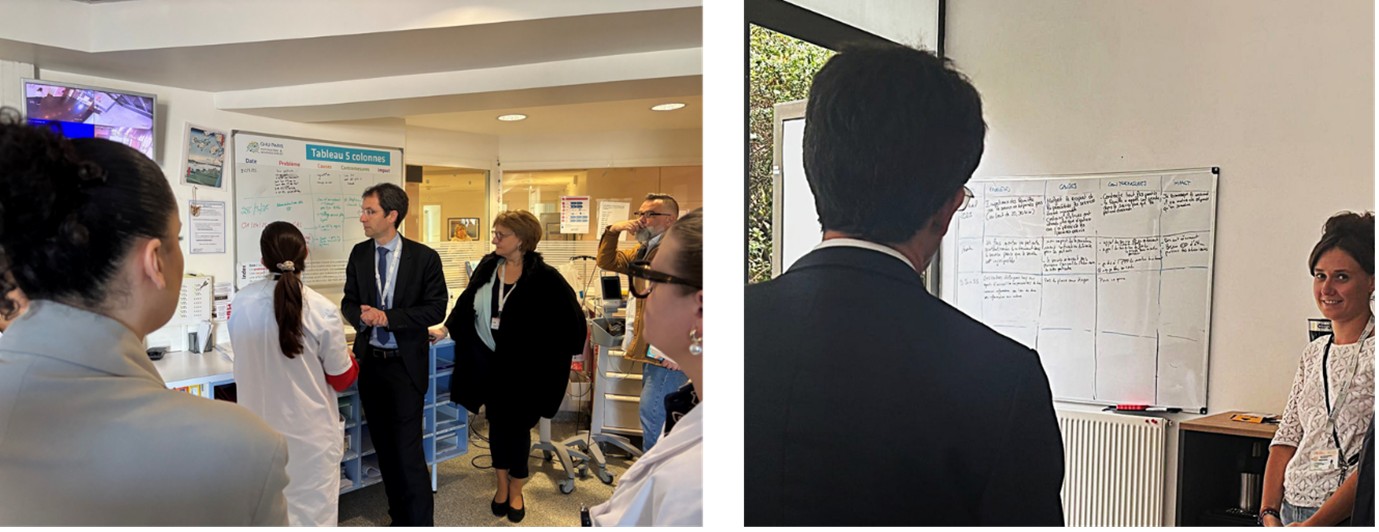
Guillaume and Louise at the gemba
When I ask him whether or not he has a standard approach to gemba visits, Guillaume pauses to reflect. “I include a moment for recognition,” he then tells me. It is important to listen to and spend time with people who deal, for example, with difficult patients or limited resources. He never spends less than an hour on each visit. “It's really an opportunity to face reality and, possibly, to challenge the COMEX as a result. But it's also a time for coaching. I get people working on the next step, the next improvement.”
He ponders for a while. “Sometimes I may challenge them more pointedly to bring them back to our focus — the patients. But I find that using tools like the 5C or 5S, as a means, transforms the conversation: we stop talking about who and start talking about how and why,” he says.
From individual learning to collective intelligence
We are back in Guillaume's office, together with Louise. She too has played a key role in driving the most recent wave of cultural change: 5C or 5S are ideal for discussing issues over which one has control, but a hospital is full of cross-departmental problems that require the expertise and availability of other departments — and probably a bit of negotiation and compromise. Guillaume and Louise have therefore been promoting the use of six-point kaizen tools, hoshin templates, communities of practice and task forces to cover the full spectrum of needs.
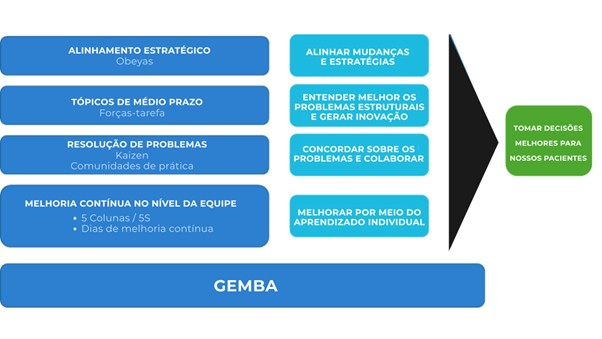
“If we had started with six-point kaizen, complex issues and A3s, everything would quickly have gone into project mode,” Guillaume reflects. “I really wanted them to become familiar with problem solving within their own scope, so that they would routinely adopt the same reasoning when moving on to more complex issues.”
The task forces come together around a theme, sometimes for several years. They meet every week or two and maintain an ongoing discussion on structural issues, such as attracting and retaining nurses, obtaining funding or sponsorship for research, or promoting sustainable development. “Kaizen is ineffective for a topic of this magnitude: there are too many factors beyond our control,” Guillaume adds. A task force will dissect the problem, identify possible levers for action, consider new regulations, propose tests, monitor them, learn and drive innovation.
We look at some numbers: one unit managed to reduce the number of unavailable beds by two-thirds in one year; there were significant increases in research funding and a reduction in resource use (18% less gas consumption in two years and 13% less water consumption in one year); recruitment also had some successes. When no KPI is readily available, the task force counts the number of successful improvements.
Who talks to whom: key knowledge in complex organizations
I turn to Louise to ask about the Communities of Practice (Communities of Practice – CoP). “We have different units and therefore different CoPs. In the case of the continuous improvement CoPs, I usually lead the discussions on ongoing changes that might affect performance; then someone presents an example of a 5C in action. If there is time, we may include a bit of continuous improvement theory,” she tells me.
An essential element of savoir-faire (know-how) in complex organizations is knowing whom to talk to in each situation. The central purpose of the CoPs is precisely to create this mutual knowledge: participants include administrative assistants, healthcare managers, nurses and administrative staff. If necessary, the CoP can invite an expert on a specific topic. Some problems discussed in the CoP can also be escalated to a task force.
Guillaume laughs. “We didn't structure it as a CoP, but that ‘who talks to whom’ is exactly what we achieved with the support functions,” he explains. Units outside Sainte Anne — where all the support functions are concentrated — complained that support was never sufficiently available to them. Guillaume encouraged IT, Maintenance and Logistics to start holding regular meetings at these units. It was a win-win situation: the meetings have now become an essential routine and long-standing problems have been solved. They went from “nobody ever listens to us” to “I know exactly whom to talk to for this kind of problem.”
Focus on patients and nursing staff. Give each actor time to explore. Introduce a takt to set the pace and generate commitment. Provide tools suited to the magnitude of the problems. Coach and explain, again and again. Encourage the creation of communities of practice. And go and see for yourself, tirelessly. Indeed, Guillaume and his team show us the way to a learning hospital.







