

True North for Industry 4.0

A group of researchers led by Krzysztof Ejsmont published a systematic literature review in 2020 that investigated research conducted since 2013 on the relationships between the Lean Model and Industry 4.0. They collected 87 relevant studies, which converge on the conclusion that the combined application of the two models increases value creation across the entire chain.
From their analysis of the studies, the researchers concluded that Industry 4.0 makes it possible to achieve a high degree of materialization of lean principles across the entire chain, and that the Lean Model is a prerequisite for implementing Industry 4.0 in a company.
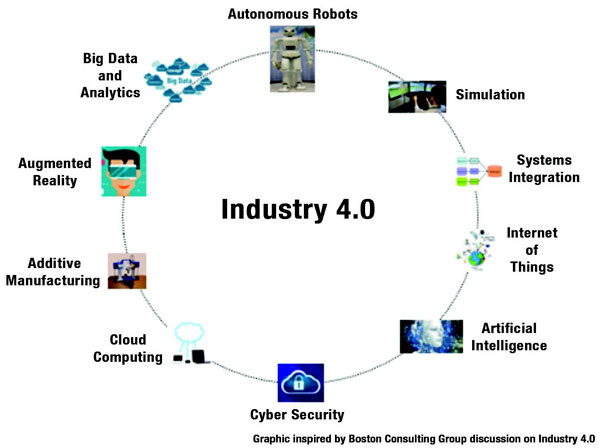
The problem with Industry 4.0
When we examine Industry 4.0, we find in its origins the concept of integrated flows of materials and information within the aims of technological integration, just as is the case at the foundations of the Lean Model of Supply Chain Management.
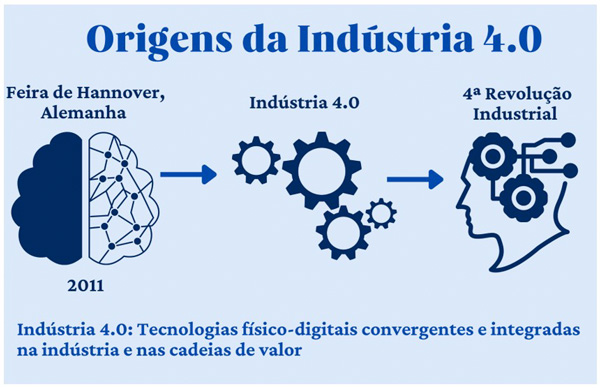
However, there is no understanding or maturity in applying such concepts in companies whose departments (even those responsible for information and digital technology) are separate and not integrated with one another, still following departmental structures that compete for resources more than they collaborate by sharing information and assets.
If the goal is not convergence and integration among them, building a system that achieves the connection of all physical, digital and biological flows, and if that goal is not fully aligned with the Lean Model's aims of continuous flow and pull, with the full, broad and concrete realization of its principles of maximizing value for the customer and stakeholders in all processes of the company and the Supply Chain, no significant gain can come from such an unfounded application.
For example, when the researchers of one study asked a supply chain professional at a large corporation, whose investor relations report indicated investments in these technologies, about Industry 4.0, the answer they received was “that subject hasn't reached us yet; it's in the innovation department.” Clearly, there was no purpose for applying the concept in the company, which was merely riding the wave.
Lean as the solution
If we understand that Industry 4.0 leads to the materialization of the lean ideal, with a value stream fully articulated and synchronized with demand, the Lean Management Model also begins to serve as a guide and orientation for introducing Industry 4.0 and transforming each organizational reality and its supply chain.
To achieve a high degree of integration with full and broad physical and virtual connection, without departmental boundaries and organizational barriers, the Lean Model offers a horizontal management view across the entire value stream, from marketing, sales and inbound logistics to production and delivery, not to mention all the stages and associated services throughout the entire post-sale and post-consumption life, with no boundaries between companies and departments.
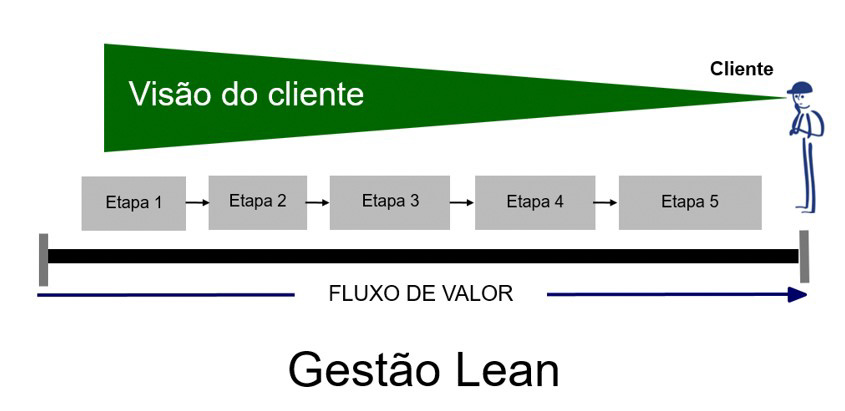
The Lean Model's ability to guide innovation has always been present in its principles. In an interview I conducted in 1998 with the then consultant Chihiro Nakao (a former member of Taiichi Ohno's group of experts), he explained in a metaphorical and peculiar way how just-in-time is enabled by continuous flow and how continuous flow, in turn, is a reflection of “the customer thinking of the product and, upon opening their eyes, the product being right in front of them,” instantly.
Now, with Industry 4.0, lean can achieve a higher degree of effectiveness by drawing on the integration and application of the most advanced technology suited to those aims. Technologies can be chosen, applied and guided by the Lean Model to achieve the goal of maximizing value creation, connecting market demands and variations in continuous flow to the just-in-time production and delivery responses of the Supply Chain agents.
For example, a manager who is unsure whether to invest in sensors for their capital goods to set up an IoT for performance monitoring, or to use the sensors for data acquisition and to build a Digital Twin for event simulation, will find in the Lean Model approach objective guidance on the degree of impact of each alternative on eliminating causes and to what extent they will be integrated with the goal of continuous flow and the pursuit of perfection.
A concrete example
In a real case, I witnessed a manager who was dissatisfied with the overall result achieved in the order lead time from replenishment. He had carried out an internal optimization by adopting smart warehouses with robots moving all orders, supported by AI for the optimized location of BINs, aiming to reduce internal movement and speed up put away and picking. However, because the docks were overloaded at certain times due to a lack of synchronization between sellers and buyers, there was still a discontinuous flow into and out of the warehouse.
To a certain extent, the warehouse, its AI algorithm and the entire investment added to excess working capital to meet a D+1 delivery target, but the most impactful root cause for reaching that target at lower cost was not internal movement, but the lack of synchronization between inbound and outbound.
In this case, a Cloud Computing system connecting the platforms and a Digital Twin system for simulating and predicting routes and demand would have been more pertinent. In terms of capital, the high-tech warehouse did not solve the cause; it only relieved the symptom.
Guided by the practical, objective and unambiguous concept of one-piece flow, fundamental to achieving the continuous flow and pull characteristic of just-in-time, the operations manager would certainly have considered other, more integrative alternatives instead of starting with the smart warehouse, which became an island of excellence surrounded by waste on all sides.
In other words, the rapid reconfiguration capability of the robotic storage system was underused insofar as the chain as a whole was not connected to the same reconfiguration needs in the warehouse's inbound and outbound.
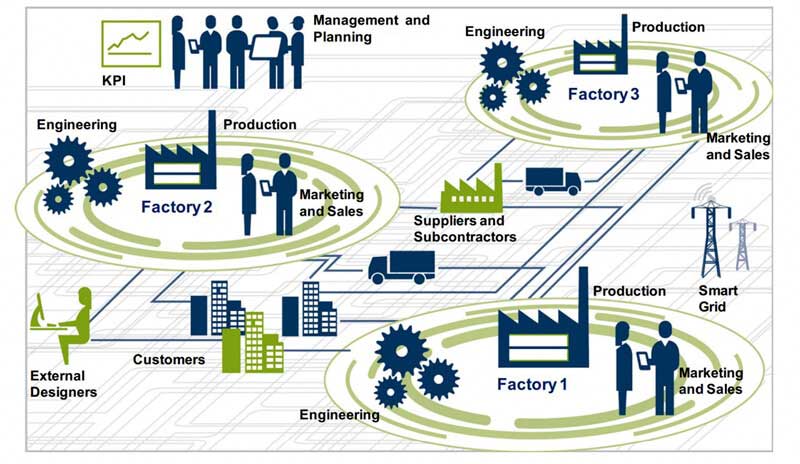
The Lean Model as a prerequisite for Industry 4.0
The great possibilities opened up by Industry 4.0 require organizational maturity so that technologies are applied to achieve improvements and innovations in agreement with the management system, without interruptions and conflicts in the transformation, while at the same time fostering a culture that sustains the journey of change.
The expression nemawashi in the Lean Model illustrates an approach to achieving maturity and consensus before change. Inherited from its Japanese origins, the term metaphorically means “preparing the ground for planting” and is applied in the Lean Supply Chain through techniques for collecting data and evidence according to a structure called the A3 Plan, in which managers objectively reach organizational consensus for change.
Industry 4.0 also offers its own model for checking organizational maturity for implementing technologies. The well-known ACATECH model (German Academy of Science and Engineering) has this objective and has been widely used to assess what stage of technological evolution a given organization is at when the assessment is made, indicating the technological steps and actions to follow in its evolution.
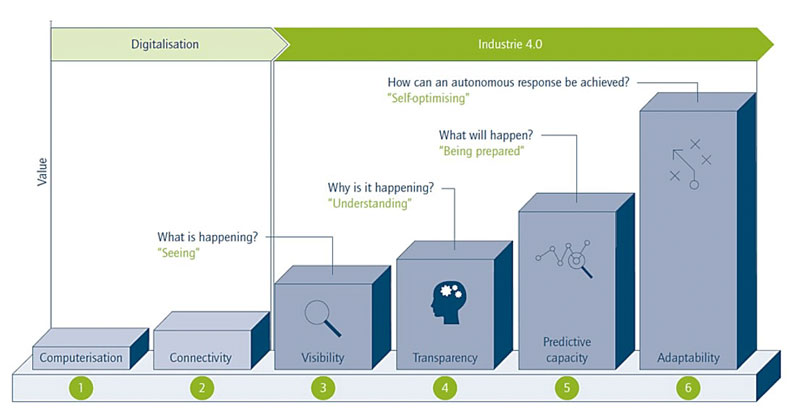
Looking at the ACATECH model, it is not hard for the reader to see that, from the connectivity steps enabled by digitalization in stage 2, followed by visibility and transparency in stages 3 and 4, many conflicts with traditional structures will have to be overcome.
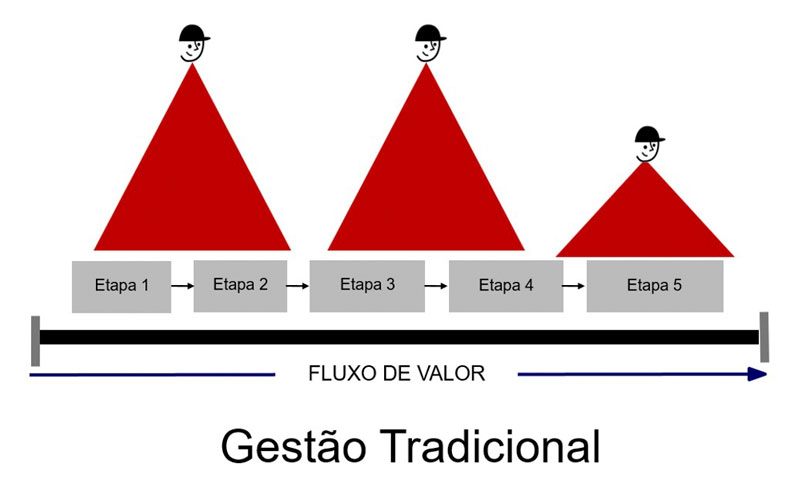
Given an organizational maturity still grounded in departmentalization, even greater efforts in time and resources will be required to advance through the stages of the ACATECH model.
On the other hand, if the organization adopts the Lean Supply Chain model, management will shift its culture to a horizontal view, with continuous value flow practices, making the adoption of connectivity actions natural, which the Lean Model exercises through techniques such as Daily Management, value stream maps, systemic kaizens and other tools (a set of practices that create a culture of collective innovation).
There are examples in our experience and investigations of real cases in which lean practice ends up, as it were, spontaneously pulling technologies that enable greater connectivity, visibility, transparency, prediction and adaptability, since these attributes are already applied and learned in management methods with people.
One last example
A case report we obtained from a Brazilian company that practices lean illustrates this perspective of the lean model as a prerequisite for adopting Industry 4.0 and, beyond that, as an element that pulls new technologies.
The company in question had identified, through value stream mapping, major losses from stoppages of machines and equipment in its plant and at its main suppliers, including vehicles and material-handling equipment. These losses were assessed as the biggest problem for the continuity of production flows and were chosen as the focus of the first improvement cycle in applying the Lean Supply Chain.
Lean tools applied to productive maintenance were implemented to connect different departments and information and to increase the visibility of performance and problems and the transparency of intervening factors and the search for causes.
The OEE indicators became competitive and a benchmark within the organization, but there were still advances toward perfection that only technology could achieve. For example, the monitoring process for predicting stoppages and taking preventive actions advanced as far as conventional and human sensing allowed, given its technological limitations.
With the advent of new technologies, sensing, simulation and machine learning techniques were chosen to predict and prevent stoppages of machines, equipment and vehicles, advancing even further in maintaining the continuous flow that the lean model had identified as central in that context.
The culture of innovation, continuous improvement and the pursuit of flow perfection through collective action was already in place; there was consensus among employees. The prerequisite of the Lean Model had prepared the ground for deepening the advances through Industry 4.0.







