

Creating a model UBS
Primary healthcare units (UBS) usually carry out many different activities – from preventive services to outpatient operations –, but all of them tend to be of low complexity. Unfortunately, this does not mean that the processes behind these services are also free of complexity. Our Campos de São José unit was a great example of the many problems this type of organization usually faces, and it took a few intense months of lean thinking to change the way we work.
Our transformation was supposed to have started in 2020, but the pandemic made us delay the start, because we had to become a vaccination center. We were finally able to begin our turnaround last year. Our first steps were to draw a high-level value stream map to understand our current state and what we had to do next, as well as to introduce daily management and A3 thinking. Our ultimate goal was to give patients faster access to our care.
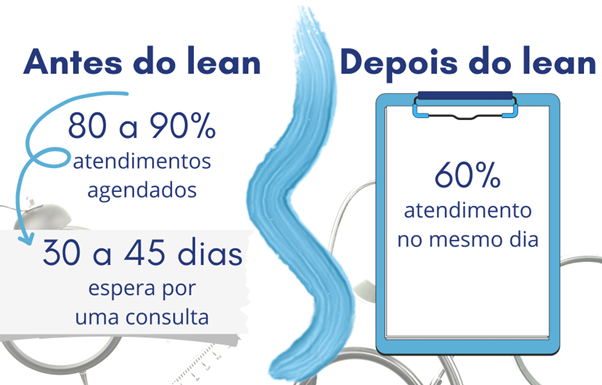
When we began implementing lean, between 80 and 90% of our visits were scheduled. People arrived very early in the morning to try to secure care, but could only book an appointment 30 or 45 days later. Today, 60% of the people we receive are able to see a doctor on the same day (we struggled a bit to define the ideal proportion between scheduled and same-day appointments, but we ended up deciding to aim for the 40 to 60% range).
Before lean, anyone who walked into the UBS had to be redirected to a later stage, depending on where they had to go. That way, someone with an appointment would be in the same line as someone who had just come in to pick up a prescription.
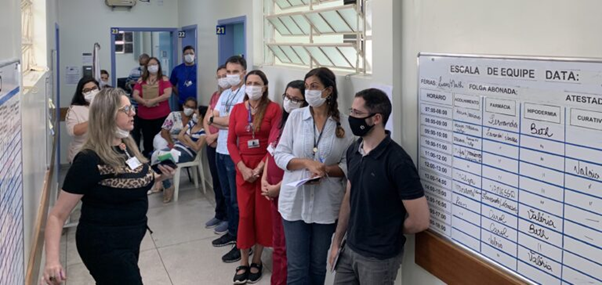
Some of the improvements we made
Our way of tackling our problems was by streamlining the line – if something did not require a consultation with a doctor, we began referring it to the nurses – and by creating dedicated care pathways. Nurses are qualified to do many things, but, for cultural reasons, there is a tendency in Brazil to refer everyone only to the doctor – even when it is not strictly necessary. Issuing a new prescription or following a vaccination plan are not activities that require the presence of a doctor (no wonder we had so many waits!).
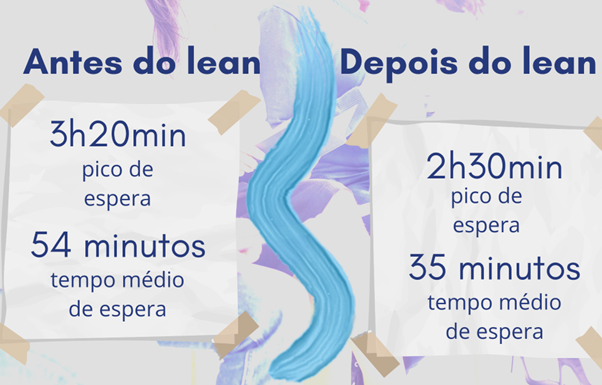
When we looked at patient arrival times throughout the day, which ran from 7 a.m. to 6 p.m., we realized that most of them tend to arrive early in the morning, hoping to get to work on time. This created long lines, with the peak wait in the early morning reaching 3h20 (with an average of 54 minutes). After we redesigned and simplified the flow (removing several unnecessary steps and interruptions), we created a smoother path for patients to access care. Waiting time decreased, both on average and at peak – 2h30 at peak and 35 minutes on average. The best part is that we managed to reduce waiting times even with an increase of more than 40% in patient volume due to the resurgence of the pandemic.
After redefining the flow, we started on standardized work, which became fundamental for us to deliver our services consistently. Part of our work is to serve our community and support it, whether by helping people who cannot get out of bed, encouraging women to have mammograms, or reminding mothers to bring their newborns in for periodic checkups. For this type of activity, standardized work proved very effective – not least because it brought consistency to the way we collect and share information about patients. We are currently introducing TWI and a kamishibai system to reveal the state of the work at any given moment.
Another important lean change we introduced was the creation of a dedicated pathway for patients with hypertension and diabetes (we call it “HiperDia”). Because they are similar conditions, it made sense to put them in the same flow. Scheduling appointments at specific times of the week for HiperDia patients who need new prescriptions or consultations helped us relieve the pressure on our care unit, with fewer people showing up at random times. As we further develop our visual management, we expect our results in this critical “value stream” to improve even more.
One of the most impactful changes we implemented was the introduction of daily huddles, which became an opportunity for us to be very detailed in our continuous analysis of the current state. Three times a day, we review new problems that may have occurred, safety alerts, complaints we have received from patients, obstacles in the HiperDia flow, or supply and maintenance problems. The huddles let us have a clear view of the situation at every moment (the 6 p.m. one lets us alert our colleagues for the following morning, so that they are aware of any problems when they start their work).
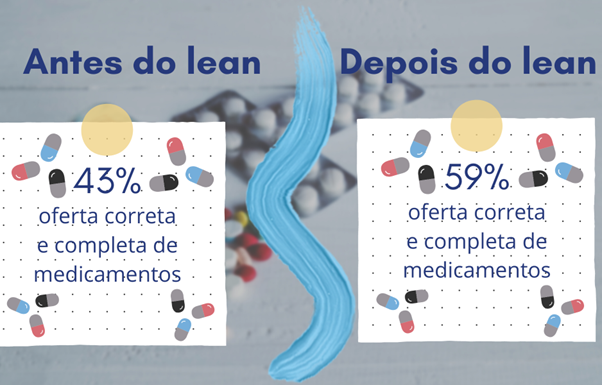
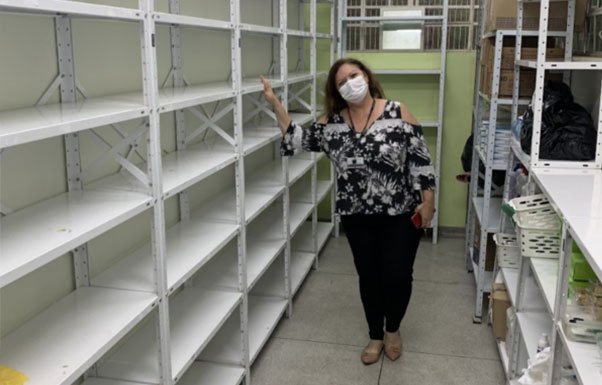
Finally, we also made changes to our medication supply. Thanks to the new weekly replenishment process, we were able to free up an entire room and cut in half the size of the area dedicated to our in-house pharmacy (see below). The correct and complete provision of medication to patients, which was at 43%, is now at 59%, which means the team can provide medication to patients immediately after prescription almost 60% of the time.
Creating a model line
We hope to turn our UBS into a model line that can be expanded to the entire health system of São José dos Campos. Now that the pandemic seems to be subsiding, we have the opportunity to take this kind of revolution to other healthcare organizations in the city.
Cross-pollination is how we learned everything we know about lean. We visited the Instituto de Oncologia do Vale (IOV) several times and were mentored by some of its leaders, such as Carlos Frederico Pinto and Stela Maris Coelho. Learning about their years-long transformation was a great source of inspiration for us. In fact, it was from them that we learned to implement value stream mapping and daily management simultaneously so that our people could understand the importance of flow and discuss it day to day. We want our unit to become a learning environment for others, just as IOV was for us.







