

Supporting our growth with lean thinking
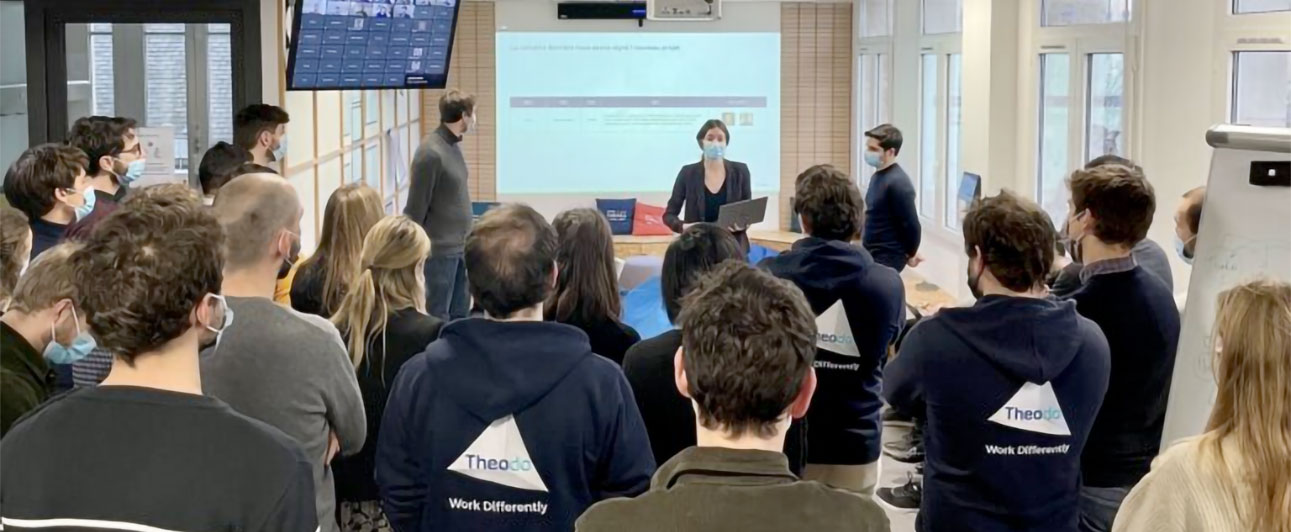
Today I met with Caroline Sauvegrain, head of operations at Theodo France. Caroline runs the company alongside Julien, CEO, and Maxime, CTO. Theodo France develops web and mobile applications and has grown continuously since its creation, about 12 years ago.
In 2020, Theodo's teams developed an app that supports the French government's loans to companies severely affected by Covid-19. They did all the development in just five days! The app had to be stable and intuitive: in the 24 hours following its launch, Bpifrance (a public investment bank) recorded 1,000 visitors per minute and received loan applications amounting to almost € 1 billion.
Caroline had just returned from Theodo's annual meeting and felt elated. She told me: “Our growth in 2020 was close to 25%, despite Covid-19. It was well above our forecast”.
It is a common idea that most startups, even those that survive their first 10 years, fail sooner or later. Theodo France is in its 13º year, and there is no doubt that its growth, from an idea conceived by the company's founders in a small office to a successful organization with 130 employees, was not an easy path. So what is the secret ingredient in Theodo's recipe for success?
Growing the customer base with Kanban
Caroline gave me some more background. “You should know that 2019 was not a good year for us. Instead of the usual double-digit growth, we stagnated for the first time in years. I felt bad about it, because sales and customer satisfaction were within my area of responsibility”, she said.
Caroline climbed the ladder very quickly. She was recruited right after finishing university, in 2015, and was promoted to sales director in 2017 and to COO in 2019. This rapid advancement gave her only a few years to learn her trade and experiment with her management approach to understand what works and what doesn't.
“I thought I could simply apply what had worked for me individually: give people challenging objectives, support them if necessary and count on their willingness to unleash their talent”, she explained.
In her world of app development, Caroline focused on moving tickets through the processes, whether in Trello or on any other task-sharing platform. The team relied on checklists to make sure nothing was wrong, and Caroline pointed out the objectives to be achieved and… she was usually disappointed with the result.
She also introduced visual management and a red box system, but the customer sort of disappeared from the process. “We discovered that our process was excluding some deals too early, because people believed Theodo was not able to close them or did not want to. Sales was unintentionally becoming a kind of selection process”, Caroline admitted. “On the other hand, when analyzing some of our best deals, I found that the people, in those cases, had not necessarily followed the standard process”.
This setback fueled her thinking. Caroline started reading books on lean management and decided to discuss the subject with her colleagues. “I thought my management approach was to give the mission and offer support, but I learned that people are not looking for superheroes they can follow blindly. Instead, they follow leaders who show a sincere interest in them, in their problems and in the decisions they must make.”
This opened Caroline's eyes. As a result, she developed a new sales system, based on kanban cards.
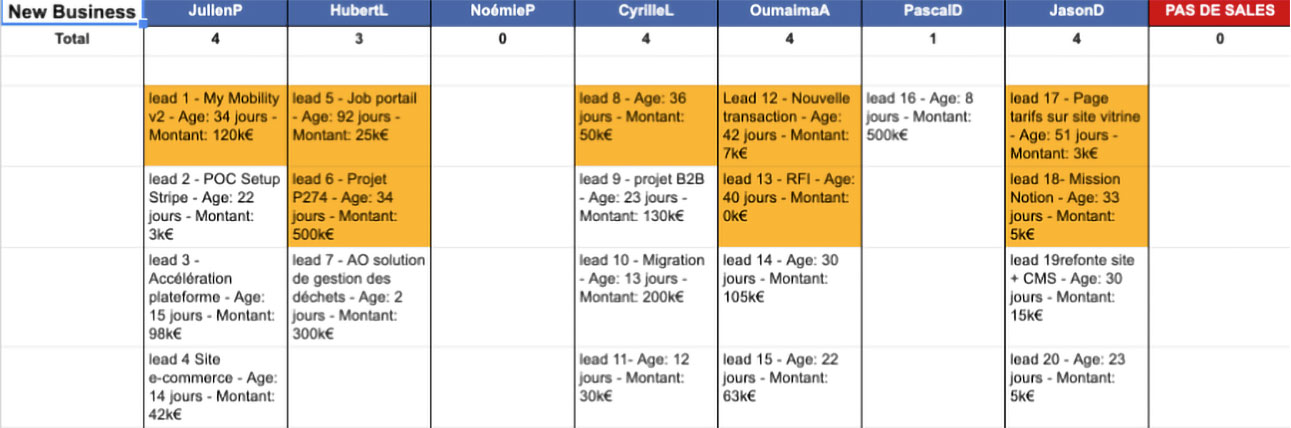
“Each column represents a salesperson, and the different leads are displayed as a kanban for each customer request”, Caroline explained. “We tracked the lead time from the moment the request arrived and tried to make sure all customers were served, regardless of the size of the request. Just as in the concept of ‘sell one, make one’, we should not move on until we have managed to close the deal.”
Looking at the real-life example of Caroline's sales kanban board, I can see a large variation between orders (from € 5 thousand to € 2 million). The leads can be easily identified (some have been there for three months).
I told Caroline that this looks a lot like a production cell, with kanban cards in “red” indicating that the cell is having difficulties.
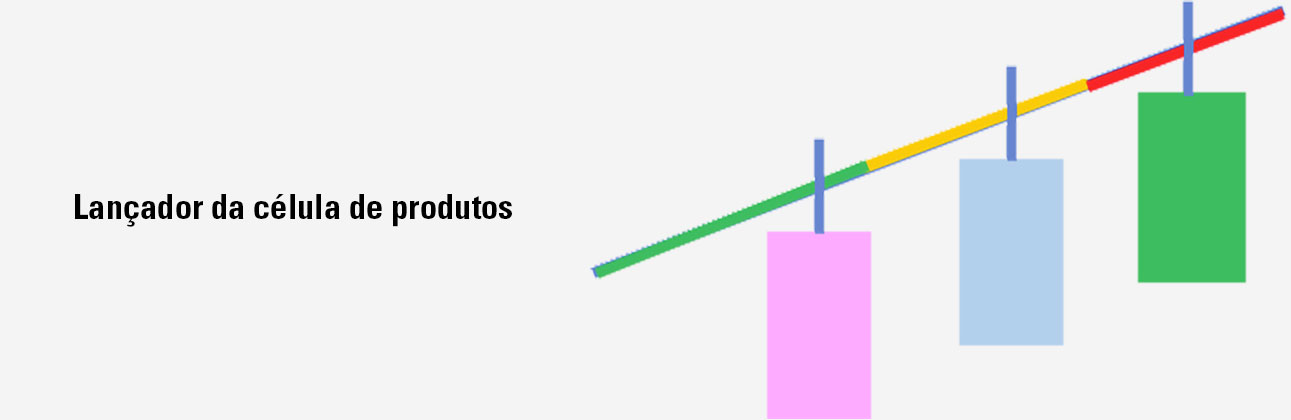
What they did before was closer to the agile approach than to kanban, in which tickets (kanban cards) move along the flow:
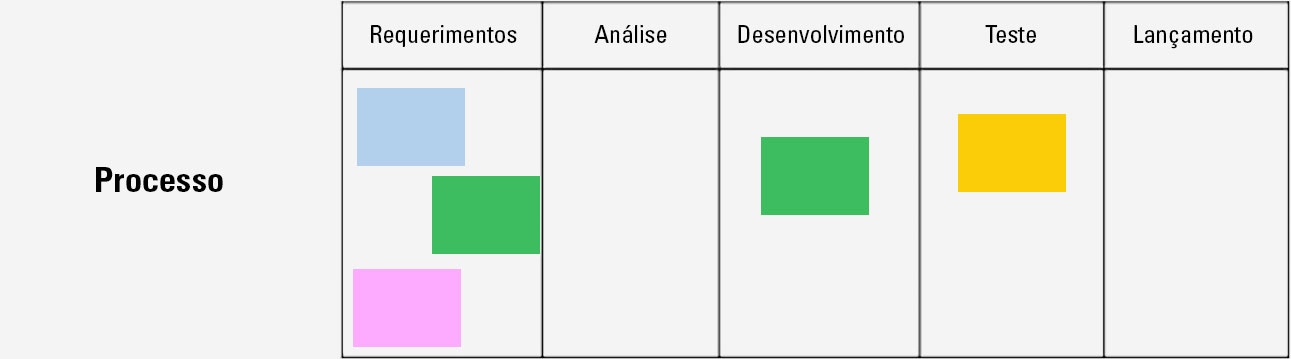
If we go back to the original intention behind kanban, withdrawal cards are clear selection signals indicating the need to withdraw components for replenishment on the production line or finished products to be shipped. However, in an office or digital environment, we are mainly talking about production cards, signaling that production needs to start. Moving these cards along the flow, as in agile kanban, somewhat compromises the original intention, which is to assign a specific production cell a clear task to be performed.
Caroline sees many advantages in this new approach:
- She and the teams no longer focus on “moving on” without closing deals that are considered too difficult to reach.
- The kanban cards clearly show the imbalance of work among the different production cells (today, each salesperson chooses the leads he or she is interested in and works on them in parallel). They also highlight the cells that are left with nothing to do.
- The cards demonstrate the vast diversity of customers and orders, a real opportunity to broaden Theodo's customer base and no longer depend on a few key customers.
The new approach unleashed the teams' potential. “I was no longer asking myself whether they had ticked every point on the process checklist. Instead, I started asking why the lead was not coming through and what could be done to serve that customer”, said Caroline. Team members began to see customers as real people, with their own problems, big or small. They began investigating new solutions that would better fit small budgets, such as no-code or low-code tools, instead of developing the code from scratch.
One of the most common effects of the “big company disease” is that the process always wins over the customer's individual needs. If you have ever requested support from an IT department, you know what I am talking about. Following the process means you will have to suffer through talking to robots before you can talk to a real human being. It seems that the robots exist to keep you from bothering the customer service representatives. When you are finally allowed in, you will have to verify your contract, your serial number or your license. Only then does someone start listening to you and let you explain your problem. If the problem does not fit the predefined categories of known problems, you will be asked to call someone else and start all over again.
What Theodo France clearly did was to choose customers over processes, which proved to be a big change considering the 25% growth achieved in the middle of a pandemic (while French GDP is at -8%).
Caroline said: “We lost two large customers in 2020 because of the Covid-19 crisis, and they are unlikely to come back any time soon, but all the smaller customers we started serving from 2019 onward (and some larger ones too) more than made up for the loss.”
"Good thinking, good products" and remote work
The new approach brought a series of new solutions, but as ideas emerged, some were not always perfectly mastered. With growth came quality problems, which generated rework and delays. “Growth has given us some good problems”, said Caroline, smiling.
She took me on a tour of Theodo's open office and showed me walls full of open discussions about the technologies that need to be mastered. There are “traces” of obeyas used to discuss app designs after the deal is closed, with concept papers and the main challenges and decisions the team needs to face in terms of tools, architecture or code. There is a lot to think about, share and learn here.
With the “new normal” created by the Covid-19 pandemic (during parts of the two lockdowns, almost 100% of the team had to work from home), I asked Caroline how working from home impacted this “good thinking, good products” activity. She told me that, within 24 hours, they completely moved their obeyas to a digital platform. With just a few clicks, she showed me the portfolio of projects they designed, which are displayed both in the open space and on the company intranet.
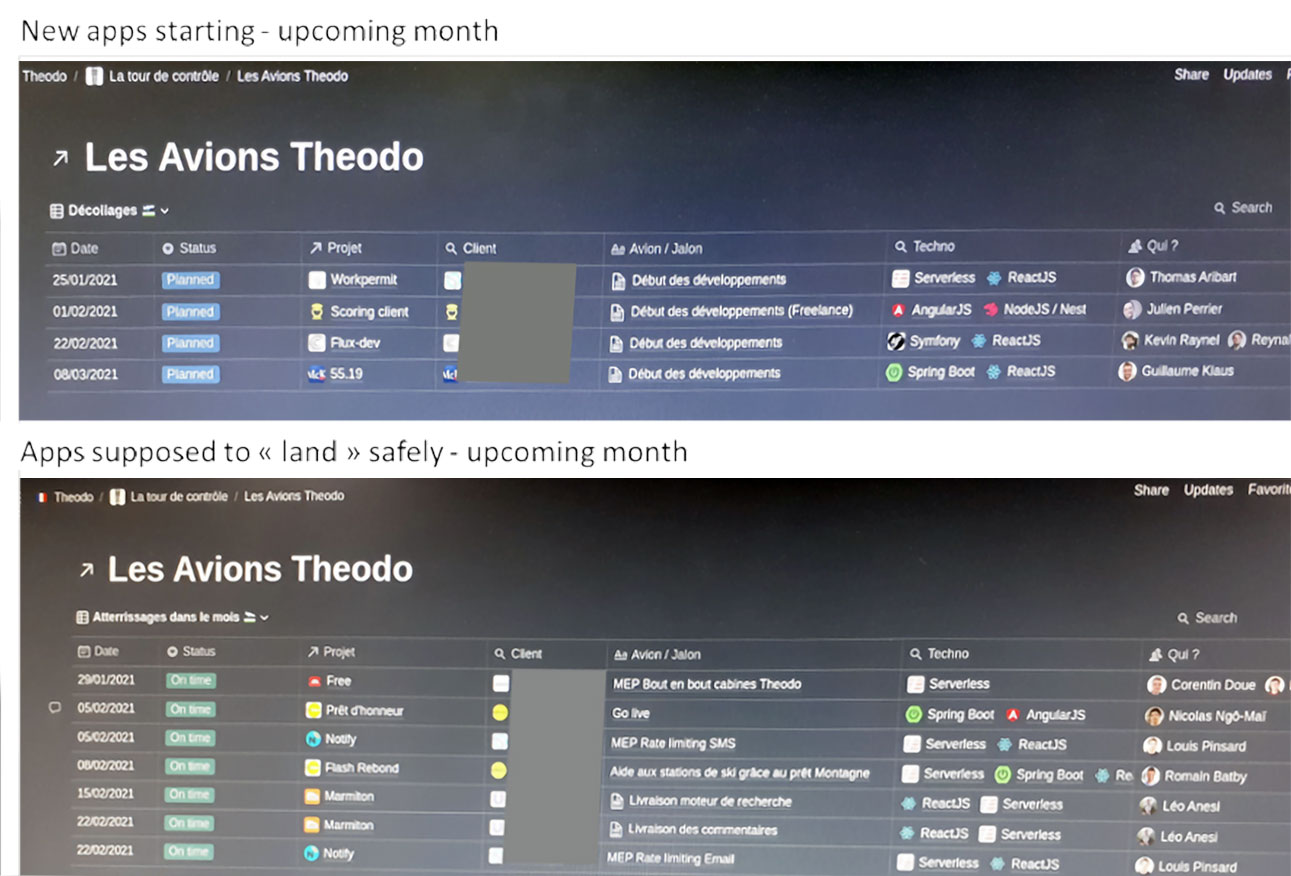
By double-clicking on any of the rows – some showing a “late” status –, you enter the project's digital obeya. Obeyas are fundamental in the design phase, because they help share the customer's expectations within the team. Things like “simple, but precise and detailed” or “a quick solution, with no bugs”. They share the emotion and the value the product is expected to deliver, rather than detailed specifications.
But this does not mean that the technical options will not be thoroughly discussed. Experimenting with ideas and making decisions about the technical challenges a project involves is a fundamental step of the design stage (one of the reasons we suffer from rework is that we always underestimate the time we need to spend in the planning phase of a PDCA cycle). Beyond the design phase, the obeyas will continue to monitor success in the product and in customer value, on-time delivery, technical challenges and customer satisfaction.
When I asked Caroline what she would recommend to other people who need to prepare for a leadership role, she thought about her answer for a moment. She then confirmed that you need to work on your emotions and energy levels, but also develop new muscles – such as structured thinking via A3 or learning to see the company as a whole, as an entity challenged by external threats that can only achieve sustainability through capability development. “Capability development gives us more options and solutions and increases speed and value for customers”, she said.







