

The role of "system 3" thinking
Nobel Prize winner Daniel Kahneman distinguishes two different routes of thought, depending on whether we think hot-headedly, which is a fast and automatic kind of thinking, or coolly, which is a slow and reflective kind of thinking:
- With the system 1 thought process, the brain forms thoughts that are fast, automatic, stereotyped, emotional and often unconscious – think of the first thing that comes to mind when you are presented with an object, an idea or a situation.
- With the system 2 thought process, the brain deliberately calculates an answer, directing attention to the situation, working out and formulating a deliberate response.
Kahneman reached this conclusion by conducting several experiments in which he manipulated the emotional description of the situation and showed that people gave different answers to the same facts. As part of my doctoral research, I replicated some of Kahneman's experiments with students and, indeed, found similar results. For example, in a classic experiment, participants were told that, in order to prepare for an outbreak of disease that would kill 600 people, they had to choose between:
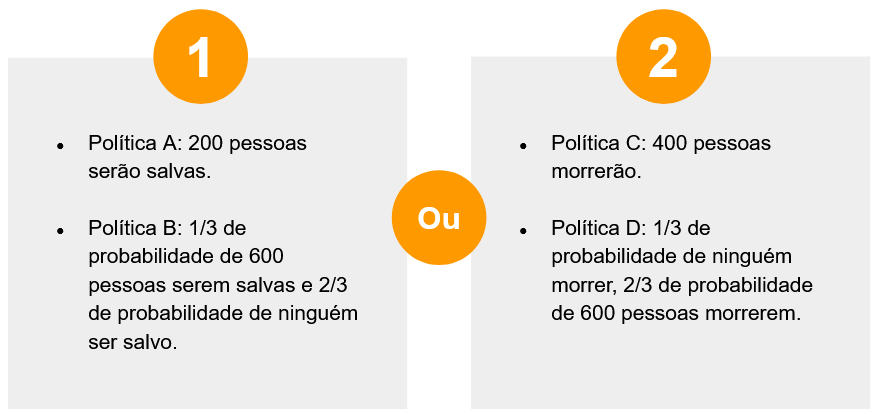
As predicted, I found that when offered options A and B, people tend to choose A, but with C and D, they tend to choose D. The information presented is mathematically the same, but how people picture it in their minds, and the emotional weight of words like “saved” and “die” or the certainty of the numbers, affects their judgment: system 1 overrides system 2. If they are asked to calculate the probabilities (that is, to engage system 2), they conclude, correctly, that the odds are the same.
Kahneman pointed out that the framing of the problem, particularly its emotional content, influenced decision making. I was also studying decision making under experimental conditions in an automotive supplier plant, observing how Toyota engineers were teaching a supplier's engineers to adopt the Toyota Production System (TPS). I witnessed some of the supplier's engineers adopting the Toyota model and abandoning their own, many others resisting regardless of the evidence presented to them (the line's productivity and quality visibly improved before their very eyes), and a few others, at the extreme, adopting the language but not the practice. Years later, I came across one of the young engineers from that project, who by then had become a plant manager, running the least lean plant you can imagine, but with all the proper language of kaizen, kanban, visual management and so on – something that is funny, sad and very puzzling all at once.
Years ago, in my dissertation, I argued that people did not just reason in the privacy of their own minds, but constantly interacted with their environment – whether through system 1 or system 2. My argument at the time was that it was necessary to include visual cues from the environment in thinking in order to understand how people reason. Although I was somewhat perplexed by this, I never really challenged the dominant view of the brain as a kind of information-processing machine – a biological computer, if you prefer – that received information from the senses, calculated a response and could go haywire if strong emotions were involved.
I became so absorbed in understanding TPS that I abandoned this line of research and focused on learning how to change plants rather than just studying mental models. Still, it became obvious over the years that Toyota sensei were constantly using TPS as a means of engaging system 2 – getting people to think for themselves – while their Western counterparts were interested in fixing system 1: creating “better” thought automatisms.
Visiting Toyota plants around the world and studying lean transformations in many countries, one of the things that struck me was how we Westerners are obsessed with seeing people as machines that need to be fixed when they become “emotional”. In the East, on the other hand, the problem was often expressed in terms of “harmony” or “balance”. We were looking for the right decision to execute (and impose on others), while our Eastern counterparts were looking for a more harmonious and collaborative answer. They were framing things differently.
Frames, once you see them, show up everywhere. People do not simply process a situation; they interpret it – in a rather disconcerting way. Think of how different people describe a controversial figure such as President Trump. Depending on whether they vote for or against him, they describe a different person – and yet it is the same man, and everyone has the same information available. With the same inputs, what could lead to such different assessments?
A small strand of neuroscience has been gaining ground over the last two decades. Perhaps the brain is not a computer after all. Instead of passively absorbing inputs, calculating and producing reactions, a new way of seeing the brain is as a simulation machine. Imagine that your brain runs simulations of the world, which it then updates and corrects using the information it receives from the senses. From this perspective, the brain does not receive information merely to process it; it projects an understanding of the world and then corrects the most obvious errors, as happens when you put your hand under a hot tap you thought was cold – it hurts just to think about it. This view explains why we so often feel so clumsy, as whenever you throw something into the trash and miss. Although our simulation seems perfect, seems like reality, it is in fact full of holes, as can be seen in the following experiment (I don't want to spoil the surprise).
We fall victim to visual illusions not because the brain is bad but, on the contrary, because it works well. It corrects puzzling cues in order to make sense of them.
In other words, there is something in our brain that is constantly trying to resonate with its environment: we want to understand and we want to be understood.
I would like to suggest that, for system 1 or system 2 to work, we must consider a system 3, a mechanism that establishes a fit between the frames running in our mind and the reality of the situation, a brain circuit that constantly projects our mental models onto real-life situations and then corrects them to a greater or lesser degree according to the feedback it receives (as if we were dreaming while awake, except that during sleep the senses are disconnected and the brain cycles on its own, whereas when awake it works with the information around it).
System 3 would imply that:
- Brains are never passive receivers of information – they hold frames that they project onto the world.
- They seek resonance with what they see and hear.
- They accept or reject dissonance, thereby triggering either system 1 as an unconscious and immediate emotional reaction or system 2 as a considered, calculated, attention-driven response.
System 3 comprises the circuit that allows us to get in tune with one another when we share enough language, intent and common ground to communicate fluently. It is what makes us pick relevant visual cues from our environment to form mental models and formulate responses, whether hot or cold.
As our minds project their frames onto the world, hoping to find resonance, they encounter the frames of others, at which point the stronger frames win and the weaker ones fall into sync with one another. For example, this is what happens when you are pulled over for speeding by a police officer – there is nothing to say; the frame is so strong that your place in it is determined. No matter how justified you feel, your frame, “I had a valid reason to speed”, will probably crumble in the face of the officers' “I'm here to enforce the traffic rules”.
If the goal of TPS is to drive deep system 2 thinking (sometimes called the thinking people system), then we need to take into account the importance of visual management in doing so. Visual management defines the structure of the system 3 mental model: it displays salient features of what is happening versus what should be happening, in order to reveal problems. Without an understanding of system 3, it is easy to underestimate the importance of the visual aspects of TPS.
When lean started, many people noticed that, while Westerners tended to do things without thinking, Toyota sensei spent a lot of time aiming before shooting. In interpreting lean tools, we can see them as 1) tools to train system 1 to adopt the right reaction in fast automatic thinking or 2) tools to reveal problems and engage system 2 to think deeply about causes and learning conditions. Still, to understand how either of these effects is achieved, we need to examine system 3 and our mind's instinctive attempt to resonate with situations and the group. Conversations and actions will follow very different paths according to the frame presented to them: the frame of automatic response or that of asking why and thinking deeply.
An understanding of system 3 can also explain why some people's hot thinking leads them to feel upset and act out when their opinions are challenged – dissonance is an emotional pain that triggers defense mechanisms. If there is no common ground, the mind may reject the new frame presented to it and express fight-or-flight responses such as anger, fear or contempt.
When I first studied lean on the shop floor, a Toyota engineer explained to me that “to make products, we first have to make people”. As a sociologist, I was intrigued by a technical system with the explicit goal of developing people. In the many years I have spent on the shop floor, I have very often met engineers who think lean tools somehow impact processes without working with people. The truth is that lean tools aim to change people's minds – getting them to see waste, look for causes and uncover hidden misconceptions – so that they then improve the process. Understanding the basic psychological processes of system 1 (hot thinking), system 2 (cold thinking) and system 3 (framing and resonance) is the key to unlocking the true power of TPS and creating the conditions for joint problem solving – and resonance in the collective will to improve.







