

The Thinking Production System: TPS as a winning strategy for developing people in the global production environment
Portuguese translation by Odier Tadashi.
Compiled in October 2003 by the "Public Affairs" Division of Toyota Motor Corporation.
At the 2003 Automotive Parts Systems Solution Fair, held in Tokyo on June 18, Teruyuki Minoura, then in charge of global purchasing at Toyota Motor Corporation, spoke about his experiences with TPS (Toyota Production System) and what it means for its suppliers and for the future of the automotive industry.
Teruyuki Minoura is confident that the long-established principles of the Toyota Production System will not change in the future and that TPS will be able to meet any challenge. He points out that the system originally arose from a trial-and-error approach aimed at solving practical problems and meeting the company's needs. Recalling the painful memories of the 1950 labor dispute that destroyed many friendships, he observes: "The business suffers if efforts are aimed at increasing productivity but the products do not sell". It was through such experiences that the basic concept of Just-in-Time emerged.
Put most simply, Just-in-Time is "all about producing and conveying only what is needed", according to Minoura. Instead of the old bottom-up "push" production system, Just-in-Time represents the shift to the "pull" system, in which workers will only produce what is needed. Tools such as the kanban system (information card), andon (information board) and pokayoke (error-proofing) were developed to implement the pull system. However, Minoura warns, "simply introducing kanban cards or andon boards does not mean you have succeeded in implementing the Toyota Production System in your plant, since they are nothing more than mere tools. New information technologies are no exception to the rule, and they too must be applied and implemented as tools".
At the start of his career, Minoura worked under the supervision of Taiichi Ohno, recognized as the creator of the Toyota Production System. Ohno, through a tireless trial-and-error approach, worked to put into practice a "pull" production system that would stop the plant when unnecessary items were produced. But Minoura stresses that it was only by refining a "set of isolated tools" into a fully developed system, named the Toyota Production System (TPS), that they were able to spread this concept throughout the company.
A "Pull" System needs workers who use their heads
For Minoura, the way TPS develops workers is its main characteristic. "In a ‘push’ system, there is little opportunity for workers to increase their knowledge because they just work, producing according to the instructions they have been given. On the other hand, the ‘pull’ system asks workers to use their heads to deal with a manufacturing process in which they themselves must decide what needs to be done and how fast it needs to be done".
"An environment where people have to think brings wisdom with it, and that wisdom brings kaizen (continuous improvement) along with it", Minoura points out. "If asked to produce only one piece at a time, to produce according to the flow, a typical line worker would end up getting confused. A basic human characteristic is to seek more knowledge when under pressure. Perhaps the main strength of the Toyota Production System is the way it develops people". That is why, when Minoura explains TPS, he says that the T actually stands for "Thinking" rather than "Toyota".
In TPS, the T also stands for "Thinking"
Recalling when Ohno asked him to solve problems, Minoura says, "I don't think he was entirely interested in my answer. I think he was just putting me through some kind of training so that I would learn to think". Similarly, Harvard Business School uses the case-study method as the best way to train business thinkers. Harvard professors never give students the answer, because, once again, that is not the point. Minoura says that "Developing people is the starting point for monozukuri (making things) at Toyota".
To reduce Lead Time, eliminate everything that does not add value
Implementing Just-in-Time production begins with reducing the lead time for making things, according to Minoura. "The way to reduce lead time is to eliminate everything that does not add value. There are only a few processes that really involve production. Most of the time, material is just moved from one place to another. If this causes a considerable increase in lead time, urgently getting rid of those steps where nothing is being processed is something that must be done as soon as possible".
Next, one must get rid of defects. "If an item is defective, ‘what is needed’ cannot be delivered. If a defect is found, the line must stop at that very moment so that measures to solve this problem can be taken. This is what characterizes the concept of building quality into the process". Minoura adds to the explanation: "Producing what is needed means producing the right quantity of what is needed. The answer is a flexible system that allows the line to produce the right quantity of what is needed. If it takes six workers to produce a certain quantity of an item and there is a drop in the quantity required, then your system should be able to free up one or two people to do other work".
The line must stop if there is a problem
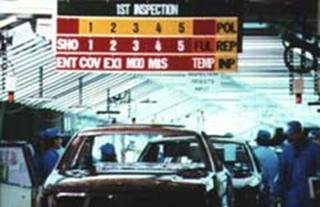
Andon light board.
It is essential to stop the line when there is a problem. "If the line does not stop, useless defective items will be passed on to the next stage. If you do not know where the problem occurred, you cannot do anything to fix it. That is where the concept of visual control comes from. The tool for this is the andon light board".
Deal with defects only when they occur and the number of people you need will decrease
Standardized work is essential for identifying where things are going wrong, Minoura says. "If you are dealing with something that is different from what is on the standardized work sheet, or different from the way others are doing it, then that is the definition of a problem. By thinking about what is causing the problem, it will become visible. When the problem becomes clear, the doors open to kaizen. If you make it a rule to deal with defects only when they occur, then the number of people will drop sharply. Whatever is running smoothly or without interruption does not need to be under supervision. If you commit to just finding and fixing problems, you will be able to have effective control of your line with fewer people".
Ask yourself "Why?" five times
When something goes wrong, the first thing to do is fix the error. Minoura recalls that Ohno used to ask them to ask themselves "Why?" five times in a row because "that way you will find the root of the problem and, if you manage to eliminate it, it will never happen again". However, Minoura emphasizes that observing the actual place where the problem happened, instead of deducing from the office what occurred, is the only correct way to answer the "Why?". "I am always led to think that the Five Whys method is not working as it should because there is a lack of practical training. The reason for this is that they always end up going back to the method of deduction. Yes, deduction. So when I ask them "Why?", they immediately report five causes to me, as fast as a flash of light, by deduction. Then again I would ask five times "Why?"for each of the causes they gave me. The result was that they began deducing once more, and so many causes are given in the attempt to get to the root of the problem that you end up totally confused about which one is important".
"Through real training", Minoura says, "you will be able to discover dozens of problems and also be able to get to the roots of those problems. You will be able to make countless improvements. If you incorporate into your equipment all the knowledge accumulated in searching for the root cause of problems during the many ‘Why? Why? Why?...’, then you will have something that no one else will have the opportunity to have. I do not believe this has anything to do with nationality, but rather with whether or not you have received proper training. I believe that this tendency to provide this kind of training and education forms the basis of the Toyota method known as monozukuri".
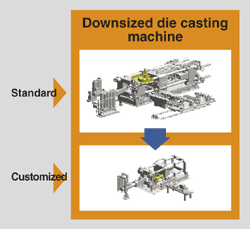 |
| Right-sized mold-making machine developed by Toyota, customized to reflect the final shape of the product, costing 50% less than its predecessor. (Source: Toyota Annual Report 2003) |
Ultimately, the goal of TPS is to achieve lasting cost reductions. And the basic principle of TPS is not something that will change. But the world keeps changing, and Minoura suggests four methods for dealing with this.
First, when considering which factors enabled Japanese manufacturing to achieve world supremacy, Minoura points out that high quality was one of the key factors. "However, nowadays, carmakers and auto parts suppliers from other countries have managed to come close to Japan's quality levels. This means that we have to think hard about what must be done to maintain our preeminence in the area of quality".
Second, as the automotive business becomes increasingly global, Minoura states: "It is important to shift our focus from being Japan-centered to being more globalized, something that is also in line with our principle of genchi genbutsu (firsthand experience), and to think about exactly what form this change should take".
Third, Minoura thinks the future will see an increasing need to build into products what the customer needs and wants."Suppliers need to work with us at every stage so that we can find a way to produce better and cheaper. This kind of collaboration can bring the new ideas we need".
Finally, Minoura says that "to allow Toyota's DNA to spread and evolve globally, we need to develop and train people globally".
But efforts to build quality into the production process are being forgotten, according to Minoura. "When we talk about defects in our plant, we are talking about defective processes. If there is a defective process, it will result in defective products. No matter how thoroughly you examine a defective product, you will not be able to improve the process. So we must look at the process with the problem. Components are carried from one supplier to another in a flow, and unless there is an excellent control system, it is impossible to prevent defects from happening. Establishing such a control system is the easiest thing to do when the supply chain is simple. And this is a matter for which senior management should be responsible".
Train people to follow rules and standards as if it were part of their nature
Nevertheless, it is human beings who can truly build quality into the product. According to Minoura, "it is important to create a climate in which people are trained to follow rules and standards as if it were part of their nature". "This kind of reflexive response is a hallmark of Toyota's monozukuri".
It is essential to create relationships of mutual trust. Minoura sees localization, or genchika, as key to this. "When I started my work in the US, we had to keep some functions in Japan, but today we are trying to do everything possible in the US. The key strategy for this now is personnel genchika. The success of genchika depends on how capable we can be of having local employees "inherit" our Toyota DNA".
Find out where a part is made at a low price and use that price as a benchmark
The basic goal is to keep increasing the level of local sourcing. "If we find that there is a place in the world where this or that part can be produced for this or that price, then we should use that price as a benchmark, while also trying to channel our efforts into finding a cheaper way to manufacture in the region itself", according to Minoura. "Personally, I think this is by far the best way to tackle this problem. If we can make local production cheaper, then the incentive to buy from other markets will disappear. But for this to really happen, to really say ‘OK, they can make this for so many dollars, so we can make the same thing cheaper here’, there needs to be collaboration between the automotive industry and its suppliers. That is why we manufacturers have the responsibility to look for the lowest price, and we must do our utmost to find a way to produce for much less in the local market, even in Japan".
Minoura warns that suppliers need to shift their focus to the car user rather than the carmaker. "You will have to start analyzing the needs and preferences of the end user. You must find out what the end user wants and work to develop components that fit those needs. Then you will be offering what you have actually developed to carmakers like us, who will incorporate these components into our designs. This is the next production profile the industry has been seeking. When this happens, terms like "carmakers" and "suppliers" will become inappropriate. The two will come closer together, becoming partners, and together they will develop high quality, lower prices and products that meet the needs of the end user. To survive, you will need to use the knowledge you have acquired on the shop floor to reduce costs and put that saved money into development. You need to make an extra effort to be able to see your own strengths and compare them with those of your competitors".
Develop people so they can come up with interesting ideas
Minoura cannot overemphasize the leadership role that people play in monozukuri. "There can be no successful monozukuri (making products) without hitozukuri (making people). To keep new revolutionary production techniques emerging, we need to develop unique ideas and knowledge by thinking about problems in terms of genchi genbutsu. This means there is a need to think about how we can develop people who can generate these ideas. As our operations become increasingly globalized, there is also a need to think about how to instill Toyota's DNA in employees in every region of the world".
Toyota exports its unique approach worldwide under the label of "Toyota Way". As part of this effort, the Toyota Institute was founded in Japan in January 2002 to educate managers and executives from both Japan and other countries. "Every year", Minoura points out, "dozens of employees from all our affiliates around the world come to Japan to learn the Toyota Way".







