

Problems and limits
One year after the start of the Covid pandemic, Toyota announced unexpectedly good results, surprising analysts once again when it stated that its production would not be significantly hurt by the chip shortage that is paralyzing its competitors. The company has been stockpiling chips, which are present in many components of modern cars, from safety to entertainment and maintenance systems.
The experts, as usual, seized on the news to claim that Toyota is abandoning its just-in-time principle and its “zero inventory” policy, as they argue every time the automotive industry faces a supply chain collapse. Few bothered to actually understand just-in-time to realize that it was always meant to be a coordination mechanism, conceived by Kiichiro Toyoda, to make equipment and people cooperate better.
As Eiji Toyoda explained (instructed by Kiichiro at the time): “What Kiichiro had in mind was to produce the necessary quantity of parts every day. To make this a reality, every step of the operation, like it or not, had to be converted to his flow production system. Kiichiro referred to this with the concept “just-in-time”. By this, he meant: “Make what is needed, but don't make too much”.
Since the catastrophes of 2011 (earthquake, tsunami and the Fukushima meltdown), Toyota has worked steadily with its various tiers of suppliers to ensure better coordination across its entire value chain – not just the first-tier supply chain. The company built stronger relationships and enabled wiser decision-making because of just-in-time, not in spite of it.
In many ways, however, the focus on just-in-time reveals a deeper misunderstanding. Lean practitioners know that just-in-time is only one of the pillars of the Toyota Production System, along with customer satisfaction, jidoka (the lesser-known pillar of “never pass a defect on”), employee satisfaction (through leveling of the workload, training to standards and involvement in kaizen) and the broader foundation of basic stability and mutual trust. It is very easy to see this “system” as a method for better organizing production – but that would mean missing the point.
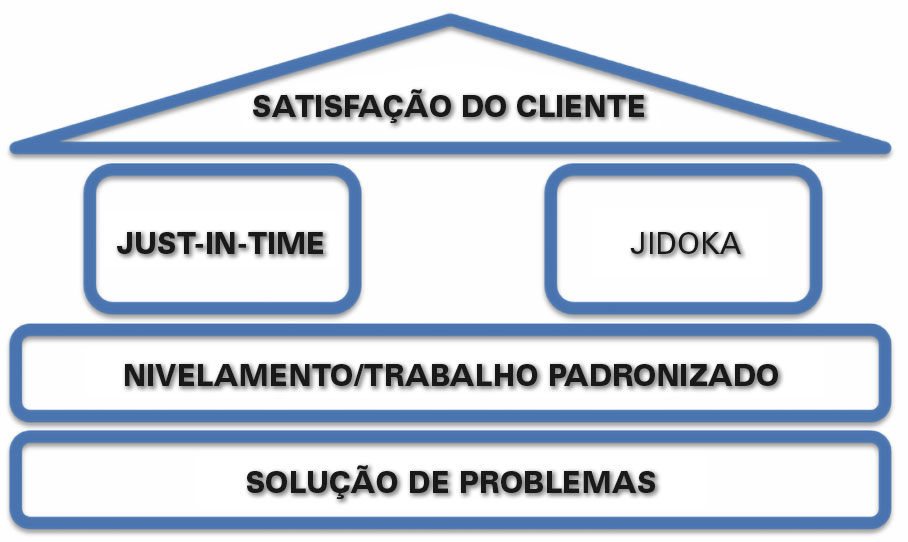
The Toyota Production System was also described by executives as the “Thinking People System”. The goal is not to apply TPS, but to teach it. The system is not a method for organizing production, but for thinking about how you produce – regardless of what you do and where you are. Going back to JIT, every operation works at a certain level of “just-in-time”: the waiting time between order and delivery. The question TPS asks is: how can we shorten this lead time? First, how do you reduce the variation in lead times by solving immediate problems? Then, how do you reduce the lead times themselves as you understand the deeper issues?
Try it yourself. Look at your own work, whatever it may be, and ask yourself “Could I…”:
- Could I better satisfy my customers? Better understand what they want, the performance and style they are looking for, and offer greater safety, quality, delivery time, cost and respect for the environment.
- Can I reduce my lead time? What is my takt time? Is there a way to get closer to continuous flow? Do I deliver results according to a customer's calendar of events, or do I push them by scheduling work in a way that is convenient (for me)?
- Can I better ensure quality? Do I identify defects exactly where they are created or further down the process? Are people and machines equipped with the means to signal problems and stop production, instead of producing defects? Do I separate human work from machine work?
- Could I involve my employees more in their satisfaction at work? How can I handle the ups and downs of workload and employment conditions well? How much should I invest in training everyone to standards every day? How persistently (and patiently) do I try to involve people in small self-directed improvements in their own work processes?
- Is there a way to build trust through better working conditions? Do all teams learn 5S and are they encouraged to take ownership of their workplace? Is everyone trained to solve problems carefully? How good is my maintenance program? Do my systems help or hinder people's work?
The point is that TPS is not a system you can simply implement. If you want a real transformation with real results, you need to mentor people so that they learn the whole – so that, in turn, they mentor others. Results come from each person applying TPS to their own work and coming up with new answers to the problems they face. To do this, they need to learn and teach themselves.
The system links the company's purpose – benefiting customers and society – and its unshakable core – people's trust in themselves, in their tools and in their managers. It creates a “line of sight” – as Tracey Richardson put it – so that all activities can always be related to customer value. Any group trained in this way of thinking can face any challenge with confidence – and serenely –, from Covid-related supply chain failures to issues related to large-scale climate change. The system teaches that any problem can be tackled through local countermeasures and by gathering positive energies to invent, copy and improve – forming overall adaptive responses.
None of the five questions above has easy answers, but each of them can be asked on any day in any place. In learning theory, these problems will always be there – which leads to threshold concepts and “aha” moments, with a before (none of this makes sense) and an after (how did I not understand this before?).
The fundamental insight of TPS is that, to make products well (monozukuri), you first need to develop people (hitozukuri) and, conversely, to develop people, you first need to teach them to solve problems in order to make better products. This is a core learning dynamic.
As many lean practitioners have discovered, applying TPS to any work situation by redesigning the process to make it “leaner” simply doesn't work. It fails every time. Consultants may deliver results, but the effort will always backslide and return to the previous working conditions.
The system was not designed to work that way. From the beginning, Eiji Toyoda was looking for learning systems that would teach people to think differently about what they were doing and how, starting from where they were. In his books, Taiichi Ohno discusses thinking about production, not actual production techniques – whether it is standing in the Ohno circle, asking why five times, learning to recognize when you are wrong or using kanban cards to visualize the gap between actual customer demand and batch production.
Lean is the only management method that looks at how people think, instead of trying to control how people behave. It is a matter of guidance and support, not command and control. The obvious assumption is that people do what they believe is right, not what they are told, and they usually have valid reasons for thinking what they think and knowing what they know. In this sense, cooperation requires more joint observation, deeper discussion and better collaborative problem solving.
As we face increasingly difficult problems, such as recovering from the pandemic and fighting climate change, we need a robust method that goes beyond this or that leader and their tricks. The Thinking People System provides exactly that. It was developed by dozens of engineers, tested and adapted in dozens of industries and thousands of companies.
To reap its benefits, however, we need to abandon once and for all the misconception that these are organizational techniques we can simply implement in other companies. Instead, we need to adopt the perspective of a system that helps us learn and teach until the whole organization is transformed, everyone, all the time. Doing this means establishing lines of mentoring on TPS throughout the company, one person at a time.







