


Related term
Cross-Dock
A facility that selects and (re)combines a variety of items coming from various suppliers so that they can be shipped to…
View termA simple diagram of every step involved in the material and information flows needed to serve customers, from order to delivery. See : Information Flow, Material Flow.


A simple diagram of every step involved in the material and information flows needed to serve customers from order to delivery. Value stream maps can be drawn at different points in time to reveal improvement opportunities. A current-state map, as shown below, follows a product's path from order to delivery to determine current conditions. A future-state map, as shown next, deploys the improvement opportunities identified by the current-state map to achieve a higher level of performance at some point in the future.
In some cases, it may be appropriate to draw an ideal-state map, showing the improvement opportunities from applying all known lean methods, including right-sized tools and value stream compression.
Because it is a management tool, someone must be responsible for the success of the value stream being defined. The value stream manager is the architect of the value stream, identifying value as defined by the customer and leading the effort to achieve an ever leaner flow.
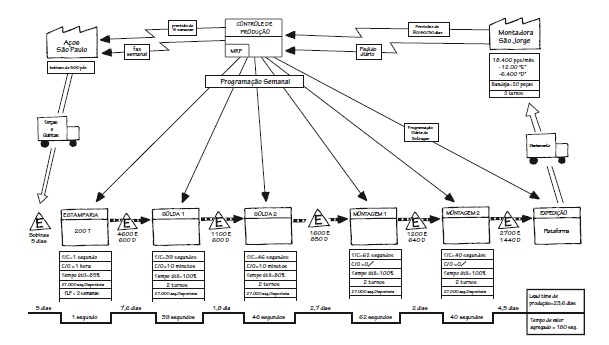
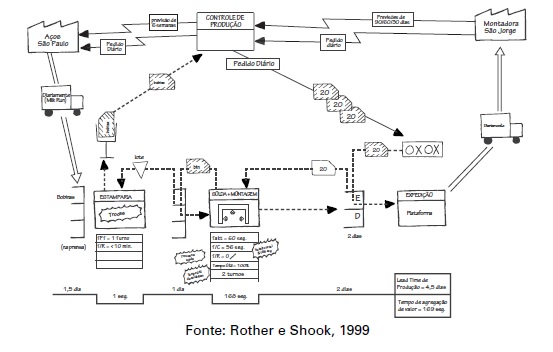
Related Article - "The essence of the Value Stream Mapping tool" . Author: José Roberto Ferro - Lean Institute Brasil. Read the full article here.
"... Value Stream Mapping is different from traditional process maps
Process maps generally focus on individual processes rather than on the flows of materials and information related to product families. The future-state vision is defined on the basis of often obvious views of improvements to be made, without taking into account the lean principles that can produce ever leaner value streams.
Don't be dazzled by inventory levels and the chance to reduce them
It is very common for people to be disappointed, and at the same time fascinated, when they find high inventory levels in their value streams, whether of raw materials, work in process or finished goods. Simply converting these numbers into financial values makes it easy to envision significant, immediate gains that seem easy to capture. Measuring inventory levels helps measure lead time, a very important indicator. But inventory buildups carry an "invisible" message: they point to where the flow is interrupted. Our task is to understand why this happens and identify what can be done to improve the flow from raw material to finished product.
Don't clutter the maps
Some companies add unnecessary information to their maps, such as inventory cost, the distance between workstations, the number of forklifts used, etc., cluttering the map with a "smoke" that makes it impossible to see what is essential. Days of work are often spent gathering this not very useful information. Using the basic parameters (C/T, C/O and Uptime) is enough to design a better future state. The goal is not to produce complete, perfect maps. A good map is one that makes it possible to see the change clearly.
Choose the right altitude
Looking from too far away means not being able to see the current state accurately and having no vision of the future. Looking too closely means seeing only isolated, rather than systemic, improvements. Understanding the current state is harder than it may seem, especially from the perspective suggested by Shook and Rother. After years of analyzing and improving individual processes, it is difficult for most managers to look at value streams from high above, seeing the door-to-door flow as a whole. A first approach may not contain many details of the individual processes, nor is that the initial goal. A brief walk along the value stream provides, in very broad strokes, just a first view of the current state.
Define improvements that can be made within one year
Mike Rother and John Shook teach us that a future state defined with an excessive number of kaizens, more than 6, probably means going far beyond the future state that can be achieved within a year. An ideal-state map can be a good vision of the future, two to five years ahead. But, as a rule, it is not very operational, because it paralyzes the team in the face of the investments required and other factors that prevent immediate action; adopting a "future map 1", whose action plan can start tomorrow and deliver results in 6 months, is essential for taking the steps needed to gradually reach the ideal state."...
Explore related terms and go deeper with real-world analyses by our industry leads.
A facility that selects and (re)combines a variety of items coming from various suppliers so that they can be shipped to…
View term
See how this concept and management mindset were applied in practice to deliver real business results.
Read the full article
Build leadership and problem-solving skills at the gemba with support from our specialists.
See the training
