


Related term
Demand Amplification
A tendency observed in multi-step processes, in which the production orders received by each upstream process are more…
View termA kanban is a signaling device that authorizes and gives instructions for the production or withdrawal of items in a pull system.


A kanban is a signaling device that authorizes and gives instructions for the production or withdrawal of items in a pull system. The term means "signals" or "signal board" in Japanese.
Kanban cards are the best-known and most common example of signaling. They are often simple cardboard cards, sometimes protected by plastic sleeves, containing information such as the part name, the part number, the external supplier or internal supplier process, and the storage and consumption locations. A bar code may be printed on the card for tracking or automatic billing.
Besides cards, a kanban can be a triangular metal plate, colored balls, electronic signals or any other device that provides the necessary information while preventing wrong instructions.
Whatever its form, a kanban has two functions in a production operation: it instructs processes to make products and instructs material handlers to move products. The first was called a production kanban (or manufacturing kanban); the second was called a withdrawal kanban (or conveyance kanban).
The production kanban tells an upstream process what type of product and what quantity must be produced to supply a downstream process. In the simplest situation, one card corresponds to one container of parts, produced by the upstream process, for the downstream process's supermarket.
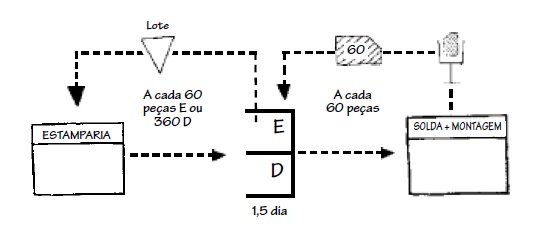
In large-batch situations - for example, a press with very short cycle times and long changeover times - a signal kanban is used to authorize production when a minimum number of containers is reached. Signal kanbans are often triangular and are therefore commonly called triangle kanbans.
Although triangle kanbans are the most common way to schedule processes that work in batches, they are only one specific type of signaling. There are other basic means of controlling batch production, including the standardized sequence and batch consolidation.
Standardized production creates fixed sequences or production patterns that are continuously repeated. However, the actual quantities produced in each cycle may vary, fluctuating according to customer demand. For example, in an eight-hour cycle the products are always made in the sequence A to F (the complexity of the changeovers and setups should define this order). Inventory size will be proportional to the length of the replenishment cycles; daily cycles mean that one day of inventory must be kept in the supermarket; weekly cycles would require one week of coverage. The main drawback of the standardized sequence is that it is fixed; you cannot jump from D to F.
Batch consolidation, in turn, involves creating physical kanbans for each container of parts in the system. As materials are consumed from the supermarket, the kanbans are taken to a board, which shows the supplying process how many containers are still in the supermarket by means of shaded spaces assigned to each and every kanban in the system (Adapted from Smalley, 2004).
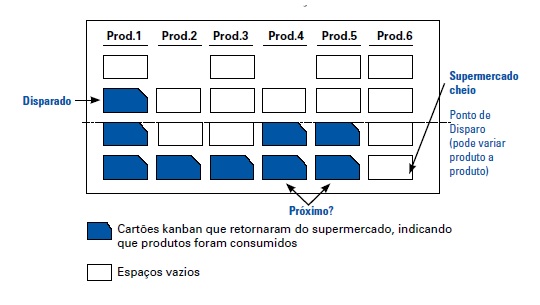
A kanban that returns to the board indicates that one more container has been withdrawn from the supermarket; kanbans that do not return to the board indicate that the container is still in the supermarket. As predefined replenishment points are reached, the supplying process begins making products to restock the supermarket.
A batch consolidation board allows information to flow back to the process more frequently, showing what is being consumed by the customer process. It also provides a visual representation of the supermarket's consumption rate, exposing problems and creating a greater sense of urgency.
However, many kanban cards may be needed, and these cards must be returned to the board reliably and frequently for the system to work properly. Discipline must be built so that schedulers and supervisors do not encourage producing batches ahead of time. The withdrawal kanban authorizes the movement of parts to a downstream process. It often takes two forms: internal or interprocess kanban (for withdrawal from an internal process) and supplier kanban (for withdrawal from an external supplier). In their original application in Toyota City, cards were generally used for both functions. However, as lean production spread, supplier kanbans for more distant companies came to be handled electronically.
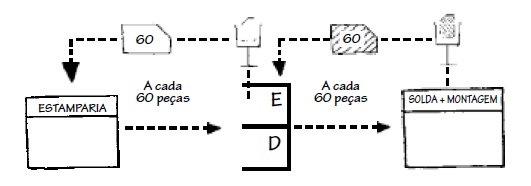
The production kanban and the withdrawal kanban must work together to create a pull system: at a downstream process, an operator removes a withdrawal kanban when using the first item from a container. This kanban goes to the nearest collection box and is picked up by a material handler. When the handler returns to the upstream supermarket, the withdrawal kanban is placed on a new container of parts for delivery to the downstream process. When this container is withdrawn from the supermarket, the production kanban is removed and placed in another collection box. The material handler working at the upstream process returns this kanban to that process, signaling the need to produce a new container of parts. As long as no parts are produced or moved without a kanban, a true pull system is being maintained.
There are six rules for using kanban effectively:
1. Customer processes order the exact quantities specified on the kanban. 2. Supplier processes produce the exact quantities, in the sequence specified by the kanban. 3. No items are made or moved without a kanban. 4. All parts and materials always have a kanban attached. 5. Defective parts and incorrect quantities are never sent to the customer process. 6. The number of kanbans is carefully reduced to lower inventories and reveal problems.
Explore related terms and go deeper with real-world analyses by our industry leads.
A tendency observed in multi-step processes, in which the production orders received by each upstream process are more…
View term
See how this concept and management mindset were applied in practice to deliver real business results.
Read the full article
Build leadership and problem-solving skills at the gemba with support from our specialists.
See the training
