Lean tools: understand what they are and how to apply them
In an increasingly dynamic and competitive world, operational efficiency and the ability to deliver real value to the customer are crucial differentiators.
In this scenario, the lean philosophy stands out as a set of practices and principles aimed at eliminating waste and increasing productivity in a sustainable way.
What many people don't know is that the lean philosophy is not limited to a single method or tool. It is an integrated system that combines various practices to generate consistent and lasting results.
So-called lean tools are the instruments that translate the philosophy into practical actions, enabling companies and professionals to build leaner and more effective processes.
Keep reading to learn more!
What are lean tools?
Lean tools are techniques and methodologies developed to identify waste, balance the workflow, ensure quality and optimize the use of resources.
They are applicable in different contexts: manufacturing, services, healthcare, technology, logistics and much more.
Here we will explore the main tools and understand how they can transform the way people work in any sector.
What are the main lean tools?
When adopting the lean philosophy, many organizations face a practical question: where to start? The answer lies in lean tools — instruments that make lean principles tangible in teams' day-to-day work.
These tools were developed to facilitate the identification of waste, organization of work, quality improvement and creation of more efficient flows. Some are simple and visual; others are more structured and strategic. All of them, however, share the same goal: generating value with fewer resources.
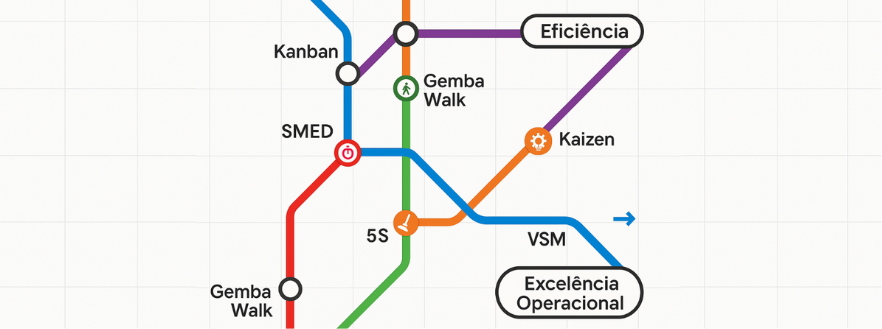
Below, get to know the most widely used lean tools and how they can transform your organization's processes.
Kaizen
One of the core philosophies of lean, Kaizen means “change for the better” in Japanese. This lean tool encourages all employees to suggest continuous, gradual improvements in their daily processes. The focus is on eliminating waste and constant improvement, creating a culture of organizational learning.
- Practical example: in a customer service team, small changes to the script can reduce call time and improve satisfaction.
- Benefits: continuous improvement, team engagement and cost reduction.
5S
5S is a method for organizing and standardizing the workplace. The five senses — Seiri (Sort), Seiton (Set in order), Seiso (Shine), Seiketsu (Standardize) and Shitsuke (Sustain) — help create a more productive, safe and efficient environment.
- Practical example: auto repair shops that use visual tool boards to reduce time lost searching for items.
- Benefits: more organized environments, fewer accidents and a foundation for continuous improvement.
Kanban
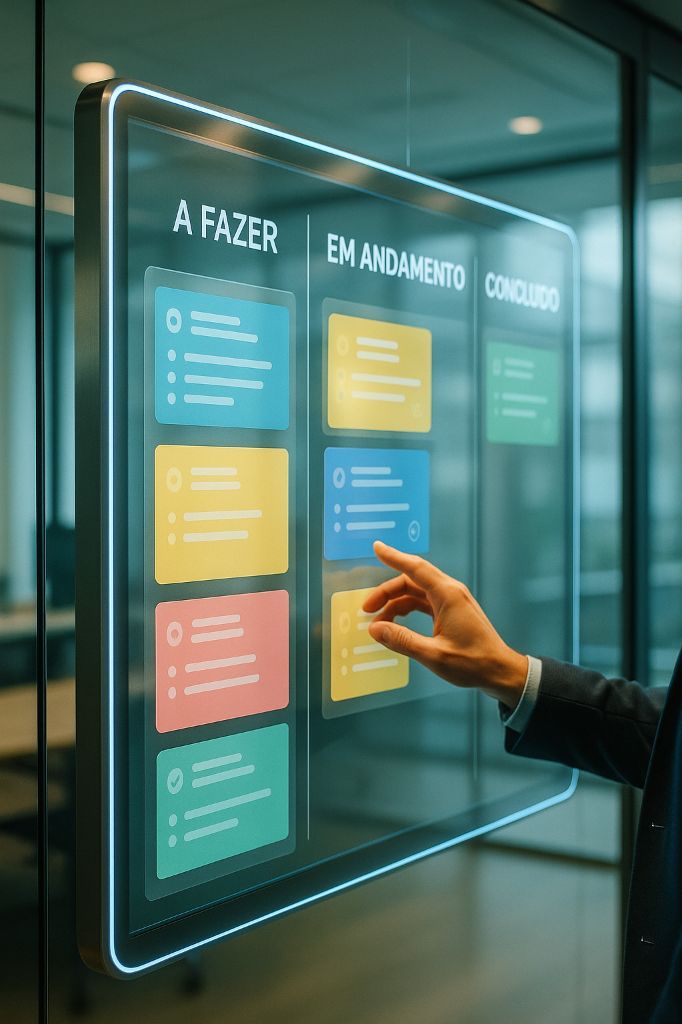
Kanban is a visual system that manages workflow through cards or signals. It limits work in progress (WIP) and promotes a more predictable and balanced pace of production.
- Practical example: software development teams that use Kanban boards (such as Trello or Jira) to visualize the progress of tasks.
- Benefits: fewer bottlenecks, greater transparency and better task prioritization.
Poka-Yoke
Poka-Yoke means “mistake-proofing” and involves devices or methods that prevent human errors from generating defects. It can be a locking, alert or automation system that prevents errors before they occur.
- Practical example: a printer that alerts you if the paper is inserted incorrectly, preventing jams.
- Benefits: fewer defects and less rework, greater process reliability.
Just in Time (JIT)
Just in Time aims to produce only what is needed, in the quantity needed and at exactly the right moment. This reduces inventory and waste, making the process more agile and economical.
- Practical example: an automaker that receives parts from suppliers only a few hours before they are used.
- Benefits: minimal inventory, greater flexibility and cost reduction.
Value Stream Mapping (VSM)
VSM (Value Stream Mapping) is a mapping tool that documents every step of a process to identify activities that do not add value. It provides a systemic view and makes it easier to identify bottlenecks and improvement opportunities.
- Practical example: an online order flow is mapped to reduce waiting and rework.
- Benefits: clarity in flows, team alignment and a foundation for restructuring processes.
Andon
Andon is a visual or audible alert system that signals problems in real time. It allows anyone to stop production when they detect an abnormality.
- Practical example: on an assembly line, an Andon button lights up a red light when a failure is identified, allowing immediate action.
- Benefits: fast problem solving, higher quality and a culture of accountability.
PDCA
The PDCA (Plan-Do-Check-Act) Cycle is the foundation of continuous improvement, as it involves planning (identifying problems and causes), doing (implementing solutions), checking (verifying results) and acting (standardizing or adjusting).
- Practical example: using PDCA to improve delivery time in an e-commerce business.
- Benefits: consistent improvements and organizational learning.
TPM
Total Productive Maintenance (TPM) seeks to involve everyone in the maintenance and care of equipment. It increases reliability and reduces unplanned downtime.
- Practical example: operators carry out daily inspections and minor repairs to prevent breakdowns.
- Benefits: fewer failures, higher productivity and a better work environment.
Takt Time
Takt Time defines the production pace needed to meet customer demand. It is calculated by dividing the available time by the number of units to be delivered.
- Practical example: in a factory, Takt Time helps balance workstations.
- Benefits: synchronization with demand and elimination of overproduction waste.
SMED
SMED (Single-Minute Exchange of Die) seeks to reduce setup time (tool changes or machine adjustments). It separates internal activities (with the machine stopped) from external ones (performed while the machine is still running).
- Practical example: in a print shop, pre-adjusting the inks before the job changeover significantly reduces setup.
- Benefits: flexibility for smaller batches and a better response to market variations.
Gemba Walk
The Gemba Walk encourages managers to go to the actual workplace to understand processes and listen to employees.
- Practical example: a logistics manager talks directly with operators to identify challenges in receiving goods.
- Benefits: solutions based on real facts and team engagement.
Heijunka
Heijunka means production leveling, which helps reduce fluctuations and creates a stable, predictable flow.
- Practical example: producing small, varied batches instead of large batches of a single product.
- Benefits: less inventory, shorter lead time and greater adaptability.
Hoshin Kanri
Hoshin Kanri connects long-term strategy with daily activities, aligning the entire company around clear objectives.
- Practical example: a company defines sustainability goals and deploys them into actions to reduce energy waste.
- Benefits: clarity of purpose and alignment at all levels.
Jidoka
Jidoka brings the concept of “automation with a human touch,” ensuring that machines detect and correct problems automatically, stopping the process when necessary.
- Practical example: machines that stop when they identify a defective item.
- Benefits: quality built into the process and greater efficiency.
Bottleneck analysis
This tool focuses on the slowest step in the process, which limits total capacity. By identifying the bottleneck, the entire operation can be reorganized to overcome it.
- Practical example: a document approval step that delays the completion of a project.
- Benefits: improved flow and increased capacity.
Continuous Flow
Continuous Flow means that work moves forward steadily, without waiting and without large batches, ensuring speed and flexibility.
- Practical example: in food production, cooking individual portions instead of large batches to quickly fulfill varied orders.
- Benefits: shorter lead time and greater value perceived by the customer.
Lean KPIs
Lean KPIs are indicators that measure performance aligned with continuous improvement goals.
- Practical example: measuring the rework rate, lead time and overall equipment effectiveness (OEE).
- Benefits: focus on results and a data culture for decision-making.
Muda
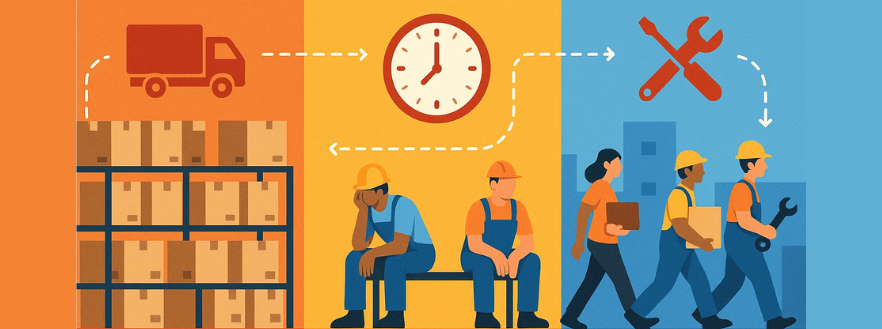
Lean wastes — such as overproduction, unnecessary transportation, waiting and others — are tackled by all the tools and form the core of lean thinking.
How to implement lean tools?
Implementing lean tools requires planning and leadership involvement. The first step is to understand the current situation, map the processes and identify the main wastes.
Next, it is essential to select the most suitable tools, train the teams and apply the concepts in pilot projects.
Another essential point is to create a culture of continuous improvement, promoting PDCA cycles (Plan, Do, Check, Act) and engaging all levels of the organization.
👉 Want to implement lean in your company? Talk to our experts at Lean Institute Brasil.
Conclusion
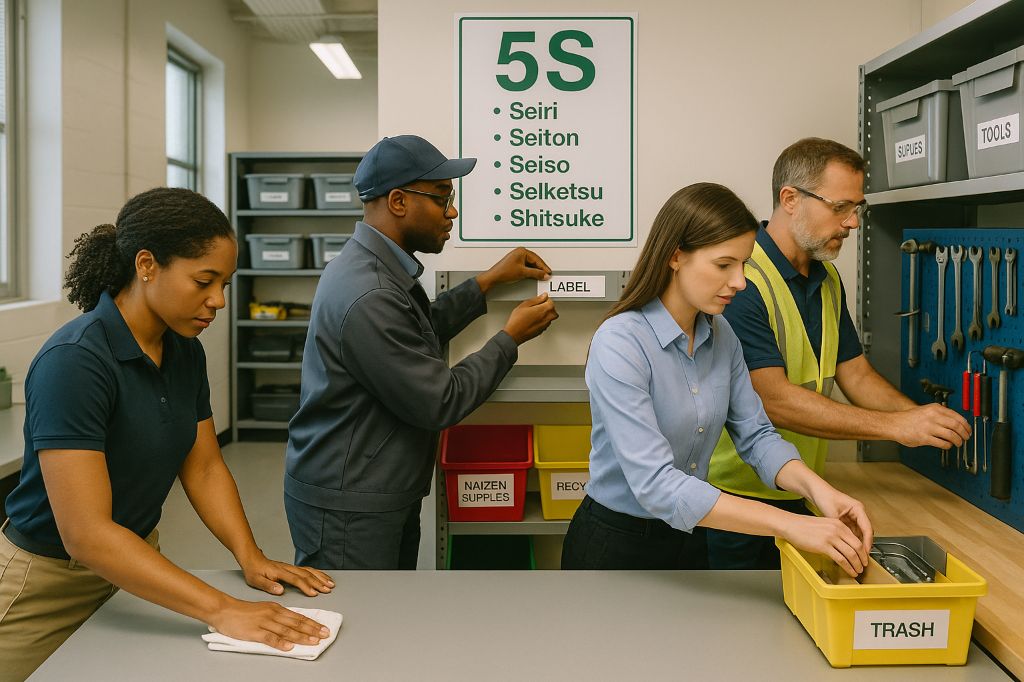
Figure 2 — Diverse team of employees applying Lean Tools, such as the principles of 5S, in an organized industrial environment with visual boards, labeled materials and aligned tools.
Lean tools are powerful resources for transforming processes, increasing efficiency and generating more value for the customer.
When applied strategically, these tools enable not only the elimination of waste, but also the building of an organizational culture oriented toward continuous improvement.
Therefore, investing in lean implementation is, above all, investing in operational intelligence and excellence in results.