
Problem solving as culture
The lean philosophy continually seeks to establish standards, expose problems and solve them quickly. In this way, it ensures the stability of processes and works to eliminate obstacles on the way to continually better future states from the customers' point of view.
One of the fundamental elements, therefore, is the capability and knowledge needed to solve problems, which become central to the company's competitiveness.
To this end, mechanisms need to be created that make problems visible and engage everyone in the company in solving them. In addition, it is necessary to transform the view that problems are bad into an understanding that they are treasures and opportunities for development and learning.
Here, we are dealing both with systemic problems related to the needs and objectives of the business, such as the formulation and deployment of strategy, and with problems in processes - whether the primary value-adding processes or support processes, such as the product development process or internal logistics - all the way down to each individual activity or step, such as repairs on a machine or defect reduction.
Generally speaking, there are few very broad problems, some medium-sized problems and many small problems. Complex problems may eventually require more time and analysis, and may be assigned to specialists.
There are two dimensions to problem solving: one technical in nature and the other cultural. Although problem analysis and solving methods have been known for decades, and many companies have spent considerable sums to train a good part of their staff, we note that there is still much maturing to be done, in the sense of internalizing this method in companies' day-to-day work and making it part of the company culture.
But how do problem-solving thinking, attitudes and practices evolve in companies? Is there a lean way of solving problems, distinct from what exists in traditional companies?
Based on our experience dealing with this in a variety of contexts, sectors, types and sizes of companies, we have identified an evolution frequently found in companies' learning and thinking with regard to problem solving.
Unawareness phase. Typically present in companies where there is no knowledge or use of lean practices and tools, not even the basic quality tools, and where there is widespread indifference to or unawareness of problems. Their existence is not known and, at times when that awareness exists, nothing is done except hastily putting out fires when there is some serious threat to the operation.
Awareness phase. Initial standardization efforts combined with greater visualization bring greater awareness of the existence of problems. But there may still be no sense of urgency; people's training and qualifications may not be adequate; and the attitude of hiding problems may continue to prevail, as problems are judged to be bad and, when they arise, people look for culprits instead of looking for root causes. And some managers may even become angry at the existence of problems, which seems to bother them and generate negative behaviors such as anger and despondency.
Initial phase of using the scientific method. At this stage, the first experiences, even using the A3 and the scientific method, are still superficial. From a technical point of view, there is no clear understanding of the problem, no systematic search for the root cause, and people jump quickly to solutions based on simplistic and often preconceived ideas.
And from a cultural point of view, exposing problems is not yet natural, which causes them to accumulate and surface too late, when they have already grown large.
Sometimes there are improvement groups formally using the steps of the problem-solving method, but in a bureaucratic way, and attacking recurring problems, because standardization and stabilization efforts do not reach the details of how people do the work and how processes are systemically integrated.
A3 reports, if used, are superficial, not least because the leaders who should be the mentors know little about the method and do not know how to use it properly. In some cases, problem solving continues to be delegated to specialists.
People feel frustrated because, despite their efforts, problems still are not being properly solved.
Maturity phase. At this stage, there tends to be a recognition that having no problems is the problem. When this happens, the view of problems and of solving them becomes an element of the culture. Revised systems enable stabilized flows. Standardized work clearly specifies each activity, its pace, and how to identify variations. Visual management systems enable immediate identification of variations between actual results and objectives, whether at the level of a production cell or at the strategic level. For each problem detected, a help chain is triggered and problem solving begins using the scientific method.
Before jumping to the solution, in any circumstances, there is an effort to understand the current situation clearly, identifying the gap between current and desired performance, based on measurable and observable items of data and facts, going to the gemba, identifying things directly at the place where they happen and talking with the people directly involved.
Setting targets, searching for the root cause, creating multiple alternatives (discussing and comparing them), defining the best alternative (considered a solution hypothesis), planning actions, implementation, checking results and, finally, standardization (in case of success) or going back (in case of failure) - revising the understanding of the situation, the targets, the root cause analysis, the plans - become part of companies' mental model, for simple and complex topics alike.
The unawareness phase generally occurs in companies with basic management and organizational problems, usually reflected in poor delivery performance, costs, etc. The awareness phase makes it possible to begin changing, but if it doesn't evolve quickly it regresses to the unawareness phase. The trap of the initial phase of using the scientific method is that it can last for many years, stagnant, and many companies with sophisticated corporate continuous improvement processes or with early lean transformations still find it hard to evolve beyond this phase. The maturity phase is only achieved when the lean transformation becomes strategic and is led by top management.
The lean way of problem solving
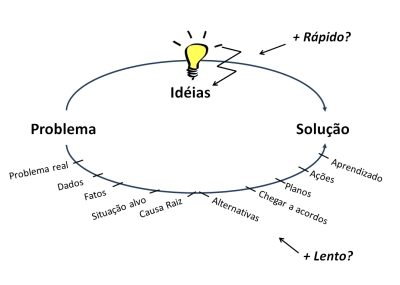
Thus, everyone is involved in problem solving, with or without the formal process of preparing an A3, and exposing and solving problems scientifically becomes part of the culture. But if leadership, starting from top management, is not engaged as those who teach employees the scientific methods, these will have little sustainability.
That is why Jim Womack, in one of the chapters of his new book, "Walking the Gemba - Gemba Walks", says that lean management contrasts with traditional management by suggesting: "go slow to go fast". The scientific method may lead to decisions that take longer, but, at the same time, their effectiveness will be much greater, avoiding rework upon rework, which will ultimately become the slowest decision ("go fast to go slow"). Leadership then comes to prefer depth and rigor instead of simply demanding speed.
So what is the managers' job? One of their main tasks is to create the conditions for the culture of scientific problem solving to be widely disseminated throughout the company, with the manager himself being the mentor of his direct reports, who,in turn, will do the same with their own reports.
Lean managers do not delegate problem solving. They get directly involved, but not to give the answer; rather, to ensure that people follow this mental method. And as a consequence, to develop people's capability and initiative.
When exposing and solving problems are embedded in its DNA, we can say that the company is well advanced in its lean transformation.
PS1. Our upcoming events are: 1) Senior management meeting: leading the transformation, on October 4 in Caxias do Sul; 2) "Fórum Lean Nordeste" (Northeast Lean Forum), to be held in Recife-PE on October 25, with the participation of Alcoa, Marisol, Beach Park, Fibrasa, CRolim and OCS.
PS2. Lean Summit 2012. We are preparing our mega-event, to be held on August 21 and 22 in São Paulo, with the confirmed presence of, among others, Mike Rother, co-author of two LIB workbooks, who will address topics related to his new book "Toyota Kata", published in Portuguese by Editora Bookman. We would like to receive suggestions about themes and subjects of interest to you for the Summit. Please send them to [email protected].
PS3. We are in the final stretch of preparing the Lean Community Forum, a virtual communication channel, to be launched on September 19. The Forum will give all its members a place to share experiences and questions, as well as support material for studying the various topics covered.
PS4. Our next release will be the book "Walking the Gemba - Gemba Walks", by James Womack, a collection of 10 years of articles about walks through many gemba at companies in different sectors of the economy and in many countries.