

DM expanded to all of the business's plants
The São Paulo plant of Beiersdorf, a German manufacturing company in the skin care segment, kicked off the implementation of DM (Daily Management) and, through a pilot project in the management area, obtained impressive results. This inspired, initially, its expansion to other areas of the company and, with the continued success of DM, later, its expansion to other plants around the world.
THE PILOT
It all began with the realization that the São Paulo plant had difficulty understanding which indicators to measure and how to measure them for more effective management and better bottom-line results for the business. No one knew for sure how they were doing in terms of their performance, nor which targets should be set or which deviations should be corrected.
Since they had already been applying lean and working with improvement teams since 2013, and had already reaped good results from it, they looked to lean for a concept that would help them manage indicators in a more transparent and visual way, as well as choose which ones would be the most suitable for understanding how the business was doing; at that point they decided they would build a DM.
After a first contact with DM, they focused on defining what its purpose would be, that is, why they were building it. They knew they needed to better understand what to measure and how to measure it; so they started with the management level, looking at the management of the plant as a whole. Initially, DM involved only the director and the first level of report, the managers.
EXECUTING THE PILOT
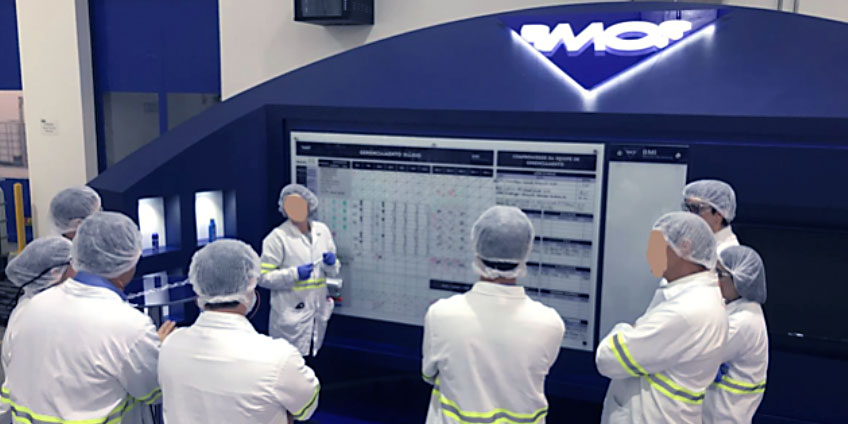
Based on the needs of the business, using the key business indicators defined and agreed upon through strategy deployment, they built a board in the center of the plant to discuss what was planned and what was achieved every day.
Every day, for 10 to 15 minutes, everyone would stop and meet to look at how the previous 24 hours had gone and how the next 24 hours would go. All of this in an effort to prevent incidents that might happen or to correct those that had already happened as quickly as possible, minimizing the consequences.
When the meeting shows that there was a problem, based on the indicators and the visual management established (green means on target, and red, off target), it is determined whether the problem is easy to solve, in which case it is solved right then and there, or whether it needs a more detailed analysis, opening an A3 and using the five whys and the Ishikawa diagram, among other structured problem-solving concepts.
One of these concepts widely disseminated in the company is the help chain, which is the subject of training sessions held periodically by leadership in order to consolidate the practice in people's minds. There is a help sequence, which works as follows:
- At the first level, as soon as they find a problem, operators have 20 minutes with their first-line leader to try to solve it;
- If they cannot, or realize that they will not be able to (in this case, even if the 20 minutes have not yet passed), they escalate to the second level: the support areas, which then have one hour to solve it.
- If the problem still persists, the third level, the team leader, is called in to try to solve it within two hours of the problem appearing.
- If the problem has still not been solved, there is a fourth level of help: management is informed and has up to one production shift to try to solve the problem.
- The fifth level of help is the director, who receives the information if the problem has still not been solved within one shift and has two more shifts to try to fix it.
- At the end of three production shifts, one working day, if the problem persists, the sixth and last level of help is triggered: the company's vice president, who will have the final decision in these cases.
EXPANSION TO OTHER AREAS OF THE COMPANY
With DM up and running, they then began to look at the history of indicators, how they had been measuring their performance and how the results had changed for the better very quickly and exponentially. They also began to reflect and observe collectively, with leaders from all levels and areas of the organization, which indicators directly or indirectly impacted the final result. This participation of leaders from other levels and areas of the organization meant that everyone had an initial contact with DM and was inspired by this example.
Day after day, more people looked at the board posted with colors and explanations to see the indicators on a daily basis. Before long, the management DM was a success in the company, with all areas wanting to go and see what was happening. This served as a basis for the other areas to show interest and begin to deploy DM to every corner of the company.
The first deployment was to the manufacturing area, which used DM in two distinct areas: on the filling line and in the reactor processing and weighing section. There, DM was adapted to the reality of each of the processes. With a more operational focus, little by little DM began to take on the look of the department and become more specific and suited to the manufacturing context. Every day, then, manufacturing would look at the board, generating plans and quick actions. DM had been successfully converted, representing not a faithful copy but an adaptation to the unique situation of manufacturing, which is different from the management level.
The expansion did not stop there, however, as each success brought more people from the most diverse areas on board with DM. Right after manufacturing, other departments joined this new effort, and DM began to be deployed to the quality, planning and logistics departments. Today, six different areas of the company have a DM on site.
EXPANSION TO THE WHOLE WORLD
It did not take long for the practice to leave Brazil and begin reaching other countries. The company's headquarters, in Germany, welcomed in 2016 a new German global Supply Chain SVP, who liked to have direct information and therefore frequently visited the plants around the world. The Brazilian plant began to proudly show its achievements during the Germans' routine visits. They were impressed by the practical and direct way the numbers were handled; the results achieved were very striking and motivating.
The questions that now needed answering were: management every day? What does that mean? What are they doing? They still could not understand what this so-called Daily Management would be.
However, the German leader soon began to realize that the problem faced by the Brazilian plant (and which was solved with DM) was not exclusive to it within the group: in all of the business's plants there was no standardization in measuring indicators, and this made everything chaotic. He then decided to explore the excellent Brazilian example further. Arriving in Brazil, he realized that the Brazilian model was very efficient and thought it could be expanded to the company's other plants. That was when a new model was born, created with inspiration from the visit of the German number one to Brazil, which included DM as one of its main elements.
With a new standard model within the group, the company's seventeen plants, in various countries, such as Chile, Mexico, the United States and several European countries, began to adopt DM, with an especially strong boom in Europe. It is worth noting that DM is flexible and did not stand still. Here in Brazil, improvements kept happening, and with each passing day it became more robust. The same happened in the other countries.
With this global expansion taking over the company, one specific department became fundamentally important: the global continuous improvement department. Through this department, an instruction booklet was created. This booklet shows who should take part in DM, where it takes place, what is measured in it, which equipment should be installed, among other things. Thanks to this booklet, any employee of the company, anywhere in the world, feels confident when implementing and/or taking part in Daily Management, since it creates a common language and shows everyone what to do and how, standardizing the process.
WHAT DM BROUGHT
DM is the place where people feel good in the company. Having DM meant, for the whole group, being able to engage people in their work and feel the excitement of taking part in this continuous improvement effort. All this collective effort ensures that product quality is always maintained or improved, with managers checking how it stands at the end of each DM.
This standardization and global use of DM brought important differentiators to the company; today, in the market in which it operates, each of its three main product lines is among the two best globally. In Brazil, this positive result is shared, with evident market dominance.
With the global crises the world went through in 2020, many companies had difficulty keeping their operations running properly, but DM gave the company the flexibility it needed to overcome each crisis and resume business afterward. Currently, the company's months are closing with spectacularly positive results, and the trend seems to be one of improvement.
New technologies keep emerging, and improvements to products and processes never stop, but it was DM that provided the stability needed for all these advances to happen. And all this began in Brazil. Today the whole group recognizes the country as the birthplace of DM worldwide, responsible for creating a new working model, one that is more efficient and lean.
THE FUTURE
With the Covid-19 pandemic, a lot had to be changed and adapted in DM. Since March 2020, the company has avoided going to the gemba in order to follow the disease prevention rules. At the beginning of the pandemic, everything on the company's shop floor stopped; people were lost.
However, nothing prevents DM from continuing to be carried out, but in a digital form. Through Excel spreadsheets, everyone can take part in DM from their home offices, using their home computers.
We hope this pandemic ends as quickly as possible. Nevertheless, we must always be prepared to face crises; with that, one question persists: what will DM look like in the future? Has the pandemic with social isolation brought lasting consequences? The Brazilian plant recently had a change of leadership, and the new leader has constantly encouraged his employees to think about these questions.
On the one hand, results are being sustained during the pandemic, and everyone is loving the virtual aspect. On the other hand, however, people feel they are missing out by not being at the gemba, for example, beside the operator. That is why what everyone is asking today is what the gemba of the future will be like. Whatever happens, the certainty that remains is that DM will be part of it, whether in person, virtual or hybrid.
Want to know more about Daily Management? Click here to discover our lean learning course on the subject.







