

Lean in Services: Eight challenges and lessons

The lean philosophy has the potential to transform organizations and help them deliver more value to customers while using minimal resources; that is why more and more companies are embracing this cultural change with high expectations. However, it is important to keep in mind that a change as big as the lean philosophy does not happen without overcoming a number of challenges.
In this article, ELOSAÚDE – Associação de Assistência à Saúde, a health plan operator from the state of Santa Catarina classified as a self-managed plan, shares the eight main challenges it had to overcome, along with eight associated lessons, learned and absorbed throughout the process, that helped transform the organization.
CHALLENGE #1: “IT'S ALL RIGHT HERE, SEE!”
Companies are made up of people. People, in turn, are the result of a rich mixture of beliefs, cultures, mental models, cognitive aspects, learning and expression processes, and are therefore different from one another; each human being is a unique labyrinth of knowledge and experience, which makes their method of turning knowledge into action equally singular.
That is why it is very common to see different people doing the same process in different ways, which goes against the lean principle of standardized work. This is a challenge companies typically face when starting a lean transformation: how to perform the difficult art of extracting information deeply rooted in people's minds, materializing it, turning it into processes and putting it on paper?
Lesson #1: Value, embrace and reconcile the multiplicity of knowledge.
Having diverse forms of expression in a company, coming from different people, is very valuable; however, if this set of knowledge does not make up a single body of knowledge, aligned with the proposed objectives and accessible to everyone in the organization, this multiplicity can become harmful, leading each individual in a different direction.
Given this, it is vital to move from the inside to the outside, that is, to take what “is right here, see!”, in the head, in the individual's mental process, and materialize it for the group. It is essential that all this intellectual diversity be externalized, agreed upon, standardized, recorded and made available to everyone involved in the processes, allowing the team to travel, in sync, a single path toward the common goal.
CHALLENGE #2: “OH, THAT'S SIMPLE”…
Making coffee is very easy, isn't it? Just boil the water, put the ground coffee in the filter and pour the hot water over it; it's very simple, right? Actually, not necessarily. There is a chasm between what we assume, what we experience along the way – in the doing – and what we conclude at the end of the journey. Perhaps we start from the assumption that making coffee is a simple task because we do it every day without great difficulty; however, that assumption rests on the certainty that we have never taken the time to think about everything it involves.
To deliver a ready cup of coffee you need access to water. You also need a container to put it in and a flame to heat it. And you can't forget the filter, the coffee – previously roasted and ground – the pot that will receive it once it is ready, the cup... and so on.
The same happens with the daily tasks we perform at work; habit, repetition, frequency and the fact that we are always doing them in an almost “automatic” mode create the false sense that they are simple and involve few steps.
Only through the meticulous treatment needed to record them and structure the value stream mapping do we come face to face with their real complexity. Even supposedly simple tasks are always more complex than our initial perception suggests. That is why the lean philosophy stresses the importance of value stream mapping; by mapping activities and tasks, we realize they are not as simple as we imagined.

Value stream map of one of the “simple” processes analyzed at ELOSAÚDE
Lesson #2: Describing is like prospecting. Gold? Only after a lot of mud and effort!
There is no gold on the surface: you have to dig! To find treasure, there is no escaping it. You have to dig! The mine doesn't build itself. (You have to dig!). And, quite often, you will have to dig several times in the same place.
Digging... That is what mapping tasks and activities in a company is like. No oversimplification or superficiality… you need to be prepared to go back to the map many times, to adjust the same fields dozens of times, to review, revisit and turn things over... From this point on, the recommendation is: don't get discouraged; the gold is coming!
Keep your focus, but don't fail to see the opportunities. In the search for gold, don't ignore the diamonds you find along the way; pay attention to these unexpected gems, because a good value stream map can bring to light surprising evidence and information, most of the time as valuable as, or more valuable than, what was originally sought.
CHALLENGE #3: THE “GABRIELA SYNDROME”
The song that pays tribute to Jorge Amado's immortal character, Grabriela, and declares: “I was born this way, I grew up this way, and that's just how I am, I'll always be this way...” is, even today, a good – and good-humored – example to illustrate the human desire to stay in the pleasant shade of one's comfort zone.
People have a natural tendency to resist change. They are instinctively driven to do things the way they have always been done, to keep the structure, to preserve known processes, because they master these familiar mechanisms and feel comfortable with them.
On the other hand, there is fear of the unknown; the habitual pain as opposed to the risk inherent in the cure. Throughout life, people get used to things. They get used to tight shoes, to endless lines, to crowded public transport, to familiar treatment, even when it is discourteous. As painful as it is to admit, this happens because change requires effort and can potentially bring new and unknown pains. And that is what makes the act of changing so difficult.
Lesson #3: People must be led, not dragged.
When starting any transformation effort, one must consider the following inalienable truth: “some people will, some people won't, some people never will”... Which means that some people will immediately buy the idea and, enthusiastic, climb aboard; others will be suspicious and wait for the boat to set sail to see whether it is safe; otherwise, they won't board. Still others won't move... They won't go. They will remain inert, if not rooting against it... Not for lack of support, encouragement or experience, but because it is in their nature not to move. Not to join. They will remain as if lifeless (that is, if they don't act as dead weight).
In any of these situations, it is important that the purpose be understood and shared by everyone, making it clear that the changes exist to improve the life and work of each person involved. You need to understand people's difficulties, but you cannot be condescending. It is imperative to encourage them, but not to carry them.
In a team, people need to be rowing in the same direction and, for that to happen, engagement must be voluntary – even if late – and not imposed. A soldier who needs to be pushed is not worthy of being on the front line (he doesn't even deserve to be in the battalion).
CHALLENGE #4: HASTE – OR: THE WHITE RABBIT'S HOLE
There is in human nature, especially in Western societies, an anguish, an anxiety, a secret “frenzy” that often makes us fall in love with hasty conclusions. These, in turn, tend to lead us into the unknown, the improbable, what cannot be verified.... Bottomless holes.
We often see people hastily pointing fingers, listing reasons, criticizing formats, unraveling errors, prophesying results, building assumptions based solely on hunches and speculation, without a serious, in-depth investigation.
The best example of this are the popular optical illusions, which exploit human anxiety and haste to induce conclusions that are not always true.
Considering each person's position, what do you see? 6 or 9?

Is God's finger moving toward or away from Adam, in Michelangelo's famous depiction “The Creation of Adam”?
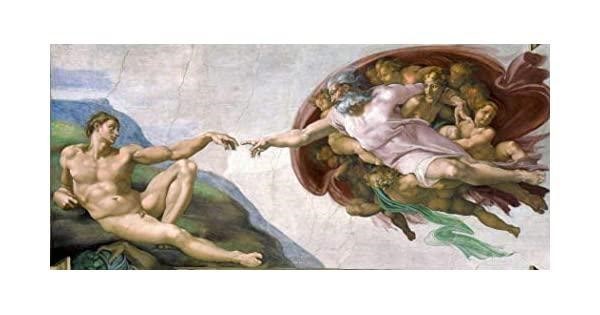
Throughout the mapping, those involved need to be aware that not every moment is right for making decisions. In fact, it is preferable to avoid inferences and decisions while structuring the value stream. Most of the time we need in-depth analysis before accepting a hypothesis or choosing a path.
Lesson #4: The only “Feelings” that was a hit was Morris Albert's song
People are conditioned from an early age to look for shortcuts and, traditionally, managers are pressed to present miraculous, infallible, immediate answers. That is why it is extremely common to see people formulating hasty hypotheses as part of the process and relying on “gut feeling” to draw conclusions. That is not exactly a sin, but it is a road with no shortcuts to error.
If we want to find concrete answers that lead to success, we need to resist the shortest path and build consistent analyses around each topic. Otherwise, we will invest a precious part of our energy betting on hasty conclusions, inconclusive shortcuts and unsustainable “feelings”.
CHALLENGE #5: SYMPTOMS X DISEASES
There is a fundamental difference between symptom and disease. A symptom is the perceptible manifestation; the disease is the reason for the event. Most of the time, we instinctively focus on symptoms – because they echo the pain, the discomfort. However, what hurts most is not always what is most serious.
The difference in symptoms can compromise the perception of severity. Between an asymptomatic hypertensive crisis and an ingrown toenail, the perception of pain is the overriding factor in seeking care. The ingrown toenail is exponentially more bothersome, but it is far from lethal, whereas asymptomatic hypertension, although it causes no physical suffering, can hide devastating outcomes, ranking as one of the most lethal conditions of the modern world.
That's how it is. Most of the time, what bothers us is not the real problem, not what we need to solve right away.
Lesson #5: Fever is not a disease; fever is a symptom.
If we have a fever, obviously we cannot ignore it or dismiss it; however, it is important to keep in mind that fever is not the disease, but an indication that something is not normal. We cannot treat only the symptoms and forget their source. Only a detailed investigation can reveal the true cause, allowing us to act beyond the symptomatic surface, thereby attacking the origin and cause of such manifestations: the disease.
Properly investigating the symptoms allows us to properly treat the disease, not the other way around.
CHALLENGE #6: MEASURING TAKES WORK
One of the first difficulties companies usually face when starting a lean implementation journey is the lack of indicators. If we don't measure, we won't have indicators. Without indicators it is not possible to draw a contrast between good and bad, adequate and inadequate, compliant and discrepant, productive and idle... consequently, the transformation is likely not to achieve the desired and necessary results. The problem, and the reason most companies don't have many – or almost no indicators –, is that a lot of sweat is needed to obtain data and facts. Measuring isn't easy; it takes work. (It takes a lot of work!).
Lesson #6: Double-check it!
Who has never been caught by the tricky question: “Which weighs more, a kilo of feathers or a kilo of lead?” Naturally, although it has an anecdotal side, the purpose of this question is to lead us to mistaken perceptions and assumptions, disconnected from reality, removed from concrete data and facts. So be wary of ready-made certainties and preconceived truths: data are more important than perceptions. Facts are more important than assumptions. Certainty is better than haste... Always investigate. It is essential to work with data and facts.
If you don't have indicators, create them. But don't move forward in the face of uncertainty.
CHALLENGE #7: CONCILIATORY, COLLABORATIVE AND HUMBLE MANAGEMENT
The owner of the process is the one who performs it, not the one who requests it. Managers need to understand that the person who masters the process is the one who does it every day, not them. Nobody knows everything (nor do they need to); there is a natural tendency, traditionally ingrained in conventional managers, to want to understand everything and have control over the whole; however, in the lean philosophy the manager does not need to be the owner of the process, nor is he obliged to be; whoever does it is the legitimate owner.
Understanding, humility, conciliation and collaboration are non-negotiable practices for the manager.
Lesson #7: The manager's role is to create conditions
If managers don't need to own the process, or even understand everything about it, then what are managers for? They are there to create conditions.
But create conditions? For what?
To create the necessary conditions (of environment, knowledge, involvement, integration, resources, interaction…) so that the true owners of the process can succeed and steer it toward the desired result. This does not mean, however, that the manager cannot participate; on the contrary, his participation is welcome. But he needs to know his place, which is that of team member, facilitator and, in certain instances, learner.
The manager acts on the team, not on the process. People need to be certain that they are the true owners of the process and, from there, make it consistent with the manager's proposals and the company's needs.
CHALLENGE #8: FEAR OF THE FUTURE
Anyone who has been in the position of mapping a future state has, at some point, been seized by the dread of uncertainty, by the fear of not knowing what would happen.
Will it work? What if the conclusions are wrong? Will we manage to reach the desired objectives? Are we being overly bold? Optimistic? Conservative?
Just like those who fear the unknown pain, there are also those who are afraid of future prosperity, because it is equally unknown. Dealing with the future, with projection, with proposals, with the unexpected, requires the courage to leave the comfort zone and sail uncharted seas. This fear is common; it is human. Once again: the known, bearable pain may seem better than the uncertainty of the cure.
Lesson #8: Fear of the future can be as paralyzing as the comfort of the present.
Fear of the unknown is natural; however, we cannot let it paralyze us. The investigation process needed in a lean journey demands living intimately with doubt. At the final moment, it also requires taking on the risk inherent in moving from the current state to the future state.
What will ensure this transition is achieved is proper grounding in data and facts, which will underpin the construction of a reliable A3. That is why one must dig, measure, record, challenge assumptions and abandon haste... Data, facts and technical planning are indispensable, because they make the path possible and pave it. Changes don't implement themselves; a lot of work and diligence are needed to reach the desired future.
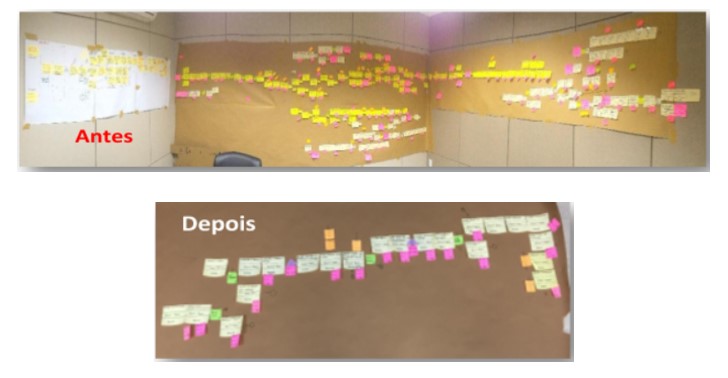
Every company has a unique experience on its lean journey; looking at this multiplicity of experiences is a valuable resource for better understanding the difficulties, challenges and learnings we may face. ELOSAÚDE shares significant stages of its process so that other companies can be inspired and pursue their own transformation journey. The journey requires dedication and is not easy (far from it); you will probably make many mistakes and shed a lot of sweat along the way, but, at the end of the day, you only reap what you sow. There is no harvest other than what has been sown and cultivated. If you resist or are too lazy to plant a new seed, you will never reap fruits different from those you already know.







