Lean for performance management in remote teams
Over the years, work has become increasingly more collaborative and, paradoxically, more independent of physical location, which makes visibility into and management of value streams mandatory tools for sustaining a business.
Throughout human history, dependence on location was a decisive factor in looking for work. Working from home was not even a possibility, and proximity to the workplace was a key determinant of productivity.
The underlying assumption was (try not to laugh): if you are at the office, you are working. And management models, even the most modern ones, were based on this assumption.
Let's look at the past to understand where we are.
The history of remote work
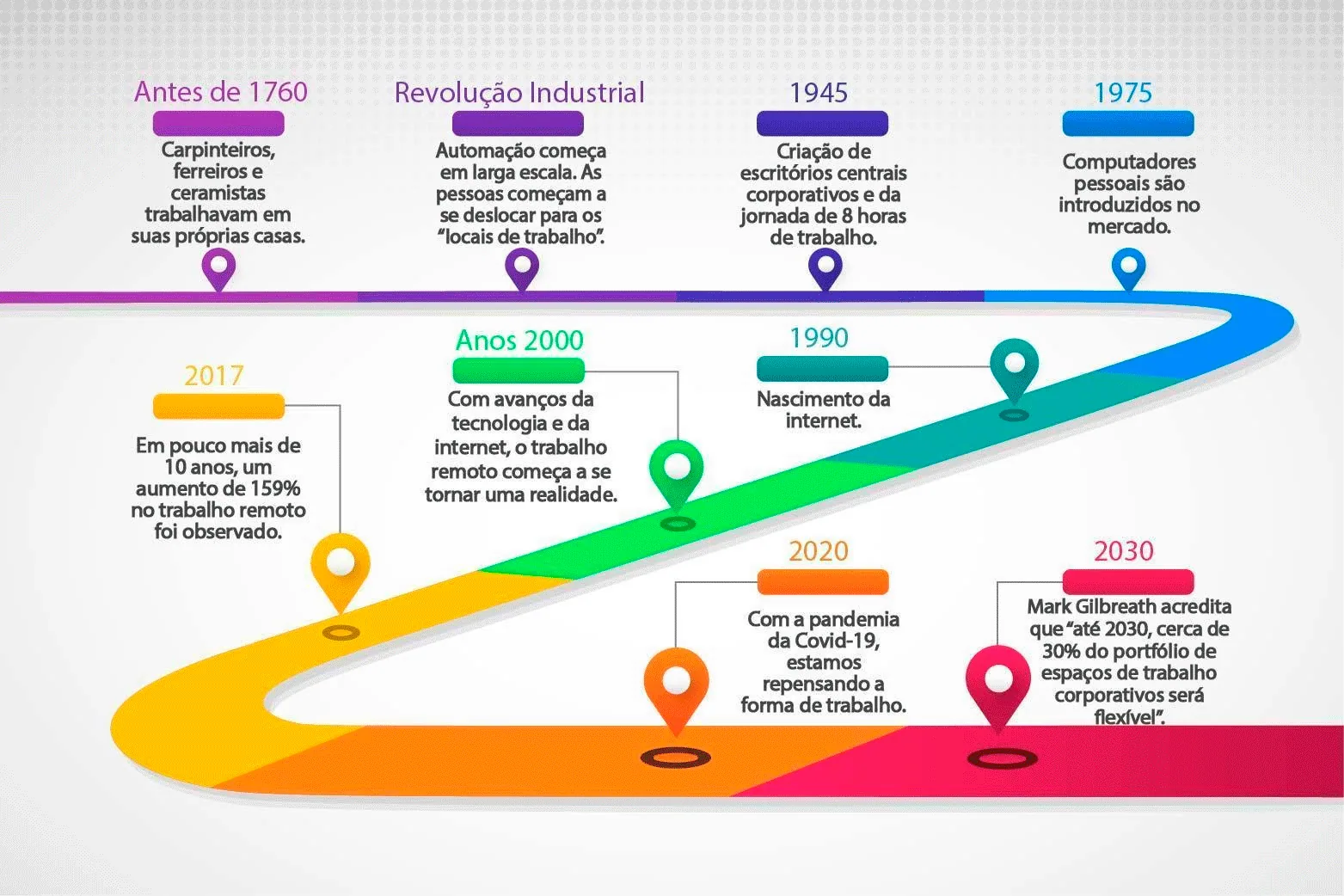
Remote work did not appear overnight in the 1980s. Long before central offices existed, everyone worked from home. It was only with the Industrial Revolution that the need for automation arose, along with the creation of factories with gigantic machines and large-scale production, which required the physical presence of employees to carry out the work.
However, thanks to recent advances in infrastructure and technology, more people own personal computers and can therefore connect their homes to the global computer network (the world wide web). Today, the internet makes it possible to work remotely from any corner of the world. Even from home. Between 2005 and 2017, remote work grew by 159%. In 2015, 3.9 million U.S. workers were working remotely. Today that number is 4.7 million, or 3.4% of the population.
This number is expected to grow. Mark Gilbreath, founder and CEO of LiquidSpace (a platform that offers temporary rental of work and meeting spaces), said in a TED Talks interview that “by 2030 about 30% of the corporate workspace portfolio will be flexible”, that is, location will no longer be a constraint on work. Suddenly, however, the Covid-19 pandemic accelerated the mass shift in how teams operate, from in-person to remote, and it is causing countless disruptions in companies, regardless of their size or degree of automation.
The difficulties of remote work and their causes
In this context, it is no longer possible to manage remote teams using traditional performance metrics, such as arrival and departure times, time spent in the office and absenteeism. Managers are beginning to realize that, without knowing the value streams that deliver the work, the performance targets related to that stream, the roles and responsibilities of each resource allocated to it and the deliverables expected from each one, there is no way to assess productivity or to ensure that strategic objectives are delivered. And some difficulties are encountered along the way:
- Holding teams accountable and ensuring they are on the right track without falling into the micromanagement trap becomes incredibly complicated. To ensure deliveries on time, within expected costs and to the desired quality criteria, which, incidentally, have always been subject to a certain dose of subjectivity, managers relied on the traditional last-minute final validation, which not infrequently required extra hours of work for adjustments and involved concentrated efforts by the whole team.
- In remote work environments, there is no way to establish visual controls that ensure the work is being done, nor to “extend” working hours or mobilize last-minute all-hands efforts. If you are not within sight (and earshot) of the manager, you can choose to become virtually invisible.
- Keeping the same procedures and mental models of the Industrial Revolution in team management no longer produces the desired results. In fact, this model has been proving inadequate for some years, but it was still sustainable insofar as some contingency could be kept.
Lean thinking and the change in mental model
Managers need to realize that the gemba has changed location, and this is where lean thinking and practices can be very useful. Here's how:
- Make the value stream visible to all employees.
Value streams, like gravity or radio waves, exist whether they are visible or not. The sequence of activities needed to deliver a product or service is mostly “in people's heads” or turned into algorithms in information systems. The first and most important step is to make them visible. Making the stream visible to all employees helps with both accountability and collaboration within the team, as people perceive the cause-and-effect relationships of their activities. The side effect may be the end of complaints and accusations over coffee, since coffee is now remote.
- Document the activities.
No matter how many functional areas this stream crosses or how much automation it has, managers need to bring together all the people who work in the same stream and document it. Documenting the activities, the variations in sequencing or in the way they are performed depending on the employee who performs them is essential to understand roles and responsibilities, handoffs and partial deliverables.
In this sense, a lean tool that can help enormously is Value Stream Mapping. This mapping is usually done in workshops with everyone involved in the stream, so that each person records the activities under their responsibility, how they perform them, the time spent on the activity and, above all, what problems they face.
The great benefit of this tool, besides making the value stream visible, of course, is that it allows everyone involved to see the stream end to end and the greater purpose, which is delivering value to the customer. In addition, gray zones in the handoffs between areas can be addressed immediately.
There are countless collaborative digital tools that make it possible to run this workshop remotely. Choose one, call in the people involved in every step of the stream and get to work.
- Define partial deliverables.
Once the stream is visible, the manager can define the partial deliverables, the control points, the cycle times and the people responsible, and set targets for these partial deliverables with regard to quality, deadlines, volumes and even costs. In other words, the expected standard.
Often, neither managers nor teams have visibility into the targets or expected standards for their activities in the dimensions that matter to the company and, consequently, they are unable to identify deviations until it is too late.
These targets must, of course, contribute to achieving the strategic targets, since every value stream delivers one of the company's products or services. This alignment is, in fact, extremely important for defining appropriate and feasible targets for the value stream's deliverables, which will guide the teams.
- Lead with Respect.
The manager in this new model becomes a leader who facilitates problem solving and a developer of people. Providing alternatives, suggesting potential directions, questioning and teaching are part of managers' new duties. Note that pointing out directions and teaching differ enormously from telling people how to do things. If you solve your child's math homework problem, he will hardly know how to solve similar problems in the future. Teaching and developing people makes the stream sustainable in continuous improvement. When a similar problem occurs again, you may not even be involved. And believe me: good management takes a lot of time. You will not be idle because you are not “getting your hands dirty” or micromanaging tasks.
There is a lot to explore on this topic, which is actually the heart of this whole change. To get started, I suggest reading this article.
- Practice discipline with your team.
Discipline and routine are words that are often confused because, broadly speaking, both refer to activities you carry out at a certain cadence. The difference between the two is your intention. While routine evokes an obligation, discipline suggests determination.
Discipline is routine that has a greater purpose, and it is fundamental, even more so in remote environments. Establishing fixed, cadenced activities to follow up on deliverables and communicate with the team creates comfort and makes planning possible. Team meetings should preferably take place at the same time, have an agenda and visual tracking for everyone, and be quick.
Make use of the countless visual management tools available. Choose the one that best fits your stream and your team's skills, or create your own visual management board.
Do not deal with individual or one-off problems in value stream follow-up meetings. Create specific agendas for that purpose. The goal here is to understand whether the work is progressing and whether there is an opportunity to help the team. This is the gemba. This is where the team's performance will be tracked.
Daily Management, one of the most powerful lean tools, can be an excellent option in this case. It makes it possible to identify potential deviations quickly and early, expose problems that need to be solved to ensure deliveries and bring leadership closer to the reality experienced by the teams. In Daily Management, leadership deals with the real, tangible day-to-day problems that can interfere with the delivery of strategic objectives, and not just with the indicators.
Reaping the rewards of change
Companies that have already adapted to the remote and collaborative work model are the ones getting ahead and reaping its benefits early. Here are some examples:
- A recent two-year study by Stanford University found a 13.5% increase in productivity when call center employees at Ctrip (a Chinese online travel company) were allowed to work remotely for nine months. And that is not counting the savings of US$ 1,900 per employee in furniture and physical space.
- The giant WordPress currently works with a 100% remote team and closed its physical offices four years ago. To give you an idea, in 2017 its net market value was US$1.16 billion.
- When CoSo Cloud allowed some of its employees to work remotely, they were 77% more productive than those who stayed in the office.
- A 2019 survey by Airtasker found that remote employees work 1.4 more days per month than those who work in offices.
- In addition, about 90% of remote workers have no intention of changing this model, which allows companies to maintain higher retention rates and reduce spending on training new hires.
In general, adopting remote work offers companies some competitive advantages:
- Better mental and physical health for employees, who replace stressful commutes with morning exercise and devote more time to their health, which can increase productivity and overall feelings of happiness.
- Better work-life balance. Greater flexibility in their schedules allows them to reconcile time for family, personal obligations and career. And with fewer interruptions at the coffee machine, tasks get done faster.
- Lower overhead, both for the company and for the employee, which means more money can be spent on team-building activities instead of extra phone lines, coffee machines, rent and office equipment.
This new work model requires transparency between manager and employees, allowing everyone to see one another's tasks, targets and responsibilities in order to encourage accountability and ensure high performance.
So, if there is one thing we can say, it is that advances in technology will undoubtedly keep expanding in quality and speed, making remote work increasingly common, which will require managers and employees to adapt to these new times.
This crisis may have been the push companies needed for a definitive change in their relationship with work. Companies that manage to incorporate the learning gained from this forced shift and take advantage of the change in mental model that lean thinking and tools provide will certainly come out ahead and better prepared for the return of Business, which will never again be As Usual.
Footnotes:
- Available at: https://www.youtube.com/watch?v=mpfRGpJe8Ss
- Nicholas Bloom James Liang John Roberts Zhichun Jenny Ying. Does Working From Home Work? Evidence From A Chinese Experiment. Stanford University: March 3, 2015.
- Available at: https://hbr.org/2013/03/how-wordpress-thrives-with-a-1
- Available at: https://www.cosocloud.com/press-releases/connectsolutions-survey-shows-working-remotely-benefits-employers-and-employees
- Available at: https://www.airtasker.com/blog/the-benefits-of-working-from-home/
- Available at: https://www.com/blog/the-benefits-of-working-from-home/
Credits:
First image credit: Freepik.
Second image credits: Freepik. Image edited and modified.