

Oakland University industrial and systems engineering students use lean thinking to improve operations and optimize warehouse space at Humble Design
Using lean thinking, Oakland University (OU) Industrial and Systems Engineering (ISE) students Monisha Vasudeva and Sagar Bajaj are helping Humble Design – a nonprofit organization that provides furniture to individuals and families who have just come out of homelessness – improve its operations and optimize space inside the organization’s warehouse in Pontiac, Michigan.
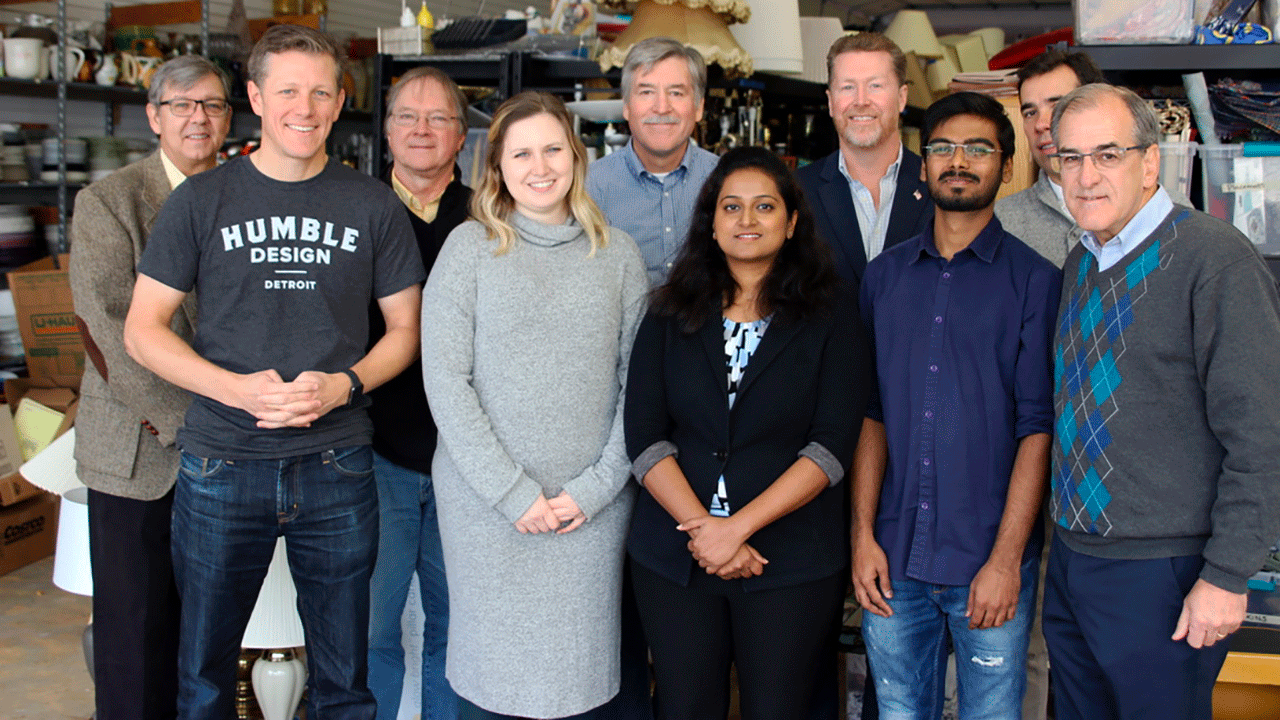
A collaborative project between Oakland University’s ISE department, OU’s Pawley Lean Institute and the Lean Enterprise Institute is helping Humble Design improve operations and optimize space inside its Pontiac warehouse.
“We are excited to support the excellent work of Humble Design”, said Robert Van Til, Ph.D., Pawley professor of lean studies and chair of Oakland University’s Industrial and Systems Engineering (ISE) department.
The project is the result of an ongoing collaboration between Oakland University’s ISE department, OU’s Pawley Lean Institute and the Boston-based Lean Enterprise Institute (LEI), which was founded by the father of the lean movement, Dr. James P. Womack.
LEI, through the James P. Womack Scholarship and Philanthropy Fund (JPW Fund), recently provided an initial donation of US$ 10,000 to Oakland University to be used to place ISE students in paid internships at community service organizations such as Humble Design, where they will be able to continue their lean learning process and help the organization improve its performance.
“We see this work as an opportunity to help Humble Design move forward, and we hope other students will take advantage of this LEI-supported internship”, said Dennis Wade, director of the Pawley Lean Institute.
Located at 180 N. Saginaw Street in Pontiac, Humble Design serves individuals, families and veterans who have just come out of homelessness, transforming empty houses into cozy, welcoming and inspiring homes with donated furniture and household goods.
“When someone is referred to us, we meet with them in their homes in order to get to know them and their new home”, said Laura Corp, operations manager at Humble Design. “Then we provide a full design service for them with donated goods from our warehouse”.
“We give our clients everything, from beds to silverware and artwork, and everything is chosen specifically for them”, she added. “Giving someone a home full of furniture makes them feel safe, happy and stable. It gives them something to strive for”.
In recent months, Vasudeva and Bajaj have been working to improve operations inside the organization’s 12,000-square-foot (approximately 3,600 square meters) warehouse in Pontiac – one of Humble Design’s four locations in the United States.
“Because Humble Design is a nonprofit organization, its operations vary when compared to a manufacturing company or any other company”, said Vasudeva. “The most challenging part of the process is the time needed to understand the organization’s basic thinking and culture, which is the key to implementing lean”.
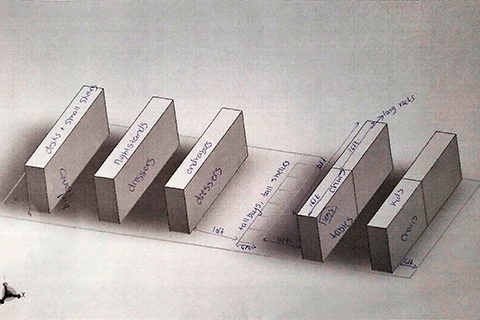
This sketch shows how the OU students plan to use shelving to optimize space.
“When lean is implemented without understanding the culture, the expected results are not delivered”, she added. “The only possible way to overcome this challenge is to ask a lot of open-ended questions of the people who work for the organization about their work, the problems they face, critical areas for improvement and so on. So, on all our visits to Humble Design, we spent a lot of time asking questions and trying to understand the basic thinking and culture”.
Humble Design employees, ISE faculty members, OU faculty members associated with the Pawley Lean Institute and LEI representatives have provided assistance and guidance to the students throughout the entire process.
“My role is to help develop lean thinking and practice with OU students Monisha and Sagar, as well as with Humble Design”, said Matt Zayko, an LEI coach and faculty member who mentors the students.
“We develop this thinking by using the scientific method to select countermeasures to help Humble Design overcome the critical problems affecting them”, he added. “We spent a lot of time in the early stages clearly identifying the problem to be addressed and using the A3 thinking process so that people stay aligned and focused on the same vision and goal”.
Vasudeva and Bajaj have already made several improvements in the warehouse, including:
- Optimizing space by categorizing the total warehouse into three sections: Section A (rugs and sofas), Section B (furniture, bed frames, mattresses and hygiene products) and Section C (kitchenware, lamps, designer workstation, toys, art, bed linens, curtains and electronics);
- Implementing new safety regulations inside the warehouse;
- Categorizing items in the warehouse based on color, size and shape;
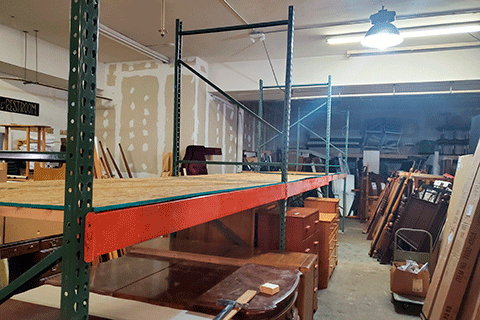
Newly installed shelving in the Humble Design warehouse helps optimize space.
- Using shelving to efficiently place furniture, rugs, metal bed frames, etc. based on their size, weight and height, making use of the warehouse’s vertical space instead of horizontal space;
- Identifying and eliminating waste by organizing recycling twice a week instead of once a week.
“Having two students dedicated to studying our warehouse and our operations and helping us find creative ways to make both more efficient has been wonderful”, said Corp. “It is helping us solve problems we have accepted for a long time. We are slowly changing our way of thinking from ‘what can we do in a week with our limitations’ to ‘what is the need and what can we do to meet the need that exists’”.
Although many improvements have already been made, Corp said the OU students continue to work with Humble Design to find even more ways to optimize space and better serve the homeless community.
“The improvements so far have mainly been related to safety”, she said. “The other improvements we are working on, such as additional shelving, will not only make the warehouse safer, but will also make all our items easier to see and access, which will be monumental for our designers and warehouse managers. It will also allow our donations to stay well presented, since we currently have to stack everything on top of each other. When December comes, this should look like a very different warehouse!”.
To learn more about Humble Design, visit www.humbledesign.org (in English).
For more information about Oakland University’s Industrial and Systems Engineering programs, visit www.oakland.edu/secs/departments/ise (in English).
To learn more about the Pawley Lean Institute, visit www.oakland.edu/lean (in English).
For more information about the Lean Enterprise Institute, visit www.lean.org (in English).
To learn more about the James P. Womack Scholarship and Philanthropy Fund, visit www.jpwfund.org (in English).
Source: Oakland University Magazine







