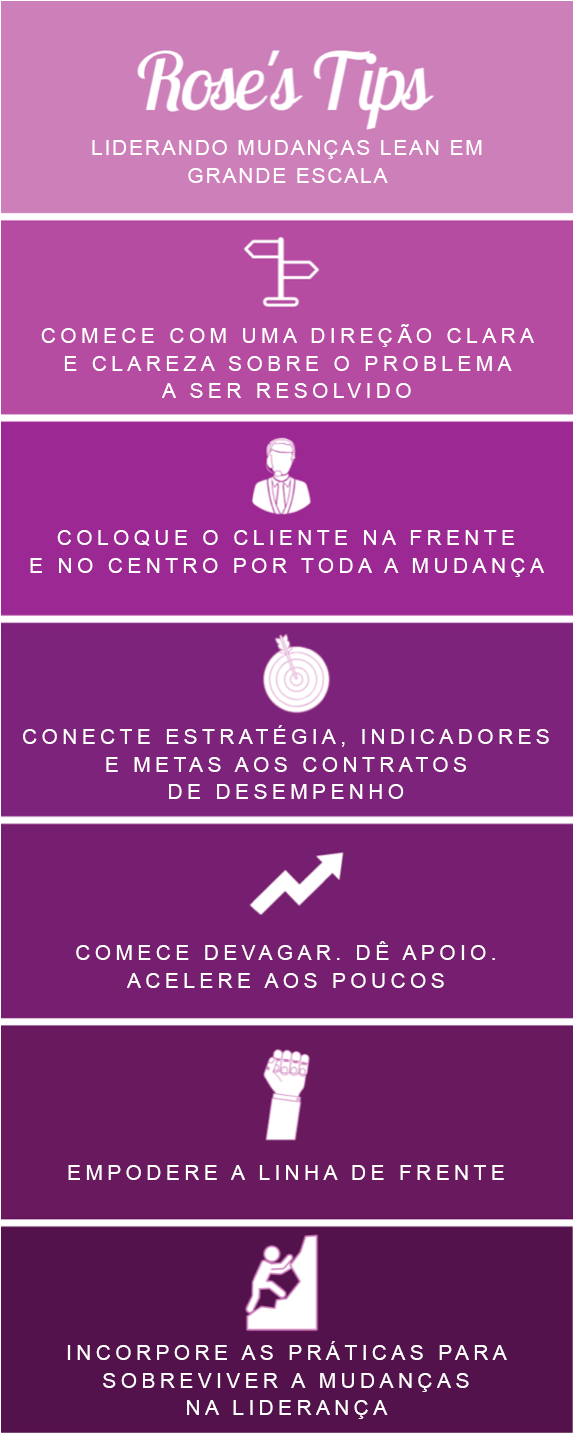
Leading large-scale lean change

Rose Heathcote: What triggered the need for a transformation at Old Mutual?
Rose Keanly: Any business transformation must start with clarity about the problem you are trying to solve. First, we had a cost problem we needed to solve – essentially, our unit costs were too high. Second, our customer service experience was not extensive and did not cover where we needed it. Third on the list, we had a sense that team morale could be improved.
RH: How did you help your teams focus on the vital things?
RK: When I took on the role of head of operations, customer service and technology, my obligation was to focus on those three areas. In other words, we knew what we had to work on. Knowing what to focus on meant that we could measure where we were, set targets for where we needed to go and demonstrate progress.
We cascaded our objectives for these three areas down to every person in the business – all 4,000 of them – so that everyone knew what mattered and we could establish a line of sight between what was happening in the gemba and how the focus areas were progressing.
For example, on the front line, we measured call response times and how many calls were resolved, and we tracked productivity at that level. By improving this, there would be a natural impact on customer satisfaction and unit costs. This was also linked to employees' performance reviews and bonuses.
It took a lot of perseverance. We stuck to it! In the eight years I led the change, we remained consistent in our focus. We did not change the indicators every year. We understood that this was a culture change. Before, people did good things, but they did not have absolute clarity and clear direction, and this was a change in performance.
RH: How, then, do you align daily work with these vital things and embed them in the culture?
RK: With clarity and a defined direction, we were able to identify the key processes that were visible to customers – challenging enough, but within the team's control – and start the pilots. In the beginning, we had help to bring in the knowledge and training, but over time we developed our own capability – we went on to use 128 teams. Each team had the chance to analyze the work it did, see the problems and find the root causes. They then decided on the necessary changes. We had some quick wins, but we also turned our people into autonomous problem solvers. We started to have less finger-pointing blaming the department next door. This approach also exposed opportunities for upstream and cross-functional improvements. To improve our processes, we made improvements to the system and the technology.
We identified best practices and began to visualize performance, holding daily meetings, analyzing the root causes of problems and carrying out these daily routines that helped sustain the wins and trigger further improvements.
Every day, the teams reviewed their own performance, aware of their targets and of the problems that kept them from reaching them (these came up in the daily meetings). We enabled people to achieve the desired performance and earn their bonuses. In this way, improvement was part of their job, not a separate responsibility they took on when they had time.
RH: How did you increase employee participation and engagement?
RK: It is not enough to push a button and expect things to change – as leaders, we have to work consistently to make change happen. Some people love change and can change quickly, while others struggle and tend to find it hard. To ensure that the change was sustainable, we repeatedly reinforced the message, set performance targets and communicated them regularly, and consistently evaluated people based on their contributions. Nothing was easy: we did not have all the answers and we had to keep going. It was hard work. Along the way, we learned a lot and made mistakes.
The most important thing we did was to change the management culture to help the front line see problems and have answers to them. Regardless of whether they were processing payments or dealing with customers, people knew where the problems were that kept customers from having a good experience and processes from working properly (which ends up affecting costs). If you can effectively engage them and enable them to identify problems and then take responsibility for solving them, you can make your transformation sustainable – which will not happen if you perpetuate a management culture in which the team leader or manager has all the answers and tells people what to do.
Human behavior is fascinating – tell someone what to do, and their reaction will be very different from the one you would get if you asked for their input and allowed them to make changes to the work, see whether those changes work and work as a team. At that point, you work with the teams to ensure the process is sustained.
Not only will this lead to better outcomes for customers and much more efficient processes, but it will also boost morale.
RH: What happens when leadership does not commit to large-scale change?
RK: I was very lucky, and I know my story was different. I was the leader and could make decisions, set the tone and say which indicators mattered. Leadership must be committed and, obviously, take the lead. They must be prepared to align and measure performance. People become frustrated when leaders do not commit or when individuals make changes in their own areas but do not receive the support they need to address the systemic problems that hurt their performance.
RH: Given the chance, what would you have done differently?
RK: First of all, I would introduce new leaders in a more formal way. Although we achieved sustainable results, it became clear that lean practices were more strongly embedded in some areas than in others. We had some turnover of leaders – people changed their minds or were promoted – and we wrongly assumed that the new leaders would simply fit in and adopt lean. We should have taken the time to introduce new leaders to our way of working. They were not used to this changing world, and it did not take long for the practices to start disappearing – for example: “we are not going to have daily meetings anymore, because I don't think they are necessary”. This diluted the efforts made previously. I am not a big believer in rigidity and in forcing people to do things the same way, crushing creativity, but there are basic lean practices about which we should have been more explicit – you are free to practice your leadership style, but within the parameters and the non-negotiable practices that you need to preserve. I feel we did not think enough about how we could make the transformation survive different leaders.
I think I would also include a regular, independent review of how we use the tools and implement the standards. It took us 3 to 4 years to reach all the teams in the departments and, although our leaders were prepared to help and coach people, we often realized that, while teaching lean to new teams, those who had already learned it began to lose their way when it came to putting lean into practice on a daily basis. We should have been more rigorous in our assessment of how the teams were practicing lean. It is not just achieving the results; it is also how we achieve them.
Finally, I believe that making cost the top priority was not ideal (although it was aligned with the strategy). We should have put the customer experience first and sent the message throughout the company that, if we could improve it, cost reduction would follow naturally. In hindsight, this would also have set the right tone for employees: with cost reduction in the foreground, some of them feared for their jobs. We would have achieved the same results with a focus on the customer experience.
RH: Did the hard work pay off?
RK: We learned a lot, and that in itself is already a return. Did we impact the focus areas? Absolutely! We recorded a 15 to 30% improvement in customer feedback (turnaround times and Net Promoter Score). We also saved hundreds of millions in costs, and morale rose by up to 30% in some teams. Of course, there was still room for improvement, but there is no doubt that lean transformed the way we do business and achieve our goals. More importantly, it helped transform our culture.