Blue sky thinking
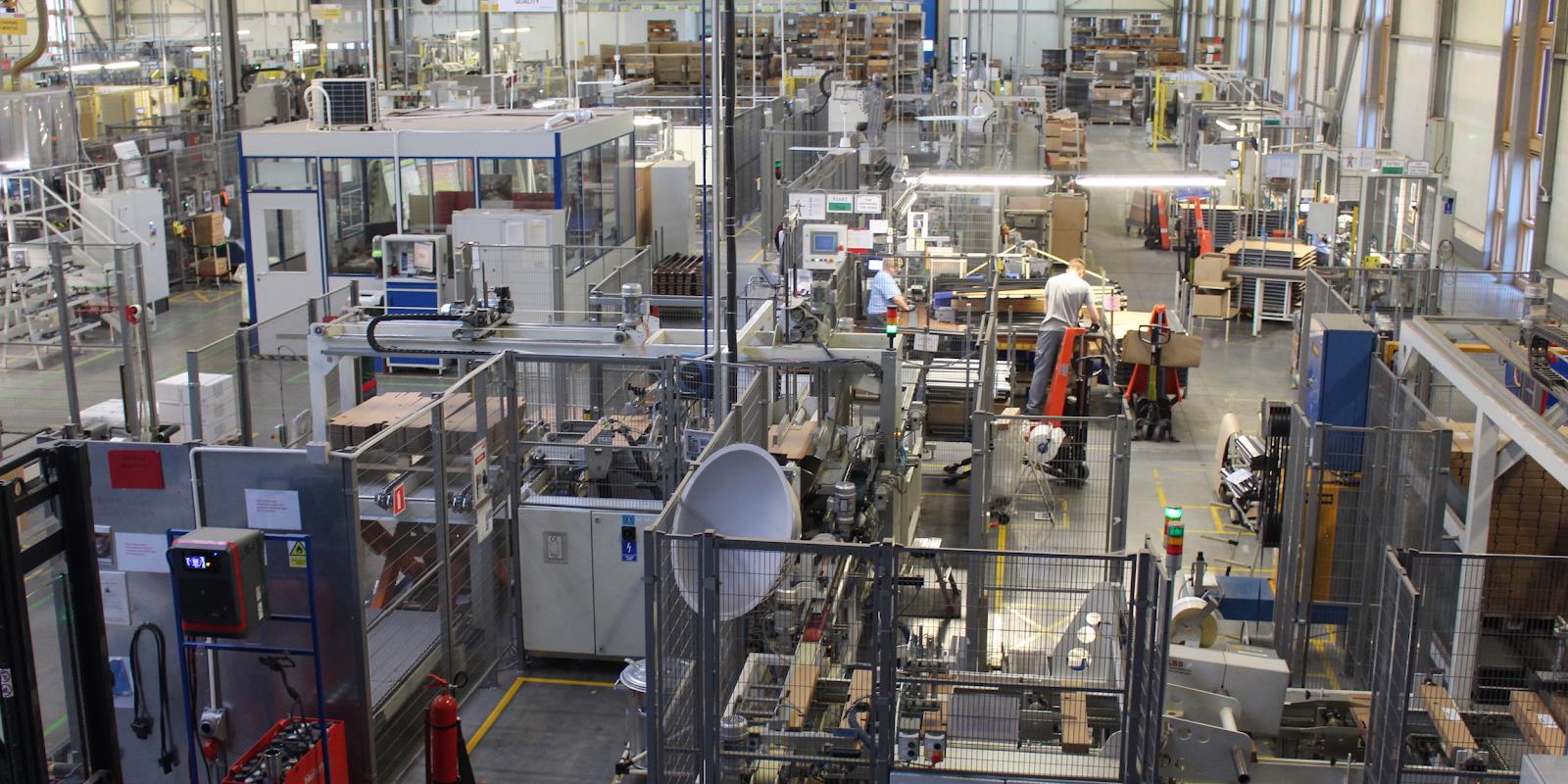
Velux, a Danish company known for its skylights and roof windows, first came to Poland in the early 1990s. Initially, they set up a sales office in Warsaw, but over the years they opened two factories in our country (across the country, Velux employs about 2,000 people).
Our plant, near Wroclaw, opened in 2003, and our lean transformation began three years later. Over time, the Velux Manufacturing Model gave us better performance and helped us increase our productivity (for example, when the introduction of polyurethane windows into our production schedule led to a considerable increase in volume in 2006). For more than a decade, our lean efforts focused on our production area: over three months, our employees completely changed the layout of the shop floor to introduce one-piece flow. The change was planned during a five-day "kaizen marathon" (we also have one-day "blitz kaizen" events for smaller problems).
In 2016, senior management decided to take lean thinking across the entire supply chain – from design to the final product. That is when we truly adopted a value stream view, a change that was well received by our production team. Until then, our lean journey had focused mainly on the tools, which we used to create stability in our processes.
More recently, we decided we wanted to better understand the impact of lean on our business. To do so, we contacted the Lean Enterprise Institute Polska and asked them to share their views on our transformation. They gave us some interesting feedback and recommended the introduction of hoshin kanri (policy deployment) at the Velux plant in Namyslow (in English). They helped us realize that we needed more structure and alignment between our processes and improvement work and the business strategy.
When we adopted the blue sky vision as our long-term strategy, we divided the organization into three levels – strategic, tactical and operational – and assigned roles and responsibilities to each of them. The system is built on the five main elements of what makes our plant work: safety/environment, quality, delivery, cost and people.
First, we created targets for our strategic level based on customer needs and assigned them to the system’s KPIs so that our employees could understand and influence our performance. We then began working to cascade these targets down to the operational level.
We have two hoshin at the strategic level – one monthly and one annual – while at the tactical level, we have a monthly hoshin supported by daily meetings. Before we implemented policy deployment, we used to have a lot of data and KPIs, and people became really confused. Besides, we ended up using only a few. Hoshin simplified our daily meeting system and limited the number of KPIs (from 117 to 18 at one of the sites). It forced us to redefine our objectives and, as a result, gave everyone a clear understanding of their responsibilities. In our new structure, targets are cascaded from the top down, and problems are escalated from the bottom up.
There is a lot of work ahead, but our culture has certainly begun to change. Our people are increasingly engaged, and now they know the business inside out.
CHANGING LEADERSHIP TO CHANGE THE CULTURE
As senior leaders, we strive to be a role model for our people: we want them to know that this new way of working matters to us, which is why we frequently attend the daily meetings and go to the gemba. The positive feedback we have received proves that visible leadership, although a bit challenging at first, sends a strong message to employees. Nowadays, all senior leaders make an effort to spend as much time as possible in the gemba.
Once a month, we hold a meeting with the general manager and 10 to 12 employees. The idea is to discuss different topics and give frontline people an opportunity to ask questions of top managers. The meeting is open to everyone.
Communication is fundamental for us. In fact, we try to create as many opportunities as possible for interaction between the different levels of the organization. We hold dozens of events every year, from photo competitions to tournaments (teams earn points based on the number of improvements, KPI performance, etc. and can win a coveted trophy) at annual picnics. Our reward system is not money-based; instead, employees whose contribution has benefited the business usually receive a diploma and meet with management. Recognition is key!
Even our 5S audits (which we have nicknamed the “gemba patrol”, taking place once a month and always with different people) are an opportunity for senior managers and frontline employees from different areas to come together in the gemba and look for improvement opportunities together. This has proven to be a very effective approach for building relationships and trust across the company. Questionnaires, such as the “Global Employee Survey”, also help give our people a voice: in fact, many of the initiatives we have implemented originate from the feedback they gave us. Velux employees know they can shape the environment in which they work: how else would we have implemented more than 2,000 suggestions last year alone?
MONITORING AND TACKLING PROBLEMS
Lean is part of our daily life now. The people at the Velux plant in Namyslow understand that it is the only way to work smarter, not harder, and that they all need to take part if we want continuous improvement to become part of our DNA. It is clear that problem solving cannot exist without the involvement of employees.
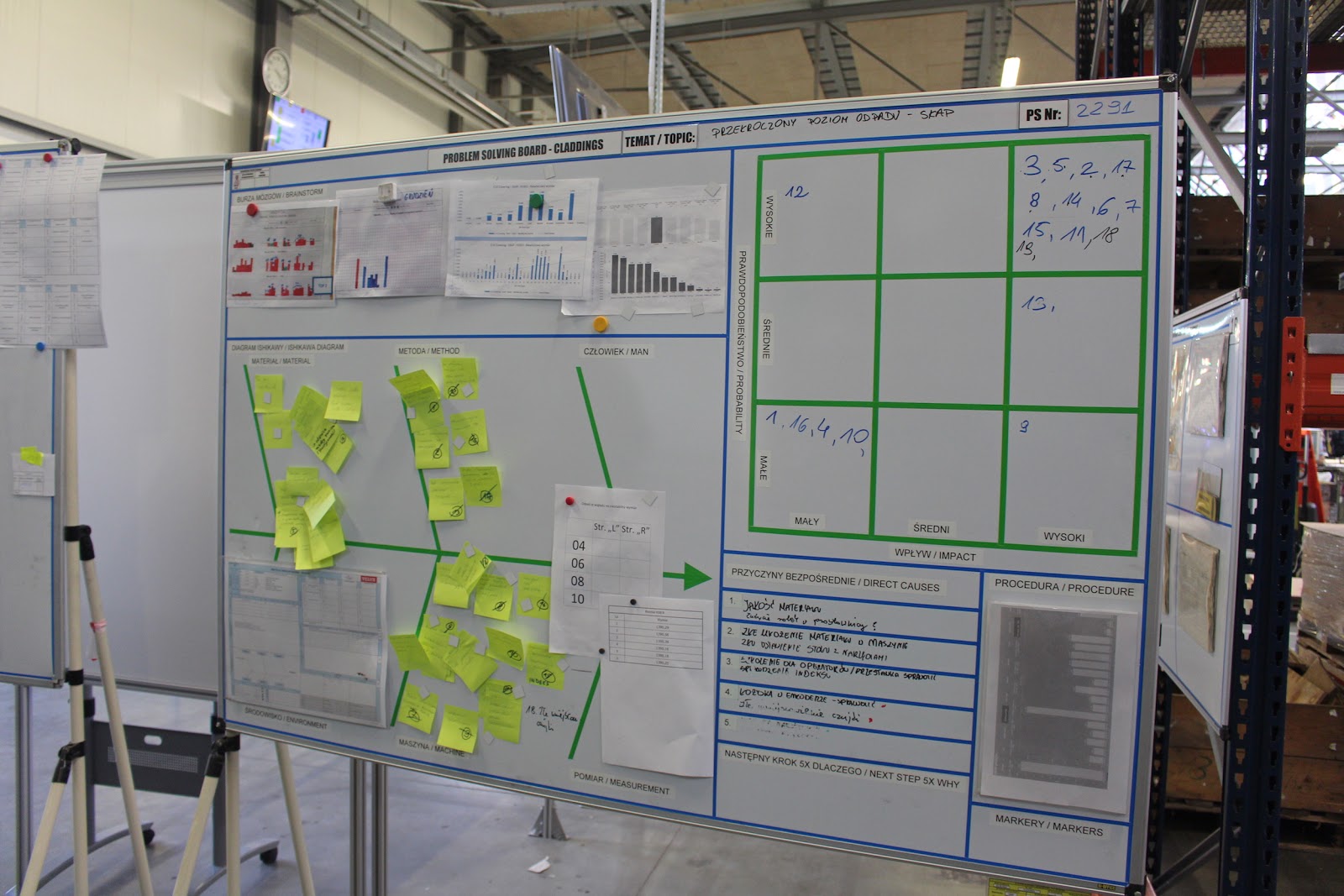
We learned long ago that a problem on the shop floor can only be fixed on the shop floor, not in a meeting room. We even put wheels on our ishikawa boards so that people can take them to where the problem is!
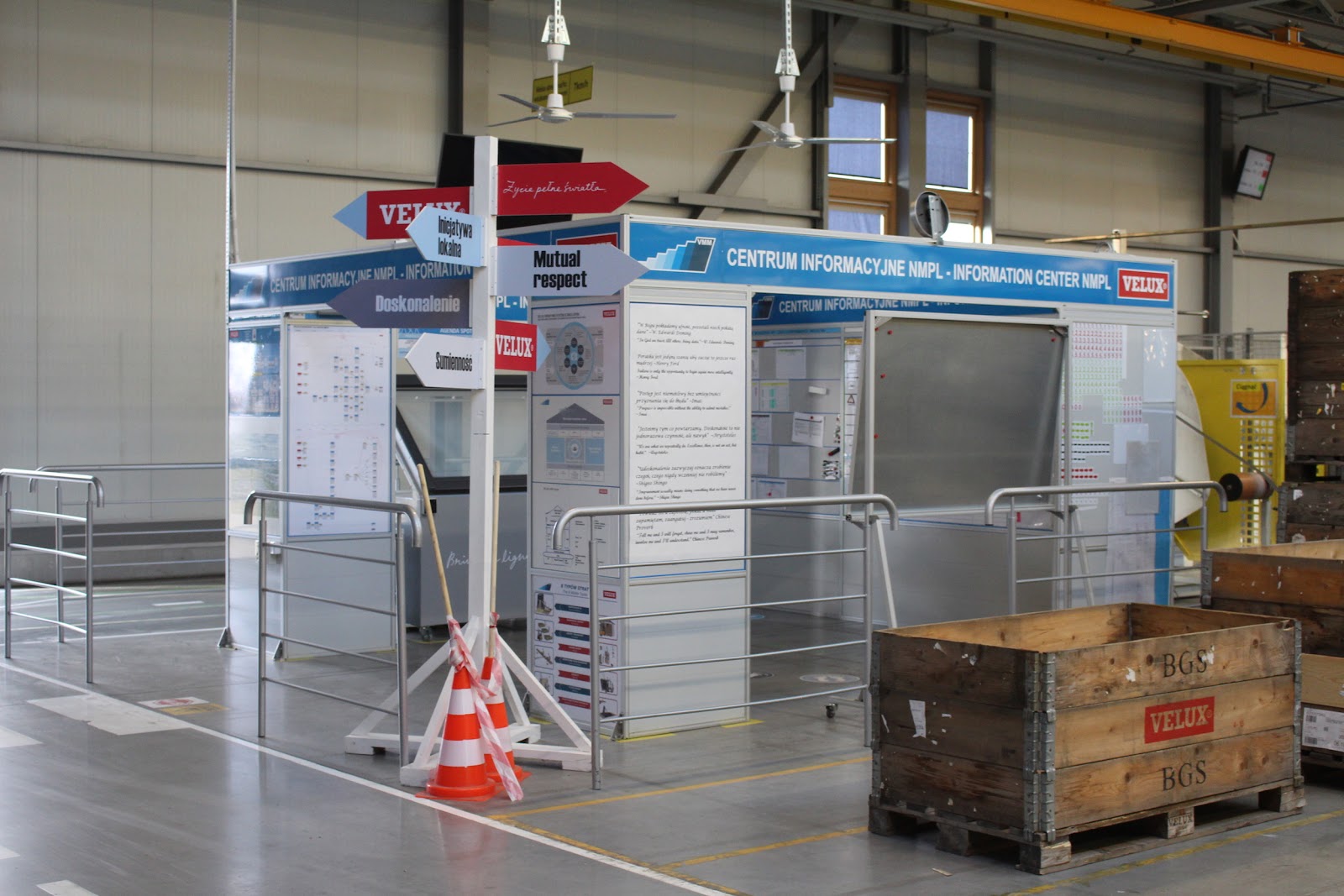
Our senior management meetings also take place in the gemba, in our “Information Center”. This rectangular space, which hosts meetings every weekday (senior management is expected to attend), is covered with boards that allow anyone to review the plant’s performance at any time. Based on indicators, we decide which problems we will tackle next. In the “Information Center”, the KPIs for each of our five main focus areas (Safety / Environment, Quality, Delivery, Cost and People) are updated daily. One KPI in red is enough to turn the whole focus area red; this means that red tends to be more prevalent than green, which is good, because we believe problems are good. For each of the problematic KPIs identified, we use a just-do-it card, a problem-solving method that uses the probability matrix and the 5 whys to solve smaller problems (larger problems will usually be assigned to an A3). The same manager could therefore have two or three cards a week, which he would pass on to his team. Every week we meet and review these cards. If the problem has not been solved, it is escalated (it will be referred to senior management, if necessary).
Thanks to hoshin, we know where the problems are and where to strike next. A particularly effective approach we introduced is the “Top Three” system: based on tactical KPIs coming from each department, we identify the three main problems the plant needs to solve each week. A very effective way to prioritize.
As leaders, we have learned to look at how people are approaching the problem, not at the actual solution. It may be counterintuitive, but we have learned that, as long as they follow the standard, they will reach the right solution, sooner or later.