

Production stability: The role of leadership at Toyota
This article seeks to show the role of “Leadership” and “Middle Management” in the day-to-day of the factory, interacting to stabilize production processes with appropriate procedures, methods, and tools at Toyota do Brasil. We will also highlight their importance in the effort to ensure the “spirit” of group unity for continuous improvement, what their main activities should be, and finally, present a suggestion for companies that are on their respective lean journeys, and what their main function would be.
1) How to measure and monitor stability in production
As we showed in the article “Stability in Toyota's production areas”, the indicator used to measure stability is “downtime”.
Monitoring is done through the “problem tracking board” (see the manual “Creating Continuous Flow” – Mike Rother & Rick Harris, version 1.0 of January 2002, page 86) and is generally filled in by the group leader, while the supervisor or area management checked it during breaks, and the directors (plant management) at the end of the day.
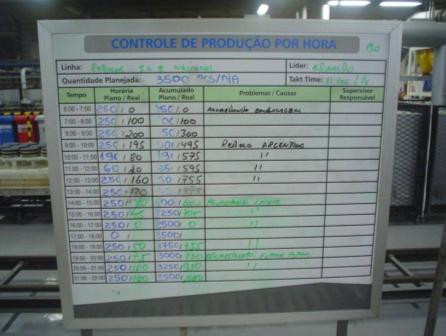
Source: Saint Gobain Abrasivos – Paulista Plant (NE Forum – 2007)
It is important to remember that all abnormalities arising from the 4M’s that directly or indirectly caused production to stop were recorded on these tracking boards and generated downtime. Thus problems such as line delays due to absenteeism or untrained operators (Manpower), long setups due to a lack of standardization (Method), parts and components arriving late (Material) and machines running with problems (Machine) contributed to instability.
When the planned production (determined by takt time) was not achieved, every reason for stoppage was quantified (how long) and qualified (what happened). The responsibility of the people (group leaders) was to analyze and solve, on the spot, the problems observed hour by hour, and that of middle management (supervision and area management) and their team was to solve them as quickly as possible with appropriate methods (see the organizational structure in the Lean Lexicon, 2007 version, page 47). The goal was to achieve an efficiency of at least 95% relative to plan, in quantities or allowable stoppage time.
2) The method for problem solving
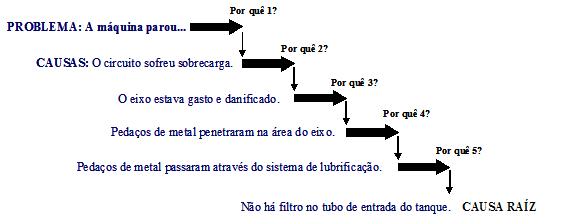
We observed that Leadership plays a fundamental role in stabilizing production because of its attitude of making problems public and solving them as quickly as possible, using scientific methods: the “5 Whys” to find the root cause and “5W+1H” (Why, What, When, Where, Who, and How) to define the actions.
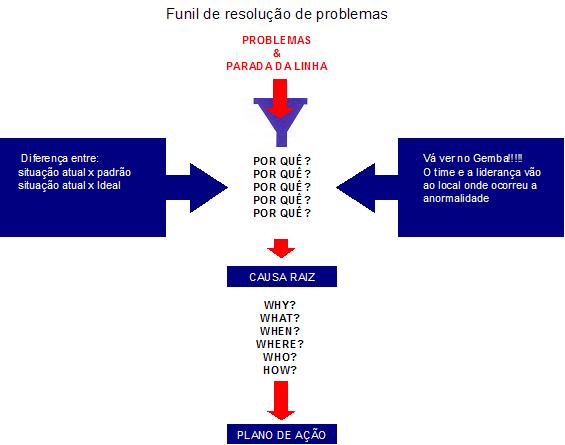
When faced with a problem detected on the production tracking board, it was up to the leader or supervisor to begin analyzing the problem and, together with their team, solve it, whether through containment or total elimination. Floater employees from all areas were involved and, under the leadership of this person in charge, carried out the plan in a short time.
Example of a line stoppage problem identified and analyzed on site:
When problems were complicated in terms of execution time or technical difficulty, as mentioned in the previous article, they were parameterized and prioritized. The most important and significant were chosen as topics for the QCC (quality control circle) or KC (kaizen circle) groups, which lasted 3~6 months of work. Invariably good results were always achieved, and at the very least there was a reduction in waste. In these group activities, we normally used the “Ishikawa diagram” or “fishbone”, where all immediate causes were raised and directed taking into account the 4 M’s, Manpower, Method, Material and Machine, in that order of priority.
The planning of the teams' kaizens to solve a problem was defined by the A3 document (see “Lean Lexicon”, second edition, version 2.0 of April 2007, page 2), which has the stages of Introduction and objectives, Current situation, Future situation, Action plan, and Indicators and Gains.
To manage the various action plans generated to solve the problems, we normally held 3 types of meetings among the teams:
A daily 5-minute meeting with the entire production team held on the shop floor, where we sought to inform each shift about the problems and improvements made in the previous shift.
- Weekly-1, lasting no more than 1 hour, with the Planning and Quality departments, where the improvements in progress and pending were monitored.
- Weekly-2, lasting no more than 1 hour, with the Directors, where the main guidelines were set.
All this effort sought to maintain production stability within the company's global standards, and the attitude of handing the team the responsibility for solving problems (guided by management) was an important factor, since those who know the problem and its solution best are those who face the difficulties every day.
The participation of the employees from the area where the problem originated created “team unity”, and giving everyone the opportunity to be heard and to participate actively in the solution brought personal satisfaction and improved communication and engagement.
3) The main activities of leadership and middle management
Below we mention some of the main activities necessary for “Leadership” to maintain production stability, considering the 4M’s of production. It is important to stress that whenever an abnormality occurred in production (problems that increased downtime), all those responsible for the areas “supplying” components or some kind of “internal service” (for example the Maintenance department) immediately came to the spot to help “Leadership”. This “team strength” is the most important factor for identifying problems, proposing countermeasures and thus fixing them so that they would not happen again.
a) Manpower
- Development of new leaders with the necessary knowledge of the lean philosophy and zero tolerance for problems.
- Implementation of multi-skilling in the production areas, thereby developing and qualifying employees.
b) Method:
- Monitoring the production andon to quickly detect where the problem will occur, and thus take “preventive” action so that the stoppage does not happen.
- Monitoring the hourly production control board to check the progress of actual versus planned production, taking the “necessary corrective” actions.
- Maintaining the routine for raising and solving problems, checking and immediately directing the solution of easy problems (through foremen, leaders and floaters), and planning the action for the most difficult and complex ones.
- Preparation, review and control of Standardized Work documents, balancing production and readjusting the layout according to changes in Takt.
- Visual control of manpower through the kanriban board (visual management, a board for controlling employee attendance, identifying key work stations in relation to experience and multi-skilling), drawing up work schedules and promoting job rotation.
- Maintenance and continuous improvement of Safety and of the “5S” program.
c) Material:
- Ensure that supermarkets are replenished, monitored and reviewed.
- Ensure that the replenishment route is being followed.
- Implementation of poka-yokes to control and contain material problems.
- Monitoring changes to products and components, with a view to reviewing packaging and its storage.
d) Machine:
- Performing first aid on machine stoppages.
- Planning and implementation of Autonomous Maintenance, through employee training and the implementation of checklists for the main machines.
- Planning, together with Maintenance, the Preventive and Corrective Maintenance plan.
- Development of machines, fixtures and equipment that meet Takt, together with Engineering.
4) Conclusion
The activities above are necessary to ensure the solution of the problems detected in production, and “Leadership and Middle Management” play an important role in this system.
Teamwork is the most important differentiator of the Toyota Production System when it comes to method, that is, the commitment and engagement of people working in groups to solve problems.
How did we achieve production stability? It was enough to solve problems as they appeared, as quickly as possible, with the scientific method or based on the knowledge and attitudes of Leadership. This is very hard to find in companies today, that is, “Leaders” without personal vanity or politics, with a single commitment: the well-being of the collective. If everyone took care of the company where they work the way they take care of their homes and belongings, we would have factories, corporations, cities, states and countries with little waste and a certain production stability.
For companies that have been on the Lean Journey for some time and that struggle to sustain the tools already introduced, the suggestion is that these leaders always be developed by their superiors. To explain better, the transfer of knowledge must come from the top down, that is, the President must have a deep knowledge of the lean philosophy and “teach” the Director, who must do the same with the Manager, and so on.





