

Fighting waste in the delivery of medical intelligence
Orizon is an organization that provides medical intelligence and analytics to fight waste in healthcare. The company serves around 18 million patients, connects 140,000 providers, is present in more than 11,000 pharmacies, carries out more than 150 million transactions a year and processes 22 million claims and medical bills annually.

Context
At the end of 2015, Orizon conducted its annual customer satisfaction survey, gathering opinions on seven different topics: speed in solving problems, quality of answers, technical performance of the solution, quality of service delivery, desire to contract new Orizon services, courtesy of the service staff and access to the relationship channel.
Of these items, two received 100% satisfaction (courtesy of the service staff and access to the relationship channel), and 89% of customers wanted to contract new services from the company, the same percentage of customers who were satisfied with the quality of the service provided. As for the technical performance of the solution, 78% of customers were satisfied. These numbers were very impressive, but lean thinking always sees opportunities for improvement.
The two numbers that worried Orizon most were the level of satisfaction with speed in solving problems and with the quality of answers, which stood at 63% and 74%, respectively. Both numbers were below 75%, the minimum target set by the company. During this same period, several competitors in connectivity services were emerging, and Orizon knew it could not sit back and wait. Therefore, the company decided to carry out a project based on lean philosophy in order to improve these numbers.
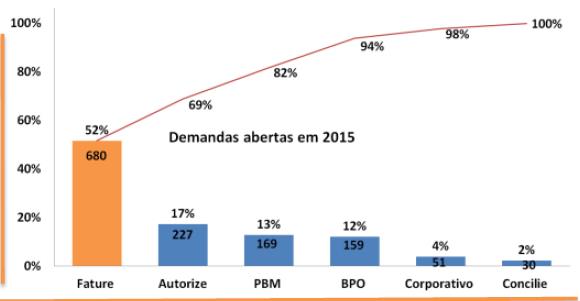
To meet the large demand it receives, the company has several platforms, each with a purpose. Among these platforms is Fature, an electronic solution that validates medical bills by applying smart rules set by the health plan operator, leaving them ready for review and payment. In short, it is a billing platform. When pulling the data on requests opened in 2015, Orizon realized that more than half of the requests were related to the Fature platform.
If you want a true and lasting transformation, you need to involve every area of the company
Fature involves the financial processes between health plan operators and providers. Requests related to this product directly influence customers' perception of quality and their satisfaction with Orizon's services. Therefore, the company began its work with this focus, bringing together people from all the directorates to ensure a broader view of the business. This was the first of many lessons lean taught Orizon: if you want a true and lasting transformation, you need to involve every area of the company, ensuring a holistic view of the process.
The improvement opportunities
The project's focus was already defined, and the cross-functional team was already formed. Fature was clearly Orizon's biggest opportunity to improve its processes, increase customer satisfaction and retain its customer base by avoiding any kind of drop in the perception of quality and of factors linked to speed and delivery of requests.
When drawing the current value stream map, the team identified 38 steps in the process, of which only 5 directly created value for the customer. The average time spent, adding up all the steps, was around 87 hours, of which only 34 were spent creating value for the customer. As a result, the average service time for this platform was 90 days, a number that could certainly be reduced considerably.
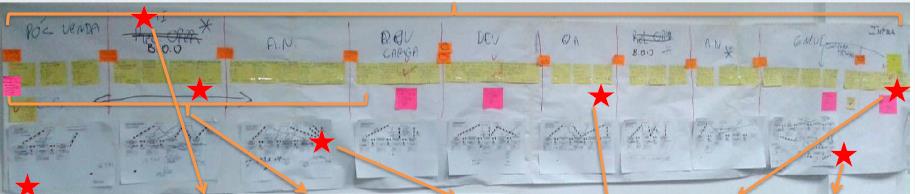
After carefully analyzing the steps, the team identified eight points (marked with stars in the figure) that represented improvement opportunities for the process. They were:
- Not all requests were recorded at the moment they occurred, making it impossible to count the real time between request and delivery and making it difficult to track status to inform the customer.
- There was a total of 38 steps in the request management process, creating the possibility of information being lost in the handoffs between the various steps and areas involved.
- The three definition areas were involved at different times, leading to different understandings and generating specifications at odds with the customer's need, and later rework.
- The interval (waiting time) between each step could reach 60 days, which generated constant complaints from customers and discomfort in the business relationship (often just to clarify a question or to say that the request would not be fulfilled).
- The release package was different from the one tested, causing a loss of quality in delivery.
- The test plan was prepared after development, that is, testing had no reference during development (which amounted to rework).
- The GMUD (Change Management) was located at the end of the process, which meant that the evaluation (and the eventual rejection of the release due to technical impacts) occurred only after development. This generated unnecessary costs and longer lead times due to rework.
- Requests coming from the customer were not recorded correctly, which revealed an incomplete system and made problem solving difficult.
Envisioning a better process
Identifying these improvement opportunities was the first step the company took to transform its process in terms of efficiency, reducing service time and the quality of service delivery. But for this to happen, Orizon first had to envision what the steps would look like in an ideal future, developing countermeasures and an action plan, as well as indicators to track the results.
The team knew that a large part of the problem lay in the excess of steps that came with Fature. Therefore, it set the goal of reducing these steps from 38 to 11. Another important point they wanted to improve was the waiting time between steps, which at the time reached 60 days. The average effort of 87 hours would also need to be reduced, so a target of 34 hours was set, since this was the time identified as creating value for the customer, the rest being waste. With a few final thoughts, such as recording all requests in the system, a clear definition of release dates and building a common understanding of the need by centralizing this task in the After-Sales area, Orizon drew its future value stream map.
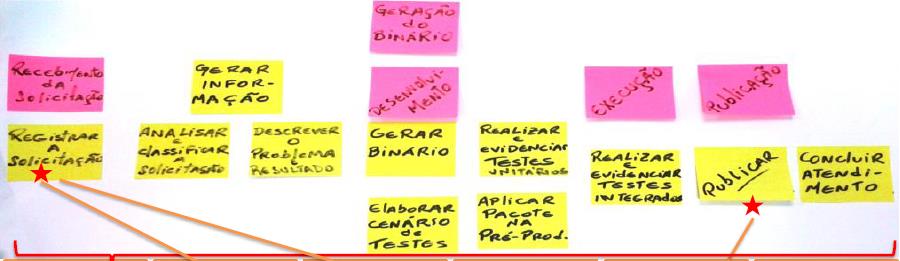
As can be seen by comparing Orizon's current stream map with its future stream map, the new process is much simpler, with fewer steps and transitions. This was Orizon's vision for its future, but to reach this state, it was necessary to develop countermeasures for the current problems and an action plan to execute them.
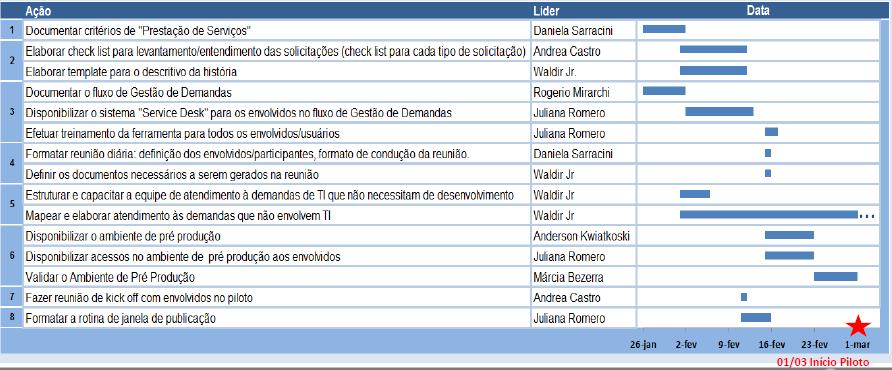
So the team met to discuss how they would achieve their goals and arrived at a set of eight countermeasures that would be needed:
- Creation of documented and communicated service delivery criteria.
- Design of a form for accurately recording the request. Assignment of a consultative profile to After-Sales.
- Recording in the system to track the status and delivery date of all requests.
- A daily meeting (of approximately 45 min) for decisions on requests. Formation of a team bringing together all the areas involved in the flow.
- Training the team to handle requests that do not require development.
- Provision of a pre-production environment for use by the Quality Assurance area.
- Having the GMUD act throughout the entire value stream.
- Increasing the number of release windows.
- A change in how requests for executing demands are recorded, to allow the problem to be solved to be recorded. New fields were created in the system to make this type of recording possible.
As important as developing effective countermeasures that take the company from where it is to where it would like to be is developing an action plan that clearly specifies who will do what and when. Orizon developed its plan, specifying dates for implementing each of its countermeasures, as shown in the figure below:
In addition, the team also defined some indicators to monitor the results their actions are bringing to the process and whether or not they need to be adjusted. The main parameter would be their annual customer satisfaction surveys, but they defined a few more indicators with the IT, After-Sales and Back Office departments to get a more specific view of the effect of each countermeasure on the final result.
Results achieved and next steps
Together with the project's developer, the Orizon team managed to simplify its processes and make them more efficient (for example, consultative requests).
Before a request was recorded in the system, the team would meet with the developers and discuss what it meant, which part of the system it would affect and who would develop it. This was part of the cell's daily discussion.
After reaching this consensus, the team recorded the request, which almost 80% of the time turned out to be consultative, that is, there was no need to touch the code, only to better instruct the customer on what to do in the system. This insight resulted in a faster and more efficient response from the company.
Orizon became a reference for its customers and suppliers in applying lean thinking to its operations. As a result, its story is already inspiring others to improve their service as well and, as a consequence, to show greater respect for their customers.
Orizon is now in the hoshin phase, deploying its strategy and new market positioning to act directly in fighting waste in the healthcare sector, bringing more health to more people. In addition, it is already carrying out improvements in several operational processes with ambitions even greater than those it had at the start of the Fature project.
People from different areas need to work together
Lessons learned
Among the lessons the company learned, one that stood out is the importance of making it clear that the commitment to problem solving belongs to everyone. That is why people from different areas need to work together, which improves speed in solving problems, creates shared knowledge of and agreement on these problems, and gives greater visibility into the volume of requests across the entire value stream.
Another valuable lesson Orizon learned during the project was a correlation between increasing the number of release windows and speed of delivery. This way, requests that have already been developed are not left sitting in inventory waiting for the days of release to the production environment.
If you want something done well, do it collaboratively
The importance of the developer in seeking creative solutions and better analyzing the context also became evident. It was through this interaction between the team and the collaborator that the group came up with one of its best “insights”: the classification of consultative requests. So the lesson is: if you want something done well, do it collaboratively (in contrast with the old proverb “if you want something done well, do it yourself”).
But the most important lesson everyone needs to learn from Orizon's story is to value your customer base and make efforts to ensure the satisfaction of those who are the pillar of your success. Without showing respect for the customers the company has, any vision of the future will hold little promise.







