

In service of customer centricity
Piotr works for a global corporation that has centralized almost all production-related processes in a single Shared Services Center, from ordering inputs to delivery. He is responsible for supplying production at his plant and is worried about an urgent order for prefabricated components - essential for production - that he placed two weeks ago. Not only has the order not yet been delivered, but Piotr is not even sure whether it was actually sent and whether it will be fulfilled by the supplier.
So he decides to send a message to the Shared Services Center using the ServiceNow system. Unfortunately, the interaction with the agent is not ideal and leaves Piotr frustrated and without any new information about the status of this important order.
Practically every organization has posters, banners, leaflets, presentations and training on how to take care of the customer, how to understand their expectations and how to meet their needs. However, the real customer experience is often disappointing. Such inconclusive interactions make customers like Piotr feel that their voice is neither heard nor understood and that their case is not handled professionally.
The root causes of this type of all-too-common interaction, in which the customer does not feel heard, understood and well served, lie in the different interpretations of the voice of the customer by different functions within a company and in the fact that the customer touchpoint is, most of the time, designed from a silo perspective.
Therefore, to have their order fulfilled on time and handled properly, the customer is often forced to wage a battle against the organization's "many-headed monster." Indeed, despite considerable efforts over decades to develop a process management culture, the dominant model in organizations is still based on functions, specialization and silos. You can see this wherever you look. When a customer calls a "call center", they are redirected from one specialist to another. In project meetings, the supposed "shared responsibility" shows itself ("I did my part of the project. Ask them.").
In mission statements and on their websites, organizations claim that the customer is at the center of everything they do, but in daily practice what the customer means to them is the aggregate number of transactions, requests and complaints. Current business trends that shape the customer's interaction with an organization, such as digital transformation, increasing process automation or the replacement of human interaction by chatbots, often leave the customer vulnerable, disappointed and frustrated. There may be no escaping these trends, but that does not mean that the silo mentality should continue to influence the way organizations do business.
At Clariant, a Swiss multinational chemical company, we have carried out several experiments in Service Management. Our approach brings together the Customer Interaction Platform (CRM), Lean Thinking and RPA (“Robotic Process Automation”) to create a synchronized operating model. These are our "Three Musketeers," joining forces under the motto "One for all and all for one." Over time, Clariant has developed several virtuous practices - from the "3D Camera" to SIC, from CTQ (Critical to Quality ) decoding to the Harmonization Lean Event and the Deviation Management Game. The result? A unique and consistent customer experience. In this article, I will tell you about some of our experiments.
HOW TO LISTEN TO THE CUSTOMER?
Service Management at Clariant has developed two practices that ensure complete and comprehensive listening to the voice of the customer - the Three-Dimensional Camera and Three-Level Recording.
The Three-Dimensional Camera model consists of three steps following a predetermined sequence. First, we explore the data in the systems, trying to identify patterns and regularities. Data exploration must conclude with the drafting of a list of questions for the people on the front line of customer service. As a second step, we ask these people the questions (see examples of questions in the image below). Finally, based on the knowledge resulting from the data and from the answers to the questions, we analyze the overall process.
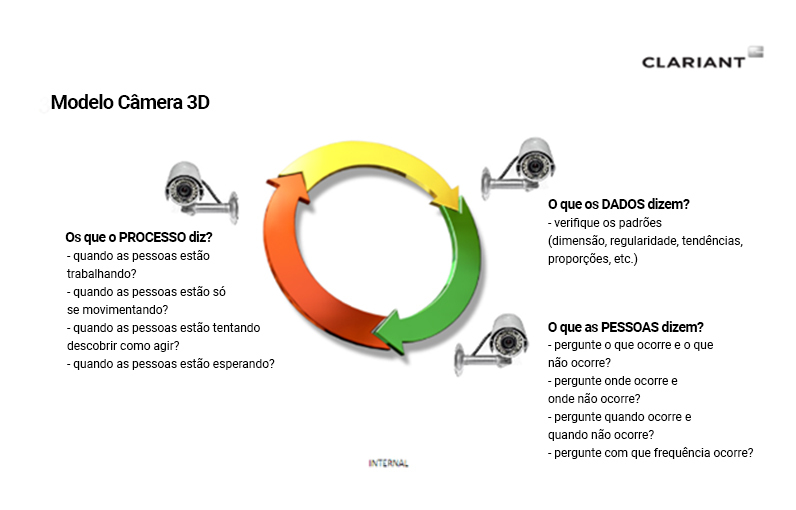
This model is essentially a description of the work done by a professional detective at the crime scene (in lean, we call it the gemba). The detective analyzes the coroner's report, as well as the results of all the analyses of chemical and biological evidence. This corresponds to the data exploration step (the first camera). After that, the professional detective compares the evidence with the witnesses' statements (the second camera). Often, a visit to the crime scene completes the picture (the third camera).
Four years ago, the Opex/Lean team (part of Service Management at GBS Clariant) implemented the Three-Dimensional Camera approach for problem solving at all levels, consistently asking the following three questions: What do the data say? What do the people say? What does the process say?
By moving away from the silo mentality, we have become much better at understanding expectations, needs, problems and risks. The knowledge provided by the three cameras allows us to approach the customer with a well-prepared and well-thought-out script, consisting of all the right questions (which we create based on Design Thinking and UX techniques).
The other practice - Three-Level Recording - focuses on the art of listening to and recording the voice of the customer on three levels: What does the customer say? What does the customer say between the lines? What does the customer not say (but we expected to hear)?
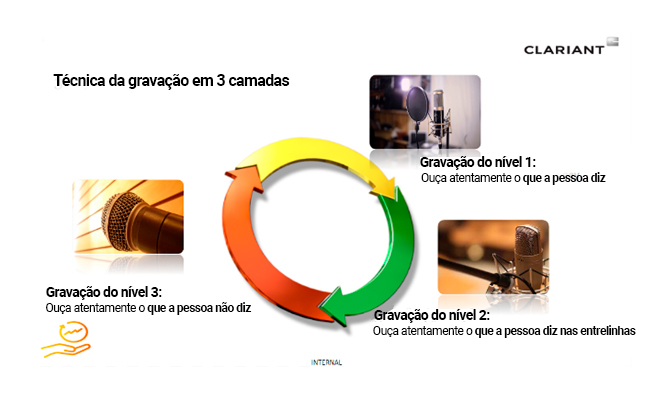
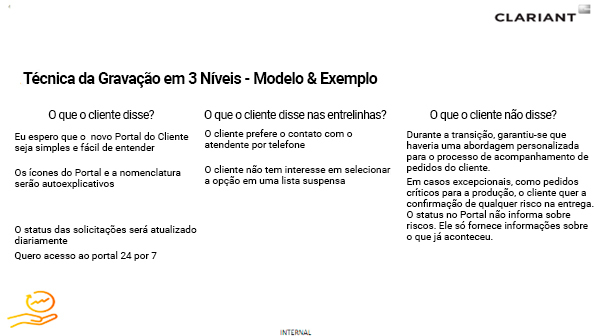
In practice, we use a template where we record the key answers. We then check whether there is coherence between what the customer says directly, what they say between the lines and what they choose to omit. If we identify any inconsistency, we know we need to repeat the analysis, for example by conducting the interview again.
Below you can see an example of Three-Level Recording related to the design of a new Customer Portal. It is evident that there are inconsistencies between the records.
HOW TO FULLY UNDERSTAND THE CUSTOMER?
Gathering customer needs and expectations is one thing, but translating them into the language of design and process is a completely different story. In many organizations, the design of products, services or processes is often based on a method that could be called "guesswork": the design team investigates the customer's requirements and makes a guess about what to offer that customer.
To translate the voice of the customer and create a coherent process that responds to the customer's real needs, Clariant's Service Management team decided to use a well-known Six Sigma technique: Critical to Quality (CTQ). Below you can see an example of developing critical success factors to meet customer expectations:
"I want a qualified professional on the other side of the Ticketing Tool system [a customer communication platform connected to the SAP system], not a Call Center agent."
We started by defining what the customer perceives as professional and competent. In other words, we went from the general to the detailed. Interviews and workshops with customers resulted in the following definition: a qualified professional listens to you to the end, without unnecessary interruptions (I was clearly heard); they know how to ask the right questions after having listened (I was completely understood); and they know how to solve your problem without avoidable delays and without the need to turn to other people from the start.
We use the Critical to Quality Tree to investigate the customer's expectations and understand their specifics, and to translate them into key process drivers. As a last step, we created metrics for these drivers.
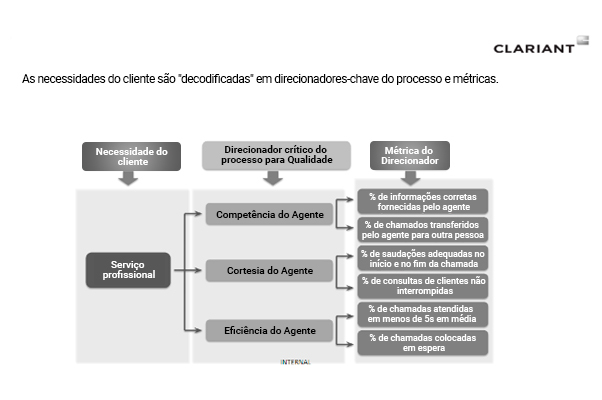
At a later stage, with the TT system receiving information in the form of metrics, the TT Dashboardwas created, a widely used visualization system with daily updates. We then had systems and metrics that standardized our interactions with customers.
The next step was to build a problem-solving system for customers' pain points. Previously, problems reported by customers were solved in an ad hocway: the customer reported a problem or made a request, our TT system logged the request, an agent created a ticket and categorized it, and then struggled to figure out how to respond. Sometimes the solution was simple: a typical request and an easy answer to formulate. Other times, however, the request was complex and unusual. On those occasions, each agent tried to find a solution, each in their own way. Sometimes they found one, sometimes they didn't. And it didn't always work. Therefore, the results on the TT Dashboard were green or yellow/red, depending entirely on the circumstances.
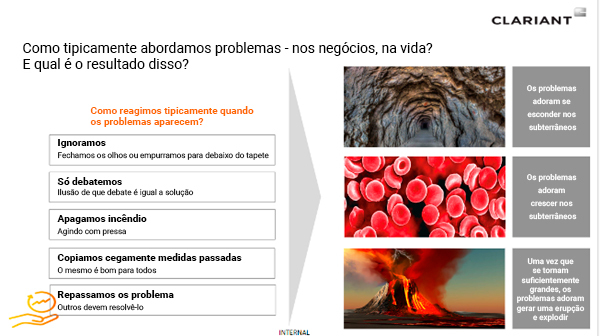
In response to this challenge, in 2019, GBS Clariant launched a global structured problem-solving program based on lean principles. We called it Structured Problem Solving (SPS), aimed at addressing root causes, and we began using A3s (called SPS OnePagers). Through observations at three centers in Poland, India and China, we described the current situation at the time.
Next, we designed different training courses, practices and simulation models. Initially, we added a coaching module (the SPS CoachingAcademy) to the training. At a later stage, we developed the SPS Mentoring Program. All problem-solving initiatives, the so-called SPS cases, are recorded in the central database, to which all employees have access.
To ensure adherence to the new problem-solving approach, we introduced two measurements - the "In Full" measurement and the "On Time"measurement. The SPS program has been running for four years, with the ultimate goal of turning everyone at GBS Clariant into problem solvers.
HOW TO COMBINE PROBLEM-SOLVING SKILLS WITH CUSTOMERS' PAIN POINTS? THE ALLIANCE BETWEEN LEAN AND TECHNOLOGY (TT)
Initially, the SPS program's operating model focused on formulating the concept, developing skills, promoting a problem-solving culture and creating the SPS Framework. This goal was achieved at the end of 2021. In 2022, we set another goal: to use TT technology to design a model in which:
- problems began to be identified systematically;
- problems began to be separated from incidents;
- identified problems began to be defined based on three attributes: size, trend, pattern;
- baseline measurements began to be calculated properly and systematically;
- responsibility began to be assigned for solving each problem;
- the Service Management area began to provide coaching and mentoring support;
- systematic records began to be made in the CPTT database;
- the start and end of the DMAIC cycle began to be triggered automatically.
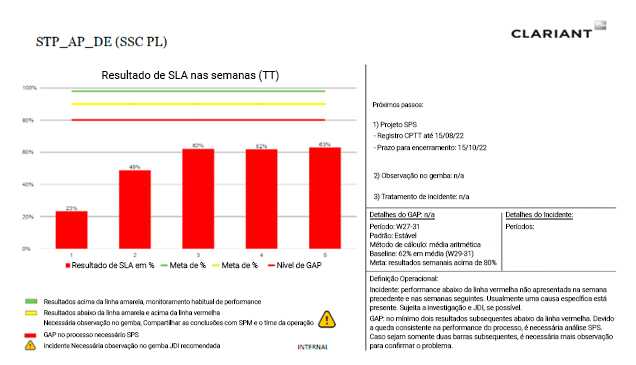
Under the new system, a Cluster Manager receives summarized information in the form of a page with a chart with explanations, metrics and actions to be carried out. This page is automatically assigned to the Daily Management Meetings, during which the team and the area leader review progress, provide support and record that a problem has been solved.
The Service Management team updates its database of incidents and problems with two objectives:
- Recurring incidents become a problem. In this case, Service Management creates an SPS case, often linked to the IT area responsible for running the TT platform, which solves a problem of recurring incidents at the source. In the long term, the goal is for most types of incidents to stop occurring for good. A problem solved at the source does not come back like a boomerang.
- Identified problems are often recurring. By having an adequate pool of identified problems and the right business analysis tools, Service Management will recognize these recurrence patterns of problems. If we know the pattern, we can also identify the typical causes and use our experience to determine which measures may work. In this way, Service Management can build a catalog of coaching and mentoring for recurring problems with a known pattern.
Below you can see an example of the July report for an Accounts Payable team.
The new operating model of the SPS program is expected to take the problem-solving culture at GBS Clariant to the next level, combining lean skills with technology. The new model was developed as part of a project entirely based on the methodology Agile and the framework SCRUM.
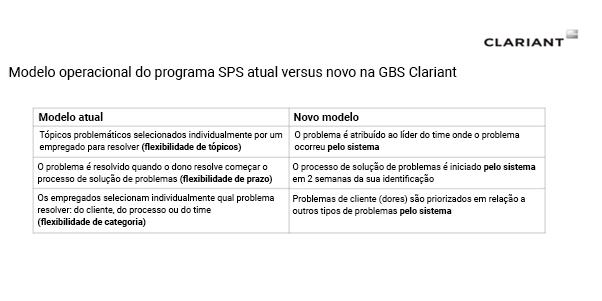
After four years of developing skills and structures in building a problem-solving culture, we decided to implement a new model. We wanted to move away from the "hero" approach in favor of more systemic solutions. The change minimizes procrastination (the system does not allow the DMAIC cycle to be postponed), prevents the selection of easier problems to solve (customer problems take priority over internal ones) and assigns clear responsibilities (the leader of the team where the problem occurred is the owner of the problem).
HOW TO COMBINE LEAN SKILLS WITH ROBOTIC PROCESS AUTOMATION (RPA)? THE ALLIANCE BETWEEN LEAN AND RPA
Since the creation of the GBS organization at Clariant, as the Service Management area, we have set up one team responsible for developing the continuous improvement culture and another responsible for Robotic Process Automation (RPA). From the start, we emphasized the need for synergy between the two teams. In practice, this translated into joint Lean/RPA meetings, mutual training in key methods and tools, as well as joint projects. However, the alliance between Lean and RPA was more incidental than systematic.
In 2022, as with Lean and Technology, we decided to build a proper model for cooperation between the domains. We launched two pilot projects run with Lean and RPA. First, we implemented TWI (we call it the Four Dimensions Method, referring to the four steps of the TWI JM method).
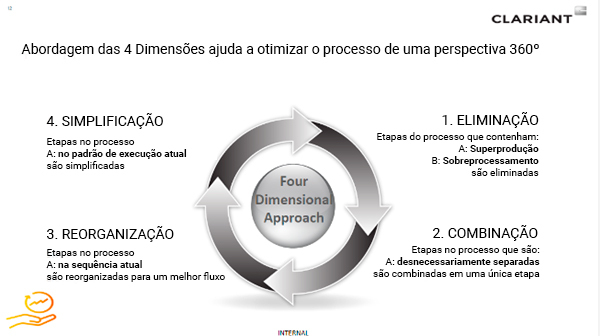
When the 4 Dimensions method points to process optimization, we assess whether the process fully or partially meets the other four criteria required for feasible and profitable automation:
- Process input digitized or capable of being digitized. The future robot needs to understand the input (today, with Machine Learning or Artificial Intelligence, this input does not need to be perfectly digitized).
- Process actions and steps must be standardized and repetitive. We cannot automate a process or part of it when it is performed differently each time.
- All branching elements in the process, such as "if OK - then" or "if NOK - then," must be based on logical rules. They cannot depend on discretion.
- Creating and maintaining a robot must deliver a positive return on investment (ROI).
This model of cooperation between Lean and RPA, tested in the pilot projects, follows this sequence: first, the Lean Flow (4 steps of the 4 Dimensions method); then, the RPA Flow (4 automation criteria).
MOVING TOWARD FULLY FLEXIBLE TEAMS
The demand for customer centricity encouraged Service Management to start a change in the team's configuration and "modus operandi". This involved the complete merger of the Technology (CIP), Opex/Lean and RPA teams. Today, none of the teams is running its own specific projects anymore. We have moved away from the model of specialization in a given subject in favor of flexibility for reallocation and full competence. In fact, 2022 was the last year in which we ran projects following traditional project management methods, such as PMBOK or PRINCE2. Our CIP (Technology) and Opex/Lean teams are already running a project that is entirely based on the Agile methodology and the SCRUM framework.
MEASURING CUSTOMER CENTRICITY
Without measuring success, there is no success. We may be getting better and more efficient in our projects, changing our organization's structures and methods and developing skills, but how do we know whether the customer is really at the center of our business system?
Measuring Customer Centricity gives us a snapshot of the Customer Experience at that moment. And these criteria are not difficult to create. They are the same ones I mentioned at the beginning of this article: Is the customer heard? Is the customer understood? Is their case handled professionally?
These criteria were adopted by our Service Management teams in one of the projects run under the SCRUM framework, and they proved very successful.
Ultimately, if customers confirm that these three criteria are met, we do not need to ask whether customers are truly at the center of everything we do as an organization. It is self-evident that they are.







